Day: April 25, 2019

  • PSX recommends CGT exemption to foreign investors

    PSX recommends CGT exemption to foreign investors

    KARACHI: Pakistan Stock Exchange (PSX) has proposed to exempt capital gain tax (CGT) on disposal of securities by foreign investors.

    The PSX in its proposals for budget 2019/2020 on Thursday, recommended the exemption of CGT on disposal of securities by foreign investors.

    Giving rationale to its proposals, the PSX said that the exemption of CGT on foreign investors would facilitate substantial capital inflow by relaxing the cumbersome and time consuming account opening and registration process for foreigners as they get discouraged and overwhelmed with the current registration structure and look for better investment alternatives in regional markets.

    It further said that Pakistan has taxation treaties with a number of countries thus foreigners would be liable to pay taxes according to the treaty. “Therefore, taxing foreigners would burden them and not only increase their cost of business but most importantly discourage them from investment in Pakistan’s capital market.”

    It is proposed that the proviso to sub – rule 2 of Rule 13N of Income Tax Rules, 2002 shall be omitted.

    The PSX said that it is observed that most countries do not impose capital gains tax on disposal of securities by foreigners.

    Bangladesh, Malaysia, and many other countries do not levy CGT on transactions of disposal of securities conducted by foreigners.

    Even in countries that do have CGT on foreign investors, the rules are distinctly different from those that apply to domestic investors, in order to provide an attractive tax environment and avoid double taxation.

    One important reason for not imposing such tax is that most of the countries have double taxation treaties.

    In Pakistan, foreign investors file income tax returns regularly and pay taxes in accordance with the provisions of the Income Tax Ordinance, 2001 or reduced rates provided under treaties executed with such countries.

    Foreign investors should be given preferential tax rates as they might still be required to pay taxes in their home country where they are considered as a resident taxpayer.

    The PSX also urged the tax authorities to review the mechanism for payment of CGT on disposal of securities for domestic investors.

    It said that at present National Clearing Company of Pakistan Limited (NCCPL) calculates and collects Withholding Tax on Capital Gains made on disposal of shares listed on Pakistan Stock Exchange Limited.

    However, it is witnessed that in many countries there is no capital gain tax collected by any institution but rather individuals/ corporate are required to file their tax returns and pay taxes if any on the capital gains made by trading of shares.

    A broad range of countries including Canada, USA, Indonesia, India, and Vietnam do not mandate the collection of CGT by any intermediary at the time of disposal of securities, and the CGT is payable at the time of filling of returns.

    In Singapore, Hong Kong, Malaysia and Mauritius there is no capital gains tax.

    Therefore, considering international perspective, it would be appropriate if in Pakistan, payment of capital gains tax be made obligatory on individuals and corporates and the status of NCCPL should be such that only the information is provided to the tax authorities by NCCPL.

    In line with the common practice internationally, the government should review and revise the mechanism for payment of tax on capital gains for filers.

    An alternative to the current convention should be explored along with pros and cons. Withholding tax at NCCPL level for filers should be debated thoroughly and replaced with the obligation on investors who are filer to pay CGT through annual tax returns.

    However, the current mechanism of withholding on CGT for investors who are non-filers shall remain the same provided no WHT on such non-filers whose Capital Gains is up to Rs100,000 per annum.

    In any case, NCCPL should provide information on all investors’ capital gains and losses to tax authorities for tracking purposes.

    In line with international practice for collection of capital gains tax, an obligation to file returns and pay taxes on disposal of securities at year end would encourage a widespread tax culture among investors.

    It is proposed that section 100B, 8th Schedule to the Income Tax Ordinance 2001 and Rule 13N of Income Tax Rules, 2002 shall be amended accordingly.

  • Stock market gains 292 points in volatile trading

    Stock market gains 292 points in volatile trading

    KARACHI: The stock market gained 292 points on Thursday amid highly volatile trading sessions.

    The benchmark KSE-100 index of Pakistan Stock Exchange (PSX) closed at 36,796 points from previous day’s closing of 36,504 points with gain of 292 points.

    Analyst at Next Capital Limited said that the decline in international oil prices after the US Energy Information Administration (EIA) reported a much bigger than expected rise in commercial crude inventories kept the oil stocks under pressure throughout the day.

    Pakistan Petroleum Limited recorded (-0.43 percent) and Pakistan Oil Fields (-0.86 percent).

    Market participation for the 100 index decreased to 84.2 million from 93.1 million in the previous session.

    Major contribution to total market volume came from BOP, WTL, and LOTCHEM churning 25.1 million shares out of the total market all share volume of 106.8 million shares.

    Analysts at Topline Securities said that following fall of around 5.5 percent in month of April (till 24th), index slightly recovered 0.8 percent as amnesty scheme is likely to be presented in front of cabinet next week.

    Further, likely meeting of Prime Minister Imran with IMF chief in China and expected arrival of IMF mission from Apr 27-30, 2019 also restored investors confidence in getting bailout package.

  • SBP launches refinance, credit guarantee scheme for women entrepreneurs

    SBP launches refinance, credit guarantee scheme for women entrepreneurs

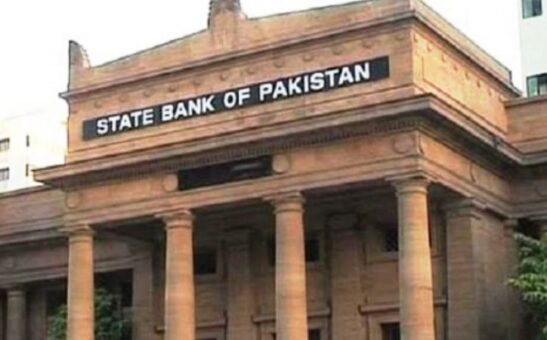
    KARACHI: State Bank of Pakistan (SBP) on Thursday launched refinance and credit guarantee scheme for women entrepreneurs in order to support and revive economic activities in the country.

    The SBP said that the financing would be available to women entrepreneurs across the country for a period of up to 5 years, including maximum grace period of up to six months.

    The maximum financing limit under the scheme will be Rs 1.5 million. The financing under the scheme should be provided for setting up of new business enterprises or for expansion of existing ones.

    The SBP said that financing under the scheme should be provided to women borrowers preferably under the personal guarantee of the borrower.

    The central bank said that as per the government’s policy to support and revive economic activities in the country and SBP’s measures for improving access to finance for the women entrepreneurs, a refinance cum credit guarantee scheme is being launched for the women borrowers across the country.

    Under the scheme, banks and DFIs will be required to provide financing facilities to women entrepreneurs to meet credit needs of their businesses.

    Under the scheme, refinancing will be provided by SBP at zero percent to participating financial institutions for onward lending to women entrepreneurs across the country at a mark-up rate of up to 5 percent per annum.

    Such loans will also be eligible for 60 percent risk coverage under SBP’s Credit Guarantee Scheme for Small and Rural Enterprises.

    The SBP said that it would allocate limits to PFIs under the scheme on receipt of request from them. The limits will be reviewed on yearly basis.

    At least 20 percent of the limit should be allocated for lending to women entrepreneurs in Balochistan.

    Applications for sanction of limits shall be sent by the interested banks/DFIs to the Director, Infrastructure, Housing & SME Finance Department.

    The SBP said that repayment of loans by borrowers shall be made in equal quarterly installments after grace period (if any). The refinance granted by SBP BSC offices to the PFIs shall be recovered, on the due dates as reported in the original repayment schedule, from the accounts of the PFIs maintained with the respective office of the SBP BSC.

    If a borrower repays the loan amount or its installment, in part or in full, before the due date(s), the PFIs shall be under obligation to repay the amount(s) so received within 15 days to the concerned office of SBP BSC failing which, fine for late adjustment of loan will be recovered from the concerned bank/DFI, at the rate of Paisa 60 per day per Rs 1,000 or part thereof or prospectively at such rate as may be announced by the State Bank from time to time.

    In case a borrower fails to repay the amount of installment as per the original repayment schedule, the PFIs will be entitled to charge normal rate of mark up on such overdue principal amount besides taking other actions to recover the same as are incidental to such defaults.

    The SBP will continue to recover the principal amount on the due dates as per the repayment schedule.

    In no case, the liability of banks/DFIs to pay/repay to SBP BSC the principal amount of refinance as per the repayment schedule or mark-up or any other charges or penalty thereon shall be dependent upon the recovery from the borrower nor shall such liability be affected by any default on the part of the borrower.

  • FPCCI signs three MoUs at Belt and Road Conference

    FPCCI signs three MoUs at Belt and Road Conference

    The Federation of Pakistan Chambers of Commerce and Industry (FPCCI) has taken significant steps towards strengthening international trade relations by signing three Memoranda of Understanding (MoUs) at the Belt and Road CEO Conference held in Beijing, China.

    (more…)
  • Country’s foreign exchange reserves declines by $202 million

    Country’s foreign exchange reserves declines by $202 million

    Pakistan’s liquid foreign exchange reserves experienced a significant decline, falling by $202 million to $15.994 billion by the week ending April 19, 2019, compared to $16.196 billion just a week prior, according to a statement released by the State Bank of Pakistan (SBP) on Thursday.

    (more…)
  • Rupee ends unchanged for ninth consecutive trading day

    Rupee ends unchanged for ninth consecutive trading day

    KARACHI: The Pak Rupee ended without change against dollar for the ninth consecutive day on Thursday.

    The rupee ended Rs141.40 to the dollar, the same last day’s closing, in interbank foreign exchange market.

    The interbank foreign exchange market was initiated in the range of Rs141.39 and Rs141.40.

    The market recorded a high of Rs141.40 and low of Rs141.40 and closed at Rs141.40.

    Currency experts said that traders were cautious ahead of IMF meeting with Pakistan authorities scheduled for this week.

    The exchange rate in open market ended with losses of the local currency.

    The buying and selling of dollar was recorded at Rs141.70/Rs142.20 as compared with previous day’s closing of Rs141.50/Rs142.00 in cash ready market.

  • Tax amnesty scheme to be introduced in three phases, to continue by December 2019

    Tax amnesty scheme to be introduced in three phases, to continue by December 2019

    ISLAMABAD: Federal Board of Revenue (FBR) has recommended three phases for new tax amnesty scheme for undeclared assets.

    The FBR recommended three phases for the amnesty scheme for period ended June 30, 2019, September 30, 2019 and December 31, 2019. The rate of tax for undeclared assets (other than domestic real estate/undisclosed income has been recommended at five percent, 10 percent and 20 percent for first, second and third phase, respectively,

    The amnesty scheme has been proposed to cover real estate sector at one percent, two percent and four percent for three phases at fair market value (not less than value prescribed by the FBR under section 68 of Income Tax Ordinance, 2001), as declared by the declarant.

    Dr. Abdul Hafeez Shaikh, Adviser to Prime Minister on Finance, Revenue and Economic Affairs recently directed the FBR to review the proposed amnesty scheme and submit a new draft.

    According to the draft the amnesty scheme would be launched through promulgation of presidential ordinance.

    According to the draft the undisclosed sales shall be chargeable to tax at the rate of three percent (3 percent) of such sales in lieu of sales tax and federal excise duty.

    It is proposed that any foreign asset declared under this Ordinance shall be required to be repatriated to Pakistan or invested in Pakistan Banao Certificate before filing of declaration in the manner prescribed by the State Bank of Pakistan. This condition shall not be applicable on such foreign asset which represents foreign real estate.

  • Trading restores at PSX after technical fault

    Trading restores at PSX after technical fault

    The Pakistan Stock Exchange (PSX) experienced a temporary suspension in trading on April 25, 2019, lasting for over an hour due to a technical fault.

    (more…)
  • Withholding tax rates on imports updated through Finance Supplementary (Second Amendment) Act 2019

    Withholding tax rates on imports updated through Finance Supplementary (Second Amendment) Act 2019

    KARACHI: Federal Board of Revenue (FBR) issued withholding tax rates on imports for tax year 2019 updated as per Finance Supplementary (Second Amendment) Act, 2019.

    The withholding tax rates updated up to March 09, 2019 on import under Section 148 of Income Tax Ordinance, 2001 as follow:

    The collector of customs shall collect withholding tax from every import of goods on the value of goods at the rate of one percent from filers of the import value increased by customs – duty, sales tax and federal excise duty and at 1.5 percent from non-filers of the import value as increased by customs-duty, sales tax and federal excise duty on the value of goods, included:

    1 (i) Industrial undertaking importing remeltable steel (PCT Heading 72.04) and directly reduced iron for its own use;

    (ii) Persons importing potassic of Economic Coordination Committee of the Cabinet’s decision No. ECC-155/12/2004 dated the 9th December, 2004

    (iii) Persons importing Urea;

    (iv) Manufactures covered under Notification No. S.R.O 1125(I)/2011 dated the 31st December, 2011 and importing items covered under S.R.O 1125(I)/2011 dated 31st December, 2011.

    (v) Persons importing Gold; and

    (vi) Persons importing Cotton

    (vii) Persons importing LNG

    — Industrial undertaking importing Plastic raw material (PCT Heading 39.01 to 39.12) for its own use.

    Filer: 1.75 percent of the import value as increased by Custom-duty, sales tax and federal excise duty

    2. Persons Importing Pulses

    Filer: 2 percent of the import value as increased by Custom-duty, sales tax and federal excise duty

    Non-filer: 3 percent of the import value as increased by custom-duty, sales tax and federal excise duty.

    3. Commercial importers covered under Notification No. S.R.O 1125(I)/2011 dated the 31st December, 2011 and importing items covered under S.R.O 1125(I)/2011 dated the 31st December, 2011

    Filer: 3 percent of the import value as increased by custom-duty sales tax and federal excise duty.

    Non-filer: 4.5 percent of the import value as increased by custom-duty , sales tax and federal excise duty

    Commercial Importer importing Plastic raw material (PCT Heading 39.01 to 39.12) for its own use

    Filer: 4.5 percent of the import value as increased by Custom-duty, sales tax and federal excise duty

    3A. Persons importing coal

    Filer: 4 percent

    Non-filer:6 percent

    4. Ship breakers on import of ship

    Filer: 4.5 percent

    Non-filer: 6.5 percent

    5. Industrial undertakings not covered under S.No 1 to 4

    Filer: 5.5 percent

    Non-filer: 8 percent

    6. Companies not covered under S. Nos 1 to 5

    Filer: 5.5 percent

    Non-filer: 8 percent

    7. Persons not covered Under S.Nos 1 to 6

    Filer: 6 percent

    Non-filer: 9 percent

    New proviso introduced through Finance Supplementary (Second Amendment) Act, 2019

    On Import of Mobile Phones by any Person (individual, AOP, Company) :

    C&F Value of Mobile Phone (in USD ($) ) Tax (in Rs)

    1. Up to $30: Rs70

    2.Exceeding $30 & up to $100: Rs. 730

    3.Exceeding $100 & up to $200: Rs. 930

    4.Exceeding $200 & up to $350: Rs. 970

    5.Exceeding $350 & up to $500: Rs. 3,000

    6.Exceeding $500: Rs. 5,200

    The tax shall be final for all other than those excluded under S. 148(7)&(8)

    The tax shall be adjustable for a tax year under S. 148(7) in respect of :-

    a. Raw material, plant, equipment & parts by an industrial undertaking for its own use;

    b. motor vehicle in CBU condition by manufacturer of motor vehicle.

    c. Large import houses as defined / explained in 148(7)(d)

    d. A foreign produced film imported for the purposes of screening and viewing.

  • Sales Tax Act 1990: One year jail for unauthorized access to FBR computerized system

    Sales Tax Act 1990: One year jail for unauthorized access to FBR computerized system

    KARACHI: Any persons attempted to gain unauthorized access to computerized system of Federal Board of Revenue (FBR) is liable to penalty and imprisonment up to one year.

    According to updated Sales Tax Act, 1990 issued by the FBR, the person trying to get unlawful access to computerized system would face harsh action.

    The law explained:

    Any person who,-

    (a) knowingly and without lawful authority gains access to or attempts to gain access to the computerized system; or

    (b) unauthorizedly uses or discloses or publishes or otherwise disseminates information obtained from the computerized system; or

    (c) falsifies any record or information stored in the computerized system; or

    (d) knowingly or dishonestly damages or impairs the computerized system; or

    (e) knowingly or dishonestly damages or impairs any duplicate tape or disc or other medium on which any information obtained from the computerized system is kept or stored; or

    (f) unauthorizedly uses unique user identifier of any other registered user to authenticate a transmission of information to the computerized system; or

    (g) fails to comply with or contravenes any of the conditions prescribed for security of unique user identifier.

    “Such person shall pay a penalty of twenty-five thousand rupees or one hundred per cent of the amount of tax involved, whichever is higher.”

    “He shall, further be liable, upon conviction by the Special Judge, to imprisonment for a term which may extend to one year, or with fine which may extend to an amount equal to the loss of tax involved, or with both.”