Day: May 26, 2019

  • Pakistan, China sign four CPEC agreements to boost bilateral cooperation

    Pakistan, China sign four CPEC agreements to boost bilateral cooperation

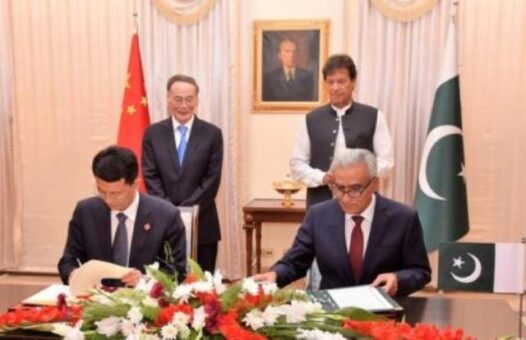
    ISLAMABAD: Pakistan and China on Sunday signed four agreements under China Pakistan Economic Corridor (CPEC) in order to further enhance bilateral cooperation.

    The signing ceremony was held here during the three-day visit of Chinese Vice President Wang Qishan, who arrived earlier in the day along with a high level delegation.

    Prime Minister Imran Khan and the Chinese Vice President witnessed the signing ceremony, which also attended by Minister for Foreign Affairs Shah Mahmood Qureshi, Planning Minister Khusro Bakhtiar, Finance Advisor Abdul Hafeez Sheikh and members of the Chinese delegation.

    A Framework Agreement on Agricultural Cooperation was signed by Chinese Vice Minister Zhang Taolin and Secretary Ministry of National Food Security Dr Muhammad Hashim Popalzai.

    A memorandum was signed on the “Requirements of FMD free zone where vaccination is practiced between General Administration of the Customs of China and Animal Quarantine Department of the Ministry of National Food Security and Research of Pakistan.”

    Chinese Ambassador in Pakistan Yao Jing and Dr Hashim Popalzai signed the document.

    The two countries also signed China Pakistan Economic Cooperation Agreement signed by Chinese Vice Minister Deng Boqing and Secretary Economic Affairs Division Noor Ahmed.

    Chinese Vice Minister Deng Boqing and Secretary EAD also signed a Letter of Exchange for Disaster Relief Goods between the two countries.

    The two friendly countries also inked agreement between CMEC and Government of Balochistan and Lasbela University in Modern Agriculture Comprehensive Development in Lasbela.

    The document was signed by Vice President of CMEC from China and Vice Chancellor Lasbela University Professor Dr Dost Muhammad Baloch and PS to Governor Balochsitan.

  • Ban foreign cigarettes without health warnings: OICCI

    Ban foreign cigarettes without health warnings: OICCI

    KARACHI: The Overseas Investors Chamber of Commerce and Industry (OICCI) has recommended to the government to impose a ban on the import of cigarettes lacking health warnings, as part of a strategy to deter the rampant smuggling of tobacco products.

    (more…)
  • PTBA suggests allowing further tax adjustment to suppliers

    PTBA suggests allowing further tax adjustment to suppliers

    KARACHI: Pakistan Tax Bar Association (PTBA) has recommended the Federal Board of Revenue (FBR) to allow adjustment of further tax against input tax.

    The PTBA in its proposals for budget 2019/2020, said that presently further tax has been charged by the registered person on the supplies made to the person who are required to be registered but does not obtain registration is not available for adjustment against input tax in pursuance of section 7(1) of the Sales Tax Act, 1990.

    Moreover, through the Finance Act, 2017, further tax at the rate of 2 percent was also levied on zero-rated supplies.

    The PTBA said that this results in unnecessary increase in cost of doing business and unrest amongst the taxpayers which is creating a negative business environment.

    “Due to this amendment, all zero –rated supplies including exports are subject to further tax.”

    Exports are made to non-resident persons who are not required to be registered with Pakistan tax authorities. Resultantly, the exporters will have the bear the amount of further tax charged to exporters which will badly affect their competiveness in the international market.

    The PTBA recommended that the supplier should be allowed adjustment of further tax against input tax.

    Appropriate clarification should be issued that export sales are not subject to further tax, the PTBA further advised.

    The proposed amendments would put an end to unnecessary litigation, result in reducing the cost of doing business and create trust between taxpayers and tax collector.

    The exporters will not be burdened with extra cost of further tax.

  • FTO orders recovery from IR officers in unlawful bank account attachment

    FTO orders recovery from IR officers in unlawful bank account attachment

    ISLAMABAD: Federal Tax Ombudsman (FTO) has ordered recovery from officers of Inland Revenue Officers in a case of unlawful recovery through bank attachment of a taxpayer.

    The FTO ordered dated May 21, 2019 in a complaint filed by a taxpayer against unlawful recovery of tax demand from the bank account of the complainant outstanding against a private limited company, and undue delay in refunding the same.

    The complainant also sought for award of cost and compensation along with additional payment for delayed refund.

    The complainant as an individual assessed to tax at Regional Tax Office (RTO) – III Karachi. According to the taxpayer, the Inland Audit Officer Unit 2 Haripur, RTO Abbotabad, without considering the fact that the complainant was assessed to tax at, RTO-III Karachi against whom no tax demand was outstanding and without serving on him any prior notice, illegally attached his bank accounts and recovered Rs1.714 million.

    The findings of the FTO in this case showed that administrative excesses for improper motives, neglect, inattention, delay, incompetence, ineptitude and inefficiency in the discharge of duties and responsibility and as a consequence unlawful recovery of tax liability outstanding against a private limited concern from the bank account of the complainant tantamount to maladministration.

    The FTO directed the FBR to:

    i. recover Rs0.45 million from Muhammad Asghar Khan Niazi, Zonal CIR, RTO Abbottabad and Hafiz Muhammad Rafaqat, IAO, Unit RTO Abbottabad (costs and compensation) in equal shares and arrange to pay the same to the complainant;

    ii. fix responsibility regarding administrative excesses neglect, inattention, delay, incompetence, ineptitude and inefficiency in the administration or discharge of duties and responsibility and initiate appropriate disciplinary proceedings against the officials found accountable;

    iii. direct the commission – IR concerned to issue additional payment for delayed refund to the complainant.

  • Hafeez reviews proposals for budget 2019/2020

    Hafeez reviews proposals for budget 2019/2020

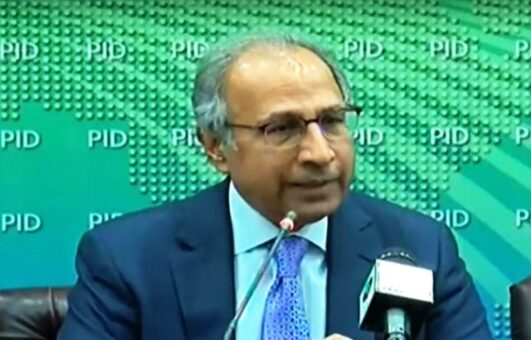
    ISLAMABAD: Dr. Abdul Hafeez Shaikh chaired a meeting on Sunday to review the proposals for budget 2019/2020.
    Shabbar Zaidi, Chairman, Federal Board of Revenue (FBR), gave a detailed presentation about the budget proposals for the upcoming budget.
    He proposed various steps to expand the tax base as well as increase revenue of the country.
    The adviser directed FBR to make tax collection process further easier and initiate measures to broadening the tax base.
    The meeting was also attended by the Adviser to PM on Commerce, Textile, Industry and Production and Investment, Abdul Razak Dawood, Minister of State for Revenue, Muhammad Hammad Azhar and other senior officials of Finance Ministry and FBR.

  • Reduction in corporate tax for E&P companies recommended to attract foreign investment

    Reduction in corporate tax for E&P companies recommended to attract foreign investment

    KARACHI: Federal Board of Revenue (FBR) has been recommended to reduce corporate tax rate for exploration and production companies in order attract foreign investment in this sector and generate more revenue for the country.

    The Overseas Investors Chamber of Commerce and Industry (OICCI) in its tax proposals for budget 2019/2020 said that the applicable tax rate for the Oil and Gas Exploration and Production sector is 40 percent.

    Before the promulgation of Income Tax Ordinance, 2001, the tax rate was 50 percent to 55 percent, however, the royalty payment to government was adjusted against the tax liability, resulting in effective tax rate of approximately 35 percent or less.

    Applicability of effective 40 percent tax rate has in fact increased the tax expense of the Oil and Gas Exploration and Production Companies, as against the incentives given to other sectors of the economy, whereby the tax rate will be gradually reduced to 30 percent.

    The OICCI recommended that in order to incentivize oil and gas exploration in the country especially after the massive reduction in the international oil prices, the corporate tax rate on E&P sector should be reduced from the current 40 percent to the rate applicable to other corporate sector by making necessary amendments in the Income Tax Ordinance 2001 and Regulation of Mines and Oilfield and Mineral Development (Government Control) Act, 1948.

    Giving rationale, the OICCI said that foreign investment will be encouraged in the country, which will eventually increase the tax collection of the government and will also greatly help to overcome the energy crises in the country.

    The OICCI highlighted another issue of limitation on payment to federal government and taxes, and said that the rate of tax applicable on E&P companies on their Oil & Gas profits are given in their respective PCAs signed with government.

    Under Rule 4AA of Part I of the Fifth Schedule to the Income Tax Ordinance, Super tax has been imposed at 3 percent for E&P companies earning Rs 500million (equivalent to US$ 5million).

    It recommended that it is critical for E&P sector and recommended that the tax applicable should be calculated strictly in accordance with the provisions of the respective PCAs signed between Government and each E&P company and are legally binding, without changes throughout the full Lease period.

    The chamber said that this will remove the negative investment scenario, and potential for litigation – due to the varying interpretations by the FBR from time to time (despite the signed PCAs with Government)

    The OICCI said that tax credits under section 65A and 65B are not currently being allowed to E&P companies by the tax authorities despite the fact that appellate Tribunal decided the matter in favour of E&P companies.

    Therefore, it is suggested that necessary clarification needs to be provided by tax authorities to assessing authorities.

    In view the current energy deficit in the country and recent decision of appellate Tribunal, these credits should be allowed to the E&P companies to promote further investments in this sector.

    Regarding depletion allowance, the OICCI said that clarity over definition of well head value for computation of depletion allowance is required.

    As per clause 3 of Fifth Schedule, depletion is calculated at 15 percent of the gross receipts representing well-head value of production, but not exceeding 50 percent of taxable income.

    E&P industry interprets above by calculating depletion at 15 percent of gross revenue before royalty deduction.

    Tax authorities calculate depletion at 15 percent of Gross Revenue after deduction of royalty.

    Therefore, it is proposed that amendment be introduced in the relevant clause in favor of E&P companies i.e. depletion to be calculated at 15 percent of revenues before royalty deduction.

    The matter is under litigation at High Court level for various E&P companies. Clarification in the definition of Well head value will ease unnecessary burden of these litigations for E&P Companies, the OICCI added.