Month: May 2019

  • Commercial importers destroying domestic industry: PBC

    Commercial importers destroying domestic industry: PBC

    KARACHI: Pakistan Business Council (PBC) – the advisory forum of large corporate entities – has said that commercial importers are involved in massive under-invoicing and they are destroying the domestic industry.

    In its budget proposals for 2019/2020, the PBC recommended measures for documentation of economy to providing level playing field for domestic manufacturing.

    The PBC said that across the board massive under-invoicing and dumping of imported products had been increasing. “Information regarding values at which various customs check post clear import consignment is not publicly available. This encourages unscrupulous importers to under-declare the value of consignments to evade government revenues,” it added.

    It also pointed out that there are massive leakages in Afghan Transit Trade (ATT) and smuggled goods are being openly sold in all major shopping centers of the country. “Customs however is not willing to act against smuggled products citing lack of cooperation from local authorities,” it added.

    The PBC recommended:

    a. values at which import shipments are cleared through PRAL or CARE need to be publicly available.

    b. The government of Pakistan must insist of Electronic Data Interface (EDI), initially for both Free Trade Agreement (FTA) and non-FTA from China. “In future the requirement of EDI should be made compulsory for imports from FTA/ PTA partner countries.

    c. Depending on industry, the import trade price (ITP) should be fixed e.g. on the basis of country of origin, weight, volume etc. after discussion with stakeholders. “ITP’s may be fixed for most items prone to mis-declaration such as consumer goods and margins of commercial importers should be monitored to assess the value of subsequent supply of imported goods. A certificate to this effect should be issued by auditors of commercial importers.”

    d. For items, prone to under invoicing and mis-declaration, Federal Board of Revenue (FBR) should designate one or two ports (including the dry ports) for clearing of import consignments. “This will allow better monitoring of the import consignments where chances of mis-declaration are on a higher side.”

    e. Additionally, the old Customs General Order 25 should be revived with a provision that local manufacturer should be given the option to buy at a 15 percent premium, any consignment which appears undervalued.

    f. Taxes and duties deposited local manufacturers and commercial importers should be published.

    g. The rate of tax collected from commercial importers should be maintained at their current level. Presently, tax collected from commercial importers is treated as final tax. The income tax collected at import stage should be treated as advance tax.

    h. Commercial importers should be required to file returns under the normal tax regime as introduced through the Finance Act, 2018.

    i. In order to allow commercial importers to claim adjustment of tax deducted at import stage, commercial importers should be asked to present certificate from auditors that at least 70 percent of imported items have been exported or soled to registered manufacturers. “This will also help increase the overall tax base,” the PBC said.

    j. Monthly sales declared by commercial importers should be matched with sales declared in annual income tax returns as well as the credit entries in all business bank accounts. “In case of any discrepancy, a reconciliation with justifiable reason should be submitted by the commercial importers.

    k. Online CREST system must be amended in a way to trace sales along with value addition thereon of person to whom supplies were made by commercial importers.

  • Utility Stores Corporation implements Ramazan Package ahead of fasting month: RM Javed Khan

    Utility Stores Corporation implements Ramazan Package ahead of fasting month: RM Javed Khan

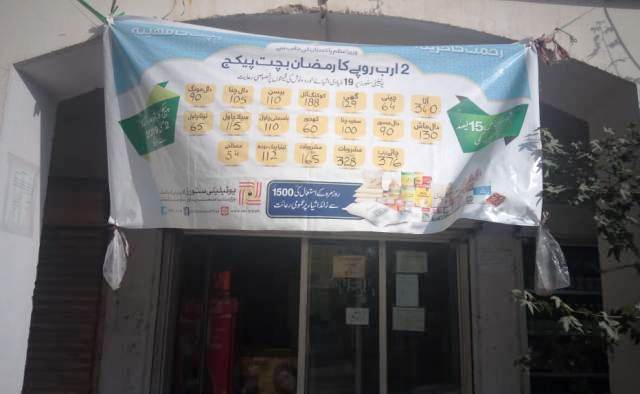
    KARACHI: Utility Stores Corporation (USC) has implemented subsidized rates under Ramazan Package announced by the government to provide relief the masses during the holy month, a top official said on Sunday.

    “The reduced rates have been implemented across the country from May 03, 2019 around three or four days ahead of Ramazan,” said Muhammad Javed Khan, USC, Regional Manager (RM), Karachi.

    “All the USC outlets are now selling hundreds of items at the subsidized rates,” he added.

    Khan said that a significant reduction had been announced in those items that were mostly used during the fasting month such as sugar, wheat flour, rice, pulses, edible oil and ghee etc.

    “These commodities have reduced prices up to 20 percent when compared with the open market,” the regional manager added.

    The federal government has provided Rs2 billion to subsidized the rates of essential items to be sold through the Utility Stores.

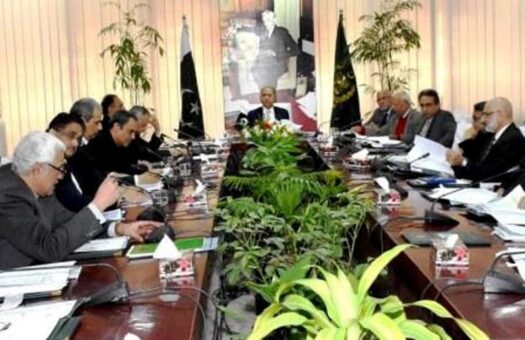
    The Economic Coordination Committee of the Cabinet (ECC) in its meeting on March 12 approved subsidy amounting Rs2 billion to provide relief the masses during Ramazan ul Mubarak.

    Javed Khan pointed out some of items having significant reduction in prices, which included: sugar Rs 64 per kilogram, wheat flour Rs340/10-kg, whet gram Rs100/kg, Dal Chana Rs105/kg, Dal Masoor Rs90/kg, vegetable ghee Rs129/kg, edible oil Rs153/liter, Rooh Afza Rs183/800ml, cold drink (all brands) Rs77/1.5 liters, Tapal tea 793/kg, dates Rs60/500 grams, Rice Super Rs114/kg.

    USC price

    The regional manager said that in order to ensure availability and avoid bulk sale the zonal chief had constituted vigilance teams for monitoring.

    He said that on the directives of Prime Minister Imran Khan the regional chiefs across the country were also visiting the outlets to ensure the availability and for price checks as well.

    Prime Minister Imran Khan has recently directives all the government functionaries to ensure securities and availability of essential items at reduced rates during the holy month of Ramazan ul Mubarak.

  • Sales Tax Act 1990: ownership transfer of taxable activity

    Sales Tax Act 1990: ownership transfer of taxable activity

    KARACHI: The sales tax law has explained application of sales tax on taxable activity or transfer of ownership.

    According to updated Sales Tax Act, 1990 issued by Federal Board of Revenue (FBR) the law explained the sales of taxable activity or transfer of ownership.

    Section 49: Sales of taxable activity or transfer of ownership

    Sub-Section (1): In case of termination of taxable activity or part thereof or its sale or transfer of ownership to a non-registered person, the possession of taxable goods or part thereof by the registered person shall be deemed to be a taxable supply and the registered person shall be required to account for and pay the tax on the taxable goods held by him:

    Provided that if the tax payable by such registered person remains unpaid, the amount of unpaid tax shall be the first charge on the assets of the business and shall be payable by the transferee of business.

    (2) In the case of sale or transfer of ownership of a taxable activity or part thereof to another registered person as an ongoing concern, the taxable goods or part thereof shall be transferred to the new owner through a zero-rated invoice and the sales tax chargeable thereon shall be accounted for and paid by the registered person to whom such taxable activity or part thereof is transferred.

  • Reza Baqir appointed as SBP governor

    Reza Baqir appointed as SBP governor

    ISLAMABAD: The federal government on Saturday appointed Dr. Reza Baqir as the governor of State Bank of Pakistan (SBP) for next three years.

    A notification issued by the finance division said that President of Pakistan had appointed Dr. Reza Baqir as governor SBP for a period of three years from the date he assumes office.

    The terms and conditions of his appointment will be notified later with the approval of the President of Pakistan.

    Dr. Reza Baqir is currently service for the International Monetary Fund (IMF) and resident representative for Arab Republic of Egypt.

  • FBR notifies sales tax rates on petroleum products for May 2019

    FBR notifies sales tax rates on petroleum products for May 2019

    ISLAMABAD: Federal Board of Revenue (FBR) on Saturday notified sales tax rates for petroleum products for the month of May 2019.

    The FBR issued SRO 507(I)/2019 on May 04, 2019 to amend the rates issued on April 30 and also amend the SRO 57(I)/2016 dated January 29, 2016.

    Following sales tax rates on petroleum products will be applicable for the month of May 2019:

    Petrol 12 percent ad valorem

    High Speed Diesel oil 17 percent ad valorem

    Kerosene 17 percent ad valorem

    Light Diesel Oil 17 percent ad valorem

    Earlier, the FBR issued SRO 499(I)/2019 issued on April 30, 2019 and reduced temporarily till May 05 at the rates: petrol 2 percent, HSD 13 percent, kerosene 8 percent and light diesel oil 9 percent.

  • Rupee gains 20 paisas in open market on monitoring to prevent money laundering

    Rupee gains 20 paisas in open market on monitoring to prevent money laundering

    KARACHI: The Pak Rupee gained 20 paisas against dollar on Saturday amid improved inflows in the open market and tight monitoring of law enforcement agency to prevent money laundering.

    The buying and selling of dollar was recorded at Rs141.30/Rs141.80 as compared with previous day’s closing of Rs141.50/Rs142.00 in cash ready market.

    Currency dealers said that the steps taken by the government to curb money laundering through money exchanges had resulted in availability of greenback for general public.

    The dealers said that during past few months the regulators and law enforcement agencies had taken various measures to stop money laundering and Hawala and Hundi.

  • Market Review: IMF loan program to move trading pattern

    Market Review: IMF loan program to move trading pattern

    KARACHI: The staff level agreement of the IMF program is expected to restore confidence of the market, analysts said on Saturday.

    Volumes usually dry out in the month of Ramzan given shorter trading hours. Albeit, with budgetary proposals following in, we believe certain sectors / scrips may come under limelight.

    Analysts said that while the outgoing quarter remained positively surprising with sectors such as Commercial Banks, Cements, and Chemicals unveiling above street consensus result outcomes, investors continued to remain wary owing to persisting economic despondency.

    This has contributed to ambiguity over future corporate earnings growth, and coupled with a lack of clarity over the finalization of the IMF program, the KSE-100 index has continued to remain under pressure. This week the bourse ended at 36,123 points, shedding 1,008 points (down by 2.7 percent) WoW.

    Negative sector-wise contributions came from i) Oil & Gas Exploration Companies (308 points) amid fall in international oil prices, ii) Commercial Banks (171 points), iii) Fertilizers (148 points), iv) Power Generation & Distribution (89 points) and Oil & Gas Mareting Companies (70 points). On the flip side, sectors that contributed positively include i) Tobacco (27 points) and ii) Insurance (5 points).

    Scrip-wise negative contribution came from PPL (125 points), OGDC (90 points), POL (78 points) and HBL (73 points). Whereas, positive scrip-wise contributions came from PSMC (24 points), PMPK (20 points), HMB (12 points) and PAKT (7 points).

    Foreign buying continued this week clocking-in at USD 4.8mn compared to a net buy of USD 9.3mn last week. Buying was witnessed in Cements (USD 3.9mn) and Commercial Banks (USD 2.0mn). On the domestic front, major selling was reported by Mutual Funds (USD 13.4mn) and Broker Proprietary Trading (USD 0.6mn). Volumes settled at 105mn shares (down by 14 percent WoW) while value traded clocked in at USD 29mn (down by 13 percent WoW).

    Other major news: i) Cabinet committees dealing with economic matters reconstituted, ii) FTA Phase-II signed with China, iii) Rs14.38 per litre increase in petrol price recommended by Ogra, iv) Talks on $8 billion bailout: Government, IMF in final round, v) CPI-based inflation recorded at 8.8 percent in April on YoY basis, and vi) Foreign exchange: SBP reserves dip 2.4 percent to stand at $8.8 billion.

  • SBP governor, FBR chairman removed as IMF team visiting

    SBP governor, FBR chairman removed as IMF team visiting

    ISLAMABAD: The federal government on Friday removed governor of the central bank and chief of the tax collecting agency in the wake of dismal fiscal position of the country and in the presence of visiting IMF mission, reports said.

    The removal of the heads of top organizations has come at a time when the fiscal year is about to end and the government is finalizing budget preparation.

    The media reported quoting sources said that Tariq Bajwa, governor, State Bank of Pakistan (SBP) had tendered his resignation after the federal government had sought his removal from the post of central bank governor.

    However, the government removed Muhammad Jehanzeb Khan from the post of the chairman of Federal Board of Revenue (FBR).

    The removal has come at a time when IMF team is visiting Pakistan on new loan program. The heads of SBP and FBR have important role in any IMF loan program.

    The reports said that decision for removing was taken when Asad Umar was Finance Minister.

  • Withholding tax rates on purchase, registration of motor vehicle for Tax Year 2019

    Withholding tax rates on purchase, registration of motor vehicle for Tax Year 2019

    KARACHI: Federal Board of Revenue (FBR) has issued updated withholding tax rates on purchase and registration of motor vehicles.

    The withholding tax rates have been updated through Finance Supplementary (Second Amendment) Act, 2019 as on March 09, 2019.
    The withholding tax rate on registration of motor vehicle to be collected by excise and taxation department of provincial government under Sub-Section 1 of Section 231B of Income Tax Ordinance, 2001:
     

    Registration of Motor VehicleFilerNon-Filer
    Up to 850CCRs7,500Rs15,000
    851CC to 1000CCRs15,000Rs37,500
    1001CC to 1300CCRs25,000Rs60,000
    1301CC to 1600CCRs50,000Rs150,000
    1601CC to 1800CCRs75,000Rs225,000
    1801CC to 2000CCRs100,000Rs300,000
    2001CC to 2500CCRs150,000Rs450,000
    2501CC to 3000CCRs200,000Rs600,000
    Above 3000CCRs250,000Rs675,000

     
    Every leasing company or a scheduled bank or a non-banking financial institution or an investment bank or a modaraba or a development finance institution, whether shariah compliant or under conventional mode, at the time of leasing of a motor vehicle to a non-filer, either through ijara or otherwise, shall collect advance tax at the rate of four per cent of the value of the motor vehicle under Sub-Section 1A of Section 231B of Income Tax Ordinance.

    Every motor vehicle registering authority of Excise and Taxation Department shall collect advance tax at the time of transfer of registration or ownership of a private motor vehicle, at the following rates under Sub-Section 2 Section 231B of Income Tax Ordinance, 2001:
     

    Engine CapacityTax for FilerTax for Non-Filer
    Up to 850CCRs 0Rs5,000
    851CC to 1000CCRs5,000Rs15,000
    1001CC to 1300CCRs7,500Rs25,000
    1301CC to 1600CCRs12,500Rs65,000
    1601CC to 1800CCRs18,750Rs100,000
    1801CC to 2000CCRs25,000Rs135,000
    2001CC to 2500CCRs37,500Rs200,000
    2501CC to 3000CCRs50,000Rs270,000
    Above 3000CCRs62,500Rs300,000

     
    Provided that no collection of advance tax under this sub-section shall be made on transfer of vehicle after five year from the date of first registration in Pakistan.

    Every manufacturer of a motor vehicle shall collect, at the time of sale of a motor car or jeep, advance tax at the following rates under Sub-Section 3 of Section 231B of Income Tax Ordinance, 2001 from the person to whom such sale is made:
     

    Engine CapacityTax for FilerTax for Non-filer
    Up to 850CCRs7,500Rs15,000
    851CC to 1000CCRs15,000Rs37,500
    1001CC to 1300CCRs25,000Rs60,000
    1301CC to 1600CCRs50,000Rs150,000
    1601CC to 1800CCRs75,000Rs225,000
    1801CC to 2000CCRs100,000Rs300,000
    2001CC to 2500CCRs150,000Rs450,000
    2501CC to 3000CCRs200,000Rs600,000
    Above 3000CCRs250,000Rs675,000
  • ECC reduces sales tax on petrol by 5 percent

    ECC reduces sales tax on petrol by 5 percent

    Islamabad: The Economic Coordination Committee of the Cabinet (ECC) has taken a significant step towards providing relief to the masses by approving a reduction of sales tax by five percent.

    (more…)