Year: 2019

  • Market ends flat despite positive opening

    Market ends flat despite positive opening

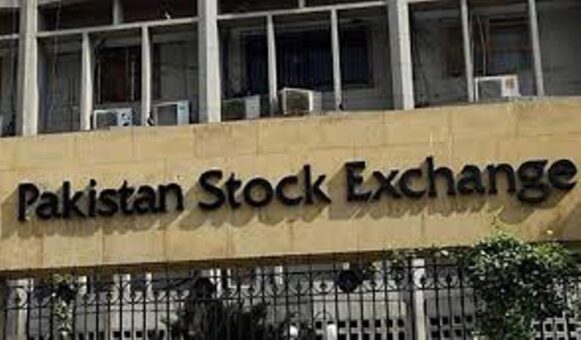
    KARACHI: The stock market ended with gain of nominal 10 points on Wednesday despite positive trading of over 400 points earlier in the day.

    The benchmark KSE-100 index of Pakistan Stock Exchange (PSX) closed at 32,982 points as against 32,972 points showing an increase of 10 points.

    Analysts at Arif Habib Limited said that the market opened on a positive note today and within no time touched day’s high of +409 points, post SBP rate hike yesterday of 100bps, inline with street consensus.

    E&P, O&GMCs, Cement, Chemical, Fertilizer and Banking Sector scrips performed well earlier today, however, save for O&GMCs and Chemical, all went bust by session’s end.

    LOTCHEM, SSGC, SNGP, EPCL traded near upper circuits. Cement sector led the volumes table with around 30 million shares (contributed by MLCF (16.5 million), DGKC (4.8 million) and FCCL (3.5 million)), followed by Chemical with 15M shares (contributed by LOTCHEM (8.2 million)).

    Sectors contributing to performance include Banks (+30 points), Power (+17 points), Food (+15 points), Chemical (+14 points), Autos (-23 points), E&P (-20 points) and Textile (-10 points).

    Volumes declined from 138.7 million shares to 111.5 million shares (-20 percent DoD). Average traded value also declined by 18 percent to reach US$ 23.2 million as against US$ 28.3 million.

    Stocks that contributed significantly to the volumes include MLCF, TRG, LOTCHEM, DGKC and UNITY, which formed 40 percent of total volumes.

    Stocks that contributed positively include HUBC (+21 points), HBL (+19 points), DAWH (+16 points), NESTLE (+15 points) and EPCL (+8 points). Stocks that contributed negatively include OGDC (-14 points), INDU (-14 points), FFC (-14 points), PPL (-10 points) and NML (-9 points).

  • Rupee gains 24 paisas against dollar

    Rupee gains 24 paisas against dollar

    In Karachi, the Pakistani Rupee experienced a significant gain of 24 paisas against the US Dollar on Wednesday, attributed to optimistic remarks regarding the economy made by the governor of the State Bank of Pakistan (SBP) the previous day.

    (more…)
  • Sales tax imposed on banking services of cheque books, lockers

    Sales tax imposed on banking services of cheque books, lockers

    KARACHI: SIndh government has imposed sales tax on services on cheque book issuance and maintaining locker vaults by a banking company to its customer.

    According to amendment made to Sindh Sales Tax on Services Act, 2011 through provincial Finance Act, 2019, the tax has been imposed on non-fund based banking services.

    The banking services have been included for tax purposes, included: bank guarantee; issuance of cheque book, payorder and demand draft; safe deposit lockers and safe vault. Besides, tax is also imposed on those services provided by banks that are not specified in the Act.

    According to tax experts with the amendments to the Finance Act, 2019 following services are become taxable: Issuance of cheque book; and commission of all sorts including ‘Banca assurance’.

    Tax experts at PwC A F Ferguson Chartered Accountants said that the taxability of banca assurance was contested by the Sindh Revenue Board as falling under tariff 9813.4990, which was rejected in a decision of the SRB Tribunal by majority.

    Through the amendment more services have been added for tax purposes, included:

    Services provided or rendered by cab aggregator and the services provided or rendered by the owners or drivers of the motor vehicles using the cab aggregator services.

    Warehouses or depots for storage or cold storage.

    Services of mining of minerals and allied and ancillary services in relation thereto.

    Site preparation and clearance, excavation and earth moving and demolition services.

    Waste collection, transportation, processing and management services.

    Vehicle parking and valet services.

    Electric power transmission services.

  • SBP revises ‘blocked accounts’ of non-resident Pakistanis under Foreign Exchange Manual

    SBP revises ‘blocked accounts’ of non-resident Pakistanis under Foreign Exchange Manual

    KARACHI: State Bank of Pakistan (SBP) has revised blocked accounts of non-resident Pakistanis under Foreign Exchange Manual and laid down procedure for investment of amount from such blocked account.

    The SBP on Wednesday issued revised chapters of Foreign Exchange Manual and said that balances held in blocked accounts may be invested in approved government debt securities” expressed to be payable in Rupees or in fixed deposit with the bank in which the account is held subject to the prior approval of the State Bank.

    Such investment must be made through the bank with whom the blocked account is kept and registered in the name of the non-resident account holder or his/her nominee(s) in Pakistan.

    “The securities should not be held in bearer form and should not be sold or transferred without the permission of the State Bank. The income generated through investments in securities and sale proceeds of such securities must only be credited to the blocked account of the respective non-resident,” the SBP said.

    The SBP said that section 6 of the Foreign Exchange Regulation Act, 1947 empowers the State Bank to block the accounts in Pakistan of any person resident outside Pakistan and direct that payment of any sums due to that person shall only be made to a blocked account.

    In other words, amounts due to a person resident outside Pakistan, to whom remittances cannot be allowed, shall be credited to the blocked accounts of that person to ensure that the funds are not directly remitted or otherwise used in a manner contrary to the provisions of the Act.

    The SBP defined as a “blocked account” means an account opened as a blocked account at any office or branch in Pakistan of a bank authorized in this behalf by the State Bank or an account blocked by the order of the State Bank.

    All Authorized Dealers are permitted to open and maintain blocked accounts subject to the conditions laid down in subsequent paragraphs of this chapter. In certain cases, banks other than the Authorized Dealers may also be authorized by the State Bank to open and maintain blocked accounts.

    The State Bank may direct an authorized dealer to open a new or designate an existing account as “Blocked Account”. A blocked account may also be opened as a joint account in the name of a resident and a non-resident. No blocked account may be un-blocked or an existing ‘free’ account may be blocked by an Authorized Dealer except under the directions from the State Bank.

    Sub-section (1)(b) of Section 6 of the Act provides that where the State Bank has directed that any payment due to a non-resident may be made to a blocked account in his name with a bank in Pakistan, the crediting of the sum to the blocked account shall, to the extent of the sum credited, be a good discharge to the person making the payment.

    The central bank said that the State Bank may not approve certain remittances in settlement of liabilities to a particular person resident outside Pakistan. Payments in discharge of such liabilities to such person may be allowed to be made to a blocked account subject to such terms and conditions as may be specified by the State Bank.

    Where the State Bank directs that a payment be made to a blocked account, it may be made either:

    (i) by a banker’s payment order/cheque marked ‘payable to blocked account of ____________________only’ or

    (ii) by a crossed cheque or warrant drawn in favour of the beneficiary and marked with the words “Payable to blocked account of payee only.”

    (iii) Where such a cheque or warrant is sent to the payee, it is desirable that the payee should arrange for the opening of a blocked account with an Authorized Dealer in Pakistan before forwarding the instrument to that bank for collection. Application mentioning the name of the payee as the transferee and clearly marked ‘Blocked Account’ must be submitted to the State Bank for prior approval. The collecting bank must endorse cheques, warrants or drafts so marked “received for the credit of blocked account at ………………………… (Bank and Branch)” before presenting them for payment. The paying bank shall not pay such instruments, unless they are approved by the State Bank for payment to a blocked account. After payment has been made, the bank must endorse the instrument as “Payment made to blocked account at ………………………… (Bank and Branch)”. The amount which the State Bank has directed to be credited to a blocked account, must be immobilized pending the opening of the account and may not be used for any other purpose except with the prior approval of the State Bank.

    The State Bank may issue special instructions regarding operations on blocked accounts. In the absence of any such special instructions, no payments into or withdrawal from blocked accounts may be made unless prior approval of the State Bank has been obtained.

  • Share market gains 14 points amid high volume

    Share market gains 14 points amid high volume

    KARACHI: The stock market gained a nominal 14 points on Tuesday amid high volume trading, analysts said.

    The benchmark KSE-100 index of Pakistan Stock Exchange (PSX) closed at 32,972 points as against 32,958 points showing an increase of 14 points.

    Analysts at Arif Habib Limited said that the market volumes finally breached the anemic 40 million level and totaled 138.7 million shares.

    Cement and E&P sector played a major role in setting the pace of market today, which oscillated between +135 points and -354 points.

    E&P scrips POL and PPL traded near lower circuits, whereas OGDC also saw significant selling pressure.

    Similarly, O&GMCs saw key scrips under pressure, such as PSO and SNGP.

    MLCF and DGKC also traded near lower circuits, however, recovered later in the day’s trading. Cement sector led the volumes table with 27 million shares, followed by Power (22 million) and Technology (15 million).

    Scrip wise activity shows KEL as volume leader with 20M shares, followed by MLCF (14 million) and TRG (13 million).

    Sectors contributing to the performance include banks (46 points), Cement (26 points), Fertilizer (18 points), Power Generation (4 points), and Transport (3 points).

    Volumes increased by from 138.7 million shares to 69.1 million shares.

    Average traded value increased by merely 92 percent to reach US$ 28.3 million as against US$ 14.8 million.

    Stocks that contributed significantly to the volumes include KEL, MLCF, TRG, BOP and LOTCHEM, which formed 43 percent of total volumes.

    Stocks that contributed positively include UBL (+24 points), LUCK (+24 points), HBL (+23 points), ENGRO (+17 points) and MCB (+15 points). Stocks that contributed negatively include POL (-29 points), PPL (-21 points), BAHL(-11 points), NML (-10 points) and ABOT (-9 points).

  • Rupee ends 160.06 against dollar

    Rupee ends 160.06 against dollar

    KARACHI: The Pak Rupee ended down by 19 paisas against dollar on Tuesday amid money policy announcement and higher demand for import and corporate payments.

    The rupee ended Rs160.06 to the dollar from previous day’s closing of Rs159.87 in interbank foreign exchange market.

    The foreign currency market was initiated in the range of Rs160.25 and Rs160.60. The market recorded day high of Rs160.95 and low of Rs159.90 in interbank foreign exchange market.

    Currency experts said that the local currency would remain under pressure due to schedule repayment of foreign debt and payment for imports.

    The exchange rate in open market also witnessed depreciation in local currency. The buying and selling of dollar was recorded at Rs160.00/Rs160.50 from previous day’s closing of Rs159.50/Rs160.50 in cash ready market.

  • SBP increases key policy rate by 100bps to 13.25 percent

    SBP increases key policy rate by 100bps to 13.25 percent

    KARACHI: The State Bank of Pakistan (SBP) on Tuesday increased key policy rate by 100 basis points to 13.25 percent for next two months.

    The policy rate was announced by SBP governor Reza Baqir at a press conference here on Tuesday.

    The governor said that the monetary policy is announced in the month of July. He said that Monetary Policy Committee (MPC) is an independent body to decide the policy rate.

    The governor said that the increase in utility prices would have inflationary pressure. The average inflation during the current fiscal year may increase to 11 to 12 percent. However, the pace of inflation will ease down during third and fourth quarter, he added.

    He said that hike in utility prices would inflate the prices of essential items. It may hurt the purchase power of common men. Considering these elements the committee decided to increase the discount rate, he added.

    The governor said that the policy rate would be eased if indicators showed improvements in coming months.

    The SBP later in its press release issued the following statement:

    There have been three key developments since the last MPC meeting.

    First, the Government of Pakistan has passed a FY20 budget that seeks to credibly improve fiscal sustainability by focusing on revenue measures to widen the tax base.

    Adjustments in utility prices and other measures in the budget are expected to lead to a one-time considerable increase in prices in the first half of FY20.

    On the other hand, the government has also committed to cease borrowing from the State Bank that would qualitatively improve the inflation outlook.

    Second, the outlook for external financing has further strengthened with the disbursement of the first tranche associated with the IMF Extended Fund Facility, activation of the Saudi oil facility, and other commitments of support from multilateral and bilateral partners.

    The current account deficit has also continued to fall suggesting that external pressures continue to decline. On the other hand, the depreciation in the exchange rate since the last MPC has added to inflationary pressures.

    Finally, on the international front, the sentiment towards emerging markets has improved with greater expectations of a policy rate cut in the United States.

    The SBP said that domestic demand is estimated to moderate to about 3 percent in FY19 and GDP growth to 3.3 percent.

    While current high frequency indicators point to a slowing in economic activity, this is expected to turn around in the course of the year on the back of improved market sentiments in the context of IMF supported program, a rebound in the agriculture sector and the gradual impact of government incentives for export-oriented industries. Conditional upon the latest available information, SBP expect the real GDP growth of around 3.5 percent in FY20.

    External conditions show continued steady improvement with a sizeable reduction in the current account deficit which fell by 29.3 percent to US$ 12.7 billion in Jul-May FY19 as compared to US$ 17.9 billion during the same period last year.

    This improvement was primarily driven by import compression and healthy growth in workers’ remittances. Export volumes have been growing even though export values have remained subdued due to a fall in unit prices as also experienced by competitor exporting countries.

    Future developments in export performance will also depend on growth rates of our trading partners and progress in alleviating domestic structural impediments.

    SBP’s foreign exchange reserves have risen to about US$8 billion on 12th July 2019 with the disbursement of the first tranche of the IMF’s Extended Fund Facility.

    Reserves are expected to rise further in FY20 on account of additional financial inflows from other international creditors including those related to the Saudi oil facility and continued improvement in current account deficit.

    The bulk of the needed adjustment in the real effective exchange rate to address the past overhang of overvaluation has been completed with the recent deprecation of the exchange rate.

    While the exchange rate is flexible and market determined the SBP stands ready to take action to address disorderly market conditions in the foreign exchange market.

    Led by substantial shortfall in revenue collection, higher than budgeted interest payments and security related expenditures, both the overall fiscal and primary deficits deteriorated in FY19.

    The FY20 budget seeks to credibly reverse the recent trend of fiscal deterioration by addressing long-standing weaknesses in the taxation system and to enhance documentation of economic activities.

    On the back of an ambitious target for tax collection and tight control over expenditures, the budget envisaged a sizable reduction in primary deficit. This fiscal consolidation would support SBP’s stabilization policies already in place.

    From a monetary policy perspective, the government’s strong commitment to end its borrowing from the SBP, and the implementation of liability management operation to restructure the outstanding debt held by SBP, would positively contribute towards monetary policy transmission while credibly anchor markets’ inflation expectations going forward.

    Reflecting the impact of stabilization measures, private sector credit (PSC) growth has started to decelerate. PSC expanded 11.4 percent during 1st Jul – 28th Jun FY19 as compared to 14.8 percent during the same period last year.

    The deceleration in credit was more pronounced in real terms as the increase in PSC was largely driven by higher input prices, which in turn increased the working capital needs of the businesses. This, together with higher budgetary borrowing led to a sharp increase in the net domestic assets (NDA) of the banking system.

    In aggregate, broad money supply (M2) grew by 12.2 percent during 1st Jul – 28th Jun FY19 as compared to 10 percent during the comparable period last year.

    Going forward, the composition of money supply is expected to change as NFA of the banking system is projected to improve, while the growth in NDA is likely to show substantial moderation.

  • Sindh notifies new motor vehicle tax rates

    Sindh notifies new motor vehicle tax rates

    KARACHI: The Sindh government has notified new rates of motor vehicle tax effective from July 01, 2019 amendment through Provincial Finance Act, 2019 for the year 2019/2020.

    The provincial government increased the rate of tax for higher engine capacity motor vehicles to Rs150,000 and Rs75,000.

    Further rates are modified in following manner:

    1. (a) (i) Motorcycles/Scooter not already registered not more than 149CC: Rs1800/once for all

    (ii) Motorcycle/scooter 150cc and above: Rs3000/ once for all.

    (b) Motorcycle/Scooter already registered and since first registration, the vehicle-

    (i) has not completed 5 years; Rs600/ once for all or Rs80 per annum

    (ii) has completed 5 years but not completed 10 years: Rs300/ once for all or Rs80 per annum

    (iii) has completed 10 years but has not completed 15 years: Rs100/once for all or Rs80 per annuam.

    (c) (i) Motor cars/jeeps etc. (Non-commercial having engine capacity up to 1000cc not already registered.: Rs20,000 once for all.

    (ii) Motor cars/ jeeps etc. (Non commercial having Engine Capacity up to 1000cc already, registered having up to date tax payment and since first registration vehicles-

    (a) Has not completed five years Rs15,000 once for all

    (b) Has completed five years but not completed 10 years: Rs10,000 once for all.

    (c) After completion of 10 years: Rs8,000 once for all.

    2. Motor vehicles not exceeding 250kgs in un-laden weight adopted and used for invalids: not tax

    3. Vehicles (trucks/trailer / Delivery vans/ Mini Buses and pick-ups etc. used for transport or haulage of goods or materials.

    (a) Electrical propelled vehicles not exceeding 1250 kgs in un-laden weight: Rs750/ per annum

    (b) Vehicles with maximum laden exceeding 1250 but not exceeding 4060 kgs. Rs1200 per annum

    (c) Vehicles with maximum laden capacity exceeding 4060 kgs but not exceeding 8120 kgs: Rs3000 per annum

    (d) Vehicles with maximum laden capacity exceeding 8120kgs but not exceeding 16000 kgs. Rs9000 per annum

    (e) Vehicles with maximum laden capacity exceeding 16000 kgs: Rs12000 per annum

    (f) All types of cranes: Rs3000 per annum

    4. Vehicle plying for hire and ordinarily used for transport of passengers (taxis and buses)

    (i) Tricycle propelled by mechanical power (rickshaws cabs) with seating capacity of not more than 3 percents: Rs600 per annum

    (ii) Motor vehicles with a seating capacity of more than 20 persons plying for hire exclusively within the limit of a corporation, municipality or cantonment or partly within and partly outside such limit with sixty percent of the total length of the route falling within the limits of a corporation, municipality or cantonment: Rs150 per seat.

    (iii) Mini buses with a seating capacity of not more than 20 percents plying for hire exclusively within the limit of corporation, municipality or cantonment: Rs240 per seat

    Explanation: For the purpose of this clause, the seating capacity shall not include the seats meant for driver and conductor.

    (iv) Motor vehicles with seating capacity of more than 20 persons plying for hire within or outside the limits of corporation, municipality

    (a) Air Conditioned: Rs225 per seat

    (b) Non Air Conditioned: Rs150 per seat

    (v) Other vehicles with a seating capacity:

    (a) Not more than 4 percent: Rs780 per annum

    (b) More than 4 persons but not more than 6 persons: Rs900 per annum

    (c) More than 6 persons: Rs300 per seat

    5. Motor vehicles (motor cars/jeeps other than those mentioned above and having-

    (a) Seating capacity of not more than three person: Rs500

    (b) Seating capacity of more than three persons but not more than six persons-

    (i) With engine power not exceeding 1000CC: Rs1,500 per annum

    (ii) With engine power exceeding 1000cc but not exceeding 1300cc: Rs2000 per annum

    (iii) With engine power exceeding 1300cc but not exceeding 1600cc: Rs4000 per annum

    (iv) With engine power exceeding 1600cc but not exceeding 2000cc: Rs4500 per annum

    (v) With engine power exceeding 2000cc but not exceeding 2500cc: Rs5000 per annum

    (vi) With engine power exceeding 2500cc: Rs7000 per annum.

    Provided that the tax in respect of the motor vehicle referred to in clauses (a) and (b) other than the commercial vehicles shall, on completion of ten years and fifteen years of the payment of the tax since first registration of the vehicles, be paid at the rate of seventy five percent and fifty percent of the tax respectively.

    6. (i) tractor without trailer: Rs200

    (ii) if trailer is attached with tractor: Rs300
  • Rupee falls to Rs160.91 to dollar in interbank early trade

    Rupee falls to Rs160.91 to dollar in interbank early trade

    KARACHI: The Pak Rupee deteriorated by another Rs1.04 in early trade on Tuesday ahead of monetary policy announcement and pressure of import and corporate payments.

    The dollar is being traded at Rs160.91 in interbank foreign exchange market. The rupee closed yesterday at Rs159.87 to the dollar in foreign currency market.

    Currency experts said that due to rescheduled payment against foreign debt the demand for greenback was high.

    They further said that as rupee was also under pressure because by fiscal year end many multinational and foreign companies repatriated their profits.

    The local currency was remained under pressure for the last over one week due to weak economic indicators.

    The experts said that the State Bank of Pakistan (SBP) is scheduled to announce monetary policy for next two months today.

    The analysts believe that the central bank may further increase key policy rate by 100 basis points to 13.25 percent as present policy rate of 12.25 percent.

    However, some relief was seen in easing trade deficit and decline of import bill by around 9 percent.

    The experts said that the policy to curb luxury and non-essential imports would help the local currency to show resilience against dollar.