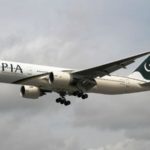
KARACHI: The Pakistan Airlines Pilots’ Association (PALPA) on Saturday said that the plane crash on a residential area was due to due to the unfitness of the aircraft itself.
An Airbus 320 of Pakistan International Airline (PIA) conducting PK 8303; travelling from Lahore to Karachi crashed a day earlier on the residential area causing 97 deaths.
The association said that this is a time for great reflection and introspection. Without assigning blame and / or in any manner implicating any person / persons, we are constrained to identify certain hard facts.
“We believe that the negligence of the PIACL management (in entirety) in ensuring maintenance of its aircrafts is a dominant factor in the occurrence of this most heart wrenching incident.”
A statement issued by PIACL’s engineering department has confirmed that aircraft maintenance & repairs are a matter which do not obtain priority.
The Pakistan Civil Aviation Authority (‘PCAA’) has also failed in its duty as the regulator. Airworthiness of an aircraft is a concern that falls exclusively within the regulatory domain of the PCAA.
There have been numerous instances when PALPA has, on behalf of its members, lodged protests with PIACL’s management with regard this particular aircraft & the dangers it posed in being utilised for flying operations.
Numerous ‘technical logs’ concerning this particular aircraft will validate PALPA’s contentions.
The aircraft’s landing gear has always been a grave cause for concern.
Our repeated expressions of distress have been misrepresented by PIACL’s management to government agencies, policy makers, as also the public at large, as unfair negotiatory tactics.
PALPA has, time and again, insisted on enforcement of the highest flight safety standards. It has been so enabled by ‘working agreements’.
These standards have been deemed as required to be most elevated particularly during the global devastation experienced at the hands of COVID 19.
At our insistence, the Aviation Division was pleased to instruct PIACL & PCAA to ensure strictest compliance of SOPs in conducting COVID 19 specific flights. These SOPs should now ideally become an intrinsic part of PIACL’s flight operations.
On 28.04.2020, the Federal Government issued a notification declaring all employment in PIACL as an ‘essential service’. The effect of this notification is that Pilots cannot, under any circumstances, refuse to partake flight operations as ordained by PIACL’s management.
PALPA is committed to the fact that the notification has been issued (i) at the behest of PIACL’s management; (ii) in bad faith. Pursuant to the notification, PIACL’s management terminated the ‘working agreement’ lastly in vogue.
The ensuing consequences now compel all Pilots to perform duties at the whims & the fancy of PIACL’s management, without the ability to demand or to hold it accountable for its failings. Any justified resistance may be met with criminal / penal consequences.
The PIACL management has employed draconian methods in dealing with its most valuable asset; i.e. Pilots. PIACL operations are being administered at the whims and fancies of a man not deemed fit or suitable to helm the organization.
On this day, the Supreme Court of Pakistan is seized of a matter challenging the appointment of Air Marshall Arshad Malik as Chief Executive Officer (‘CEO’) for PIACL.
He is discharging duties under an injunctive order passed by the Supreme Court of Pakistan. Final adjudication of proceedings is awaited.
The CEO’s unfitness to hold office is demonstrated through his statement to the press. By insinuating that the (deceased) commanding officer of PK 8303 was ‘unable to land the aircraft despite 2 open runways’ is a stark reflection of his lack of knowledge of aviation affairs.
The reality of the situation is as follows. Landing gear is ordinarily deployed about 2000 feet before the landing strip / runway. In this instance, the landing gear failed & the commanding officer was compelled to ‘go around’. For those who are unaware, ‘go around’ is a term used when an aircraft landing is unsuccessful & the aircraft is brought around to perform a landing. During the second approach, both engines failed & the (deceased) commanding officer declare ‘may day’.
PALPA (& it’s entire membership) is grief struck & concerned for the overall welfare of all persons (including passengers). Under present circumstances, however, we are unable to enforce good sense, prudent policies & flight safety standards upon PIACL’s management on account of oppressive policies enacted by it in concert with the Federal Government. Any position taken by us is at the risk of facing criminal prosecution.
We, therefore, call upon:
1 – The Honourable Prime Minister of Pakistan, Mr. Imran Khan Niazi, & the Federal Minister for Aviation Affairs, Mr. Ghulam Sarwar Khan, to reconsider the Federal Cabinet’s desire to classify PIACL employment as an ‘essential service’
2 – The Honourable Chief Justice of Pakistan, Justice Gulzar Ahmed, to appreciate our concerns & to take up PIACL matters pending before the Supreme Court of Pakistan on urgent basis.
3 – The PIACL Board of Directors to reconsider their misplaced, unjustified & otherwise unlawful act of (i) ‘unrecognising’ PALPA; & (ii) terminating the ‘working agreement’.