Day: December 3, 2020

  • Hunger may jeopardize food security, economic uplift in Pakistan: report

    Hunger may jeopardize food security, economic uplift in Pakistan: report

    ISLAMABAD: Among countries in the developing world, Pakistan faces one of the most severe crises of malnutrition, which is the fundamental cause of child morbidity and mortality.

    Pakistan ranks 88th out of 107 countries in the Global Hunger Index while food security and nutrition crisis is expected to worsen in the wake of the COVID-19 pandemic because country has a serious hunger level.

    These are the finding of the “2020 Global Hunger Index & Strategy for Stakeholders’ Engagement on Food and Nutrition Security 2021– 2025 report launched in Islamabad this week by Alliance 2015 — a strategic network of leading eight European non-government and non-profit organizations engaged in humanitarian and development actions in Pakistan and the world.
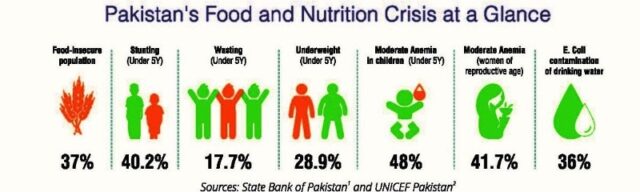
    The report highlights that the worsening food and nutrition security situation retarded human and economic development and carried the risk of jeopardizing national security if it was not tackled well by government, private sector, civil society, media, public, communities, academia and research institutions, the report pointed out.

    “The time to act is now, individually, and collectively,” the report has warned. The report also identifies key stakeholders and roles they can play in averting this crisis besides laying out stakeholders’ engagement goals and objectives in the next five years.

    The COVID-19 pandemic has further aggravated the food and nutrition security situation in Pakistan. Travel restrictions and limitations on the movement of essential goods including food and agricultural inputs, protracted loss of income and rise in prices have already negatively impacted millions of Pakistanis.

    The IMF has predicted a sharp reversal in the declining poverty rates, with 40 percent of the population below the poverty line after the spread of COVID-19.

    Moreover, 17 million children under the age of five are missing routine vaccinations, leaving them unprotected and more vulnerable to health risks posed by COVID-19 outbreak.

    The report highlights that globally, far too many individuals are suffering from hunger: nearly 690 million people are undernourished; 144 million children suffer from stunting, a sign of chronic under-nutrition; 47 million children suffer from wasting, a sign of acute under-nutrition; and in 2018, 5.3 million children died before their fifth birthdays, in many cases as a result of under-nutrition.

    Although hunger worldwide has gradually declined since 2000, in many places progress is too slow and hunger remains severe.

    Furthermore, these places are highly vulnerable to a worsening of food and nutrition insecurity caused by the overlapping health, economic and environmental crises of 2020.

    To better respond to, and indeed to prevent, the report highlight that complex emergencies, multilateral institutions, governments, communities and individuals should use the lessons learned during the COVID-19 pandemic and other crises to build safe, resilient food systems.

    They should review food, health, and economic systems through a One Health lens to chart a path to environmental recovery by investing in sustainable food production, distribution and consumption.

    The report warned that beyond 2030, still other actions will be important such as working towards a circular food economy that recycles nutrients and materials, regenerates natural systems and eliminates waste and pollution.

    An alarming 37 percent of the population in Pakistan is classified as food insecure; meaning that they do not “have physical and economic access to sufficient, safe and nutritious food that meets their dietary needs and food preference for an active and healthy life,” according to the Food and Agriculture Organization.

    The COVID-19 pandemic has exposed the fragility of globalized food systems characterized by increasing dependence on food imports by low- and middle-income countries, underinvestment in local farmers, farmer associations and smallholder-oriented value chains, increasing rates of diet-related non-communicable disease.

    Inadequate emergency responses are disrupting local food systems and fail to support local producers. COVID-19 containment measures—enforced without a clear declaration that agricultural and food services are essential—have contributed to food insecurity in many countries.

  • E-commerce transactions through debit cards up by 152 percent

    E-commerce transactions through debit cards up by 152 percent

    KARACHI: The online payment through debit cards for e-commerce registered phenomenal growth of 152 percent in first quarter of current fiscal year, according to data released by State Bank of Pakistan (SBP) on Thursday.

    The online payment for e-commerce increased to Rs11.1 billion in the first quarter (July – September) 2020/2021 as compared with Rs4.4 billion in the same quarter of the last fiscal year.

    The volume of transactions also registered around 200 percent during the period under review. According to SBP data the volume of debt card transactions increased to 3.9 million during first quarter of the current fiscal year as compared with 1.3 million in the same quarter of the last fiscal year.

    The total e-commerce transactions registered 81 percent growth during the first quarter of the current fiscal year. The value of e-commerce transactions (payment through debt, credit and pre-paid cards) increased to Rs24.1 billion during the quarter under review as compared with Rs13.5 billion in the same quarter of the last fiscal year.

    The e-commerce transactions through credit card increased to Rs12.9 billion during the first quarter of fiscal year 2020/2021 as compared with Rs9.1 billion in the corresponding quarter of the last fiscal year.

  • ECC abolishes peak-hour electricity tariff

    ECC abolishes peak-hour electricity tariff

    ISLAMABAD: Economic Coordination Committee (ECC) of the Cabinet on Thursday approved abolishment of higher electricity tariff for peak hours.

    Adviser to the Prime Minister on Finance and Revenue, Dr. Abdul Hafeez Shaikh chaired the meeting of the Economic Coordination Committee (ECC) of the Cabinet.

    Minister for Privatization Muhammad Mian Soomro, Minister for Economic Affairs Makhdoom Khusro Bakhtiar, Minister for Railways Sheikh Rashid Ahmed, Adviser to the PM on Commerce Abdul Razak Dawood, SAPM on Revenue Dr. Waqar Masood, SAPM on Power Tabish Gauhar and Adviser to the PM on Institutional Reforms and Austerity Ishrat Hussain participated in the meeting.

    Governor State Bank of Pakistan Dr. Reza Baqir joined the meeting through video link.

    The Power Division presented the case for abolishment of Time-of-Use tariff scheme for Industrial consumers to spur industrial activity amid COVID-19 pandemic by removing the distinction between the current system of peak and off-peak hours as a part of Industrial support package.

    The underlying rationale is to incentivize industrial units to operate round the clock and produce greater output during testing times.

    Consequently, ECC accorded approval, in principle, to the proposal regarding amendment in the respective SROs both for the XWDISCOS and K-Electric to charge the off-peak rates against the peak hours.

    The abolishment of peak and off-peak tariff structure would be implemented with effect from November 01, 2020 till April 30, 2021.

  • Share market ends flat in range bound trading

    Share market ends flat in range bound trading

    KARACHI: The share market ended with an increase of 20 points on Thursday as market traded in range bound during the day.

    The benchmark KSE-100 index of the Pakistan Stock Exchange (PSX) closed at 42,047 points against 42,027 points showing an increase of 20 points.

    Analysts at Arif Habib Limited said that the market traded range bound after a gradual yet sketchy run up from around 39500 level till now, which has resulted in an addition of 2500 points however, investors still seem perplexed for reasons of rising cases of corona and potential negative impact of lock down.

    International crude prices also traded direction less for want of an impending decision by OPEC+ regarding crude output. Resultantly, E&P stocks also traded range bound without much excitement.

    Cement and Steel sectors saw cautious buying activity, however, selling pressure kept the increase in prices in check. Among scrips, TRG led the table with 35.2 million shares, followed by MLCF (30.9 million) and ASL (29.6 million).

    Sectors contributing to the performance include Power (-7 points), Pharma (-4 points), E&P (-2 points), Autos (+8 points), Cement (+7 points) and Fertilizer (+5 points).

    Volumes declined from 476.8 million shares to 420 million shares (-12 percent DoD). Average traded value also dipped by 12 percent to reach US$ 112.5 million as against US$ 127.4 million.

    Stocks that contributed significantly to the volumes include TRG, MLCF, ASL, HASCOL and PRL, which formed 36 percent of total volumes.

    Stocks that contributed positively to the index include SYS (+27 points), LUCK (+17 points), MCB (+15 points), FFC (+15 points) and PSO (+12 points).

    Stocks that contributed negatively include TRG (-12 points), MTL (-12 points), SEARL (-11 points), HBL (-8 points) and COLG (-7 points).

  • SECP allows online account opening to capital market investors

    SECP allows online account opening to capital market investors

    ISLAMABAD: Securities and Exchange Commission of Pakistan (SECP) on Thursday allowed Pakistani residents and non-resident investors to open online account in the capital market.

    A statement issued by the SECP stated that this new regime is part of the SECP’s digital transformation agenda, allows investors to seamlessly open his or her account with a broker from anywhere in the country without requiring to submit any documents physically or visit a broker. “The new hassle-free process shall enable investors to commence trading swiftly.”

    However, to ensure maximum investor protection, an alternate online customer verification process has been introduced for opening of online account.

    “The online verification will be conducted independently by the Centralized KYC Organization. In addition, the account opening process has been made simpler by reducing the number of pages to be signed by the investors.”

    The new account opening system is a continuation of SECP’s reform agenda that aims at enhancing investor outreach, introducing digitization and ensure robust growth of the capital markets.

    A sizeable investor base is a crucial stepping stone for development of any capital market and is therefore part of the major objectives of the SECP.

    “It is expected that the new regime would revolutionize Pakistan’s capital market and contribute significantly towards economic growth in the country by channeling investment and savings through the market,” the SECP said.

  • Country’s weekly FX reserves ease by $311 million

    Country’s weekly FX reserves ease by $311 million

    KARACHI: The liquid foreign exchange of reserves of the country fell by $311 million to $20.241 billion by week ended November 27, 2020, State Bank of Pakistan (SBP) said on Thursday.

    The foreign exchange reserves were at $20.552 billion by week ended November 20, 2020.

    The official reserves of the SBP fell by $305 million to $13.11 billion by week ended November 27, 2020 as compared with $13.415 billion a week ago.

    The SBP attributed the decline in official reserves to scheduled external debt payment by the government.

    The foreign exchange reserves held by commercial banks also eased by $6 million to $7.131 billion by week ended November 27, 2020 as compared with $7.137 billion a week ago.

  • Rupee strengthens by 29 paisas on inflows

    Rupee strengthens by 29 paisas on inflows

    KARACHI: The Pak Rupee strengthened by 29 paisas against the dollar on Thursday owing to reports of growth in exports of the country.

    The rupee ended Rs160.17 to the dollar from previous day’s closing of Rs160.46 in the interbank foreign exchange market.

    Currency dealers said that the market witnessed supply of the foreign currency that was more than the demand for import and corporate payments.

    They said that reportedly exports were had maintained over $2 billion value in November 2020.

  • PRAL issues cyber security advisory for FBR officials working from home

    PRAL issues cyber security advisory for FBR officials working from home

    ISLAMABAD: Pakistan Revenue Automation (Pvt) Limited (PRAL) has issued cyber security advisory for officials of Federal Board of Revenue (FBR), who are working from home in the wake of resurgence of coronavirus.

    In its advisory issued on Thursday, the PRAL said that switching to remote working because of the ongoing coronavirus pandemic can create cyber security problems for an organization like FBR and its employees.

    Attackers are exploiting the situation, so look out for phishing emails, scams and other hacking attempts.

    “A new type of phishing attack is rising which is focusing on coronavirus (COVID-19). Adversaries’ sends phishing & spam emails to users to open the infected word document claiming an update report from World Health Organization (WHO) of Pakistani Health Authorities.”

    Therefore, all FBR resources who are authorized by the competent authority to Work From Home are directed to adhere to the following strategy points:

    01. Avoid public Wi-Fi networks and use PRAL recommended VPN for secure communications.

    02. Use of remote desktop software such as Teamviewer, Anydesk, etc. are strictly prohibited.

    03. Make sure you are using a secure connection for your work from home environment.

    04. Keep password strong and change it regularly. Always memorize the password, never write it.

    05. Enable two factor (2FA) or multi-factor authentication, wherever possible.

    06. Encrypt your home PC hard drive and USB sticks to safe data in case of theft.

    07. Keep your home PC operating system patched. Install & update your home PC with top-rated antivirus, anti-malware and firewalls. You may also get latest freeware antivirus and other security software from PRAL technical support team.

    08. Check all security software is up to date in your home PC. Privacy tools, add-ons for browsers and other patches need to be checked regularly.

    09. All work from home resources are advised to communicate using official FBR email only.

    10. All FBR remote workers are advised to be suspicious of any emails asking them to check or renew their password and login credentials, even if they seem to come from a trusted source.