Month: December 2020

  • SECP allows online account opening to capital market investors

    SECP allows online account opening to capital market investors

    ISLAMABAD: Securities and Exchange Commission of Pakistan (SECP) on Thursday allowed Pakistani residents and non-resident investors to open online account in the capital market.

    A statement issued by the SECP stated that this new regime is part of the SECP’s digital transformation agenda, allows investors to seamlessly open his or her account with a broker from anywhere in the country without requiring to submit any documents physically or visit a broker. “The new hassle-free process shall enable investors to commence trading swiftly.”

    However, to ensure maximum investor protection, an alternate online customer verification process has been introduced for opening of online account.

    “The online verification will be conducted independently by the Centralized KYC Organization. In addition, the account opening process has been made simpler by reducing the number of pages to be signed by the investors.”

    The new account opening system is a continuation of SECP’s reform agenda that aims at enhancing investor outreach, introducing digitization and ensure robust growth of the capital markets.

    A sizeable investor base is a crucial stepping stone for development of any capital market and is therefore part of the major objectives of the SECP.

    “It is expected that the new regime would revolutionize Pakistan’s capital market and contribute significantly towards economic growth in the country by channeling investment and savings through the market,” the SECP said.

  • Country’s weekly FX reserves ease by $311 million

    Country’s weekly FX reserves ease by $311 million

    KARACHI: The liquid foreign exchange of reserves of the country fell by $311 million to $20.241 billion by week ended November 27, 2020, State Bank of Pakistan (SBP) said on Thursday.

    The foreign exchange reserves were at $20.552 billion by week ended November 20, 2020.

    The official reserves of the SBP fell by $305 million to $13.11 billion by week ended November 27, 2020 as compared with $13.415 billion a week ago.

    The SBP attributed the decline in official reserves to scheduled external debt payment by the government.

    The foreign exchange reserves held by commercial banks also eased by $6 million to $7.131 billion by week ended November 27, 2020 as compared with $7.137 billion a week ago.

  • Rupee strengthens by 29 paisas on inflows

    Rupee strengthens by 29 paisas on inflows

    KARACHI: The Pak Rupee strengthened by 29 paisas against the dollar on Thursday owing to reports of growth in exports of the country.

    The rupee ended Rs160.17 to the dollar from previous day’s closing of Rs160.46 in the interbank foreign exchange market.

    Currency dealers said that the market witnessed supply of the foreign currency that was more than the demand for import and corporate payments.

    They said that reportedly exports were had maintained over $2 billion value in November 2020.

  • PRAL issues cyber security advisory for FBR officials working from home

    PRAL issues cyber security advisory for FBR officials working from home

    ISLAMABAD: Pakistan Revenue Automation (Pvt) Limited (PRAL) has issued cyber security advisory for officials of Federal Board of Revenue (FBR), who are working from home in the wake of resurgence of coronavirus.

    In its advisory issued on Thursday, the PRAL said that switching to remote working because of the ongoing coronavirus pandemic can create cyber security problems for an organization like FBR and its employees.

    Attackers are exploiting the situation, so look out for phishing emails, scams and other hacking attempts.

    “A new type of phishing attack is rising which is focusing on coronavirus (COVID-19). Adversaries’ sends phishing & spam emails to users to open the infected word document claiming an update report from World Health Organization (WHO) of Pakistani Health Authorities.”

    Therefore, all FBR resources who are authorized by the competent authority to Work From Home are directed to adhere to the following strategy points:

    01. Avoid public Wi-Fi networks and use PRAL recommended VPN for secure communications.

    02. Use of remote desktop software such as Teamviewer, Anydesk, etc. are strictly prohibited.

    03. Make sure you are using a secure connection for your work from home environment.

    04. Keep password strong and change it regularly. Always memorize the password, never write it.

    05. Enable two factor (2FA) or multi-factor authentication, wherever possible.

    06. Encrypt your home PC hard drive and USB sticks to safe data in case of theft.

    07. Keep your home PC operating system patched. Install & update your home PC with top-rated antivirus, anti-malware and firewalls. You may also get latest freeware antivirus and other security software from PRAL technical support team.

    08. Check all security software is up to date in your home PC. Privacy tools, add-ons for browsers and other patches need to be checked regularly.

    09. All work from home resources are advised to communicate using official FBR email only.

    10. All FBR remote workers are advised to be suspicious of any emails asking them to check or renew their password and login credentials, even if they seem to come from a trusted source.

  • ECC withdraws regulatory duty on cotton yarn import

    ECC withdraws regulatory duty on cotton yarn import

    ISLAMABAD: The Economic Coordination Committee (ECC) on Wednesday approval removal of 5 percent regulatory duty on import of cotton yarn.

    The Ministry of Commerce presented a proposal before the ECC regarding removal of 5 percent regulatory duty on import of cotton yarn till June 30, 2021. After detailed discussion, the chair approved the removal of regulatory duty on import of cotton yarn to enhance value-added exports.

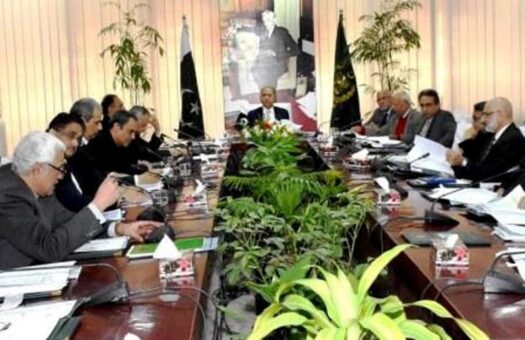
    Adviser to the Prime Minister on Finance and Revenue, Dr. Abdul Hafeez Shaikh chaired the meeting of the ECC of the Cabinet in Islamabad.

    Minister for Planning, Development and Special Initiatives Asad Umar, Minister for Production and Industries Hammad Azhar, Minister for Privatization Muhammad Mian Soomro, Adviser to the PM on Commerce Abdul Razak Dawood, Minister for Power Omar Ayub Khan, Minister for Maritime Affairs Syed Ali Haider Zaidi, SAPM on Petroleum Nadeem Babar, SAPM on Revenue Dr. Waqar Masood and Adviser to the PM on Institutional Reforms and Austerity Ishrat Hussain also participated in the meeting. Governor State Bank of Pakistan Dr. Reza Baqir joined the meeting through video link.

    The Ministry of Commerce submitted another summary to re-consider the earlier decision taken by ECC dated October 19, 2020 regarding procedure for registration under concessionary regime of electricity, RLNG and Gas in export oriented sectors (erstwhile zero-rated sectors). After due deliberation, the chair directed to maintain status quo with a condition that FBR may register new manufacturers or exporters in five export oriented sectors (erstwhile five zero-rated sectors) in coordination with the Ministry of Commerce till June, 2021.

    Communication Division requested ECC for conversion of National Highways Authority loans into Government Grant or grant a waive-off for a much needed fiscal space. A detailed presentation was made before the forum to remodel NHA as a self-sustaining and performance based organization. ECC directed to constitute a sub-committee under the Chairmanship of Minister for Planning, Development and Special Initiatives and would include SAPM Nadeem Babar, Minister for Maritime Affairs Ali Zaidi, Secretary Finance and Secretary Communications to prepare a holistic proposal suggesting revenue generation roadmap for NHA within a month.

    NHA was also granted a one-month moratorium to work out details and present recommendations regarding financial viability of NHA before the forum.

    The ECC recommended a summary presented by the Industries and Production Division to approve release of funds to PSM for payment in lieu of gas supply to SSGC through a Technical Supplementary Grant (TSG).

    ECC approved allocation of upto 9.5 MMCFD gas from M/s PPL’s Benari X-I discovery to SSGCL. Similarly, allocation of 10 MMCFD gas from PPL’s Hadaf X-I to SSGCL was also approved during the meeting. Federal Minister for Maritime Affairs raised the matter of priority berthing for wheat and sugar.

    The ECC directed the Logistics Committee to ensure berthing of wheat and sugar vessels on priority, keeping in view, that other imports are not affected.

    The ECC also accorded approval for allocation of additional funds for maintenance of Islamabad High Court Building and Judges Residences through TSG as requested by the Ministry of Housing and Works.

    The agenda item on Karachi Transformation Plan, presented by the Ministry of Planning, Development and Special Initiatives was deferred to the next ECC meeting for a detailed discussion.

  • PTBA demands 60-day extension for filing income tax returns

    PTBA demands 60-day extension for filing income tax returns

    ISLAMABAD: Pakistan Tax Bar Association (PTBA) has demanded the tax authorities to extend the date for filing income tax returns for two months considering resurgence of coronavirus, calculation errors on IRIS portal and newly launched simple return form for small manufacturers.

    In a letter sent to FBR Chairman, the PTBA sought extension for filing of income tax returns for tax year 2020.

    It is pertinent to mention here that the FBR had already extended the date from September 30, 2020 to December 08, 2020.

    The PTBA, the representative of all tax bars in the country, apprised the FBR chairman that the second wave of COVID-19 had already emerged and reportedly it was more dangerous than the first wave.

    The tax bar said that several areas of the country were under lockdown/smart lockdown and micro lockdown due to the latest situation.

    Besides, the FBR has also instructed its field offices to reduce the staff strength to half to prevent the spread of the pandemic.

    “It is worth mentioning here that normal life and business activities are not going on due to the COVID situation which can be evaluated from the fact that even the government of India has further extended time for filing of return till January 31, 2021 from the original due date i.e. July 31, 2020,” the PTBA said, adding that timely filing of returns of income for tax year 2020, in this situation, is not possible.

    Apart from the COVID situation, the PTBA also highlighted the situation of wrong calculation of minimum tax on the IRIS portal at the time of filing income tax return. “Moreover, the other issues like tax calculation of Behbood Saving Certificates, profits etc. is also required to be deployed correctly in the system.”

    Previously, the PTBA on November 13, 2020 communicated with the FBR on such issues. The tax bar said that the issues pertaining to calculation of minimum tax liability by the system are persistent and not resolved.

    The PTBA further pointed out the newly introduced single page income tax return form for individuals and Association of Persons (AOPs) having turnover less than 50 million through SRO 1261(I)/2020. “It is not understandable that the manufacturers having less than 50 million turnover, can file their returns within available time left i.e. 12 days which is humanly impossible.”

    Considering these extraordinary circumstances due to COVID, calculation errors on IRIS and newly introduced income tax return form, the PTBA demanded the FBR to extend the last date for filing the income tax returns for further 60 days or up to January 31, 2021.

  • SBP issues guidelines for e-commerce exporters

    SBP issues guidelines for e-commerce exporters

    KARACHI: State Bank of Pakistan (SBP) on Wednesday issued guidelines for e-commerce exporters in order to promote such exports from Pakistan.

    The SBP said that in order to promote Business-to-Consumer (B2C) e-Commerce exports from Pakistan, State Bank of Pakistan has reviewed the aforementioned instructions to align these with the changing business dynamics of e-commerce exports.

    For this purpose, a separate Module to implement e-commerce exports has also been developed in WeBOC in collaboration with Pakistan Customs and other relevant stakeholders.

    Accordingly, a revised regulatory framework has been developed keeping in view the current business needs of e-commerce exports, which would replace the existing Para 39 Chapter 12 of FE Manual.

    The revised framework is given hereunder:

    Business-to-Consumer (B2C) E-Commerce Exports

    (i) Forms Prescribed for Declaring E-Commerce Exports:

    As per Federal Government Notification No. I(6)-ECS/48, dated the July 1, 1948, a declaration is required to be furnished by the exporter at the time of exports to the Collector of Customs that an amount representing the full export value of the goods has been or will be disposed of in a manner and within a period specified by the State Bank of Pakistan. In case of e-commerce exports, the declaration required to be furnished by the exporter shall be filed by the courier, in the prescribed format, on behalf of the exporter in the E-Commerce export module of the WeBOC. For exports other than through E-Commerce module of WeBOC, Form-E shall continue to be issued by Authorized Dealers at the request of the exporters as per the existing prescribed instructions.

    (ii) Registration/ Due Diligence of the E-Commerce Exporters in WeBOC by Authorized Dealer

    Authorized Dealer, upon receipt of request along with an undertaking from the exporter as per Annexure-A, shall register the exporter in the B2C E-Commerce module in WeBOC after performing the due diligence of the customer, as per applicable instructions on managing ML / FT risk.

    Authorized Dealers handling the E-Commerce export related transactions are responsible to carry out customer’s Risk Profiling and its periodical monitoring to ensure that any ML/ FT risk is timely and appropriately identified and managed in accordance with the risk management policy of the authorized dealer. The ADs may add a separate section for e-Commerce in their Risk Management Policy to manage ML/ FT risk.

    (iii) Shipment in WeBOC through Couriers registered by Pakistan Customs

    The exporter shall submit their export consignment along with required details to any courier of their choice, registered with Pakistan Customs in WeBOC. The courier handling the export shipment shall file the Goods Declaration to Pakistan Customs on behalf of the exporter. Each individual consignment shall be identified on the basis of unique House Airway Bill (HAWB) Number as per the format prescribed by Pakistan Customs. The value of each consignment should be based on the actual price of the product as per the invoice issued to customer and must not exceed USD 5,000. The detail of export shipments shall be accessible to the Authorized Dealer in the E-Commerce profile of the exporter in WeBOC after the shipment of goods from Pakistan.

    (iv) Method and Period for Realization of Export Proceeds

    Full export value of goods exported from Pakistan and declared to the Customs authorities by courier companies on behalf of E-Commerce exporters, adjusted for any permissible discount as per sub-para vi below, should be received on the due date for payment or within 60 days from the date of shipment, whichever is earlier. The export proceeds should be received from abroad by an Authorized Dealer, through banking channel or international payment scheme/gateway, either in foreign currency, in which the Authorized Dealer maintains accounts, or in Pakistan Rupee from Non-Resident Rupee Account Repatriable or NRP Rupee Value Account.

    (v) Monthly Reconciliation Statement of E-Commerce Exporters

    Exporter shall be required to submit a monthly statement to the Authorized Dealers, in physical/electronic form, giving details of proceeds realized against the export shipments as per prescribed format given at Annexure-Balong with the relevant invoices. The Authorized Dealer will use the data provided in the format to mark the realization of outstanding export shipments in WeBOC, as per procedure given in sub-para vii below. The statement shall be submitted by the exporters within five (5) working days from the end of month to which the statement pertains. Authorized Dealer would promptly follow up with the exporter if the statement is not submitted as per prescribed timeline.

    (vi) Remittance of Foreign Expenses and Retention in Exporters’ Special Foreign Currency Account

    Authorized Dealers are permitted to allow payment of commission/charges/discounts/bank charges due to foreign importers/agents/financial institutions by E-Commerce exporters in Pakistan up to 10% of the invoice value of goods. In cases where the exporter is not required to pay any of the above expense or pay an amount less than above mentioned maximum permissible limit such amounts of commission/discount etc. or differential, not exceeding the 10% limit, can be retained in exporter’s foreign currency retention account with Authorized Dealers in Pakistan. The funds held in such foreign currency accounts can be used by the exporters for payment abroad on account of marketing /promotion and other services related to e-commerce exports. The account can also be used for settlement of overdue/ shortfall export proceeds, replacements etc., and other permissible purposes under the relevant regulations.

    (vii) Realization against E-Commerce Export Shipments

    Authorized Dealer will record proceeds realization against each HAWB in E-Commerce Bankers’ Credit Advice (BCA) module in WeBOC through the following options:

    Settlement against 100% Realization.

    Settlement with discount/commission etc. (up to 10%).

    Settlement with Proceeds from Exporters Foreign Currency Retention Account including partial/ short realization.

    Settlement against Advance Payments.

    Settlement against replacement/ repaired/ faulty goods.

    (viii) Handling of Overdue Cases

    Authorized Dealers shall monitor the non-realization or delay in realization of export proceeds by E-Commerce exporters beyond the prescribed period of 60 days from the date of shipment of goods through WeBOC.

    In case the outstanding export bills aggregating to USD 20,000/- or above are not realized within 60 days from the date of shipment (as per WeBOC data), as at the end of respective month, Authorized Dealer shall mark the exporter’s status as ‘Suspended’ in the E-Commerce module of WeBOC. This ‘Suspended’ status shall be marked by 15th of the following month after taking into account the monthly statement of proceeds realization filed by the exporter, as per Para v above. This would debar the exporter from further exports through E-Commerce module.

    The status of exporter may be restored by Authorized Dealer to ‘Active’ in the WeBOC at any time during the month subject to realization of outstanding export bills, unrealized for 60 days or more from the date of shipment, provide the aggregate amount of such outstanding bills becomes less than USD 20,000/-.

    In case of non-realization or delay in realization of export proceeds beyond 90 days from the date of shipment (as per WeBOC data), as of month end date, the same shall be reported as ‘overdue’ to SBP-Banking Services Corporation (Annexure C), as per guidelines prescribed in Para 33, Chapter 12 of FE Manual. However, the shipments overdue on month end and subsequently marked realized in the WeBOC, on the basis of monthly proceeds realization statement submitted by the exporter, should be excluded from such reporting.


  • Stock market gains 362 points to continue momentum

    Stock market gains 362 points to continue momentum

    KARACHI: The stock market on Wednesday added 362 points after carrying the momentum shown in the past couple of sessions.

    The benchmark KSE-100 index of Pakistan Stock Exchange (PSX) closed at 42,027 points as against 41,665 points showing an increase of 362 points.

    Analysts at Arif Habib Limited said that the market carried the momentum shown in the past couple of sessions and finally crossed the 42,000 index level.

    Cement sector led the Index on the back of an increase in Cement price / bag in North Region, which coincided with brisk buying activity in small and mid-caps in Autos, Chemical, Steel, Refinery and Miscellaneous sectors that pulled the index with 409 points. The Index closed the session +362 points.

    International crude oil prices also started recovering on the news of UK announcing expeditious delivery of vaccine. Among scrips, UNITY topped the volumes with 39.7 million shares, followed by TRG (38.5 million) and PRL (34.5 million).

    Sectors contributing to the performance include Autos (+75 points), Banks (+57 points), Technology (+38 points), Cement (+34 points) and Power (+31 points).

    Volumes declined from 489.6 million shares to 476.9 million shares (-3 percent DoD). Average traded value however, increased by 5 percent to reach US$ 127.2 million as against US$ 121.4 million.

    Stocks that contributed significantly to the volumes include UNITY, TRG, PRL, MLCF and HUMNL, which formed 36 percent of total volumes.

    Stocks that contributed positively to the index include BAHL (+42 points), TRG (+41 points), MTL (+40 points), HUBC (+24 points) and LUCK (+23 points). Stocks that contributed negatively include PPL (-14 points), PKGS (-5 points), HBL (-4 points), EFUG (-3 points) and KTML (-3 points).

  • Rupee falls by 64 paisas on payment demand

    Rupee falls by 64 paisas on payment demand

    KARACHI: The Pak Rupee fell by 64 paisas against the dollar on Wednesday owing to payment demand for import and corporate payments.

    The rupee ended 160.46 to the dollar from the previous day’s closing of Rs159.82 in the interbank foreign exchange market.

    Currency dealers said that the demand for import and corporate payments was higher during the day.

    They said that the market had also seen supply of the dollar but was not sufficient to help the local currency.

  • FBR needs to collect Rs3,275 billion in seven months to achieve annual target

    FBR needs to collect Rs3,275 billion in seven months to achieve annual target

    ISLAMABAD: Federal Board of Revenue (FBR) is required to collect Rs3,275 billion in remaining seven months to meet the revenue collection target for the current fiscal year.

    The FBR has been assigned to collect Rs4,963 billion as revenue collection target for the fiscal year 2020/2021.

    The FBR provisionally collected Rs1,688 billion during first five months (July – November) 2020/2021, according to details made available on Tuesday.

    The collection during the first five months of the current fiscal year however above the target of Rs Rs1,669 billion for the period.

    The revenue collection during July-November (2020-2021) also witnessed an increase of over 4 percent as compared to the collection of Rs1,623 billion in the corresponding period of the last fiscal year.

    According to the breakup figures, the Income Tax collection during the period under review was recorded at Rs 577 billion.

    Similarly, collection of Sales Tax, Federal Excise Duty, Customs Duty remained at Rs 743 billion, Rs 104 billion and Rs 264.4 billion, respectively.

    The FBR collected gross revenue of Rs 1,773 billion during the first five months compared to the collection of Rs1,664 billion last year, showing an increase of Rs109 billion in the current year.

    Meanwhile, during the month of November 2020, the FBR collected revenues Rs 347 billion against the target of Rs 348 billion.

    Meanwhile, during the first five months of current fiscal year, refunds to the tune of Rs 80 billion were issued against Rs41 billion last year. The refunds helped in boost economic activity in the country.

    The refunds issued during the month of November this year were recorded at over Rs17 billion which were Rs4 billion in the corresponding month last year.

    Despite increase in refunds, FBR still managed to cross the revenue collection of November last year.

    During the first five months of current Fiscal Year, smuggled goods worth Rs27 billion were seized as compared to seizures of Rs18 billion during the corresponding months of 2019.

    According to an FBR press statement, the board’s appreciable performance was despite the fact that the economy had been sluggish in the wake of on-going COVID-19 pandemic.

    Moreover, the government had extended significant tax relief measures to the public in the Finance Act, 2020.

    The statement added that the board was fully geared towards automation, e-audit, and simplification of procedures, e-payment of duty draw back so as to add to Ease of Doing Business (EoDB).

    The board launched a single page simplified Income Tax Return for SME manufacturers and also upgraded IRIS system for issuing SMS and e-mails whenever any notice was issued or any assignment is created by Tax Officer.

    The FBR launched a system Maloomat-TaxRay wherein taxpayers’ can access all information available with the FBR by logging through a secure mechanism.

    This feature has been launched in mobile app, Tax Assan, so that taxpayers’ can easily access all such information.

    They had appealed the taxpayers to avail these facilitative measures and ensure filing Annual Income Tax Returns by the last date i.e. December 8, 2020.