Day: May 30, 2021

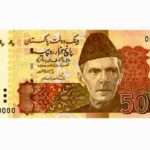
  • Rs5000 banknote proposed to withdraw from circulation

    Rs5000 banknote proposed to withdraw from circulation

    KARACHI: A former chairman of Federal Board of Revenue (FBR) has recommended the government to stop the circulation of Rs5000 banknote and phase out in circulation the banknote within one year.

    Syed Shabbar Zaidi, former FBR chairman, submitted his proposals for budget 2021/2022 to Prime Minister Imran Khan.

    “There has to be gradual evaporation of Rs5000 banknote. A time limit be prescribed up to which Rs5000 note will be valid say June 30, 2022 and in the meantime the same can be exchange with bank. This is completely different from Indian Scheme.”

    Shabbar Zaidi served the FBR as chairman during May 10, 2019 to January 06, 2020. Being a FBR chairman from private sector, he had taken major decisions during his stay despite bureaucratic hurdles.

    The suggestion to stop Rs5000 banknote from legal tender has importance because Prime Minister Imran Khan had on many occasion lauded Shabbar Zaidi.

    The proposal for withdrawal of Rs5000 banknote was not new as it had been submitted time to time for stopping corruption and black economy.

    Sources said that the office of the prime minister had forwarded the proposals of Shabbar Zaidi to the finance ministry for further consideration to make part of final proposals for budget 2021/2022.

  • FBR urged to allow CGT exemption to private companies

    FBR urged to allow CGT exemption to private companies

    KARACHI: Tax practitioners have demanded the Federal Board of Revenue (FBR) to allow capital gain tax (CGT) exemption to private companies in order to encourage corporatization in the country.

    The Karachi Tax Bar Association (KTBA) in its proposals for budget 2021/2022, pointed out that as per section 37, gain on sale of shares of private companies shares is taxed at corporate tax rate.

    “This gain is reduced by 25 percent in case the holding period is more than one year,” the tax bar said.

    In case of gain on disposal of immovable property, the gain is exempt in case the holding period is more than 4 years.

    In case of capital gain on securities under section 37A, the gain is exempt on securities acquired before 1 July 2012.

    “Hence, investment in shares of private companies stands at comparative disadvantage,” the KTBA added.

    It is proposed that the gain on sale of private company shares should also be allowed exemption in case if the holding period is 10 years or more.

    The proposal has been submitted in order to encourage and benefit corporatization of business.

    The tax bar also highlighted that as per definition of dividend the distribution made by a company to its shareholders on reduction of capital shall be deemed dividend.

    This situation is generally referred to as buy-back of shares. On the other hand, under Rule 13P of the Income Tax Rules, 2002, the shares buy-back transaction is treated as Capital Gains.

    Thus, there exists a contradiction among the provisions of Ordinance and Rules.

    Contradictory provisions in law that needs to be corrected, the KTBA suggested. It is proposed that following exclusion after clause (f) in subsection (19) of section 2 be inserted:

    “Any payment made by a company on purchase of its own shares from a shareholder in accordance with the provisions of section 88 of the Companies Act, 2017 (XIX of 2017)”.

  • Tax on property income should be made final

    Tax on property income should be made final

    KARACHI: The Federal Board of Revenue (FBR) has been urged to rationalize rental income from property and individuals or Association of Persons (AOPs) should be taxes as full and final discharge of tax liability.

    Karachi Tax Bar Association (KTBA) in its proposals for budget 2021/2022 said that the rental income from property, AOP or individual and company (taxable as separate block of income) should be taxed at a uniform rate of 15 percent of the gross rent as full and final discharge of tax liability.

    The tax bar said that at present for every person except companies the income from property is chargeable to tax at the rate specified in Division (VIA) of Part-I of the First Schedule, which is considered to be their final tax liability and they are not allowed any expenditure against gross rent, except option provided under sub-section (7) of section 15A of the Income Tax Ordinance, 2001.

    The companies are required to pay normal tax (current at 29 percent) on such income after adjustment of admissible expenditure out of gross rent.

    The tax rate on rental income has been gradually increased from 20 percent to 35 percent for individuals and AOPs vide the Finance Act, 2019.

    Apart from that the lessor is also required to pay Sindh Sales Tax at 3 percent to SRB. It makes the total tax impact very unfair and exorbitant.

    The current taxation framework makes the total tax impact on property income very unfair and exorbitant.

    The KTBA further suggested that rental income taxable under normal tax regime should be allowed to be adjusted against business loss. The restriction imposed through Finance Act, 2013 needs to be reconsidered.

    The impact of taxes (direct and indirect) on rental income will be rationalized. Investors will be encouraged to declare their genuine rental income.

  • Date extended for encashment of bearer prize bonds

    Date extended for encashment of bearer prize bonds

    ISLAMABAD: The finance division has extended last date for redemption of bearer prize bonds Rs40,000 and Rs25,000 denominations up to September 30, 2021.

    According to notifications issued by the Finance Division the last date for redemption of Rs40,000 denomination bearer prize bonds has been extended up to September 30, 2021. Similarly, the last date for encashment of Rs25,000 denomination bearer prize bonds has also been extended up to September 30, 2021.