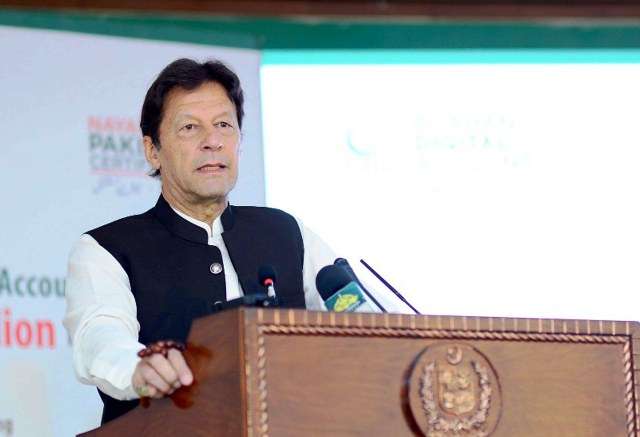
ISLAMABAD: Prime Minister Imran Khan on Monday said that currently inflation is the core issue in Pakistan. The prime minister said that due to recent inflationary trend in international commodity market, inflation is the core issue in Pakistan currently.
“We are working hard to ensure effective monitoring of prices of essential commodities through good governance and better price control mechanism.”
Ensuring a proper control on supply chain, effective price enforcement and a strict check on hoarding are being made more effective for this purpose, he added.
The prime minister directed the authorities concerned to take all necessary measures to provide maximum relief to common man by making the Market Committees at district and tehsil levels more effective.
Earlier the Prime Minister was apprised that a successful pilot project was launched in Rawalpindi/Islamabad by PTIs Good Governance Team which resulted in substantial drop in prices of essential commodities by ensuring strict enforcement of Government notified rates.
The prime minister was also informed that stay orders secured by the ineffective market committees need to be vacated at the earliest to reconstitute robust price monitoring mechanism at district and tehsil levels.
The meeting was attended by Advisor on Finance Shaukat Fayyaz Tarin, Senator Saifullah Niazi and other officers concerned.
ISLAMABAD: The automaton of Utility Stores Corporation (USC) will help the government provide targeted subsidy to beneficiaries under Ehsaas Program.
Federal Minister for Industries and Production Makhdum Khusro Bakhtyar presided over the meeting on the progress of digitalization and automation program of Utility Store Corporation under the Digital Pakistan Initiative.
The meeting was attended by Secretary Industries and Production, MD USC, senior officials of the Ministry and representative of PTCL & NRTC.
MD USC briefed the Chair on digitalization program of corporation: encompassing it’s business process under ERP (enterprise resource planning); including supply chain, warehousing, financials, deployment of POS, human resources, and targeted subsidy which will be consummated by end this month.
He also informed the Minister that USC had completed the automation of utility stores in Islamabad region, shifting 20% of total sales on automation which would be inaugurated in next week.
While reviewing the progress of USC’s digitalization, the Minister highlighted that the government would provide targeted subsidies at the Utility Stores for the Prime Minister Ehsaas program beneficiaries by linking their Ehsaas Cards/national identity cards with the sale points while making these stores a targeted subsidy tool.
The Minister appreciated the team of USC and remarked that this project would be the largest digitalization program of any public sector oriented company.
He informed that upon completion, Prime Minister of Pakistan would inaugurate the automation program of USC, as Digital Pakistan’s vision has been very close to his heart.
The Minister also lauded the ongoing cooperation of PTCL and NRTC to work hand-in-hand with USC to carry out the automation program.
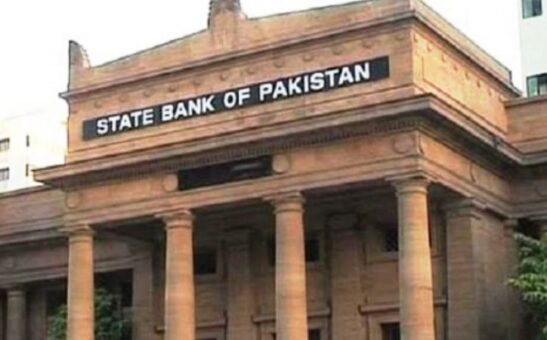
In a statement on Monday, FPCCI President Mian Nasser Hyatt Maggo expressed shock over the interest rate of up to 9 per cent under SBP’ SME Asaan Finance Scheme (SAAF).
The SMEs were appreciative of the announcement of collateral-free SAAF Scheme; but, the interest rate of 9 per cent makes it unaffordable, unproductive and unsupportive for SMEs, he added.
Maggo said that it is a welcome step that SBP has selected eight banks to get financing under SAAF Scheme from SBP; however, it makes no economic and commercial sense to allow these eight banks to charge up to 8 per cent in addition to 1 per cent of SBP’s lending fee to banks.
The FPCCI chief demanded that SAAF scheme should not have a total interest rate over 3 per cent, which will make it at par with TERF to make it affordable for SMEs, i.e. 1 per cent for SBP financing and 2 per cent for banks’ margin.
He said that in the post-pandemic scenario, nowhere in the world SMEs can afford to get capital at 9 per cent and pay it back without getting bankrupted. Maggo also noted, with concern, that SBP itself sets maximum interest rate under TERF Scheme at 3 per cent for larger enterprises and business groups; and, for SMEs, it has taken a discriminatory and unsupportive stance.
Iftikhar Ghani Vohra, Convener of FPCCI’s Central Standing on SMEs, said that based on the feedback from across Pakistan, he can say that SMEs are not happy with the exorbitant interest rate; as 9 per cent will make the SAAF Scheme unaffordable for them.
Vohra added that his committee had a detailed meeting with the SBP officials in the mid-September; and, they categorically conveyed their concerns to the officials. However, FPCCI’s concerns have fallen on deaf ears and no change in interest rate has been announced.
Maggo said that he disagrees with the assertion by SBP that all stakeholders have been taken onboard on SAAF Scheme; as FPPCI’s proposal has not been taken into account. It is pertinent to note that FPCCI is the apex representative body of all the SMEs, chambers & associations of Pakistan and; therefore, the biggest stakeholder in the policies affecting SMEs, he added.
KARACHI: Arif Habib Limited (AHL), Pakistan’s leading Brokerage and Investment Banking Firm, makes history by winning the awards of “Best Brokerage House”, “Best Corporate Finance House”, “Best Economic Research House” and “Best Research Analyst” by CFA Society Pakistan in their 18th Excellence Awards for 2020.
The occasion was graced by Shaukat Tarin, Advisor to the Prime Minister on Finance and Revenue.
These annual awards are considered capital markets’ benchmarks and are based on a confidential poll, surveying respondents comprising the buy-side asset managers and investment professionals from Pakistan’s financial sector including Banks, Asset Management Companies, DFIs and other financial Institutions.
AHL has achieved the distinction of winning all the three House awards, Brokerage/Corporate Finance/Economic Research, in any award ceremony organised by the CFA Society of Pakistan. AHL has received the Best Corporate Finance House award for seven consecutive years.
Tahir Abbas, Head of Research at AHL, was recognized as the Best Research Analyst for the third time.
During the ceremony, Shahid Ali Habib, CEO of Arif Habib Limited said, “We are humbled by the appreciation in CFA Society Pakistan Awards ceremony. We Alhamdulillah have made history by winning all the House awards, which has never happened in previous events. All the credit goes to our hardworking team and our clients who have put confidence in us.”
KARACHI: The Consumer Confidence Index (CCI) has declined sharply to 70.8 points in the third quarter of 2021, compared to 88.0 points in the second quarter of 2021, translating into 19.6 per cent decrease.
Analysts at Arif Habib Limited said that the market continued to remain range-bound today as inflationary concerns heated up among investors after the statement came from Adviser to the Prime Minister on Finance that IMF has asked Government to further hike levy on petroleum products.
Textile sector remained under pressure as Ministry of Energy (Petroleum Division) had already moved a summary to the federal cabinet for ending subsidized gas supply to the industrial sector including captive power plants immediately.
Activity continued to remain side-ways as market witnessed hefty volumes in the 3rd tier stocks. On the flip-side, Institutional activity stayed lackluster. In the last trading hour, profit taking was witnessed across the board mainly led by technology sector.
Sectors contributing to the performance include Technology (-45 points), E&P (-28 points), Banks (-26 points), Pharma (-20 points) and Engineering (-19 points).
Volumes decreased from 469.9 million shares to 364.9 million shares (-22.3 per cent DoD). Average traded value also decreased by 19.8 per cent to reach US$ 75.0 million as against US$ 93.5 million.
Stocks that contributed significantly to the volumes include HUMNL, TELE, FNEL, GGL and WTL.
KARACHI: The Pak Rupee (PKR) fell by 50 paisas against the dollar on Monday owing to higher demand for import payments during the day.
The rupee ended Rs170.51 to the dollar from last Friday’s closing of Rs170.01 in the interbank foreign exchange market. Earlier, in the day the rupee had recovered some value but later the demand deteriorated the rupee value.
Currency experts said that the market witnessed higher dollar demand due to the first day of the week.
The local currency recorded the all-time low of Rs175.27 against the dollar on October 26, 2021. However, following the announcement of the Saudi government to support a financial assistance package to Pakistan the rupee had made a sharp gain.
The experts said that the large imports are major concerns for rupee stability in the coming days. The import bill registered a growth of 65.15 per cent to $25.06 billion during July – October 2021 as compared with $15.17 billion in the same period of the last fiscal year.
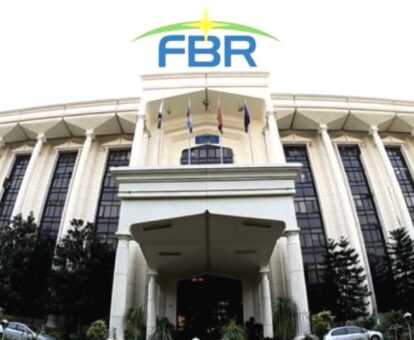
Part III, Sixth Schedule of Income Tax Ordinance, 2001 has explained the procedure for the grant of approval to gratuity funds for treatment of income tax. by Commissioner Inland Revenue (IR).
1. Approval of Gratuity Funds. — (1) The Commissioner may accord approval to any gratuity fund which, in his opinion, complies with the requirements of rule 2 and may, at any time, withdraw such approval if, in his opinion, the circumstances of the fund cease to warrant the continuance of the approval.
(2) An order according approval or withdrawing approval shall take effect from such date as the Commissioner may fix.
(3) The Commissioner shall neither refuse nor withdraw approval to any gratuity fund unless he has given the trustees of that fund a reasonable opportunity of being heard.
2. Conditions for approval. — In order that a gratuity fund may receive and retain approval, it shall satisfy the conditions hereinafter specified and any other conditions which the Board may, by rules, prescribe –
(a) the fund shall be a fund established under an irrevocable trust in connection with trade or undertaking carried on in Pakistan, and not less than ninety per cent of the employees shall be employed in Pakistan;
(b) the fund shall have for its sole purpose the provision of a gratuity to employees in the trade or undertaking on their retirement at or after a specified age or on their becoming incapacitated prior to such retirement, or on termination of their employment after a minimum period of service specified in the regulations of the fund or to the widows, children or dependents of such employees on their death;
(c) the employer in the trade or undertaking shall be a contributor to the fund; and
(d) all benefits granted by the fund shall be payable only in Pakistan.
3. Application for approval. — (1) An application for approval of a gratuity fund shall be made in writing by the trustees of the fund to the Commissioner by whom the employer is assessable and shall be accompanied by copy of the instrument under which the fund is established and by two copies of the rules and, where the fund has been in existence during any year or years prior to the financial year in which the application for approval is made, also two copies of the accounts of the fund relating to such prior year or years (not being more than three years immediately preceding year in which the said application is made) for which such accounts have been made up, but the Commissioner may require such further information to be supplied as he thinks proper.
(2) If any alteration in the rules, constitution, objects or conditions of the fund is made at any time after the date of the application for approval, the trustees of the fund shall forthwith communicate such alteration to the Commissioner mentioned in sub-rule (1), and in default of such communication, any approval given shall, unless the Commissioner otherwise orders, be deemed to have been withdrawn from the date on which the alteration took effect.
4. Gratuity deemed to be salary. —Where any gratuity is paid to an employee during his life-time, the gratuity shall be treated as salary paid to the employee for the purposes of this Ordinance.
5. Liability of trustees on cessation of approval. —If a gratuity fund for any reason ceases to be an approved gratuity fund, the trustees of the fund shall nevertheless remain liable to tax on any gratuity paid to any employee.
6. Contributions by employer, when deemed to be his income. — Where any contributions by an employer (including the interest thereon, if any,) are repaid to the employer, the amount so repaid shall be deemed for the purposes of tax to be the income of the employer of the income year in which they are so repaid.
7. Particulars to be furnished in respect of gratuity funds. — The trustees of an approved gratuity fund and any employer who contributes to an approved gratuity fund shall, when required by notice from the Commissioner, furnish, within such period not being less than twenty-one days from the date of service of the notice as may be specified in the notice, such return, statement, particulars or information, as the Commissioner may require.
8. Provisions of the Part to prevail against regulations of the fund. —Where there is a repugnance between any rule of an approved gratuity fund and any provision of this Part or of the rules made thereunder the said rule shall, to the extent of repugnance, be of no effect and the Commissioner may, at any time, require that such repugnance shall be removed from the rules of the fund.
9. Appeals. — (1) An employer objecting to an order of the Commissioner refusing to accord approval to a gratuity fund or an order withdrawing such approval may appeal, within sixty days of the receipt of such order, to the Board.
(2) The Board may admit an appeal after the expiration of the period specified in sub-rule (1), if it is satisfied that the appellant was prevented by sufficient cause from presenting it within that period.
(3) The appeal shall be in such form and shall be verified in such manner and shall be accompanied by such fee as may be prescribed.
10. Provisions relating to rules. —(1) In addition to any power conferred in this Part, the Board may make rules –
(a) prescribing the statements and other information to be submitted along with an application for approval;
(b) limiting the ordinary annual and other contributions of an employer to the fund;
(c) regulating the investment or deposit of the moneys of an approved gratuity fund;
(d) providing for the assessment by way of penalty of any consideration received by an employee for an assignment of, or the creation of a charge upon, his beneficial interest in an approved gratuity fund;
(e) providing for withdrawal of the approval in the case of a fund which ceases to satisfy the requirements of this Part or the rules made thereunder; and
(f) generally, to carry out the purposes of this Part and to secure such further control over the approval of gratuity funds and the administration of gratuity funds as it may deem requisite.
11. Definitions.—In this Part, unless the context otherwise requires, “contribution”, “employee”, “employer”, “regulations of a fund” and “salary” have in relation to gratuity funds, the meaning assigned to those expressions in rule 14 of Part I in relation to provident funds.
(Disclaimer: The text of above section is only for information. Team PkRevenue.com makes all efforts to provide the correct version of the text. However, the team PkRevenue.com is not responsible for any error or omission.)