
Chief Executive Officer (CEO) of Jazz, Aamir Ibrahim, has emphasized that abolishing the withholding tax on mobile phone services would directly benefit consumers by making telecom services more affordable.
(more…)Author: Mrs. Anjum Shahnawaz
-

Reducing corporate tax to 25 percent recommended
KARACHI: Federal Board of Revenue (FBR) has been urged to gradually reduce the corporate tax rate to 25 percent by tax year 2023.
Overseas Investors Chamber of Commerce and Industry (OICCI) in its tax proposals for budget 2020/2021 recommended consolidation of all federal taxes in one lump sum.
The government previously announced a policy for gradual decrease in corporate tax rate to bring it down to 25 percent by Tax Year 2023. However in the 2019 Finance Act the rate was frozen at 29 percent.
The tax system has become cumbersome and inefficient due to a number of parallel taxes. In addition to direct corporate taxes, companies also pay other levies like the Workers Profit Participation Fund (WPPF) at 5 percent, Workers Welfare Fund (WWF) at 2 percent on their profits, thus the effective tax rate goes up significantly.
If other taxes like the provincial infrastructure taxes in Sindh and Punjab, stamp duty on Purchase Orders and contracts, together with many other local levies are added, overall tax burden goes up to about 40 percent of profits, which is a significant tax burden with consequential increase in cost of doing business.
The OICCI recommended to consolidate all federal taxes – Income Tax, and levies like WWF, WPPF in one lump sum so as to make the system more efficient and business friendly.
Further, continue the previously announced policy to annually revise the tax rate to eventually align with the average Regional Corporate rate of 25 percent by FY 2023.
-

Terminal operators refuse to extend waiver from detention, demurrage charges: KCCI
KARACHI: Karachi Chamber of Commerce and Industry (KCCI) has said terminal operators have refuse to extend waiver from demurrage and detention charges despite clear instruction of the government to facilitate the trade in the wake of COVID-19.
(more…) -
PSX proposes tax relief for exchange traded fund
KARACHI: Pakistan Stock Exchange (PSX) has proposed Exchange Traded Funds, transfer of Portfolio (basket of securities) from Authorized Participant (AP) to ETF’s Account should not be treated as disposal.
In its proposal for budget 2020/2021, the PSX suggested that in order to facilitate the market for Exchange Traded Funds, transfer of Portfolio (basket of securities) from Authorized Participant (AP) to ETF’s Account should not be treated as disposal and therefore holding period of ETF constituents be carried forward to the ETF, upon conversation of Portfolio Deposit to ETF units, for the purpose of CGT calculation.
Tax relief for ETF instrument will play a significant role in not only the benefit to existing ETFs recently launched but also in the successful launch of further ETFs in Pakistan, as the current structure would trigger capital gains in the creation of ETFs units. Moreover, a rationalization rate of tax on ETF investments, at par with the tax on other asset classes, would attract more investors towards ETFs.
An Exchange Traded Fund (ETF) is a pooled investment vehicle, with shares which can be traded throughout the day on a stock exchange, at a price determined by the market. Similar to a traditional mutual fund, an ETF provides investors a proportionate share in a pool of underlying securities.
ETFs are one the fastest growing category of passive fund investments. Globally ETFs are an integral part of product offerings in the capital markets. It is a product with significant presence in over 47 countries.
Internationally, there are over 8,000 ETFs with aggregate Assets Under Management of about USD 6.5 trillion by the end of 2019 and estimated to grow to around USD 7.6 trillion by the end of 2020.
ETFs typically track an underlying index; they can also be based on sectors and strategies. They hold immense potential for investors to gain exposure to various market themes, without paying excessive management fees for getting a diversified exposure or developing a portfolio.
PSX proudly announced on March 24, 2020, the successful listing and commencement of trading in Pakistan’s first ever Exchange Traded Funds (ETF).
Two ETFs, namely NIT Pakistan Gateway ETF and UBL Pakistan Enterprise ETF, were launched on March 24, 2020 by the National Investment Trust Limited and UBL Fund Managers Limited, respectively.
Given the current circumstances and in the interest of safety, a first of its kind virtual launch was organized by PSX for the landmark launch of the ETFs.
This virtual launch is a step taken to make sure that the message of availability of ETFs in the Pakistani Capital Market goes across to all investors and market participants while ensuring their safety in the wake of the current threat of the potential spread of the Covid-19 virus.
Therefore, as PSX is working actively with all market participants and regulators, the tax structure for ETFs needs to be rationalized to incentive prospective Aps to deal in ETF’s Account (both maintained with Trustee), would trigger Capital Gains Tax (CGT).
Internationally, the growth and attraction of ETFs has been driven by the essential requirement that creation of ETF units by authorized participants are not subject to capital gains.
A fundamental feature of ETFs is that the creation of their units are made in-kind, and not in cash as in the case of a mutual fund, so it does not trigger capital gains tax.
In almost every market where ETFs are traded, regulators have allowed the practice of in-kind transfer portfolio securities. Examples include Saudi Arabia, Canada, UK, and USA.
The following proviso should be inserted after sub- section 3 of section 37A to the Income Tax Ordinance, 2001;
“Transfer of Portfolio (basket of securities) from Authorized Participant (AP) to ETF’s Account should not be treated as disposal and therefore holding period of ETF constituents be carried forward to the ETF, upon conversion of Portfolio Deposit to ETF unit, for the purpose of CGT calculation.”
Appropriate amendment to be made in the Income Tax Rules, 2002.
-
Exports fall by 54 percent in April amid COVID-19 pandemic
ISLAMABAD: Pakistan’s exports have declined by 54 percent in April 2020 owing to ongoing lockdown and cancellation of foreign orders.
According to trade data released by Pakistan Bureau of Statistics (PBS) the exports were at $957 million in April 2020 as compared with $2.09 billion in the same month of the last year.
The massive decline in exports can be attributed to cancellation of foreign orders due to outbreak of coronavirus. Besides, the manufacturing activities were remained halted due to lockdown to prevent the COVID-19 pandemic.
The existing situation also reduced the import bill in the month under review. The imports fell by 34.5 percent to $3.09 billion in April 2020 as compared with $4.714 billion in April 2019.
The exports in first ten months (July – April) 2019/2020 also fell by four percent to $18.41 billion as compared with $19.16 billion in the corresponding period of the last fiscal year.
On the other hand the import bill fell by 16.5 billion to $39.9 billion in the first ten months of current fiscal year as compared with $45.4 billion in the corresponding period of the last fiscal year.
The trade deficit shrank by 25.68 percent to $19.49 billion during July – April 2019/2020 as compared with the deficit of $26.23 billion in the same period of the last fiscal year.
-
Curtailing powers of tax officers in recovery, entering premises suggested
KARACHI: Business community has suggested curtailing powers of tax officers while invoking provisions of sales tax laws.
(more…) -
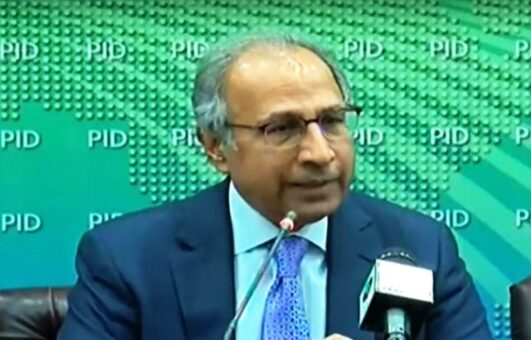
Sales tax rate reduction: Think tank to discuss with FBR
Islamabad – The Federal Government’s think tank convened its third meeting on Sunday to deliberate on fiscal measures, including sales tax, aimed at mitigating the economic challenges arising from the COVID-19-induced slowdown. The discussion, chaired by Advisor to the Prime Minister on Finance and Revenue, Dr. Abdul Hafeez Shaikh, emphasized the critical role of sales tax adjustments in spurring consumer spending and economic recovery.
(more…) -

Sindh allows property registrations; issues SOPs
KARACHI: The Sindh government has allowed registration of properties from Monday May 04, 2020 with certain restriction to ensure compliance of lockdown to prevent spread of coronavirus.
The provincial government has permitted Board of Revenue (BOR) to allow functioning / opening of the offices of sub-registrars in Karachi Division with effect from May 04, 2020 with the condition of strict observance of Standard Operating Procedures (SOPs).
The Sindh government issued following SOPs for functioning of sub-registrar offices:
01. The offices of sub-registrars shall start functioning from 10:00 am daily on all working days and close at 4:00 pm during Ramazan ul Mubarak and on the notified office timings of the government of Sindh in the subsequent months;
02. Each aspirant for registration of document shall contact the concerned sub-registrar through one of the messaging services (SMS/Whatsapp) to get an appointment of a fixed time reserved for execution of his/her documents;
03. Each party shall get a fixed time of 20 minutes, and the party concerned shall be obligated to reach within the office premises at least five minutes earlier, and get their presence acknowledged by the concerned officials/ peshkar;
04. No person shall be allowed to enter the office without demonstrable message of appointment;
05. Only actual executants and identifiers shall be permitted to enter the office who all shall make sure that they present themselves in the office at the fixed time;
06. If any one of the mandatory signatories is missing, the documents shall not be received, and a new time shall be given;
07. The executants shall bring along their hand sanitizers; sanitize their hands before and after execution/registration of the document; wear a recommended face mask; maintain social distancing among themselves and with the staff;
08. No executants/identifier shall be allowed entry in the office premises unless he/she has adopted the above protective measures;
09. The executants and identifiers shall stand in a queue at their designated spot marked by the sub-registrars at three feet distance for each person;
10. The entire job shall be completed within 20 minutes where after the parties shall leave the office, and the next party shall be called in;
11. For the party in waiting, there shall as well be markings at three feet distance for each individual in the corridor or other appropriate place to be identified by the sub-registrar concerned. Such notices shall be displayed at conspicuous places for public information;
12. No hand shake or other means of body touch shall be permissible;
13. It shall be lawful for the sub-registrar to defer registration by putting a specific note about violation of these SOPs and / or other relevant SOPs notified by the Home Department Government of Sindh by any one or more persons from amongst the executing parties;
14. Minimum nuclear staff shall be called for duty;
15. The sub-registrar shall be duty bound to follow and implement the SOPs.
16. The sub-registrar shall keep his office, record etc. disinfected continually;
17. The entire staff shall put on face mask and hand gloves of appropriate specifications;
18. The district registrar shall constitute monitoring team, and shall himself carry out surprise visits to the office of sub-registrars to check whether the SOPs are being followed in letter and spirit;
19. A daily log of inspections along with a brief account of the observations shall be submitted to the inspector general of registration Sindh and Member RS&EP Board of Revenue Sindh;
20. The concerned deputy commissioner/assistant commissioner shall carry out surprise inspection of the offices of sub-registrars to monitor implementation of the SOPs and upon finding any violation, the deputy commissioner shall immediately generate a report for senior member board of revenue for criminal/departmental action;
21. No private person shall be allowed entry in the scanning or audit office;
22. All the relevant SOPs notified by the Home Department shall be additionally followed in letter and spirit; and
23. The sub-registrar shall cause these SOPs to be conspicuously displayed in and outside his office.
-
Withholding tax rate should be increased for immovable property purchase by non-filer
KARACHI: The withholding tax rate should be enhanced to 10 percent for non-filer purchaser of immovable property in the budget 2020/2021.
Pakistan Business Council (PBC) in its budget proposals 2020/2021 recommended to increase the rate of withholding tax for unregistered and non-filers of income tax returns.
The PBC recommended that advance income tax is collected on sales of immovable property under section 236C, which is 1 percent for both filers and non-filers, should be increased for non-filers to 10 percent for properties of 900 square yards or more.
The PBC said that the concept of separate withholding tax rates for filers & non-filers was introduced as a measure for increasing documentation of the economy.
Though large amounts are being collected from non-filers, no effort has been made to increase the tax base.
The non-filers for the most part have built the cost of this government levy into pricing and passed it on to their customers.
In order to broaden the tax base and to achieve increase in overall tax collection without burdening existing tax payers, the policy to increase tax on non-filers / unregistered persons should be implemented specifically in the following cases:
a) unregistered industrial / commercial entities (not having STRN) having bill amount in excess of Rs. 20,000 per month, extra sales tax should be increased from 5 percent to 20 percent.
b) After collection of extra tax as referred above for a continuous period of 6 months, all these connections should be provisionally converted into NTN and STRNs and return filings from these connections should be enforced.
c) In case of provisional registration as above, utility companies be directed to issue show cause notices where annual billing amount exceeds Rs.2.4 million and directing provisionally registered persons to obtain permanent registration. In case of non-compliance, utility companies be directed to disconnect utility connections.
d) Moreover, in order to bring all commercial / industrial users in the tax net and to verify filer status, Electric distribution companies should provide one year to all such consumers to get their NTN registered with electricity distribution companies. In case of failure to provide NTN, electricity connection should be disconnected. Considering the fact that all industrial / commercial connections will be linked with NTN, the tax department will then be in a better position to assess the electricity consumed by commercial / industrial users and corroborate the same with amount of sales / production etc. reported in sales tax / income tax return
e) in order to bring all commercial / industrial users in the tax net and to verify filer status, electric distribution companies should provide one year to all such consumers to get their NTN registered with them. Thereafter, such commercial/industrial consumers without NTN should be charged advance income tax @ 30 percent (from existing 12 percent) on their utility bills. Those with NTN but non-filer status be charged at 20 percent WHT.
f) Residential consumers be made liable to provide NTN in case electricity bill amount exceeds Rs.1.2 million per year or levy advance income tax withholding of 20 percent.
g) All exemptions (like exemption on agricultural income) under the Income Tax Law should only be made available to filers so that exempt income is also reported and wealth is reconciled.
h) Withholding tax on International business class tickets under section 236L is same Rs. 16,000 for filer and non-filer, it should be increased to Rs. 50,000 for non-filers.
i) Withholding tax @ 5 percent or Rs. 20,000, whichever is higher, is applicable under section 236D on all functions organized by filers as well as nonfilers. Rate of withholding be increased for non-filers to Rs. 100,000 as minimum and no WHT from filer.
j) Function halls withholding tax on electric bills should be 30 percent which can be adjusted against tax liability by providing proof of tax deducted from their customers.
k) Withholding income tax on interest income u/s 151 is 15 percent for filer and 30 percent for non-filer. Rate should be increased to 50 percent for non-filers in case interest income is more than Rs.2,000,000/-
l) Annual private motor vehicle tax u/s 234 for non-filers is Rs. 9,000 for 1600cc-1999cc and Rs. 20,000 for 2000 cc and above. Rate for non-filers should be increased to Rs. 50,000 for 1600cc-1999cc and Rs. 200,000 for 2000 cc and above
m) Advance income tax is collected on sales of immovable property under section 236C, which is 1 percent for both filers and non-filers, should be increased for non-filers to 10 percent for properties of 900 square yards or more
n) Holding of land by non-filers should be made more expensive by asking those authorities collecting property tax (cantonment boards / societies/ registrar) to collect adjustable advance income tax, from non-Filers, on behalf of the Federal Government as follows:
o) Rs. 500,000 per year for 800 yards or more but less than 1800 yards
p) Rs. 1 million per year for 1800 yards and above.
-

Massive under-invoicing by commercial importers destroying domestic industry: PBC
KARACHI: Pakistan Business Council (PBC) has said that massive under-invoicing especially by commercial Importers is destroying domestic industry.
In its budget proposals for fiscal year 2020/2021, the PBC said that across the board massive under invoicing and dumping of imported products has been increasing.
Information regarding values at which various custom check posts clear import consignments is not publicly available.
“This encourages unscrupulous importers to under-declare the value of consignments to evade government revenues.”
There are massive leakages in the Afghan Transit Trade (ATT) and smuggled goods are being openly sold in all major shopping centers of the country.
“Customs however is not willing to act against smuggled products citing lack of cooperation from local authorities.”
In order to resolve the problems, the PBC proposed following:
a) Values at which import shipments are cleared through PRAL or CARE need to be publicly available.
b) The Government of Pakistan must insist of Electronic Data Interchange (EDI), for both FTA and non-FTA imports from China. In future the requirement of EDI should be made compulsory for imports from FTA / PTA partner countries.
c) Depending on industry, the Import Trade Price (ITP) be fixed e.g. on the basis of country of origin, weight, volume etc. after discussion with stakeholders. ITP’s may be fixed for most items prone to mis-declaration such as consumer goods and margins of commercial importers be monitored to assess the value of subsequent supply of imported goods. A certificate to this effect should be issued by auditors of commercial importers.
d) For items, prone to under invoicing and mis-declaration, FBR should designate one or two ports (including the dry ports) for clearing of import consignments. This will allow better monitoring of the import consignments where chances of mis-declaration are on a higher side.
e) Additionally, the old Customs General Order 25 needs to be revived with a provision that local manufacturers be given the option to buy at a 15 percent premium, any consignment which appears undervalued.
f) Taxes and duties deposited by local manufacturers and commercial importers should be published.
g) The rate of tax collected from commercial importers be increased by at least by 2 percent. Presently, tax collected from commercial importers is treated as an advance tax. Final Tax.
h) In order to allow commercial importers to claim adjustment of taxes deducted at import stage, commercial importers should be asked to present certificate from auditors that at least 70 percent of imported items have been exported or sold to registered manufacturers. This will also help increase the overall tax base.
i) Monthly sales declared by commercial importers should be matched with sales declared in annual income tax return as well as the credit entries in all business bank accounts. In case of any discrepancy, a reconciliation with justifiable reasons should be submitted by the commercial importers
j) Online CREST system must be amended in a way to trace sales along with value addition thereon of person to whom supplies were made by Commercial importers.
Transparency in collection of taxes will discourage mis-declaration, measures to discourage evasion of taxes and duties will help industry to fairly compete with unscrupulous imports and also Government stands to benefit from the increased indirect taxes revenues.
It will also help in accountability of the customs staff and will reduce the incidence of Customs Duty & Sales Tax evasion and increase government revenues.
The proposed change will help in boosting the manufacturing base of Pakistan, the PBC added.