KARACHI: The filing of wealth statement has been made mandatory for persons filing annual income tax return for tax year 2019.
(more…)Author: Mrs. Anjum Shahnawaz
-

Weekly Review: stock market to keep positive momentum
The stock market is poised to sustain its positive trajectory in the coming week, supported by an improving macroeconomic environment.
(more…) -

FBR notifies adjudication benches for Benami cases
The Federal Board of Revenue (FBR) has taken a decisive step in addressing Benami cases by establishing dedicated adjudication benches in three major cities across the country.
(more…) -

Customs officers authorized business access for audit
KARACHI: Customs officers have been authorized under customs laws to enter business premises to access records necessary for the purpose of audit.
Federal Board of Revenue (FBR) issued Customs Act, 1969 updated up to June 30, 2019 incorporating amendments introduced through Finance Act, 2019.
The Section 26B of the Act authorizes customs officers to access record for the purpose of audit.
Section 26B: Access for the purposes of audit.-
Sub-Section (1): The appropriate officer of Customs, after giving a notice in writing specifying the date of visit, shall have access to business or manufacturing premises, registered office or any other place where any goods, stocks, documents or records relating to the ongoing audit are kept or maintained. Such officer may inspect the goods, stocks, documents, records, data, correspondence, accounts, statements, utility bills, bank statements, information regarding nature and sources of funds or assets with which his business is financed, and any other records or documents required under any Federal or Provincial laws, maintained in any form or mode. Such an officer may take into his custody such documents, records or any part thereof, in such form as he may deem fit, against a signed receipt.
Sub-Section (2): In all cases, except where it would defeat the purpose of the audit, a reasonable advance notice regarding a visit shall be given to the person concerned.
Sub-Section (3): Whosoever causes any obstruction or fails to provide any documents, record, statement etc, as required under subsection (1), with an intention to defeat the purpose of the Act by way of destroying, altering or concealing any books, documents or records required to be maintained under this Act, shall be guilty of an offence under this section.
Related Stories
Determination of values for imports and exports under Customs Act
-

KTBA highlights glitches, lacunas in income tax return forms
KARACHI: Karachi Tax Bar Association (KTBA) on Friday pointed out glitches and lacunas in income tax return forms which resulted in difficulties in filing tax returns for tax year 2019
The tax bar wrote a letter to the chairman of Federal Board of Revenue (FBR) regarding its previous communication on August 27, 2019 about the draft income tax return forms for for individuals and AOPs for the tax year 2019 were issued on August 23rd, 2019 through SRO 951 of 2019.
Through our above letter we communicated our serious concern as to the shortage of time period allowed in terms of number of days, for going through the entire SRO which contained 56 pages of returns of income and their annexures, which were only seven days and that too were issued in the evening of Friday followed by Saturday and Sunday, the next days.
The shortage of time was coupled with the fundamental drawback, which was also duly highlighted in our above referred correspondence that the return forms were neither issued in offline/demo mode, with the formulas, nor in the Excel format, at the least, so as to enable the user to have any clue as to what changes have actually been made.
“This, you [FBR chairman] would appreciate can only be done by feeding the data in the forms so as to evaluate whether the form is correctly performing the computation/ working out the income and the tax liability.”
It is an admitted norm that where suggestions are genuinely intended to be solicited, these are facilitated not only in terms of ample time but in the right desired format as well, which the Bar and its members have been deprived of completely this year.
The forms were not rolled out either in Excel form or on the IRIS till the last day.
Despite our genuine request what came out as a startling fact that the Draft Returns were finalized on the eve of September 02, 2019 through SRO 979 of 2019, without any modicum of change, let alone any suggestion.
Up till now since the issuance of the forms, more than seventeen (17) days have been passed on and it is now not a much unknown fact that return forms are filled with glitches and lacunas, which are factually deterring any bona fide filing of a tax return by an individual, whether Salaried or Business; resident or a non-resident.
Needless to mention that Individuals constitute the largest class of tax filers out of 2.5 million club of taxpayers.
Few of these flaws are being narrated hereunder for your necessary attention as filing of tax returns has been seriously jeopardized by these anomalies:
i. Statement of Final Taxation for Individuals, Salaried Individuals and AOPs is not accompanied with Wealth Statement, which is a separate requirement under Section 116 of the Income Tax Ordinance, 2001;
ii. Non-residents are not required to file Wealth Statement. On the other hand, the IRIS is invalidating their filing at the portal without a Wealth Statement;
iii. The IRIS is also asking for details of Personal Expenses in cases of Non-resident, without which the return cannot be submitted.
iv. Tax Return of a Salaried Individual contains only Reconciliation of Wealth without any details of assets/ Wealth Statement which is not in accordance with Section 116 of the Ordinance;
v. In the Wealth Reconciliation which is accompanied with the Tax return, the detail from the last year Amnesty is being included in the inflows of the total. All those who filed Asset Declaration last year are now unable to file return as of now.
vi. Person who is required to file statement under Section 115(4) of the Ordinance has no option left to file Wealth Statement as no separate tab is appearing in IRIS module.
vii. There is a single field/ column for foreign income only contrary to the requirements of section 103(8) read with section104 of the Ordinance that provides computation of foreign income/ loss and adjustment and carry forward of losses;
viii. There is no option to declare foreign income with their respective heads of income and instead only figure sums it all which does not give the fair picture of the foreign income;
ix. Tax on income from Bahbood Certificates/ Pensioners Benefit account is not being properly worked out.
x. There is no provision for adjustment or claim of capital loss in return form after NCCPL issues the annual certificate
Besides the above lacunas, what needs emphasis here is that legal and permissible time period for filing a return is 90 days under section 118 of the Ordinance, while on the contrary, only 27 days have been given here between September 2nd and September 30, 2019.
The tax bar said that the obnoxious condition imposed on them September 5, 2019 vide C.No.2(I)Cond./I.Tax/2018 dated September 05, 2019 whereby the instruction was given to the Commissioners to ensure the payment of due tax before allowing any extension.
“It means the taxpayer has to pay for the income tax first if one has to apply for extension, beyond the dead line of September 30th, 2019 which he should not be needed to beg for in the first place. It is not only a disgrace to a bonafide taxpayer to succumb to an unwarranted condition of tax payment but also tantamounts to make him suffer through the encroachment in his legal space under the Ordinance, which allows him necessary time period to file his return of income with respect and without getting his legal right vitiated. It need not to be emphasized that the Commissioner is otherwise independently empowered to grant extension to a taxpayer in terms of section 119(3) of the Ordinance if such a request is made to him without regard to any instructions from the Board.”
At the same time, the bar is cognizant of the fact the FBR’s campaign to increase the number of returns/ compliant taxpayers should not be sabotaged merely on the ground of short time period given firstly to understand the forms and again to file the returns of income.
It is, therefore, all befitting that the due number of days, which are ninety (90) from the issuance date of the final return forms are allowed to the taxpayers and is not compromised on any pretext.
-

FBR taking significant steps to improve tax administration: IMF
ISLAMABAD: International Monetary Fund (IMF) on Friday said that Federal Board of Revenue (FBR) is undertaking significant steps to improve tax administration and its interface with taxpayers.
An International Monetary Fund (IMF) mission, led by Ernesto Ramirez Rigo, visited Islamabad and Karachi during September 16–20, 2019 to take stock of economic developments since the start of the Extended Fund Facility (EFF) and discuss progress in the implementation of economic policies.
A full mission for the first review under the EFF, is planned for late-October. At the conclusion of the staff visit, Ramirez Rigo issued the following statement:
“While the authorities’ economic reform program is still in its early stages, there has been progress in some key areas. The transition to a market-determined exchange rate has started to deliver positive results on the external balance, exchange rate volatility has diminished, monetary policy is helping to control inflation, and the SBP has improved its foreign exchange buffers.
“There has been a significant improvement in tax revenue collections, with taxes showing double-digit growth net of exporters refunds. Moreover, the FBR is undertaking significant steps to improve tax administration and its interface with taxpayers. Staff and the authorities have analyzed the worse than expected fiscal results of FY2018/19, which were partially the result of one-off factors and should not jeopardize the ambitious fiscal targets for FY2019/20. Importantly, the social spending measures in the program have been implemented.
“The near-term macroeconomic outlook is broadly unchanged from the time of the program approval, with growth projected at 2.4 percent in FY2019/20, inflation expected to decline in the coming months, and the current account adjusting more rapidly than anticipated. However, domestic and international risks remain, and structural economic challenges persist. In this context, the authorities need to press ahead with their reform agenda.
“In order to complete the first review, an IMF staff team plans to return to Pakistan in late-October to assess the end-September program targets.”
-
Stock market shed 73 points in range bound activity
KARACHI: The stock exchange declined by 73 points on Friday in a range bound trading activity.
The benchmark KSE-100 index of Pakistan Stock Exchange (PSX) closed at 32,111 points as against 32,184 points showing a decline of 73 points.
Analysts at Arif Habib Limited said that the market remained range bound today, trading above 32,000 level, although moved between +149 points and -129 points during the day.
Volumes again registered healthy growth from 137 million shares yesterday to 153 million shares.
Oil Chain remained under selling pressure with the exception of PSO that showed considerable gain.
Banks, Steel, Cement also downplayed, which brought the index under pressure in the second session. MLCF issued financial results today that saw 85 percent right issuance besides nominal dividend of 5 percent.
By the end of session, MLCF hit lower circuit and closed at that level. Cement sector led the volumes with 26.3 million shares followed by Technology (16 million) and Chemical (13.4 million).
Scrip wise activity reflects MLCF registering 18 million shares, followed by TRG (6.9 million) and PIBTL (6.6 million).
Sectors contributing to the performance include Cement (-49 points), Banks (-25 points), Technology (-11 points), Investment Banks (+29 points), O&GMCs (+15 points).
Volumes increased further increased from 137 million shares to 153 million shares (+12 percent DoD). Average traded value on the contrary witnessed slight decline of 1.3 percent DoD to reach US$ 37.2 million as against US$ 37.7 million.
Stocks that contributed significantly to the volumes include MLCF, TRG, PIBTL, LOTCHEM and UNITY, which formed 29 percent of total volumes.
Stocks that contributed positively include DAWH (+30 points), PPL (+20 points), PSO (+14 points), BAFL (+12 points) and EPCL (+7 points). Stocks that contributed negatively include OGDC (-22 points), HBL (-19 points), LUCK (-18 points), FCCL (-8 points), and TRG (-8 points).
Related Stories
Stock market ends down by 353 points on easing international oil prices
-

Rupee gains 16 paisas on improved inflows
Karachi, September 20, 2019 – The Pakistani rupee appreciated by 16 paisas against the US dollar on Friday, buoyed by improved inflows of export proceeds and workers’ remittances, according to traders and market analysts.
(more…) -
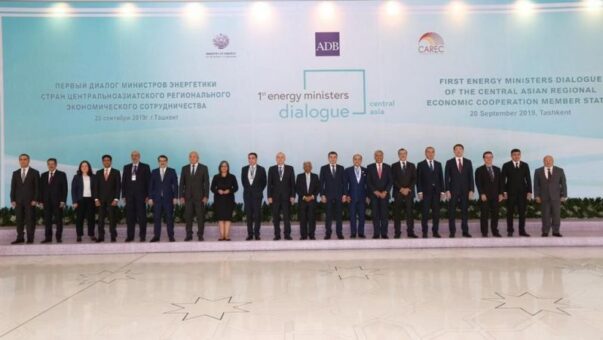
Nine countries sign declaration to enhance cross-border cooperation at CAREC Energy Ministers’ Dialogue
TASHKENT, UZBEKISTAN: Nine countries in Central and West Asia, including Pakistan, on Friday signed a historic declaration that will accelerate cross-border cooperation on energy issues and move the region a step closer to the creation of a regional energy market, said a statement issued by Asian Development Bank (ADB).
Energy ministers and leaders from Afghanistan, Azerbaijan, Georgia, Kazakhstan, the Kyrgyz Republic, Mongolia, Pakistan, Tajikistan, and Uzbekistan signed the 10-point declaration at the end of the Central Asia Regional Economic Cooperation (CAREC) Energy Ministers’ Dialogue held in Tashkent.
The meeting marks the first time energy ministers from Central and West Asia have come together to discuss common regional energy challenges. Uzbekistan’s Minister for Energy, Alisher Sultanov, opened the meeting on behalf of the Prime Minister of Uzbekistan Abdulla Aripov.
The opening address was delivered by Asian Development Bank (ADB) Vice-President for Private Sector Operations and Public–Private Partnerships Mr. Diwakar Gupta. The energy minister from Turkey, Fatih Dönmez, attended the meeting as an observer.
The declaration sets the region on a faster reform path toward more liberal energy markets with greater private sector participation and investment, increased power connections and exchanges between countries, and a strong commitment to tap renewable energy sources and clean technologies.
The group also endorsed a new CAREC Energy Strategy for the next 10 years that will provide the roadmap to reach the region’s goal of a secure energy future.
“This is a historic achievement and an important commitment,” said Gupta. “The energy sector drives economic growth in the region, so this unprecedented gathering of energy leaders is very important. Today, they have strengthened their commitment to work together to deliver an electricity supply for the region that is reliable and affordable, develop modern energy markets, and embrace clean energy as a more efficient, sustainable source of power.”
The meeting of ministers has come at a critical time for the region as its energy sector faces a number of challenges. CAREC countries are rich in natural resources, but uneven distribution of these resources—compounded by inadequate infrastructure and inefficient state-owned energy utilities—means some countries continue to face power shortages. To keep pace with the region’s economic growth and an increasing demand for power, the region will need to double its current power system capacity by 2030. The capacity expansion will require sizable investments, estimated to be about $400 billion in cumulative investments up to 2030.
Regional energy cooperation, modern energy markets, and a significant increase in private investment in the energy sector is an opportunity to overcome these challenges and to create a stable supply of power for domestic use and for export to attractive energy markets in the People’s Republic of China (PRC), Pakistan, and India, along with new strategic transit opportunities for oil and gas through Turkey and Georgia.
Unlocking private sector participation and investments is key to meeting the region’s significant energy infrastructure needs. The declaration committed the region to policy reforms in creating a more conducive business environment for attracting private investments across the region.
“The region cannot achieve the level of investment needed without large private investments,” said ADB Director General for Central and West Asia Werner Liepach. “Private investments demand predictive policies, stable regulations, transparency, and good governance. I am deeply impressed by the CAREC countries’ strong commitments to reforms, which is the only way towards a more reliable, affordable, modern, and sustainable energy future.”
Following the Ministerial Dialogue, officials attended the opening of the 4th CAREC Energy Investment Forum. The 2-day forum aims to unlock and guide private investment in the region’s energy sector and is attended by a mix of energy leaders, policy makers, project developers, technology providers, investors, international financial institutions, members of the diplomatic community, academia, and young entrepreneurs and students.
ADB is the secretariat of the CAREC Program. Since 2001, the CAREC Program has financed 196 regional projects worth $34.5 billion in the areas of transport, energy, and trade in its member countries. Over a third of this amount, or $12.8 billion, has been financed by ADB; $13.8 billion by other development partners such as the World Bank, the Islamic Development Bank, and the European Bank for Reconstruction and Development; and $7.9 billion from CAREC governments. The 11 members of CAREC are Afghanistan, Azerbaijan, the PRC, Georgia, Kazakhstan, the Kyrgyz Republic, Mongolia, Pakistan, Tajikistan, Turkmenistan, and Uzbekistan.
ADB is committed to achieving a prosperous, inclusive, resilient, and sustainable Asia and the Pacific, while sustaining its efforts to eradicate extreme poverty. In 2018, it made commitments of new loans and grants amounting to $21.6 billion. Established in 1966, it is owned by 68 members—49 from the region.
-

PIA’s empty flights cause Rs184 million losses
KARACHI: The Auditor General of Pakistan (AGP) has detected Rs184 million losses due mismanagement by Pakistan International Airlines (PIA) for carrying empty flights.
The AGP in its audit report for PIA Islamabad Office for the year 2016/2016, observed that 46 flights were operated without any passenger, resulting loss of Rs184 million. These flights are other than 36 flights for Hajj and Umrah.
The AGP said that General Manager, Network and Schedule Planning, PG-X(Reporting to Director Marketing) was responsible to supervise and monitor proper designing of long term and short term operating plans; and to focus on network management and evaluation of multiple scenario of schedule changes.
The audit of the view that operation of flight without passenger shows lack of proper planning and control on the part of the management.
“The matter was report to the management in October, 2018 but no reply was received. DAC meeting was not convened despite requests by the audit.”
The AGP recommended to investigate the matter with a view to fix responsibility on the persons at fault.