Author: Mrs. Anjum Shahnawaz

  • KIA launches sportage vehicle in Pakistan

    KIA launches sportage vehicle in Pakistan

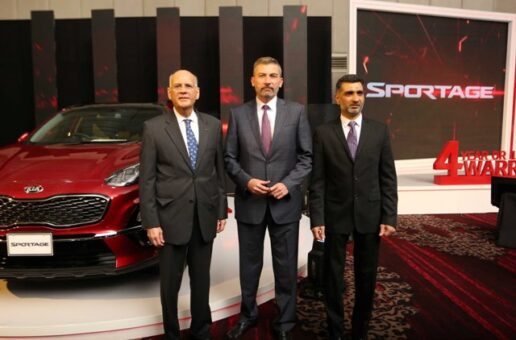
    KARACHI: KIA Lucky Motors on Wednesday launched Pakistan’s first all-wheel 2000 CC SUV. KIA Sportage is Pakistan’s first all-wheel drive car with 100,000 km or 4 years warranty.

    KIA Sportage comes in two models- top of the line being an All-Wheel Drive (AWD) version, which is a first of its kind in Pakistan among locally manufactured vehicles.

    “We promised that we will introduce high-tech specifications and innovation and we have started setting the benchmark for the industry already, said confident looking CEO of Kia Lucky Motors,” Asif Rizvi while addressing the media at a press briefing.

    Asif Rizvi said that KLM has invested $175 million on setting up a new state of the art Auto plant having a capacity of 50,000 units per year.

    KIA has the Power to Surprise and the 4 year or 100,000 KM warranty has come like a pleasant surprise for Pakistani consumers and the response to Sportage booking is a promising sign for KIA.

    “We have received an overwhelming response to the KIA Sportage from our customers,” he said.

    KIA Sportage limited quantity which was introduced at introductory prices, was completely sold out in just 10 days. Apart from being the first All-Wheel Drive locally assembled vehicle, KIA Sportage will have panoramic sunroof and several smarts features that Pakistani consumers will enjoy for the first time in any locally produced vehicle.

    Asif Rizvi informed that currently KLM has 15 dealers across Pakistan and KIA has a 3-year program to expand its dealers’ network in all major cities of the country.

    Asif Rizvi said that earlier, Pakistani consumers had limited choices of brands and models. There were long waiting periods and some consumers even had to pay premium to get their vehicles delivered early, but after the new entrants come in the market, consumers will not have to pay any premium nor will they have to wait months for delivery of vehicles.

    With the introduction of the New Entrants in the local auto sector, customer satisfaction will also improve and we are confident that overall the consumers will benefit, in terms of warranty period and improvement in service quality.

    “We want to increase the Pakistani consumers’ confidence on locally produced vehicles and KIA will make sure that its products and services attract the consumers to buy locally produced KIA vehicles,” Asif added.

    KIA vehicles will have Euro II engines as per the fuel options available in Pakistan. Talking about the tax concession for New Entrants, Asif Rizvi said that the concessions have been given to attract new investment in the Auto sector and thus increase the choices and options of locally produced vehicles for the Pakistani buyers.

    The existing players have a huge localization advantage over the new comers in this sector. He said it would take any New Entrant at least 5 years to achieve similar levels of localization, hence the tax concession given by the Government to ensure level playing field for all auto players.

    Asif Rizvi He said that KIA Lucky Motors has entered into the Pakistani market with a long-term commitment.

    Since inception, KIA has introduced Painting Robots at its plant to give a superior quality paint experience to its customers. KIA has also equipped its plant with full body Coordinate Measuring Machine (CMM) and a very well designed Test Track mirroring Pakistan’s actual road conditions, all to ensure the best quality and ultimate Customer Satisfaction.

    Talking about the global ranking and quality of KIA vehicles, Asif Rizvi informed that for five consecutive years, KIA has been ranked as No 1 mass produced car in the JD Power’s Initial Quality Survey which is based on their own internal inspection processes (JD Power is an American company that ranks vehicles).

  • Stock market plunges by 723 points on weak financial results

    Stock market plunges by 723 points on weak financial results

    KARACHI: The share market plunged by 723 points on Wednesday due to poor financial results of major scrips and confrontation between Pakistan and India on Kashmir issue.

    The benchmark KSE-100 index of Pakistan Stock Exchange (PSX) closed at 30,277 points as against 31,001 points showing a decline of 723 points.

    Analysts at Arif Habib Limited said the index was declined due to host of factors including weak economy, confrontation between Pakistan and India on Kashmir issue and poor results.

    Redemption at mutual funds kept the flow of selling across the board. Apparently better financial results of MCB & UBL unable to help stock prices of both the banks in place and just prior to result announcement UBL touched lower circuit.

    Cement sector led the volumes with 11.9 million shares, followed by banks (8.5 million) and power (7.3 million).

    KEL topped the chart at 4.6 million shares, followed by MLCF (4.4 million) and LOTCHEM (2.8 million).

    Sectors contributing to the performance include Banks (-200 points), E&P (-176 points), Fertilizer (-89 points), Power (-68 points), O&GMCs (-51 points).

    Volumes increased from 54mn shares to 65 million shares (+20 percent DoD). Average traded value increased by 3 percent to reach US$ 17.4 million as against US$ 16.8 million.

    Stocks that contributed significantly to the volumes include KEL, MLCF, LOTCHEM, TRG and HASCOL, which formed 27 percent of total volumes.

    Stocks that contributed positively include DAWH (+9 points), SHFA (+5 points), KTML (+3 points), FFBL (+3 points) and SRVI (+2 points). Stocks that contributed negatively include OGDC (-70 points), UBL (-55 points), HUBC (-51 points), PPL (-51 points) and ENGRO (-45 points).

    Related Posts

    Share market extends losses on negative sentiments

  • Rupee continues to make gain against dollar on eighth consecutive trading day

    Rupee continues to make gain against dollar on eighth consecutive trading day

    KARACHI: The Pak Rupee continued to make gain against dollar for eighth consecutive day on Wednesday owing to improved inflows of home remittances related to Eid-ul-Azha.

    The rupee gained 40 paisas to end Rs158.25 to the dollar from previous day’s closing of Rs158.65 in interbank foreign exchange market.

    Currency dealers said that the rupee was improving as overseas Pakistanis are sending foreign exchange to their relatives for Eid related expenses.

    The foreign currency market was initiated in the range of Rs158.55 and Rs158.65. The market recorded day high of Rs158.55 and low at Rs158.25 and closed at Rs158.25.

    The rupee started recovery against the dollar during the last week and continued so far. The rupee has gained around Rs2.28 to the dollar during the past eight consecutive sessions.

    The exchange rate in open market also witness appreciation in rupee value. The buying and selling of dollar was recorded at Rs157.50/Rs158.50 as compared with last day’s closing of Rs157.70/Rs158.70 in cash ready market.

    Related Posts

    Rupee appreciates for 7th consecutive trading day

  • MCB Bank declares Rs10.67 billion net profit for first half

    MCB Bank declares Rs10.67 billion net profit for first half

    KARACHI: MCB Bank has declared Rs10.67 billion net profit for first half (January – June) 2019 as compared with the profit of Rs9.76 billion in the same half of the last year.

    According to financial results for the period January – June 2019 shared with Pakistan Stock Exchange (PSX) on Wednesday, the bank declared 11 percent growth in net profit for the first half of the current fiscal as compared with the corresponding half of the last year.

    The bank announced earnings per share at Rs9.01 as compared with Rs8.24.

    The profit before tax of the bank also grew to Rs18.24 billion during the period under review as compared with Rs15.99 billion in the same period of the last year.

    Total income of the bank for the period was stood at Rs35.75 billion for the first half ended June 30, 2019. Net mark-up income / interest income of the bank was recorded at Rs27.8 billion. Non-mark-up income of the bank was recorded at Rs7.9 billion.

    The expenses of the bank were recorded at Rs16.75 billion as compared with Rs17.51 billion. The provision for write-offs was at Rs759 million.

  • UBL announces 52 percent increase in net profit in first half

    UBL announces 52 percent increase in net profit in first half

    KARACHI: United Bank Limited (UBL) has recorded 52 percent growth in its net profit for first half ended June 30, 2019.

    According to financial results for the period January – June 2019 shared with Pakistan Stock Exchange (PSX), the bank announced Rs9.54 billion profit after tax for the first half ended June 30, 2019 as compared with Rs6.27 billion in the same half of the last year.

    The bank announced earnings per share at Rs7.8 as compared with Rs5.12.

    The profit before tax of the bank also grew to Rs18 billion during the period under review as compared with Rs10.6 billion in the same period of the last year.

    Total income of the bank for the period was stood at Rs42 billion for the first half ended June 30, 2019. Net mark-up income / interest income of the bank was recorded at Rs29.9 billion. Non-mark-up income of the bank was recorded at Rs12.14 billion.

    The expenses of the bank were recorded at Rs19.568 billion as compared with Rs18.8 billion. The provision for write-offs was at Rs4.49 billion.

    The rise in profitability was mainly no provision for pension liability this year as the bank paid Rs8.4 billion in the first half of the last year.

  • 2019/2020: FBR explains withholding tax on profit on debt

    2019/2020: FBR explains withholding tax on profit on debt

    ISLAMABAD: Federal Board of Revenue (FBR) has explained levy of withholding tax on profit on debt for tax year 2019/2020 applicable from July 01, 2019.

    The FBR said that every person, other than a company, receiving profit on debt from persons mentioned in clause (a) to (d) of sub-section (1) of Section 151 are separately taxed at the rates provided in Division IIIA of Part I of the First Schedule.

    The section 151 explains:

    151. Profit on debt. — (1) Where –

    (a) a person pays yield on an account, deposit or a certificate under the National Savings Scheme or Post Office Savings Account;

    (b) a banking company or financial institution pays any profit on a debt, being an account or deposit maintained with the company or institution;

    (c) the Federal Government, a Provincial Government or a Local Government pays to any person profit on any security other than that referred to in clause (a) issued by such Government or authority; or

    (d) a banking company, a financial institution, a company referred to in sub-clauses (i) and (ii) of clause (b) of sub-section (2) of section 80, or a finance society pays any profit on any bond, certificate, debenture, security or instrument of any kind (other than a loan agreement between a borrower and a banking company or a development finance institution) to any person other than financial institution.

    The FBR said that prior to the Finance Act, 2019, the rates were 10 percent where profit on debt was up to Rs5 million, 15 percent where profit on debt was more than Rs5 million but not more than Rs25 million and 15 percent where profit of debt exceeding Rs25 million.

    Through Finance Act, 2019, the rates of imposition of tax under Section 7B mentioned in Division IIIA, Part I of the First Schedule have been enhanced as:

    01. Where profit on debt does not exceed Rs5 million, the tax rate shall be 15 percent;

    02. Where profit on debt exceeds Rs5 million but does not exceed Rs25 million, the tax rate shall be 17.5 percent; and

    03. Where profit on debt exceeds Rs25 million but does not exceed Rs36 million, the tax rate shall be 20 percent.

    The FBR said that where the profit on debt exceeds Rs36 million in a tax year, section 7B will not be applicable and the profit on debt will not be separately taxed for persons other than companies.

    In such cases, profit on debt will be chargeable to tax under the head ‘income from other sources’ under section 39 and tax shall be imposed at the rates specified in paragraph (1) or (2), as the case may be, of Division I, Part I of the First Schedule.

  • Customs agents express concerns over delay in grounding of containers

    Customs agents express concerns over delay in grounding of containers

    KARACHI: The Karachi Customs Agents Association (KCAA) has expressed concerns over the delay in grounding of containers at Karachi International Container Terminal Ltd. (KICTL) and said it may result in choking of the terminal.

    In a letter sent to KICTL management on Tuesday, the KCAA pointed out the issue regarding delay in grounding of containers at the terminal.

    The KCAA has been informed by its members that they are facing unnecessary delays in clearance of their consignments within time from KICTL due to delay in grounding of containers marked for the examination.

    It has been observed that since last two to three weeks backlog of the containers is increasing day by day and still there is a backlog of 8 to 10 days.

    If the situation remains unresolved, there is no doubt that the terminal will be choked, due to this reason the trade will be affected very badly and will also bear heavy financial losses in shape of container detention and port demurrage charges, consequently the cost of doing business will increase.

    Furthermore, in view of the forthcoming Eid-ul-Azha holidays the impact of container backlog will increase significantly.

    It is pertinent to mention here that shortage of cargo handling equipments / machinery at KICTL is observed. While any new vessel is berthed all equipments / machinery are shifted towards for unloading of cargo from that vessel, thus the containers grounding process is delayed.

    The KCAA suggested that in order to facilitate the trade the grounding of containers should be on first priority and thereafter the process of unloading the cargo from vessel be carried out after completion of grounding work.

    Further, it is also observed that while the members are approaching to KICTL for deliveries of their consignments within the free days period but unfortunately, KICT staff informed that the container still remain on vessel so that they are unable to give the delivery, which is one the cause for delay and unnecessary demurrage being accumulated on the goods without fault of our members.

    “In this context, we have come to know through our reliable members that Free Days period is being calculated by the KICTL from the date of vessel berth whereas the free days must be started when the container is unloaded from the vessel,” the KCAA said.

  • Pak-Afghan Chamber hails decision to open Torkham border round the clock

    Pak-Afghan Chamber hails decision to open Torkham border round the clock

    KARACHI: The announcement of keeping the Torkham border open for 24/7 was highly well-received by the business communities across the border and is surely a step in the right direction, however, it is critical to ensure that upgraded infrastructure and well-equipped & competent staff is in place to tackle the challenges.

    Zubair Motiwala, Chairman, Pakistan-Afghanistan Joint Chamber of Commerce and Industry (PAJCCI) Chairman, appreciated the initiative of Prime Minister with an aim to increase bilateral trade ties between the two countries, but he also iterated that this single step needs to be intertwined with other confidence building measures that should reduce the trust deficit across the border.

    The Border management system, including quick processing at the border, scanning facility in place, appropriate number of manpower with the desired skill set should also be ensured. The congestion and infrastructure challenges at port leading to delays which is further aggravated by dilapidated road conditions also reduces the speed of consignments reaching the border, which needs to be looked into to reap the benefits from this endeavor.

    During a meeting with customs officials, it was highlighted that Torkham border has one gate which is used for the movement of all types of cargo, including Transit, Trade (Import / Export) and Empty Containers that limits the efficacy of border facilitation, this not only increases the time of processing but also creates a backlog.

    The electricity and internet disconnects also cause significant issues as it hampers the operation of WeBoC system, leading to the piling of documents that needs pre-processing for clearance of the consignments. The most critical issue highlighted was limited manpower on the border, which in normal working conditions is also not sufficient.

    Motiwala commented that it is heartening to see that these matters were taken under perspective by the Government and as highlighted during the visit of Chief Minister Mahmood Khan, the arrangement at border for ensuring round the clock functionality were deemed satisfactory. PAJCCI Chairman believed that if these issues are curbed then this investment at the border will surely support enhancement in trade and facilitation of transit.

    He also iterates the need to ensure the same across the border so that the benefits can be achieved mutually through an efficient border system on both the sides.

    Co-Chairman PAJCCI, Khan Jan Alokozai also welcomed the initiative of Pakistan Government to keep the border operational 24/7 and hope to see it replicated at the Chaman and Ghulam Khan borders as well.

  • Hafeez Shaikh briefs US treasury officials on FATF action plan implementation

    Hafeez Shaikh briefs US treasury officials on FATF action plan implementation

    ISLAMABAD: A US delegation led by Ambassador Alice G. Wells, Acting Assistant Secretary of State for the Bureau of South and Central Asian Affairs, along with the US Treasury officials comprising Scott Rembrandt, Deputy Assistant Secretary, Grant Vickers, David Galbraith and others held a meeting with Abdul Hafeez Shaikh, Adviser to the Prime Minister on Finance & Revenue today at Finance Division, Islamabad.

    A statement on Tuesday said that the adviser briefed the visiting delegation on measures pertaining to economic reforms being undertaken by the government of Pakistan to ensure economic discipline, efforts being made towards implementation of FATF Action Plan and the key challenges being faced.

    He emphasized the importance of bilateral engagement with the US and the need to encourage entrepreneurs from private sector of both the countries which will lead to enhanced trade.

    The Adviser informed that over the past three months, the Government has taken significant steps to bring financial discipline that include reduction in Current Account deficit, focus on increasing revenue generation, measures to reduce fiscal expenditures, reduce fiscal borrowings, efforts to enhance foreign exchange reserves through bilateral and multilateral support, arrangement of petroleum credit facility with KSA and IDB and IMF Program.

    Further, as part of its institutional development initiative, SBP and FBR are being resourced and empowered. At the same time to support economic growth and facilitate the people below the poverty line, various Programs to support our export oriented industries and health insurance schemes have been introduced for the poor.

    Regarding, implementation of FATF Action Plan, the Adviser briefed that the government is putting in all-out efforts to complete the Action Plan, involving all relevant authorities at the federal and provincial levels, supported by capacity building through international partners.

    The Adviser expressed Government of Pakistan’s commitment to enhance the effectiveness of its AML/CFT Framework being undertaken by the government of Pakistan, with the objective to ensure that all the actions that are being taken to curb Terror Financing are irreversible and sustainable.

    The Adviser urged for continued support of the international community for strengthening of the AML/CFT Framework over a longer period of time. Ms. Alice G. Wells appreciated the briefings and expressed that the US would continue to remain engaged with Pakistan in its economic reforms efforts and help build an environment that facilitates business development between the two countries.

  • Share market extends losses on negative sentiments

    Share market extends losses on negative sentiments

    KARACHI: The share market extended losses on Tuesday owing to investors sentiments grappled by prospects of global slowdown amidst SINO-US trade war and Kashmir issues between Indo-Pak.

    The benchmark KSE-100 index of Pakistan Stock Exchange (PSX) closed at 31,001 points as against 31,181 points showing a decline of 180 points.

    Analysts at Arif Habib Limited said that the market initially went down by 147 points and reverted the loss by around +300 points to post gain of 149 points.

    Carrying the trend from yesterday, HUBC kept falling that reflected the pressure on Index amongst other scrips such as HBL, UBL, PSO, MCB, NBP.

    Volumes remained low at 54 million shares. Cement sector led the volumes table with 7.7 million shares, followed by Power (5.9 million) and Technology (4.7 million).

    MLCF ranked first amongst volume leaders with 4.8 million shares, followed by KEL (3.1 million) and HUBC (2.4 million).

    Sectors contributing to the performance include Banks (-94 points), Power (-37 points), Chemical (-18 points), O&GMCs (-17 points), Autos (-12 points) and Fertilizer (+26 points).

    Volumes increased slightly from 52 million shares to 54.3 million shares. Average traded value on the contrary jumped by 49 percent to reach US$ 16.8 million as against US$ 11.2 million.

    Stocks that contributed significantly to the volumes include MLCF, KEL, HUBC, TRG and FFC, which formed 27 percent of total volumes.

    Stocks that contributed positively include FFC (+19 points), POL (+11 points), DAWH (+10 points), HBL (+6 points) and GHGL (+5 points).

    Stocks that contributed negatively include UBL (-38 points), MCB (-37 points), HUBC (-26 points), COLG (-12 points) and THALL (-10 points).

    Related Posts

    Share market plunges 1.53 percent on border tension