Author: Mrs. Anjum Shahnawaz

  • Chartered Accountants declare documenting agriculture income must for tax reforms

    Chartered Accountants declare documenting agriculture income must for tax reforms

    KARACHI: The Institute of Chartered Accountants of Pakistan (ICAP) has said that documentation of agriculture income is must for bringing tax reforms in the country.

    In its budget proposals for year 2019/2020 the ICAP said that there was a serious need of brining taxation of agriculture income under a more transparent and documented manner.

    “Capacity building of Provincial Authorities, in this regard, is required to be undertaken by the federal government,” it said.

    Though taxation of agricultural income may remain with the provinces under the Constitution but there is no bar on federal government in documenting agricultural income, so that the agricultural assets and income earned there from are identified and not used for under reporting and mis-declaration, it added.

    Following are the other proposals of the ICAP for tax reforms:

    Effective Utilization of Available Database

    The basic source for broadening of the existing Tax Base is financial transactions carried out by the persons who avoid filing tax returns.

    All major financial transactions require CNIC number and the FBR should remain in touch with these authorities/offices to collect information.

    The ICAP believes a proper mechanism is central to this issue and needs to be introduced in the law to bring the potential unregistered persons, whose information is already available in the shape of NTN/CNIC, through withholding provisions. Further, all the bank accounts (including existing bank accounts) should mandatorily be tagged with tax registration.

    As such, banks should only open accounts of traders and shopkeepers (including sole proprietors and association of persons) having trade license and / or proper tax registration.

    Additionally, commercial connections of gas and electricity provided to non-filer should also be discontinued.

    With the advent of global tightening on the grey/black portion of the economy as well as rising scrutiny on the untaxed offshore assets, we encourage setting up of separate

    Directorate for International Taxation and Special Unit (Automatic Exchange of Information – AEOI) for dealing with cases arising out of exchange of information.

    However, AEOI requires further strengthening of resources and integration with the local database for broadening of the tax base. All these requirements should appropriately be included and made part of the relevant laws.

    Facilitating / Rewarding Tax Payers to create an incentive culture

    In order to encourage and motivate taxpayers, we suggest some mechanism has to be developed to stop all types of unfair treatment with existing taxpayers e.g. explanation of each and every credit entry in the bank statements.

    In this regard, issuance of a Taxpayer Facilitation Card should help with a preferential treatment given to individual taxpayers paying taxes above a particular threshold in a year (say, tax of Rs 1 Million, or above).

    Filers should also, in letter and spirit, be given priority treatment at various infrastructural facilities e.g., at NADRA, excise and taxation when registering motor vehicles, courts of law, airports etc.

    Final Taxation based on Income Parity

    Presently, certain sectors / goods are being taxed under Presumptive / Value Added / Fixed Tax Schemes. It is proposed that all Presumptive / Value Addition / Fixed Tax Schemes be abolished and, all such sectors / goods may be brought under the uniform tax regime to promote the culture of income-based taxation rather than receipt-based taxation.

    Minimum Tax (MT) and Alternative Corporate Tax

    For rationalization of taxes, simplification as well as overall efficiency, we suggest only one type of Minimum Tax Regime should be applicable on the taxpayer.

    At present, additional MT Regimes in the form of ACT and MT on services are also applicable, which is undue and creates distortions.

    Alternatively, ACT should be made applicable on the companies after two years of date of incorporation or start of commercial production, whichever is later.

    In this regard, Small Companies should be exempt from ACT altogether. In case MT paid due to a tax loss for the year, it is proposed that the taxpayer be made entitled to carried-forward, and therefore should be able to adjust it against the tax liability for five succeeding tax years.

    In our view, applicability of 8 percent MT on services also stands unreasonable. There are already a number of exceptions created for this regime, which is resulting in discrimination.

    Simplification of Withholding Tax Regime

    The chartered accountants believe, for simplification purposes, there should be a minimum number of withholding taxes but with few standard rates for all withholding taxes.

    The differentiation should be on the basis of filer and non-filer only. All withholding taxes collected or deducted should be made available for adjustment.

    They suggest to reduce withholding tax provisions for “filers” while raising the rate of withholding taxes for non-filers at the same time.

    This would help “filers” to utilize resources for business purposes.

    Further, exemption certificates be issued for all sorts of withholding taxes to the filers by receiving advance tax on quarterly / monthly basis.

    Reforms in Sales Tax Filings

    In case of any omission or wrong declaration in the return, a registered person is required to obtain approval from the Commissioner Inland Revenue in order to enable him/her to revise his/her return.

    Previously, this option was provided through SRO 278(I)/2010 dated 28 April 2010, but revoked through SRO 487/2011 dated 3 June 2011 due to potential misuse of this facility by declaring nominal increase in tax liability in revised return.

    However, now owing to STRIVE, the manipulation chances are minimal.

    Further, serious reforms are required in respect of following:

    (i) Claim of input tax within six months, beyond which approvals are unnecessarily required;

    (ii) Refund claim under sections 10 and 68 beyond one year requires unnecessary approvals and condonation with no response time prescribed for Tax Officials;

    (iii) Automated system of applications for condonations under section 74 is required; and

    (iv) Automatic restoration of un-adjusted input tax is required if refund cheque is not issued.

    At present, refund claims result in removal of input tax from the system because of which taxpayer is unable to utilize input tax if refund cheque is not issued in time.

    Appellate Forums

    It is felt that the principles of justice are not met at the first level of appeal i.e. Commissioner-Appeals. In this regard, Commissioner-Appeals should be brought under the administrative control of the Federal Ministry of Law and the Appellate Tribunal under the control of the High Court of the respective jurisdiction.

    All decisions of Commissioner-Appeals and Appellate Tribunal should also be reported for transparency and improvement of confidence of the taxpayer in the taxation system of the country.

    It is also suggested that an officer once appointed as Commissioner-Appeal not be subsequently assigned any functions, powers and responsibilities of an office or authority subordinate to the Federal Board of Revenue.

    Relaxation in Levy of Advance Tax on Import of Raw Materials

    In order to minimize cost of production, we suggest, the Industrial undertakings be allowed to import raw material in the first year of production, without payment of any advance tax.

    For subsequent years, they may be allowed exemption against advance tax under Section 148 on import of raw material, as per actual requirement, instead of 125 percent quantity of the previous year.

    The tax scheme should also be rationalized with the taxation of the commercial importers, if opted for normal tax regime.

    Tax on Surplus of Not-for-Profit Organization

    It is recommended to abolish sub-section (1A) and (1B) of section 100C of the ITO, as it is directly causing hindrance to the welfare activities involving capital expenditure to be incurred over a period exceeding one year. This requires due attention.

    Alternatively, the limit of spending in a year on charitable and welfare activities from receipts during that year currently set at minimum 75 percent of such receipts, may be analyzed over a reasonable period (at least three years), to account for expenditures, which are inevitably spread over a period exceeding one year.

    Execution of Contract by a Non-Resident Supplier

    The Finance Act 2018 brought about certain amendments in the Income Tax laws to tax supply of goods by a non-resident in case of overall arrangements for Engineering, Procurement, Construction and Commissioning (EPCC), even if the supply is made outside of Pakistan.

    The said amendments, in our view, as introduced through the Finance Act 2018, are not consistent with the International Tax Laws. Therefore, it is suggested that the competent authority reconsider such amendments in order to align it with the International Tax Laws.

    Adjustable Input Tax

    Presently, Section 8B restricts the claim of input tax up to 90 percent of the output tax and requires mandatory payment of 10 percent.

    It is suggested that Section 8B may either be removed from the statute or, at least, the mandatory payment of 10 percent be reduced to 5 percent.

    The issue of bogus refund is reduced to certain extent after introduction of STRIVE.

    Capacity Building of Revenue Authorities

    Capacity building is immensely important for the tax-collecting institution to assume and effectively execute larger challenge of documenting the economy.

    In this regard, the FBR should also go for hiring of professional staffs (like CAs, ICMAPs, PIPFAs, etc.) both at Commissioner and operational level having sufficient experience e.g. 2-5 years for the relevant position.

    Documenting the Economy & Revamping the Tax Mechanism

    Though not preferred, but a one-time Amnesty Scheme may be considered for bringing the black money into the tax net.

    Sufficient time should be provided so that people properly understand and make maximum use of the scheme. This may give better results after recent introduction of AEOI and follow-up tax proceedings.

    Rationalization of Further Tax and Extra Tax Regime

    Extra tax at the rate of 2 percent is levied and collected by the manufacturers and importers on certain goods designated as specified goods under Chapter XIII of the Sales Tax Special Procedure Rules, 2007 and, are tabulated in Rule 58S. Subsequent supply of specified goods subject to Extra Tax at the rate of 2 percent is exempt from the payment of sales tax, including those as made by retailers as per Rule 58T(5).

    Accordingly, distributors, wholesalers or retailers of such goods cannot issue any tax invoice to their customers. In this regard, it is suggested that suitable amendments are made in the law to specifically exclude items subject to Extra tax from the ambit of Further Tax.

  • FPCCI hails appointing professional for FBR top post

    FPCCI hails appointing professional for FBR top post

    KARACHI: Federation of Pakistan Chambers of Commerce and Industry (FPCCI) on Tuesday praised the government for appointing a professional as chairman of the Federal Board of Revenue (FBR).

    (more…)
  • Reza Baqir appointed as SBP governor

    Reza Baqir appointed as SBP governor

    ISLAMABAD: The federal government on Saturday appointed Dr. Reza Baqir as the governor of State Bank of Pakistan (SBP) for next three years.

    A notification issued by the finance division said that President of Pakistan had appointed Dr. Reza Baqir as governor SBP for a period of three years from the date he assumes office.

    The terms and conditions of his appointment will be notified later with the approval of the President of Pakistan.

    Dr. Reza Baqir is currently service for the International Monetary Fund (IMF) and resident representative for Arab Republic of Egypt.

  • FBR notifies sales tax rates on petroleum products for May 2019

    FBR notifies sales tax rates on petroleum products for May 2019

    ISLAMABAD: Federal Board of Revenue (FBR) on Saturday notified sales tax rates for petroleum products for the month of May 2019.

    The FBR issued SRO 507(I)/2019 on May 04, 2019 to amend the rates issued on April 30 and also amend the SRO 57(I)/2016 dated January 29, 2016.

    Following sales tax rates on petroleum products will be applicable for the month of May 2019:

    Petrol 12 percent ad valorem

    High Speed Diesel oil 17 percent ad valorem

    Kerosene 17 percent ad valorem

    Light Diesel Oil 17 percent ad valorem

    Earlier, the FBR issued SRO 499(I)/2019 issued on April 30, 2019 and reduced temporarily till May 05 at the rates: petrol 2 percent, HSD 13 percent, kerosene 8 percent and light diesel oil 9 percent.

  • Meezan Bank, CDC sign agreement to launch share custody services

    Meezan Bank, CDC sign agreement to launch share custody services

    KARACHI: Meezan Bank – Pakistan’s leading Islamic bank, and Central Depository Company (CDC) signed an agreement to launch shares custody services, a statement said on Friday.

    (more…)
  • Banking timings during Ramazan-ul-Mubarak announced

    Banking timings during Ramazan-ul-Mubarak announced

    KARACHI: State Bank of Pakistan (SBP) on Friday announced banking timings during holy month of Ramazan-ul-Mubarak.

    During the ensuing holy month of Ramazan-ul-Mubarak 1440 AH, the following office hours will be observed in the State Bank of Pakistan, which will also be followed by all banks, development finance institutions and microfinance banks:-

    Monday to Thursday from 10:00am to 4:00pm with prayer break from 2:00pm to 2:15pm whereas on Fridays office hours will be from 9:00am to 2:00pm without any break.

    However, it is further advised to observe the following business (banking) hours for public dealing:-

    Monday to Thursday from 10:00am to 2:00pm without any break whereas on Fridays business (banking) hours for public dealing will be from 9:00am to 1:00pm without any break.

    After the holy month of Ramazan-ul-Mubarak, the above timings will automatically be reverted to pre Ramadan-ul-Mubarak timings, the SBP said.

  • forex reserves deplete by $251 million to $15.743 billion

    forex reserves deplete by $251 million to $15.743 billion

    KARACHI: The total liquid foreign exchange reserves of the country have depleted by $251 million to $15.743 billion by week ended April 26, 2019 as against $15.994 billion in the previous week, State Bank of Pakistan (SBP) said on Thursday.

    The official reserves of the central bank fell by $219 million to $8,805 billion for the week under review as against $9.024 billion by week ended April 19, 2019. The central bank said that the official reserves were declined due to external debt servicing and other official payments.

    The foreign exchange reserves with the commercial banks also declined by $33 million to $6.937 billion for the week ended April 26, 2019 as compared with $6.97 billion a week ago.

  • Meezan Bank posts 49 percent growth in quarterly net profit

    Meezan Bank posts 49 percent growth in quarterly net profit

    KARACHI: Meezan Bank Limited has declared 49 percent increase in profit after tax to Rs2.85 billion for the quarter ended March 31, 2019 as compared with Rs1.19 billion in the same period of the last fiscal year.

    The Earnings per Share (EPS) – on enhanced capital increased to Rs. 2.44 per share, said a statement on Monday.

    The Board of Directors of Meezan Bank Limited in its meeting approved the condensed interim unconsolidated financial statements of the Bank and its consolidated financial statements for the quarter ended March 31, 2019.

    The meeting was presided by Mr. Riyadh S. A. A. Edrees – Chairman of the Board and Faisal A. A. A. Al – Nassar – Vice Chairman of the Board, was also present.

    The Board has approved 10 percent interim cash dividend (Rs 1.00 per share) and 10 percent bonus shares in the meeting. Quarterly cash dividend has been approved for the first time in the history of the Bank and is in keeping with the Board desire to ensure that investors in Meezan Bank are well looked after. The Bank has maintained an unbroken payout record since the Bank’s listing on Stock Exchange in the year 2000.

    The growth in profitability was driven by an increase of 57 percent in net spread primarily due to the Bank’s focus on maintaining a good quality high yield earning assets portfolio.

    Profit paid to depositors also doubled, as a result of increase in deposits and increase in depositors’ profit rates. The fees and commission income of the bank grew by 18 percent driven by an increase in trade business volume handled by the bank.

    Administrative and operating expenses increased by 24 percent primarily due to rising inflation, rupee devaluation and increase in costs associated with new branches – an investment in the future.

    However, the rise in expenses was sufficiently absorbed by the growth in the bank’s income resulting in improvement in the banks income expense ratio. The bank added 16 new branches to its network during the quarter bringing the total number of branches to 676 in 189 cities.

    The Bank is now the 7th largest bank in terms of branch network as well as in terms of deposit base.

    The investments portfolio increased to Rs219 billion from Rs124 billion in December 2018 – a growth of 77 percent. During the quarter, a consortium led by Meezan Bank successfully closed Pakistan’s first-ever energy Sukuk issued by the Power Holding Private Limited, a company wholly owned by the Government of Pakistan (GoP).

    The Sukuk is guaranteed by the GoP and is eligible for SLR for the purposes of the State Bank of Pakistan (SBP). The Bank is the largest investor in this Sukuk with a participation of Rs. 85 billion.

    The Islamic financings and related assets portfolio closed at Rs494 billion with an ADR of 64 percent. The bank maintained its financing exposure in all sectors and continued to actively pursue growth in Small and Medium Enterprise (SME) / Commercial and Consumer segment.

    The NPL ratio and NPL coverage ratio stood at 1.4 percent and 137 percent respectively. The bank remains a well-capitalized institution with Capital Adequacy Ratio of 15.5 percent.

    The VIS Credit Rating Company Limited (formerly JCR-VIS Credit Rating Company Limited), in 2018, assigned the Bank an Entity Rating of ‘AA+’ (Double A Plus) for the Long Term and ‘A1+’ (A-One Plus) for the Short Term with stable outlook.

    The Subordinated Tier II Sukuk and Additional Tier I Sukuk of the Bank has been assigned a credit rating of ‘AA’ (Double A) and ‘AA-’ (Double A Minus) respectively. These ratings represent sound performance indicators of the Bank.

  • Second phase of Pak-China FTA signed; two premiers witness signing ceremony

    Second phase of Pak-China FTA signed; two premiers witness signing ceremony

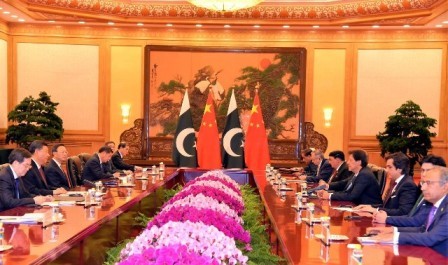
    ISLAMABAD: The second phase of Pakistan China Free Trade Agreement (FTA) signed on Sunday, which was witnessed by the premiers of both the countries.

    Prime Minister Imran Khan and Chinese Premier Li Keqiang witnessed the signing ceremony at a meeting on the conclusion of the 2nd Belt and Road Forum (BRF) in Beijing, a statement said.

    The list of MoUs/Agreements signed/exchanged on the occasion is as follows:

    i. Second Phase of China Pakistan Free Trade Agreement

    ii. Declaration for Completion of Preliminary Design of Phase-I for Up-gradation of ML-1 and Establishment of Havelian Dry Port under CPEC

    iii. MoU on Cooperation in the field of Marine Sciences between the China Geological Survey (CGS), Ministry of Natural Resources of China, the Institute of Oceanography, Ministry of Science and Technology.

    iv. MoU between CIDCA and Ministry of Planning, Development and Reform on Implementation of the Projects under JWG of CPEC on Socio-Economic Development.

    v. China-Pakistan Economic and Technical Cooperation Agreement

    vi. Rashakai SEZ Joint Venture and License Agreement between KPEZMDC and CRBC.

    The two prime ministers were accompanied by ministers and senior officials.

    Both leaders reaffirmed the time-tested and strong friendship between Pakistan and China and exchanged views on the myriad facets of bilateral engagement.

    The prime minister extended felicitations to the Chinese leadership on the successful holding of the 2nd Belt and Road Forum (BRF).

    Noting the depth and breadth of the Belt and Road Initiative (BRI), the Prime Minister said it was of immense significance for the world in terms of connectivity and shared prosperity.

    The two sides exchanged views on bilateral collaboration in the context of CPEC and prospects of further deepening economic linkages.

    Prime Minister Imran Khan underscored the importance of CPEC for Pakistan’s economy and noted with satisfaction its expansion into new areas of development – including industrial development; livelihood projects; social uplift; and agriculture in line with the priorities of government.

    He hoped that Chinese investment in Specialized Economic Zones (SEZs) would expand Pakistan’s industrial base and assist in diversifying its export basket.

    Underlining the steady growth of bilateral cooperation since the Prime Minister’s last visit to China in November 2018, Premier Li Keqiang expressed satisfaction at the positive momentum of CPEC projects.

    He hoped that the conclusion of the Second Phase of China-Pakistan Free Trade Agreement (FTA), would give further boost to trade and economic relations between the two countries.

    The two sides agreed to further deepen the political, security, economic, education, science & technology, cultural, and people-to-people relations.

    It was agreed to maintain the existing momentum of high level exchanges between the two countries.

    The two leaders also exchanged views on regional issues including peace efforts in Afghanistan and peace and stability in South Asia.

    They also agreed to closely coordinate in their endeavors.

  • Sales Tax Act 1990: IR officers authorized to arrest fraudsters

    Sales Tax Act 1990: IR officers authorized to arrest fraudsters

    KARACHI: The sales tax law has authorized officers of Inland Revenue to arrest persons committing fraud or any other offence.

    The Section 37A of the updated Sales Tax Act, 1990 issued by Federal Board of Revenue (FBR) explained the powers of IR officers for making arrests.

    Section 37A: Power to arrest and prosecute

    Sub-Section (1): An officer of Inland Revenue not below the rank of an Assistant Commissioner of Inland Revenue or any other officer of equal rank authorised by the Board in this behalf, who on the basis of material evidence has reason to believe that any person has committed a tax fraud or any offence warranting prosecution under this Act, may cause arrest of such person.

    Sub- Section (2): All arrests made under this Act shall be carried out in accordance with the relevant provisions of the Code of Criminal Procedure, 1898 (Act V of 1898).

    Sub-Section (3): deleted

    Sub-Section (4): Notwithstanding anything contained in sub-section (1) to subsection (3) or any other provision of this Act, where any person has committed a tax fraud or any offence warranting prosecution under this Act, the Commissioner may, either before or after the institution of any proceedings for recovery of tax, compound the offence if such person pays the amount of tax due along with such default surcharge and penalty as is determined under the provisions of this Act.

    Sub-Section (5): Where the person suspected of tax fraud or any offence warranting prosecution under this Act is a company, every director or officer of that company whom the authorized officer has reason to believe is personally responsible for actions of the company contributing the tax fraud or any offence warranting prosecution under this Act shall be liable to arrest; provided that any arrest under this sub-section shall not absolve the company from the liabilities of payment of tax, default surcharge and penalty imposed under this Act.