Category: Money & Banking

Money and banking drive economic activity by facilitating transactions, savings, and investments. Banks manage financial resources, offer credit, and regulate money supply, ensuring stability and growth in Pakistan’s financial sector.

  • Banks observe extended working hours to facilitate taxpayers

    Banks observe extended working hours to facilitate taxpayers

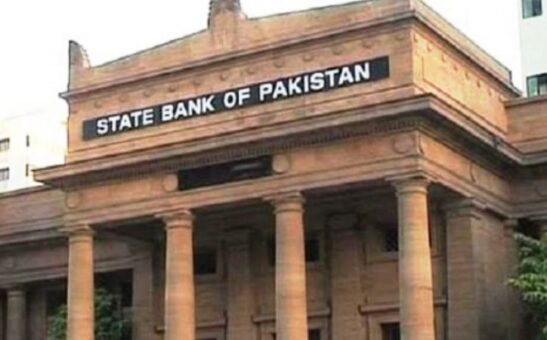
    KARACHI: The State Bank of Pakistan (SBP) has instructed banks across the country to observe extended hours on December 8, 2020, in a move aimed at facilitating taxpayers in making timely payments of duties and taxes.

    (more…)
  • Rupee falls by 19 paisas on import payment demand

    Rupee falls by 19 paisas on import payment demand

    KARACHI: The Pak Rupee fell by 19 paisas against the dollar on Monday owing to higher demand for import and corporate payments.

    The rupee ended Rs160.32 to the dollar from last Friday’s closing of Rs160.13 in the interbank foreign exchange market.

    Currency experts said that the higher dollar demand was due to the market was opened after two days weekly holidays.

    They hoped that they the local currency likely to gain in coming days due to strong economic fundamentals.

  • Key data of banking system: bank accounts top 60 million

    Key data of banking system: bank accounts top 60 million

    KARACHI: Around 60 million bank accounts are in the country having population of 208.31 million, the State Bank of Pakistan (SBP) said in a report.

    The SBP in its report on payment system released this week said that the currency circulation by September 30, 2020 was at Rs6,422 billion.

    According to the central bank the payment system infrastructure as on September 30, 2020:

    Number of Banks (Branches)44(16,121)
    Commercial/ Specialized Banks Branches14,938
    Microfinance (Branches)1,183
    Number of Real Time Online Branches (RTOBs)15,978
    Number of banks having ATM machines35
    Number of banks having open-looped POS machines5
    Number of banks having closed-looped POS machines4
    Number of banks providing Internet Banking services27
    Number of Banks providing Mobile Phone Banking services27
    Number of Banks providing Call Center Banking services23
    Total Number of PRISM System Participants50
    Total number of ATMs Interoperable Switches1
    Total number of Cash & Cheque Deposits Machines (CDMs)184
    Total number of Cash Deposits Machines with Cash Withdrawal facility20
    Multipurpose ATMs (With Cash & Cheque Deposit & Cash Withdrawal)15
  • President praises SBP, banks for progress in financial inclusion of disable persons

    President praises SBP, banks for progress in financial inclusion of disable persons

    KARACHI: The President of Pakistan, Dr. Arif Alvi has appreciated efforts of State Bank of Pakistan (SBP) and performance of banks in improving the accessibility infrastructure at banks for persons with disabilities and lauded their efforts for increasing financial inclusion of persons with disabilities.

    The president shared his view in an online meeting with the SBP governor Dr. Reza Baqir, SAPM on Poverty Alleviation and Social Safety, Dr Sania Nishtar, senior SBP officials and Presidents/CEOs of banks on Friday, according to a statement issued by the SBP. The meeting took stock of the progress on decisions made for improving the accessibility infrastructure for persons with disabilities.

    The president also appreciated the establishment of a Working Group by SBP for taking up the agenda.

    Dr. Alvi said that the unavailability of concrete information on the number of people with disabilities is a major limitation for designing comprehensive plans to improve their quality of life.

    He shared that the government is working with different stakeholders to have a better estimate of the number of people with disabilities that will help their identification and certification.

    He, however, desired that timelines along with a clear vision must be defined clearly for the Working Group.

    He further emphasized that such working groups may also be created at each bank. He stated that creating awareness regarding various facilities for persons with disabilities is highly imperative and social media can play an important role in this regard.

    The president further said that plight of persons with disabilities has become even more critical in the middle of the prevalent COVID 19 crisis that is deepening pre-existing inequalities.

    He appreciated SBP’s specific role in taking a number of measures to address the likely negative economic impacts on individuals, businesses and banking institutions.

    The State Bank’s successful measures have reduced the negative impacts of COVID-19 on economic growth, employment generation and at the same time ensured that the banking and payment systems remain healthy, he said.

    In response to President, Dr. Alvi’s call, Governor SBP, Dr. Baqir, assured that SBP would continue providing its full regulatory support to increase financial inclusion of persons with disabilities.

    The banks’ Presidents/CEOs also pledged their complete cooperation for this objective.

    In his welcome remarks, the SBP governor appreciated the exceptional interest and resolve of the President of Pakistan as a source of inspiration for all the stakeholders.

    He said that if the society does not provide appropriate support to persons with disabilities, it leads to their economic disempowerment depriving them of their independent economic and social lives.

    He remarked that persons with disabilities could economically support themselves and contribute towards the society at large when provided with adequate education, rehabilitation and financial and moral support.

    He emphasized that a sizeable number of persons with disabilities do have the required capacity to work and contribute in the mainstream economic activities and thus successfully support their families.

    He urged the banks to be cognizant of this gap and explore avenues to make inclusion of this untapped segment of the economy a reality.

    SBP presented an update on different action items decided in the last meeting of SBP with the President.

    The action items included accessible infrastructure at entrance of all bank branches and ATM cabins, availability of forms and documents in braille for basic banking services, accessibility audit of bank branches by SBP and allocation of credit targets for SBP refinance schemes on SME and Low Cost Housing Finance.

  • Rupee makes four paisas gain against dollar

    Rupee makes four paisas gain against dollar

    KARACHI: The Pak Rupee made four paisas gain against the dollar on Friday amid demand for import and corporate payments.

    The rupee ended Rs160.13 to the dollar from previous day’s closing of Rs160.17 in the interbank foreign exchange market.

    Currency dealers said that the demand for the foreign currency was higher due to last trading day of the current week.

    They said that however supply of the greenback was sufficient to help the rupee to make gain.

    The currency dealers were optimistic that the local currency would make gain in coming days owing to encouraging economic indicators.

  • E-commerce transactions through debit cards up by 152 percent

    E-commerce transactions through debit cards up by 152 percent

    KARACHI: The online payment through debit cards for e-commerce registered phenomenal growth of 152 percent in first quarter of current fiscal year, according to data released by State Bank of Pakistan (SBP) on Thursday.

    The online payment for e-commerce increased to Rs11.1 billion in the first quarter (July – September) 2020/2021 as compared with Rs4.4 billion in the same quarter of the last fiscal year.

    The volume of transactions also registered around 200 percent during the period under review. According to SBP data the volume of debt card transactions increased to 3.9 million during first quarter of the current fiscal year as compared with 1.3 million in the same quarter of the last fiscal year.

    The total e-commerce transactions registered 81 percent growth during the first quarter of the current fiscal year. The value of e-commerce transactions (payment through debt, credit and pre-paid cards) increased to Rs24.1 billion during the quarter under review as compared with Rs13.5 billion in the same quarter of the last fiscal year.

    The e-commerce transactions through credit card increased to Rs12.9 billion during the first quarter of fiscal year 2020/2021 as compared with Rs9.1 billion in the corresponding quarter of the last fiscal year.

  • Rupee strengthens by 29 paisas on inflows

    Rupee strengthens by 29 paisas on inflows

    KARACHI: The Pak Rupee strengthened by 29 paisas against the dollar on Thursday owing to reports of growth in exports of the country.

    The rupee ended Rs160.17 to the dollar from previous day’s closing of Rs160.46 in the interbank foreign exchange market.

    Currency dealers said that the market witnessed supply of the foreign currency that was more than the demand for import and corporate payments.

    They said that reportedly exports were had maintained over $2 billion value in November 2020.

  • SBP issues guidelines for e-commerce exporters

    SBP issues guidelines for e-commerce exporters

    KARACHI: State Bank of Pakistan (SBP) on Wednesday issued guidelines for e-commerce exporters in order to promote such exports from Pakistan.

    The SBP said that in order to promote Business-to-Consumer (B2C) e-Commerce exports from Pakistan, State Bank of Pakistan has reviewed the aforementioned instructions to align these with the changing business dynamics of e-commerce exports.

    For this purpose, a separate Module to implement e-commerce exports has also been developed in WeBOC in collaboration with Pakistan Customs and other relevant stakeholders.

    Accordingly, a revised regulatory framework has been developed keeping in view the current business needs of e-commerce exports, which would replace the existing Para 39 Chapter 12 of FE Manual.

    The revised framework is given hereunder:

    Business-to-Consumer (B2C) E-Commerce Exports

    (i) Forms Prescribed for Declaring E-Commerce Exports:

    As per Federal Government Notification No. I(6)-ECS/48, dated the July 1, 1948, a declaration is required to be furnished by the exporter at the time of exports to the Collector of Customs that an amount representing the full export value of the goods has been or will be disposed of in a manner and within a period specified by the State Bank of Pakistan. In case of e-commerce exports, the declaration required to be furnished by the exporter shall be filed by the courier, in the prescribed format, on behalf of the exporter in the E-Commerce export module of the WeBOC. For exports other than through E-Commerce module of WeBOC, Form-E shall continue to be issued by Authorized Dealers at the request of the exporters as per the existing prescribed instructions.

    (ii) Registration/ Due Diligence of the E-Commerce Exporters in WeBOC by Authorized Dealer

    Authorized Dealer, upon receipt of request along with an undertaking from the exporter as per Annexure-A, shall register the exporter in the B2C E-Commerce module in WeBOC after performing the due diligence of the customer, as per applicable instructions on managing ML / FT risk.

    Authorized Dealers handling the E-Commerce export related transactions are responsible to carry out customer’s Risk Profiling and its periodical monitoring to ensure that any ML/ FT risk is timely and appropriately identified and managed in accordance with the risk management policy of the authorized dealer. The ADs may add a separate section for e-Commerce in their Risk Management Policy to manage ML/ FT risk.

    (iii) Shipment in WeBOC through Couriers registered by Pakistan Customs

    The exporter shall submit their export consignment along with required details to any courier of their choice, registered with Pakistan Customs in WeBOC. The courier handling the export shipment shall file the Goods Declaration to Pakistan Customs on behalf of the exporter. Each individual consignment shall be identified on the basis of unique House Airway Bill (HAWB) Number as per the format prescribed by Pakistan Customs. The value of each consignment should be based on the actual price of the product as per the invoice issued to customer and must not exceed USD 5,000. The detail of export shipments shall be accessible to the Authorized Dealer in the E-Commerce profile of the exporter in WeBOC after the shipment of goods from Pakistan.

    (iv) Method and Period for Realization of Export Proceeds

    Full export value of goods exported from Pakistan and declared to the Customs authorities by courier companies on behalf of E-Commerce exporters, adjusted for any permissible discount as per sub-para vi below, should be received on the due date for payment or within 60 days from the date of shipment, whichever is earlier. The export proceeds should be received from abroad by an Authorized Dealer, through banking channel or international payment scheme/gateway, either in foreign currency, in which the Authorized Dealer maintains accounts, or in Pakistan Rupee from Non-Resident Rupee Account Repatriable or NRP Rupee Value Account.

    (v) Monthly Reconciliation Statement of E-Commerce Exporters

    Exporter shall be required to submit a monthly statement to the Authorized Dealers, in physical/electronic form, giving details of proceeds realized against the export shipments as per prescribed format given at Annexure-Balong with the relevant invoices. The Authorized Dealer will use the data provided in the format to mark the realization of outstanding export shipments in WeBOC, as per procedure given in sub-para vii below. The statement shall be submitted by the exporters within five (5) working days from the end of month to which the statement pertains. Authorized Dealer would promptly follow up with the exporter if the statement is not submitted as per prescribed timeline.

    (vi) Remittance of Foreign Expenses and Retention in Exporters’ Special Foreign Currency Account

    Authorized Dealers are permitted to allow payment of commission/charges/discounts/bank charges due to foreign importers/agents/financial institutions by E-Commerce exporters in Pakistan up to 10% of the invoice value of goods. In cases where the exporter is not required to pay any of the above expense or pay an amount less than above mentioned maximum permissible limit such amounts of commission/discount etc. or differential, not exceeding the 10% limit, can be retained in exporter’s foreign currency retention account with Authorized Dealers in Pakistan. The funds held in such foreign currency accounts can be used by the exporters for payment abroad on account of marketing /promotion and other services related to e-commerce exports. The account can also be used for settlement of overdue/ shortfall export proceeds, replacements etc., and other permissible purposes under the relevant regulations.

    (vii) Realization against E-Commerce Export Shipments

    Authorized Dealer will record proceeds realization against each HAWB in E-Commerce Bankers’ Credit Advice (BCA) module in WeBOC through the following options:

    Settlement against 100% Realization.

    Settlement with discount/commission etc. (up to 10%).

    Settlement with Proceeds from Exporters Foreign Currency Retention Account including partial/ short realization.

    Settlement against Advance Payments.

    Settlement against replacement/ repaired/ faulty goods.

    (viii) Handling of Overdue Cases

    Authorized Dealers shall monitor the non-realization or delay in realization of export proceeds by E-Commerce exporters beyond the prescribed period of 60 days from the date of shipment of goods through WeBOC.

    In case the outstanding export bills aggregating to USD 20,000/- or above are not realized within 60 days from the date of shipment (as per WeBOC data), as at the end of respective month, Authorized Dealer shall mark the exporter’s status as ‘Suspended’ in the E-Commerce module of WeBOC. This ‘Suspended’ status shall be marked by 15th of the following month after taking into account the monthly statement of proceeds realization filed by the exporter, as per Para v above. This would debar the exporter from further exports through E-Commerce module.

    The status of exporter may be restored by Authorized Dealer to ‘Active’ in the WeBOC at any time during the month subject to realization of outstanding export bills, unrealized for 60 days or more from the date of shipment, provide the aggregate amount of such outstanding bills becomes less than USD 20,000/-.

    In case of non-realization or delay in realization of export proceeds beyond 90 days from the date of shipment (as per WeBOC data), as of month end date, the same shall be reported as ‘overdue’ to SBP-Banking Services Corporation (Annexure C), as per guidelines prescribed in Para 33, Chapter 12 of FE Manual. However, the shipments overdue on month end and subsequently marked realized in the WeBOC, on the basis of monthly proceeds realization statement submitted by the exporter, should be excluded from such reporting.
  • Rupee falls by 64 paisas on payment demand

    Rupee falls by 64 paisas on payment demand

    KARACHI: The Pak Rupee fell by 64 paisas against the dollar on Wednesday owing to payment demand for import and corporate payments.

    The rupee ended 160.46 to the dollar from the previous day’s closing of Rs159.82 in the interbank foreign exchange market.

    Currency dealers said that the demand for import and corporate payments was higher during the day.

    They said that the market had also seen supply of the dollar but was not sufficient to help the local currency.

  • Rupee weakens by 40 paisas against dollar

    Rupee weakens by 40 paisas against dollar

    KARACHI: The Pak Rupee fell by 40 paisas against the dollar on Tuesday owing to payment demand for import and corporate payments.

    The rupee ended 159.82 to the dollar from the previous day’s closing of Rs159.42 in the interbank foreign exchange market.

    Currency dealers said that the demand for import and corporate payments was higher during the day.

    They said that the market had also seen supply of the dollar but was not sufficient to help the local currency.