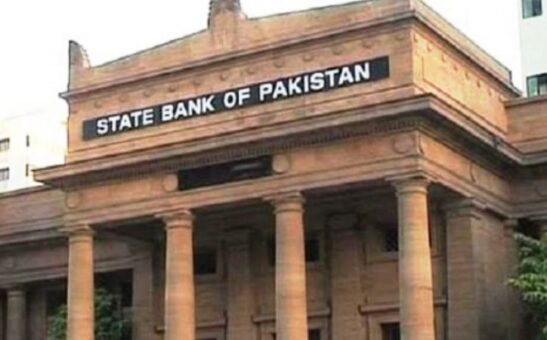
Money and banking drive economic activity by facilitating transactions, savings, and investments. Banks manage financial resources, offer credit, and regulate money supply, ensuring stability and growth in Pakistan’s financial sector.
KARACHI: The Pak Rupee fell by six paisas against the dollar on Monday as the market opened after public and weekly holidays and witnessed higher demand for import and corporate payments.
The rupee ended at Rs160.38 to the dollar from last Thursday’s closing of Rs160.32 in the interbank foreign exchange market.
Currency dealers said that the rupee came under pressure during the day as the market opened after three days for public holiday on account of Qauid-e-Azam day and two weekly holidays.
The demand remained higher during the day despite inflows of workers’ remittances and export receipts. However, these inflows were not sufficient to support the local unit.
KARACHI: State Bank of Pakistan (SBP) on Thursday launched a survey of Overseas Pakistanis to analyze recent trends in remittances and the future outlook.
The central bank launched the survey in collaboration with Ministry of Planning, Development and Special Initiatives (MPD&SI).
The survey will be available to all Overseas Pakistanis globally till January 9, 2021.
The survey attempts to assess underlying factors that may have affected recent remittances behavior, including switching from informal to formal channels, from brick and mortar outlets to digital platforms, future plans of moving back to Pakistan, as well as the amount of remittances they expect to send in the next six months.
With the support of the Ministry of Overseas Pakistanis and Human Resource Development (MOPHRD), Ministry of Commerce, Ministry of Foreign Affairs (MOFA) and Pakistan Remittance Initiative (PRI), this survey is being conducted simultaneously at Pakistani Consulates and Embassies, Overseas Bank Branches of Pakistani Banks as well as online.
SBP and MPD&SI encourage Overseas Pakistanis to actively participate in this short online survey. The survey is very easy to access through the following web link: https://surveyctosbp.surveycto.com/collect/survey_on_recent_remittance_behavior_of_overseas_pakistanis?caseid
KARACHI – The Pakistani Rupee strengthened by 23 paisas against the US dollar on Thursday, driven by an adequate supply of the greenback to meet import and corporate demand, according to market dealers.
KARACHI: The Pak Rupee gained 13 paisas against the dollar on Wednesday on sufficient supply of the greenback to meet import and corporate demands, dealers said.
The rupee ended Rs160.55 to the dollar from the previous day’s close of Rs160.68 in the interbank foreign exchange market.
The dealers said that the rupee was appreciated after sufficient supply of the dollar in the market and it offset the demand for import and corporate payments.
They said that the market had positively responded to current account surplus.
The current account posted $1.64 billion surplus for the first five months of the current fiscal year as compared with a current account deficit of $1.74 billion in the corresponding period of the last fiscal year.
The dealer said that the new type of coronavirus detected in the UK also spread fears across the globe. The importers are also cautious in making new orders amid the discovery of new type of the COVID.
The currency experts hoped that the local unit would make gains in coming days despite year ending owing to improved economic indicators.
KARACHI: Depositors will require submitting a declaration to their financial service providers for taking responsibility for any security lapse and subsequent monetary losses related to their accounts.
New account holders will give this declaration to banks from April 01, 2021. Under this declaration customers will be responsible for sharing their personal information which resulted in fraudulent activity and monetary losses.
The State Bank of Pakistan (SBP) on December 14, 2020 issued regulations for further strengthening depositors’ protection. The regulations namely ‘Key Fact Statement for Deposit Products’ are aimed at increasing consumer comprehension about a banking product’s affordability and risks, leading to better decision-making.
However, the regulations provide a sigh of relief to banking institutions as an annexure related to this clearly explain: “Safe custody of access tools to your [prospective account holder] account like ATM cards, PINs, Cheques, e-banking usernames, passwords; other personal information, etc. is your responsibility. Bank cannot be held responsible in case of a security lapse at the customer’s end.”
At present a large number of people having bank accounts are receiving calls from fraudsters pretending themselves as bankers or officials from the SBP. Such fraudsters ask people to update their account details and demand secret information related to their accounts including identity, password, pin code etc. They further pressurize people that in case requirements are not provided then their bank account will be suspended. Having such serious calls many people compromise their information and lose a handsome amount within a short span of time.
The central bank and commercial banks for a long time are running an awareness campaign that financial institutions never ask account holders to share any information on phone calls.
“SBP never asks for any personal details regarding legal status, CNIC or any bank account details,” the central bank clearly mentioned on its website. Furthermore, banks have also displayed such messages on their official websites and aware people through the media.
Despite these clear instructions of the SBP and commercial banks, people are sharing their information to such fake calls and losing money on a regular basis. On the other hand, banks were held responsible for the losses when customers made appeals before Banking Mohtasib.
A customer declaration under ‘Key Fact Statement for Deposit Products’ will help banks to make strong defence in cases of security lapse and money losses.
KARACHI: The State Bank of Pakistan (SBP) on Tuesday announced that the central bank would remain closed on December 25, 2020 (Friday) due to Quaid-e-Azam Day and Christmas.
The SBP said that it will remain closed on December 25, 2020 (Friday) being a public holiday on the occasions of Quaid-e-Azam Day and Christmas, as declared by the Government of Pakistan.
The commercial banks shall also observe the public holiday.
KARACHI: The Pak Rupee gained three paisas against the dollar on Tuesday owing to improved sentiments after reports of current account surplus during the first five months.
The rupee ended Rs160.68 to the dollar from the previous day’s closing of Rs160.71 in the interbank foreign exchange market.
Currency dealers said that the market remained positive due to reports of current account surplus as shown in Balance of Payment for the period July – November of fiscal year 2020/2021.
The current account posted $1.64 billion surplus for the first five months of the current fiscal year as compared with a current account deficit of $1.74 billion in the corresponding period of the last fiscal year.
The dealer said that the new type of coronavirus detected in the UK also spread fears across the globe. The importers are also cautious in making new orders amid the discovery of new type of the COVID.
The currency experts hoped that the local unit would make gains in coming days despite year ending owing to improved economic indicators.
KARACHI: State Bank of Pakistan (SBP) has issued updated list of panel of audit firms, which are allowed to conduct audit of banking companies.
The central bank updated the list up to December 21, 2020.
State Bank of Pakistan’s Panel of Auditors Maintained Under Section 35 (1) of Banking Companies Ordinance, 1962
Following is the list of chartered accountant firms with their categories to conduct audit:
Category Description Category ‘A’ Audit Firms in Category “A” are eligible to conduct audit of all Banks and DFIs Category ‘B’ Audit Firms in Category “B” are eligible to conduct audit of Banks and DFIs having assets up to Rupees 100 billion or branches up to 160. Category ‘C’ Audit Firms in Category “C” are eligible to conduct audit of banks and DFIs having assets up to Rupees 15 billion or branches up to 30.
Category ‘A’
A1. A.F. Ferguson & Co. State Life Building No. 1/C, I.I. Chundrigar Road, Karachi. Tel: +92 (021) 32426711-15 Fax: +92 (021) 32415007 Web: www.affco.com.pk
A13. Riaz Ahmad & Co. 10-B, Saint Mary Park, Main Boulevard, Gulberg III, Lahore. Tel: +92 (042) 35718137-39 Fax: +92 (042) 35718136 Email: [email protected] Web: www.racopk.com
The Pakistani Rupee experienced a significant drop of 62 paisas against the US Dollar on Monday, closing at Rs160.71 compared to the previous Friday’s rate of Rs160.09 in the interbank foreign exchange market. This decline is attributed to increased demand for foreign currency driven by import and corporate payment requirements.
KARACHI: The State Bank of Pakistan (SBP) has set a target of 20 million women bank accounts by year 2023 in order to reduce the gender gap in financial inclusion, a statement said on Saturday.
The SBP said that women’s access to financial and economic opportunities is essential for sustainable and inclusive economic growth.
However, women in Pakistan are disproportionately under-served by the financial system.
Only 18 percent of adult women in Pakistan have an active bank account compared with 51 percent men.
“In order to address the gender disparities, the central bank has adopted a medium-term national target of 20 million active women bank accounts by 2023 under National Financial Inclusion Strategy.”
The target will be achieved through the launch of a policy to reduce the gender gap in financial inclusion, titled Banking on Equality, which aims to promote women financial inclusion in Pakistan.
“Banking on Equality: Reducing the Gender Gap in Financial Inclusion”, is a flagship policy initiative of State Bank of Pakistan for promoting women financial inclusion. The policy will introduce a gender lens within the financial sector through specific measures to bring a shift towards gender friendly business practices.
To initiate a national dialogue on women financial inclusion, SBP has organized a webinar titled “Consultative Launch of Banking on Equality policy: Reducing the Gender Gap in Financial Inclusion” on Monday, December 21, 2020 at 1730 PKT (Pakistan Standard Time).
The webinar, that will be shown live on State Bank’s Facebook page [https://www.facebook.com/StateBankPakistan] aims to promote awareness of the significance of women financial inclusion and hold discussions among distinguished international thought leaders to discuss practical ways to give a boost to women financial inclusion in Pakistan.
SBP Governor, Dr. Reza Baqir will host the consultative launch of the Banking on Equality policy with introductory presentation on the policy by SBP Deputy Governor Ms. Sima Kamil, and followed bya high level panel discussion around women’s financial inclusion. The panel members would include PrincessZahra Aga Khan Director Aga Khan Development Network (AKDN), Ms. CeylaPazarbasioglu from IMF and Dr. Reza Baqir Governor, State Bank of Pakistan while Dr. Anita Zaidi from Bill and Melinda Gates Foundation (BMGF) will moderate the panel discussion.
Princess Zahra Aga Khan is a Member of the Board of Directors of the Aga Khan Development Network (AKDN). Princess Zahra serves in various leadership roles within the Aga Khan Development Network, including as Trustee of the Aga Khan University and the University of Central Asia.
Ms. CeylaPazarbasioglu is Director of the Strategy, Policy, and Review Department (SPR) of the IMF. In this capacity, she leads the work on the IMF’s strategic direction and the design, implementation, and evaluation of Fund policies. Ms. Pazarbasioglupreviously served as Vice President at the World Bank Group.
The panel moderator, Dr. Anita Zaidi, is the President of Gender Equality at Bill and Melinda Gates Foundation. Dr. Zaidi is overseeing a division comprised of the Foundation’s Gender Equality program team and Gender Program Advocacy and Communications team.