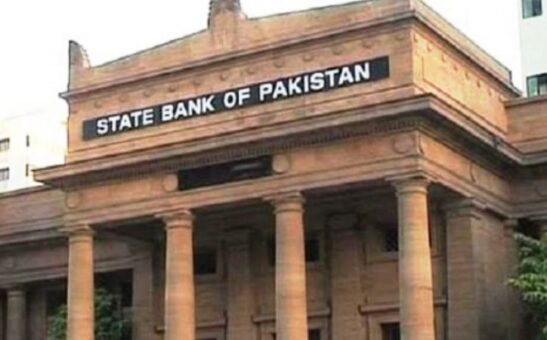
Category: Money & Banking

Money and banking drive economic activity by facilitating transactions, savings, and investments. Banks manage financial resources, offer credit, and regulate money supply, ensuring stability and growth in Pakistan’s financial sector.

  • Mobile banking registers phenomenal growth; transactions increase to Rs1,764 billion

    Mobile banking registers phenomenal growth; transactions increase to Rs1,764 billion

    KARACHI: The usage of mobile banking has surged phenomenally as transactions worth Rs1,764 billion recorded during fiscal year 2019/2020, which is 104 percent higher over the preceding fiscal year.

    (more…)
  • Money printing cost rises to Rs13.32 billion in FY20: SBP

    Money printing cost rises to Rs13.32 billion in FY20: SBP

    KARACHI: The State Bank of Pakistan (SBP) has said that cost of printing of money increased to Rs13.32 billion in fiscal year 2019/2020.

    The central bank in its annual performance report said that the banknote printing charges increased to Rs.13.325 billion in 2019/2020 from Rs.11.419 billion in 2018/2019, thereby registering an increase of 17 percent mainly due to larger volumes of printing and increase in printing rates.

    The exchange gains/ (losses) arise on FCY assets and liabilities of the Bank. Major part of the foreign currency assets of the Bank are USD denominated whereas the foreign currency liability exposure is mainly SDR and USD denominated.

    Accordingly, the movement in the PKR/SDR and PKR/USD exchange rates directly affects the exchange account.

    The bank earned a net exchange gain of Rs.66.402 billion during FY20 as against exchange loss of Rs. 506,131 million during FY19.

    The PKR depreciated against USD and SDR during the period however, exchange gain arose due to improvement in net FCY liability exposure as compared to previous year.

    Other operating income include penalties levied on banks/financial institutions, licenses and e-CIB fee, gains/(losses) on sale and re-measurement of investments and other income.

    The other operating income increased to Rs.8.604 billion in FY20 from Rs.4.347 billion in last year. The increase is primarily attributed to increase in income on penalties levied on banks and financial institutions, licenses fee, e-CIB fee and gain on disposal of foreign investments classified as “fair value through profit or loss”.

  • State Bank’s annual profit surges to historic high of Rs1.16 trillion

    State Bank’s annual profit surges to historic high of Rs1.16 trillion

    KARACHI: The State Bank of Pakistan (SBP) has declared profit of Rs1.16 trillion, the highest profit in the history of the bank, for the year ended June 30, 2020.

    The SBP in performance report issued on Thursday said that the stability in the exchange rate allowed SBP to return to profitability after incurring loss in the preceding year. The SBP recorded a loss of Rs846 million for the year ended June 30, 2019.

    “The profit so earned by the SBP in the year ended June 30, 2020 is highest in its history.”

    The high interest rate prevalent in the first three quarters of the year allowed the central bank to accrue significant amount of interest income from the interest sensitive assets, particularly lending to the Government and income from the Bank’s open market operations.

    Further, during the year, the liquidity mopping up operations were relatively on reduced scale and hence the interest expense registered a substantial decline.

    The total assets stood at Rs.12,273 billion as at June 30, 2020 as compared to Rs.11,467 billion on June 30, 2019, registering an increase of Rs.806 billion primarily due to increase in foreign currency accounts and investments.

    Similarly, the total liabilities of the bank stood at Rs.11,219 billion as at June 30, 2020 as compared to Rs.10,761 billion as at June 30, 2019, registering an increase of Rs.458 billion. This rise was primarily led by increase in currency in circulation.

    SBP introduced certain interest free/subsidized refinancing schemes during COVID-19 pandemic. As per the requirements of IFRS-9, the subsidized loans are required to be recorded at fair value.

    Accordingly, an amount of Rs.4,194 million has been recognized as fair valuation adjustment against these loans. This fair valuation adjustment will be amortized and recorded as income over the period of loans.

  • Dollar falls to Rs160.26 as Pak Rupee gains 36 paisas

    Dollar falls to Rs160.26 as Pak Rupee gains 36 paisas

    KARACHI: The Pak Rupee gained another 36 paisas against the dollar on Thursday owing to inflows of workers’ remittances and export receipts offset the demand for import payment.

    The rupee ended Rs160.26 to the dollar from the previous day’s closing of Rs160.62 in the interbank foreign exchange market.

    Currency experts said that due to positive economic indicators and current account surplus the rupee made gain. They said that during the day the market witnessed demand for dollars but the inflows helped the rupee to further appreciate against the greenback.

    The inflow of workers’ remittances has registered a sharp increase of 31.2 percent after making the fourth consecutive month of over $2 billion received in September 2020.

    The State Bank of Pakistan (SBP) said that the remittances increased to $2.3 billion, 31.2 percent higher than the same month last year and 9 percent higher than in August 2020.

    Workers’ remittances remained above $2 billion for the fourth consecutive month in September, the central bank said.

    On a cumulative basis, remittances rose to a record $ 7.1 billion in the first quarter of current fiscal year, 31.1 higher than the same period last year.

    The level of remittances in September was slightly higher than SBP’s projections of $2 billion.

  • SBP imposes penalty of Rs272 million on four banks

    SBP imposes penalty of Rs272 million on four banks

    KARACHI: State Bank of Pakistan (SBP) has imposed a monetary penalty of Rs272 million on four commercial banks for violating regulatory instructions related to Know Your Customer (KYC) and AML/CFT.

    According to details of significant enforcement action by the central bank issued on Wednesday, the SBP imposed penalty on the four banks during first quarter (July – September) 2020/2021.

    The SBP imposed the highest amount of penalty of Rs116.27 million imposed on Bank Islami Limited for procedural violations in the areas of CDD/KYC, General Banking Operations & Asset Quality. The SBP directed the bank to strengthen its processes to avoid recurrence of such violations.

    The central bank imposed an amount of Rs 59.23 million as penalty on Soneri Bank Ltd for procedural violations in the area of CDD/KYC. In addition to penal action the bank has been advised to strengthen its processes to avoid recurrence of such violations.

    The SBP imposed an amount of Rs10 million as penalty on The Bank of Punjab for procedural violations in the area of General Banking Operations. In addition to penal action the bank has been advised to strengthen its processes to avoid recurrence of such violations.

    The central bank imposed Rs86.12 million as monetary penalty on Albaraka Bank (Pakistan) Ltd for violations in the areas of AML/CFT,FX Operations &General Banking Operations.

    In addition to penal action the bank has been advised to conduct an internal inquiry on breaches of regulatory instructions and take disciplinary action against the delinquent officials.

  • Dollar falls to 160.62 as Pak Rupee makes 29 paisas gain

    Dollar falls to 160.62 as Pak Rupee makes 29 paisas gain

    The Pak Rupee experienced a notable appreciation of 29 paisas against the US dollar on Wednesday, closing at Rs160.62 in the interbank foreign exchange market. This marked an improvement from the previous day’s closing rate of Rs160.91 to the dollar.

    (more…)
  • Bank holiday announced

    Bank holiday announced

    KARACHI: The State Bank of Pakistan (SBP) has announced bank holiday on October 30, 2020 on the occasion of Eid Milad-Un-Nabi.

    A circular issued on Tuesday addressing the president / chief executives of all banks / Development Financial Institutions and Microfinance Banks that the SBP would remain closed on October 30, 2020 (Friday), the 12th Rabi-ul-Awal 1442 AH on the occasion of Eid Milad-Un-Nabi.

  • Dollar slips to Rs160.91

    Dollar slips to Rs160.91

    KARACHI: The Pak Rupee made another 14 paisas gain against dollar on Tuesday owing to improved inflows of workers’ remittances and export receipts.

    The rupee ended Rs160.91 to the dollar from previous day’s close of Rs161.05 in the interbank foreign exchange market.

    Currency experts said that foreign exchange market remained positive due to higher foreign exchange reserves of the country and frequent inflows of workers’ remittances and export receipts.

    They said that during the day the market witnessed demand for dollar however sufficient supply of the greenback helped the rupee to make gain.

    The liquid foreign exchange reserves of the country increased by $287 million to $19.302 billion by week ended October 16, 2020. The foreign exchange reserves of the country were at $19.015 billion by week ended October 09, 2020.

    The official reserves of the central bank also increased by $269 million to $12.067 billion by week ended October 16, 2020 as compared with $11.798 billion a week ago. The SBP attributed the increase in official reserves to the government inflows.

    The inflow of workers’ remittances has registered sharp increase of 31.2 percent after making fourth consecutive month of over $2 billion received in September 2020.

    The State Bank of Pakistan (SBP) on Monday said that the remittances increased to $2.3 billion, 31.2 percent higher than the same month last year and 9 percent higher than in August 2020.

    Workers’ remittances remained above $2 billion for the fourth consecutive month in September, the central bank said.

    On a cumulative basis, remittances rose to a record $ 7.1 billion in first quarter of current fiscal year, 31.1 higher than the same period last year.

    The level of remittances in September was slightly higher than SBP’s projections of $2 billion.

  • National Bank declares 110 percent growth in quarterly profit

    National Bank declares 110 percent growth in quarterly profit

    KARACHI: National Bank of Pakistan (NBP) on Tuesday declared massive growth in after tax profit by 110 percent to Rs11 billion for quarter ended September 30, 2020.

    According to financial result, the sharp increase in profitability may be attributed to significant rise in gain securities. The bank’s gain on securities increased to Rs3.59 billion for the quarter ended September 30, 2020 as compared with Rs250 million in the same quarter of the last year.

    The net interest income of the bank increased by 71.58 percent to Rs31.4 billion for the quarter ended September 30, 2020 as compared with Rs18.3 billion in the same quarter of the last year.

    The total income of the bank jumped up by 58.86 percent percent to Rs40.78 billion for the quarter under review as compared with Rs25.67 billion in the same period of the last year.

    Operating expenses of the bank increased to Rs15.45 billion for the quarter ended September 30, 2020 as compared with Rs13.43 billion in the same period of the last year, showing growth of 15.04 percent.

    The NBP paid Rs7.67 billion as tax for the period under review as compared with Rs3.4 billion in the corresponding quarter of the last year, showing an increase of 126 percent.

  • SBP revises mechanism for valuation, repatriation of disinvestment proceeds

    SBP revises mechanism for valuation, repatriation of disinvestment proceeds

    KARACHI: In order to further streamline the process of remittance of disinvestment proceeds, State Bank of Pakistan (SBP) has decided to further delegate the authority to banks of resident companies for remittance of disinvestment proceeds to non-resident investors, a statement said on Monday.

    The SBP invited the attention of the Authorized Dealers (ADs) or banks is to the instructions contained in Para 7(vii), Chapter 20 of Foreign Exchange Manual in terms of which designated Authorized Dealer is allowed for remittance of disinvestment proceeds not exceeding the market value (in case of listed securities)/ break-up value (in case of unlisted securities) favoring the non-residents.

    Accordingly, the above referred Para of Chapter-20 ibid has been replaced as follows:

    “Subject to observance of the procedure outlined above, the companies issuing/registering transfer of shares in favour of non-residents on repatriation basis, may export the share certificates through the designated Authorized Dealer to the shareholders. The designated Authorized Dealer shall also allow remittances in respect of the following:-

    (i) Dividend, net of applicable taxes, as permitted under Chapter 14.

    (ii) Disinvestment proceeds, less brokerage / commission and taxes, as under:

    A. For disinvestment proceeds not exceeding the market value (in case of listed securities)/ break-up value (in case of unlisted securities), the designated Authorized Dealer shall allow the remittance on submission and review of:

    a) Name and address of the non-resident share holder.

    b) Name and address of the company whose shares were sold by the non-resident beneficiary, indicating whether it is a listed or unlisted/private limited company and is covered under para 6 ibid. (This requirement may be waived by the Authorized Dealer in case of quoted shares).

    c) Name, address and residential status of the buyer of the shares in question.

    d) Copy of broker’s memo in case of quoted shares/break-up value certificate of a QCR rated practicing Chartered Accountant in case of unlisted shares.

    e) Attested copy of executed Share Purchase Agreement (enforceable at law) between resident buyer and non-resident seller, showing rupee value of shares purchased.

    f) Attested copy of latest audited financials of the company whose shares were being sold.

    g) Duly filled/ signed M-Form for the rupee value of the remittance in favor of non-resident.

    h) An undertaking from the buyer that the transaction is not between related parties. In case the transaction is between related parties, an undertaking that the same has been concluded at an arms-length basis.

    i) Authorized Dealer will ensure due diligence of the transaction/ buyer from AML/ CFT perspective.

    B. For disinvestment proceeds exceeding the market value (in case of listed securities)/ break-up value (in case of unlisted securities), the designated Authorized Dealer shall allow the remittance after satisfying itself about the genuineness of the transaction by reviewing the following additional documents:

    a) Detailed justifications/ rationale/ basis of setting the transaction price per share, from the buyer, in original.

    b) Attested copy of detailed valuation/ transaction due diligence by the buyer showing basis, methodology and key valuation metrics used for valuation of shares as per generally accepted best practices for valuation of shares.

    c) In case the total remittance of disinvestment proceeds exceeds US Dollar 50 million (or equivalent in other currencies) during a span of six months, the applicant, in addition to above information/ documents, shall also submit an independent/ third party review of the buyer’s valuation, from QCR rated practicing chartered accountant as per the latest generally accepted valuation techniques/ methods for a particular type of industry in which resident company is operating. The review report should at least provide view on the appropriateness of the basis and methodology used in the valuation/ transaction due diligence. Further, the review report should also include local/ global comparable transactions and/or trading multiples of comparable publicly traded companies and key valuation metric(s) comparisons, if available.”

    4. Authorized Dealers are advised to bring the above instructions to the knowledge of all their constituents for meticulous compliance.