Category: Money & Banking

Money and banking drive economic activity by facilitating transactions, savings, and investments. Banks manage financial resources, offer credit, and regulate money supply, ensuring stability and growth in Pakistan’s financial sector.

  • Rupee ends firmer against dollar

    Rupee ends firmer against dollar

    KARACHI: The Pak Rupee ended firmer against the dollar on Thursday as inflows were sufficient to meet the demand for import and corporate payments.

    The rupee ended Rs159.26 to the dollar from previous day’s closing of Rs159.27 in the interbank foreign exchange market.

    Currency dealers said that the supply of the foreign currency was sufficient to meet the demand for import and corporate payments.

  • Rupee makes another gain of 82 paisas against dollar

    Rupee makes another gain of 82 paisas against dollar

    KARACHI: The Pak Rupee gained another 82 paisas against dollar on Wednesday owing to ease in demand for import payment and improved economic indicators.

    The rupee ended Rs159.27 to the dollar from previous day’s closing of Rs160.09 in interbank foreign exchange market.

    Currency dealers said that due to second phase of covid pandemic globally and subsequent lockdowns discouraged importers to place new orders.

    Further the improved foreign exchange reserves and current account surplus also supported the rupee to make gain.

    The local currency recovered Rs1.72 against dollar during past three trading days.

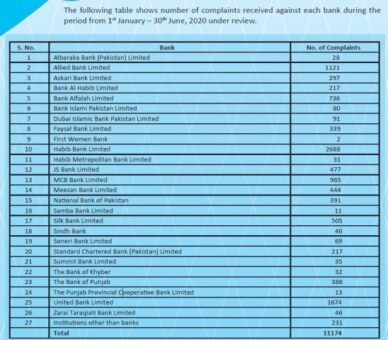
  • Mohtasib receives 11,174 complaints against banks during six months

    Mohtasib receives 11,174 complaints against banks during six months

    KARACHI: Around 11,174 complaints have been filed against commercial banks during first half of current calendar year, said a report issued by Banking Mohtasib (Ombudsman) Pakistan.

    The office of banking ombudsman in its half yearly report (January – June 2020) said that due to more public awareness about this institution as an alternate dispute resolution forum, in the last three years there has been seen an increase of 62 percent in public complaints.

    “Although during the Global Pandemic of Covid-19 despite of the fact that our office was not working at full strength, we have received 11,174 complaints during first six months of the year 2020 (i.e. from 01.01.2020 to 30.06.2020).”

    These also include the complaints received at the Prime Minister Portal relating to banking issues. The increase in number of complaints represents the confidence of general public in the working of this institution and the relief being obtained speedily and without any cost.

    The recent development in the technological field such as the digital banking, internet banking, mobile banking and ATMs, in the development of the economic activity in the country is enormous.

    Unfortunately, a large segment of our society is not financially literate besides, low level of education particularly those living in the rural areas do not have much knowledge about the products introduced by the banks.

    Certain fraudsters taking advantage of the innocent people misguide them for their poor knowledge of the latest banking techniques.

    All bank are continuously making public awareness campaigns, to discourage their evil designs and guiding the customers not to disclose details of their personal and financial credentials to any unknown person but during past two to three years, a large number of complaints of unauthorized fund transfer were received.

    Recommendations in this regard to SBP have been made time to time to protect the depositors hard earned savings.

    Related Stories

  • Rupee recovers 96 paisas against dollar

    Rupee recovers 96 paisas against dollar

    KARACHI: The Pak Rupee recovered 96 paisas against the dollar on Tuesday following the central bank kept the policy rate unchanged and lower demand of the foreign currency from importers.

    The rupee ended Rs160.09 to the dollar from the previous day’s closing of Rs161.05 in the interbank foreign exchange market.

    Currency dealers said that a day earlier the State Bank of Pakistan (SBP) kept the key policy rate unchanged at 7 percent giving confidence to trade and industry.

    They further said that the imposition of lockdown to prevent spread of coronavirus in international markets also discouraged importers from placing new orders to their foreign suppliers.

    The rupee gained to Rs158.30 against the dollar on November 17, 2020. However, since then the local currency witnessed a declining trend.

  • Dollar advances to Rs161.05

    Dollar advances to Rs161.05

    KARACHI: The US dollar strengthened against the Pakistani rupee on Monday, gaining 32 paisas due to increased demand for imports and corporate payments. The exchange rate settled at Rs161.05 to the dollar in the interbank foreign exchange market, rising from last Friday’s closing of Rs160.73.

    (more…)
  • SBP keeps key policy rate unchanged at 7 percent

    SBP keeps key policy rate unchanged at 7 percent

    KARACHI: The monetary policy committee of the State Bank of Pakistan (SBP) has decided to keep the key policy rate unchanged at 7 percent for next two months.

    (more…)
  • SBP announces incentives for banks to finance low cost housing

    SBP announces incentives for banks to finance low cost housing

    KARACHI: The State Bank of Pakistan (SBP) on Friday amended regulations to incentivize banks for financing low cost and affordable housing.

    A statement said that the central bank is constantly providing enabling regulatory environment to promote housing and construction finance.

    This is an important sector that has significant economic linkages with other sectors in the economy and the current level of credit provision in this sector is at a very low level of less than 1 percent of GDP which is much lower than in other similar countries and in the region.

    To support the provision of finance to this sector and especially facilitate affordable housing, SBP has now announced five regulatory relaxations to incentivize banks for financing low cost and affordable housing.

    Firstly, the definition of low cost housing finance used in the current regulations for banks has been aligned with definition used under Government Markup Subsidy Facility for Housing Finance eligible under Tiers I & II of housing finance.

    Specifically, in the SBP regulations, the value of housing unit has been increased from Rs 3 million to Rs 3.5 million with maximum loan size increased from Rs 2.7 million to Rs 3.15 million. Consequently, the incentive for low cost housing finance will increase for banks as they will not only be able to enjoy markup subsidy facility by the Government but the regulatory incentives under low cost housing finance by SBP as well.

    Current regulations and banking practices require banks to obtain documentary evidence of income. Provision of this information is difficult for people generating income from informal sources which are generally in low income segments.

    In order to facilitate financing for this segment, State Bank is urging the banks to use alternate methods to identify income sources and assess the credit worthiness of the borrower.

    The 2nd and 3rd type of relaxations are being given to facilitate financing for this segment. Accordingly, under 2nd relaxation, banks have been exempted from the requirement of using ‘verifiable income’ for the purpose of calculating Debt Burden Ratio (DBR) in case of low cost housing finance where banks are using income proxies and where income of borrower is not verifiable.

    Resultantly, borrowers with ‘non-verifiable income,’ estimatedby banks using income proxies, will also become eligible to avail low cost housing finance.

    Thirdly, banks have also been exempted from the requirement of observing DBR, in case of low cost housing finance, where banks are using repayment surrogates like rent, utility bills, telcos bills, etc. to assess repayment capacity of borrower. Hence, borrowers without verifiable or non-verifiable income will become eligible to avail low cost housing finance.

    Fourthly, banks have been exempted from the requirement of Internal Credit Risk Rating System for the low cost housing finance till September 30, 2022 as their current systems do not specifically cater for low cost housing finance.

    Accordingly, borrowers of low cost housing finance who cannot avail financing due to banks internal credit rating criteria will now become eligible if the bank is otherwise satisfied. This time barred relaxation will provide banks to develop their Internal Credit Risk Rating Systems for low cost housing finance.

    Finally, in order to provide comfort to the borrowers who have liquid securities or already have a housing unit, banks have been allowed to extend housing finance for purchase/construction of a residential property by accepting existing residential property or liquid securities in lieu of equity contribution for housing finance at the time of calculations of Loan to Value ratio.

     Financing bank will create its lien on existing residential property/liquid securities in addition to mortgage of residential property being financed.

    It is expected that the above regulatory incentives would provide further impetus to SBP’s on-going efforts to accelerate housing and construction finance in Pakistan. It is reminded that banks have already been given mandatory targets of 5 percent of their private sector advances as housing and construction finance by December 31, 2021.
  • Rupee ends down by 11 paisas on foreign payment demand

    Rupee ends down by 11 paisas on foreign payment demand

    The Pakistani Rupee faced a modest decline of 11 paisas against the US dollar on Friday, closing at Rs160.73 in the interbank foreign exchange market.

    (more…)
  • SBP to issue monetary policy statement on Nov 23

    SBP to issue monetary policy statement on Nov 23

    KARACHI: State Bank of Pakistan (SBP) will announce monetary policy for next two months on Monday November 23, 2020, a statement said on Thursday.

    The SBP said that the Monetary Policy Committee of the SBP will meet on Monday, November 23, 2020 at SBP Karachi to decide about Monetary Policy.

    Later on, SBP will issue the Monetary Policy Statement on the same day.

    In its previous monetary policy statement on September 21, 202, the central bank kept the policy rate unchanged at 7 percent.

  • Rupee depreciates by 79 paisas amid CA surplus

    Rupee depreciates by 79 paisas amid CA surplus

    The Pakistani Rupee (PKR) continued its downward trend against the US Dollar on Thursday, depreciating by 79 paisas in the interbank market. The rupee closed at Rs160.62 against the dollar, compared to the previous day’s rate of Rs159.83, as demand surged for import and corporate payments.

    (more…)