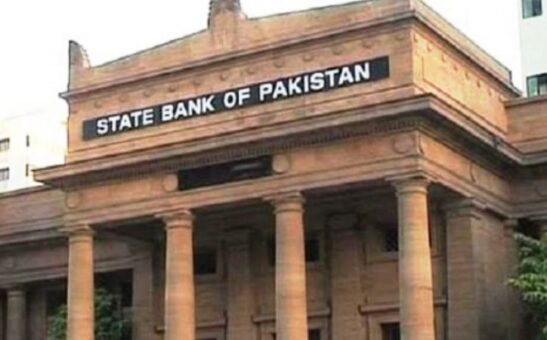
Money and banking drive economic activity by facilitating transactions, savings, and investments. Banks manage financial resources, offer credit, and regulate money supply, ensuring stability and growth in Pakistan’s financial sector.
KARACHI: The deposits of salaried persons in the domestic banking system surged by 35 percent in August 2020 as financial institutions provided safe avenue for investment.
The banking deposits of salaried persons increased to Rs2.252 trillion by end of August 2020 as compared with Rs1.671 trillion in the same month of the last year, according to data released by State Bank of Pakistan (SBP) on Tuesday.
Banking experts said that in the past the interest rates were very high which enabled banks to offer attractive rate of return to depositors.
The central bank kept the policy at higher rate of 13.25 percent till March 2020. However, in the wake of economic slowdown after COVID-19, the SBP significantly reduced the policy rate starting from March 2020.
In the monetary policy announcement on June 25, 2020, the SBP brought down the key policy rate to 7 percent, which is still applicable to date.
The decision brought the cumulative reduction in the policy rate since mid-March to 625 basis points, the SBP said in its policy statement.
It is important to note that the deposits of the banking system reached to a record high of Rs16.327 billion by August 2020.
The categorization of deposits showed personal deposits registered 18.53 percent growth to Rs8.051 trillion in August 2020 as compared with Rs6.792 trillion in the same month of the last year.
The deposits of salaried persons are part of the category of personal deposits.
The other components of this category i.e. deposits of self employed registered 12 percent increase to Rs3.376 trillion in August 2020 as compared with Rs3.012 trillion in the same month of the last year.
Meanwhile, the deposits of other personal accounts registered 15 percent growth to Rs2.423 billion as compared with Rs2.108 billion in the same month of the last year.
KARACHI: The Pak Rupee slipped by 10 paisas against dollar on Tuesday owing to higher demand for import and corporate payments.
The rupee ended Rs166.27 to the dollar from previous day’s closing of Rs166.17 in interbank foreign exchange market.
Currency experts said that the local unit was remained under pressure due to higher import and corporate payment.
However, they said that the recent announcement of the federal government to launch Naya Pakistan Certificates with attractive rate of return in both rupee denomination and dollar denomination bills, would help the local currency to gain value in coming days.
KARACHI: State Bank of Pakistan (SBP) on Monday allowed banks to open their selected branches on Saturdays with ensuring implementation of SOPs to prevent coronavirus.
The SBP said that through a notification on October 14, 2011 under which banks / microfinance banks were permitted to open their selected branches at various business centers / commercial hubs / ports etc. on Saturdays.
However, subsequent to outbreak of COVID-19 pandemic, banks / MFBs through BPRD Circular Letter No. 8 dated March 23, 2020 were advised to open their branches / work places with bare minimum staff for reduced timings from Monday to Friday until further instructions.
Since the banks / MFBs have been reverted to normal office and business hours in terms of instructions contained in BPRD Circular Letter No. 37 of July 31, 2020, hence it has been decided that banks / MFBs may open selected branches on Saturdays in line with instructions contained in BPRD Circular No. 11 of 2011 subject to implementation of SOPs / guidelines issued by the Federal & Provincial Governments, from time to time, the SBP added.
KARACHI: The Pak Rupee fell by 20 paisas against the dollar on Monday owing to higher demand of the foreign currency for import and corporate payments.
The rupee ended Rs166.17 to the dollar from last Friday’s closing of Rs165.97 in interbank foreign exchange market.
Currency experts said that the market was opened after weekly holidays and the local unit was under pressure due to demand for import and corporate payments.
They however said that improved inflows of remittances would help the local unit to recover in coming days.
The inflow of workers’ remittances sharply increased by 31 percent during first two months of the current fiscal year owing to initiatives of the central bank.
The inflow of remittances surged to $4.86 billion during July – August 2020 as compared with $3.71 billion during the corresponding period of the last fiscal year.
The inflows of remittances also registered an increase of 25 percent to $2.1 billion in August 2020 as compared with $1.68 billion in the same month of the last year.
KARACHI: Workers’ remittances to Pakistan have experienced a significant boost, surging by 31% during the first two months of the current fiscal year. This sharp increase is attributed to initiatives by the State Bank of Pakistan (SBP), which have facilitated the inflow of remittances from Pakistani workers abroad.
KARACHI – The Pakistani Rupee gained significant ground against the US Dollar, strengthening by 43 paisas on Friday. The surge was attributed to the burgeoning foreign exchange reserves of the country and the optimistic sentiments generated by the recent launch of Roshan Digital Accounts, a financial initiative catering to non-resident Pakistanis (NRPs).
ISLAMABAD: Prime Minister Imran Khan on Thursday inaugurated the Roshan Digital Account, which is a new initiative of the State Bank of Pakistan (SBP), in partnership with major banks in Pakistan.
The Roshan Digital Account is for non-resident Pakistanis (NRPs). Through this account, NRPs will be fully integrated with Pakistan’s banking and payments system, said a statement issued by the SBP.
For the first time in the country’s history, NRPs will be able to open an account in Pakistan without requiring physical presence either in Pakistan or in any embassy or consulate.
This account will provide them access to a full range of banking services and exciting investment opportunities in Pakistan from wherever they live, including the soon to be launched Naya Pakistan Certificates issued by the government, as well as the stock market and real estate.
Funds in these accounts will also be fully repatriable, such that they can be remitted back from Pakistan without any prior approval from SBP.
Addressing the audience, the Prime Minister dedicated the occasion to overseas Pakistanis, noting that they have always made Pakistan proud through their achievements and dedication to their motherland.
He was delighted that SBP was offering a new channel to connect overseas Pakistanis with their motherland financially and congratulated the Governor SBP, Dr. Reza Baqir, on this initiative.
The Prime Minister called overseas Pakistanis the greatest resource of the country. He said that in many parts of the world, expatriates have played an important role in the development of their countries. However, he regretted that Pakistan has historically been unable to tap its diaspora effectively. However, he remarked that his government is committed to better integrating overseas Pakistanis into the local economy, and that the Roshan Digital Account is very important first step in this direction.
The Prime Minister highlighted that the country needs more investment from abroad to fund the current account deficit and raise foreign exchange reserves. In this context, he remarked that overseas Pakistanis can help the country by investing in recently announced mega projects of the country through the Roshan Digital Account.
In particular, he emphasized the on-going boom in the housing sector, which provides very attractive investment opportunities for overseas Pakistanis.
In his address, Governor SBP Dr. Reza Baqir noted that the Roshan Digital Account represents a new era in the banking system of Pakistan, as it features a completely digital on-boarding process.
To enable this historic change, SBP introduced all the necessary amendments to existing rules and regulations. He explained that these accounts will initially be available through eight major banks in Pakistan, with more banks added in due course.
The SBP governor said that today we have crossed another milestone as part of SBP’s commitment to a digital financial ecosystem for Pakistan’s economy and in keeping with the Prime Minister’s vision.
He highlighted that the name of the account reflected the ethos of NRPs, who make their country proud through their hard work and passion. It is to these star performers abroad that the “Roshan” account is dedicated, he said.
The Governor highlighted that opening the account will require a basic set of information and documents. Banks have been asked to complete all necessary customer due diligence within 48 hours after receiving complete information.
He assured NRPs that SBP and the banks were committed to providing them a world-class user experience and to proactively resolving any problems they may encounter during the roll-out of the initiative. In this context, he highlighted the dedicated customer support and monitoring system established by SBP and the banks.
The governor thanked different overseas Pakistani fora, the Ministry of Finance, the Ministry of Overseas Pakistani and Human Resource Development, the Foreign Office, the eight participating banks and the think tank constituted by the Prime Minister for their valuable support in refining and promoting the initiative.
In his address, Adviser to the Prime Minister on Finance and Revenue Dr. Abdul Hafeez Sheikh congratulated the State Bank of Pakistan on this new initiative. He outlined the difficult macroeconomic conditions the country was facing when the government took over and the bold decisions taken to bring stability and promote economic growth in the country.
He also highlighted the swift measures taken by the government in the last few months to help people and the business community cope with the impact of the Covid-19 pandemic. Looking ahead, he expressed confidence that the Roshan Digital Account would pave the way for overseas Pakistanis to increase their investment in Pakistan.
The ceremony was attended by ministers, parliamentarians, presidents and CEOs of banks, and senior officials from SBP.
KARACHI: State Bank of Pakistan (SBP) on Thursday issued procedure for investment in Naya Pakistan Certificates (NPC) which will be offered to both overseas and resident Pakistanis at attractive rates of return in Pak Rupee and US Dollar denomination bills.
The SBP said that The certificates shall be subscribed by eligible individuals through Foreign Currency Value Account (FCVA) or NRP Rupee Value Account (NRVA), being marketed as Roshan Digital Accounts (RDAs) by the agent banks.
The funds for investment in Certificates must be remitted from abroad in the investor’s FCVA or NRVA after June 30, 2020.
The agent banks shall be responsible for Know Your Customer (KYC), Customer Due Diligence (CDD) and Enhanced Due Diligence (EDD) of the investors.
The Certificates shall be offered digitally through the web-links of following agent banks: Bank Al-Falah, Faysal Bank, HBL Bank, MCB Bank, Meezan Bank, Samba Bank, United Bank Limited and SCB Pakistan.
The investors shall have the option to subscribe either Pak Rupee denominated or US Dollar denominated certificates of 3-Month, 6-Month, 12-Month, 3-Year and 5-Year tenors.
Amount of Investment in each tenor certificate shall be as under:
US Dollar Denominated Certificates
Minimum investment of USD 5,000 with integral multiples of USD 1,000.
PKR Denominated Certificates
Minimum investment of PKR 100,000 with Integral multiples of PKR 10,000.
The Certificates of following tenors shall be yielding gross return (before the deduction of tax) as under:
Tenor of Certificate
USD Denominated Certificate
PKR Denominated Certificates
3-Month
5.50%, p.a.
9.50% p.a.
6-Month
6.00% p.a.
10.00% p.a.
12-Month
6.50% p.a.
10.50% p.a.
3-Year
6.75% p.a.
10.75% p.a.
5-Year
7.00% p.a.
11.00% p.a.
The 3-Month, 6-Month and 12-Month tenor certificates shall be single-coupon securities on which principal and profit shall be paid on maturity or on premature encashment. Whereas, 3-Year and 5-year certificates shall be coupon securities, on which periodic profit payment shall be paid on half-yearly basis.
The Investor will place the order to subscribe the certificate electronically by visiting the NPC webpage of their respective agent bank and giving investment details including currency, tenor and the amount to be invested.
The PKR denominated NPCs can only be purchased from the balances in the investors’ NRVAs whereas USD denominated NPCs can be purchased from the balances in the investors’ FCVAs. For the investors having their FCVAs in currency other than USD, the banks shall debit the investors’ account by an amount equivalent to the amount of investment requested in USD denominated NPCs by applying the exchange rate prevailing at the time of execution of the transaction.
The agent banks shall, after debiting the investor’s account with an amount equal to the amount of his/her investment order, consolidate the orders received from FCVA or NRVA holders during a working day till 1:00 p.m. Pakistan Standard Time (PST), and shall transmit the same on the prescribed format to the SBP through SBP’s Data Acquisition Portal (DAP) by 2:30 p.m. (PST) the same day.
In case of purchase of US Dollar denominated certificates, agent banks have two options to remit the purchase value of certificates to State Bank of Pakistan (SBP) either through their USD Clearing Account maintained with SBP, or through transfer of funds to the nostro account of SBP maintained with the Federal Reserve Bank of New York, New York, USA. Details of SBP’s nostro account are provided hereunder:
Beneficiary Bank Name:
Federal Reserve Bank of New York, New York, U.S.A.
Beneficiary Account Title:
State Bank of Pakistan, I.I.Chundrigar Road, Karachi, Pakistan.
Beneficiary Account Number
021085172.
Beneficiary Bank SWIFT/BIC:
FRNYUS33.
Transaction charges, including but not limited to correspondent bank charges shall be on the account of the banks, and the banks shall ensure to remit to the SBP nostro account the complete purchase amount of the Certificates.
In case of purchase of Pak Rupees denominated certificates, agent banks shall authorize SBP to debit the total purchase value of these certificates from their Pak Rupees account maintained with the SBP and issue the Naya Pakistan Certificates of aforesaid maturities per contra credit to the respective bank’s SGLA account (IPS holding).
After debiting the USD Clearing Account (or Pak Rupees current account) of the concerned bank, SBP shall issue the Certificates on the same day on which the order is placed through the Subsidiary General Ledger Account (SGLA) by affording requisite credit to the IPS holding account thereof. However, where the purchase value of the order is remitted to the aforesaid nostro account of SBP, Certificates will be issued on T+1 basis in the like manner.
PROCEDURE OF PERIODIC PAYMENTS: 1. Periodic Coupon Payments:
The periodic coupon payments shall be made on six (6) monthly basis only in respect of Certificates of 3-year and 5-year maturities in their respective currencies.
The six (6) months for the periodic coupon payment shall be determined from the date of issuance of the certificates. For example: if certificates are issued on 10th September 2020, the profit payments shall be made on 10th March 2021 and on subsequent six-monthly dates accordingly.
SBP shall make the periodic coupon payments (net of deduction of tax as specified in Rule 18 of the NPC Rules, 2020) on their respective due dates by crediting the USD Clearing account of the bank, or as the case may be the PKR current account, with advice to the bank concerned for onward credit to the investors’ FCVA or NRVA on the same day.
In the event of failure of the bank to credit the amount in the investor’s account, despite receipt of credit from SBP in its account (US Dollar clearing account or PKR current account), the bank shall be liable to make the investor good by paying compensation for the delayed period at the coupon rate as may be applicable to the respective Certificates.
Premature Encashment:
The Investors can have premature encashment of their certificates. Premature encashment proceeds shall be worked-out such that rate of return accruing to that investor is equivalent to rate of return of the nearest shorter maturity of Certificates or such rate as may be notified by Finance Division from time to time. However, no profit shall be paid in case of encashment of certificates before completion of 3 (three) months. The illustrations for calculation of net encashment proceeds in case of premature encashment are attached at Annexure C-3.
The request for Premature Encashment shall be submitted through the investor’s respective agent bank. The banks shall consolidate all requests received on a single day and intimate the SBP through DAP on the prescribed format attached at Annexure C1/C2.
SBP shall afford credit in the USD Clearing account or PKR current account of commercial bank the net encashment proceeds on T+2 working day basis, where T is the date of submission of request by agent bank as mentioned in [B2(b)] above.
The requesting bank shall credit the FCVA or NRVA of investor on the same day on which it receives credit from the SBP in its account, failing which the bank shall be liable to make the investor good by paying compensation for the delayed period at the same rate as may be applicable to the encashed NPC.
Redemption at Maturity:
Maturity proceeds of Certificates, including the amount of final coupon (net of deduction of tax), shall be credited to the USD Clearing account or PKR current account of the investor’s bank account maintained with SBP.
On realization of maturity proceeds by the banks in their accounts with the SBP, the bank shall be liable to credit the FCVA or NRVA of respective investor on the same day, failing which the bank shall be liable to make the investor good by paying compensation for the delayed period at the coupon rate as may be applicable to the respective Certificates.
The Certificate shall not be automatically reinvested or rolled-over after the maturity date.
GENERAL INSTRUCTIONS:
In case of a holiday on the periodic profit or principal payment date, the next working day falling after the holiday will be considered the periodic profit date/principal payment date. In such case, no profit will be payable for the period of the holidays.
The Certificates shall be pledgeable as security for raising financing in Pakistan subject to such conditions as may be prescribed by SBP.
The Certificates are not transferable except if required under the relevant laws.
SBP, and/ or the agent banks, reserve the right to accept or reject the investment application if the investor does not comply with the necessary requirements under the rules or instructions.
In case of death of an investor, the payment (principal and profit, if any), will be made to the legal heirs of the deceased investor in accordance with the succession certificate or equivalent documentation in accordance with the law for the time being in force.
KARACHI: The Pak Rupee recovered 12 paisas against dollar on Thursday owing to improved economic indicators, dealers said.
The rupee ended Rs166.40 to the dollar from previous day’s closing of Rs166.52 in interbank foreign exchange market.
Currency experts said that positive sentiments prevailed in the foreign exchange market due to launching of roshan digital accounts by the State Bank of Pakistan (SBP) for overseas Pakistanis.
They said that the investors hoped significant inflows of the foreign currency under this initiative of the government.
The rupee recovered the value after losing 76 paisas during first three days of the current week.
Karachi – The banking sector in Pakistan has witnessed a historic surge in deposits, reaching an all-time high of Rs16.327 trillion by the end of August 2020, according to data released by the State Bank of Pakistan (SBP) on Thursday.