Category: Budget

This is parent category of budgets presented by Pakistan government. Here you will find year-wise federal and provincial budgets.

  • FBR to disable mobile SIMs on non-filing of tax returns

    FBR to disable mobile SIMs on non-filing of tax returns

    ISLAMABAD: Finance Bill 2022 has proposed to empower Federal Board of Revenue (FBR) to disable mobile phone SIMs of non-filers of annual tax return.

    Besides, it is also proposed to empower the FBR to disconnect connections of electricity and gas of non-filers.

    READ MORE: Pakistan amends tax laws to legalize money transfers

    The amendment has been proposed though Budget 2022/2023, which was presented on June 10, 2022.

    The Finance Bill, 2022 proposed insertion of Section 114B to the Income Tax Ordinance, 2001.

    Following is the text of proposed amendment:

    114B. Powers to enforce filing of returns.— (1) Notwithstanding anything contained in any other law for the time being in force, the Board shall have the powers to issue income tax general order in respect of persons who are not appearing on active taxpayers’ list but are liable to file return under the provisions of the Ordinance.

    READ MORE: Fixed tax rates for retailers, payable through electricity bills

    (2) The income tax general order issued under sub-section (1) may entail any or all of the following consequences for the persons mentioned therein, namely:–

    (a) disabling of mobile phones or mobile phone SIMS;

    (b) discontinuance of electricity connection; or

    (c) discontinuance of gas connection.

    (3) The Board or the Commissioner having jurisdiction over the person mentioned in the income tax general order may order restoration of mobile phones, mobile phone SIMs and connections of electricity and gas, in cases where he is satisfied that —

    READ MORE: Pakistan amends laws to hunt tax evaders living abroad

    (a) the return has been filed; or

    (b) person was not liable to file return under the provisions of the Ordinance.

    (4) No person shall be included in the general order under sub-section (1) unless following conditions have been met with, namely:–

    READ MORE: CGT up to 15% slapped on immovable properties

    (a) notice under sub-section (4) of section 114 has been issued;

    (b) date of compliance of the notice under sub-section (4) of section 114 has elapsed; and

    (c) the person has not filed the return.

    (5) The action under this section shall not preclude any other action provided under the provisions of the Ordinance.”

  • Pakistan amends tax laws to legalize money transfers

    Pakistan amends tax laws to legalize money transfers

    ISLAMABAD: Pakistan has amended tax laws to grant approval of legal banking channels to money transfer by money transfer operators and bureaus.

    The country presented budget 2022/2023 on June 10, 2022 and amended tax laws to grant approval the money transfer made through operators, bureaus and exchange companies.

    Through Finance Bill, 2022 amendment made to Section 111 of the Income Tax Ordinance, 2001. The Section 111 is related to undeclared money and assets.

    An explanation has been proposed to sub-section 4 of Section 111 to the Income Tax Ordinance, 2001, which is as follow:

    READ MORE: Fixed tax rates for retailers, payable through electricity bills

    “Explanation.— For removal of doubt, it is clarified that the remittance through money service bureaus, exchange companies or money transfer operators shall be deemed to constitute foreign exchange remitted from outside Pakistan through normal banking channels as provided under this sub-section.”

    Previously, the Federal Board of Revenue (FBR) on September 24, 2021 said that tax authorities will not ask source of foreign exchange not exceeding Rs5 million remitted through exchange companies (ECs) or money transfer operators.

    READ MORE: Pakistan amends laws to hunt tax evaders living abroad

    The FBR issued explanation to the Tax Laws (Third Amendment) Ordinance, 2021.

    The revenue body said Section 111(4) of Income Tax Ordinance, 2001 provides exclusion from unexplained income or assets to any amount of foreign exchange remitted from outside Pakistan through normal banking channels not exceeding Rs5 million en-cashed into rupees by a scheduled bank.

    The amendment through insertion of an explanation has now also treated remittances through Money Service Bureaus (MCBs), Exchange Companies (ECs) and Money Transfer Operators (MT0s) or other similar entities as foreign exchange remitted from outside Pakistan through normal Banking channels.

    After a formal clarification from SBP, Circular No. 05 of 2022 was issued by the Board.

    READ MORE: CGT up to 15% slapped on immovable properties

    Through this amendment the FBR’s clarification has now been made part of legislation to facilitate foreign remittance and align the law with innovations that have taken place in the banking industry.

    Through the Circular No. 05 of 2022, the FBR has withdrawn all the appeals pertaining to income tax exemption on inward foreign remittances.

    “In order to win the trust of the taxpayers and spare the public resources for more productive use elsewhere, all departmental appeals filed on the strict sensu interpretation of the law, be withdrawn immediately, and no further appeals be filed if one all fours of this clarification,” according to the circular.

    Further, all circulars and instructions issued on the matter previously issued stand rescinded, the FBR added.

  • Fixed tax rates for retailers, payable through electricity bills

    Fixed tax rates for retailers, payable through electricity bills

    ISLAMABAD: The government has announced a fixed tax regime for small retailers, which will be collected their monthly electricity bills.

    The fixed tax regime has been proposed through budget 2022/2023, which was announced on June 10, 2022.

    Through Finance Bill, 2022 amendment has been made to Income Tax Ordinance, 2001 to propose special provisions relating to payment of tax through electricity connections.

    READ MORE: Pakistan amends laws to hunt tax evaders living abroad

    Finance Minister Miftah Ismail on the floor of the house while presenting the federal budget said a fixed tax regime for small retailers is being proposed wherein tax will be collected along with electricity bills along with simplified registration and reporting regime.

    “The proposed tax will range from Rs.3000 to Rs.10,000 and this will be a final discharge of tax liability. I can reassure the business community that FBR will not probe further after payment of the fixed tax by a retailer,” the minister added.

    READ MORE: CGT up to 15% slapped on immovable properties

    Through the Finance Bill, 2022 a new Section 99A has been inserted to the Income Tax Ordinance, 2001, which is as follow:

    “99A. Special provisions relating to payment of tax through electricity connections.

    (1) Notwithstanding anything contained in the Ordinance, a tax shall be charged and collected from retailers other than Tier-I retailers as defined in Sales Tax Act, 1990 (VII of 1990) and specified service providers on commercial electricity connections at the rates provided in clause (2A) of Division IV, Part IV of the First Schedule.

    READ MORE: Tax imposed on deemed income from immovable properties

    (2) A retailer who has paid sales tax under sub-section (9) of section 3 of Sales Tax Act, 1990 (VII of 1990), shall not be required to pay tax under this section and the sales tax so paid shall constitute discharge of tax liability under this section.

    (3) The tax collected or paid under this section shall be final tax on the income of persons covered under this section in respect of business being carried out from the premises where the electricity connection is installed.

    (4) For the purposes of this section, Board with the approval of the Minister in-charge may issue an income tax general order to-

    (a) provide the scope, time, payment, recovery, penalty, default surcharge, adjustment or refund of tax payable under this section in such manner and with such conditions as may be specified.

    READ MORE: Pakistan amends tax laws for foreign digital transfers

    (b) provide record keeping, filing of return, statement and assessment in such manner and with such conditions as may be specified;

    (c) provide mechanism of collection, deduction and payment of tax in respect of any person; or

    (d) include or exempt any person or classes of persons, any income or classes of income from the application of this section, in such manner and with such conditions as may be specified.”

    READ MORE: Pakistan imposes tax on high net-worth individuals

    The rate of tax leviable under section (99A), and collectable under sub section (1A) of Section 235 shall be as under:-

    Gross amount of monthly billTax
    Where the amount does not exceed Rs. 30,000Rs. 3000
    Where the amount exceeds Rs. 30,000 but does not exceed Rs. 50,000Rs. 5000
    Where the amount exceeds Rs. 50,000 but doesnot exceed Rs. 100,000Rs. 10,000
    Specified retailers and service providers through Income Tax General OrderRs.50,000
  • Pakistan amends laws to hunt tax evaders living abroad

    Pakistan amends laws to hunt tax evaders living abroad

    ISLAMABAD: Pakistan has proposed to amend tax laws to bring wealthy citizens living abroad and evading tax.

    The amendment has been proposed through budget 2022/2023, which was presented on June 10, 2022.

    READ MORE: CGT up to 15% slapped on immovable properties

    According to budget documents, criteria for the resident person for the purpose of taxation are being modified.

    The current regime is being misused by wealthy individuals whereby they are not tax residents of any country therefore it is proposed that any citizen of Pakistan who is not a tax resident of any other country shall be treated as a tax resident of Pakistan.

    READ MORE: Tax imposed on deemed income from immovable properties

    Through Finance Bill, 2022, amendment has been proposed to Section 82 of Income Tax Ordinance, 2001.

    The amendment proposed to the Section is as follow (amendment in bold):

    82. Resident individual. — An individual shall be a resident individual for a tax year if the individual —

    READ MORE: Pakistan amends tax laws for foreign digital transfers

    (a) is present in Pakistan for a period of, or periods amounting in aggregate to, one hundred and eighty-three days or more in the tax year; or

    (c) is an employee or official of the Federal Government or a Provincial Government posted abroad in the tax year;

    “(d) being citizen of Pakistan is not a tax resident of any other country.”

    READ MORE: Pakistan imposes tax on high net-worth individuals

  • CGT up to 15% slapped on immovable properties

    CGT up to 15% slapped on immovable properties

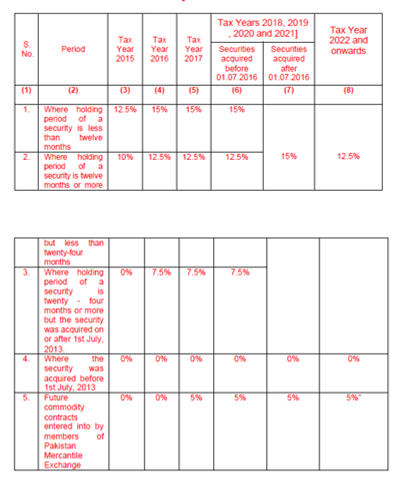
    The federal government has implemented capital gains tax (CGT) ranging up to 15 percent on the disposal of immovable properties within one year of purchase.

    (more…)
  • Tax imposed on deemed income from immovable properties

    Tax imposed on deemed income from immovable properties

    ISLAMABAD: A tax rate at 20 per cent has been imposed on deemed income from immovable properties through a new section introduced to Income Tax Ordinance, 2001.

    The government announced federal budget 2022/2023 on June 10, 2022 and introduced new tax on a person having more than one immovable property.

    A person having more than one immovable property which values above Rs25 million shall be treated as five per cent of rental income of fair market value.

    READ MORE: Pakistan amends tax laws for foreign digital transfers

    Through the Finance Bill, 2022 a new Section 7E has been introduced to Income Tax Ordinance, 2001 for the purpose.

    Following is the tax of the proposed Section through the Finance Bill, 2022:

    “7E. Tax on deemed income.– (1) Notwithstanding anything contained in the Ordinance, for tax year 2022 and onwards, a tax shall be imposed at the rates specified in Division VIIIC of Part-I of the First Schedule, on the income specified in this section.

    READ MORE: Pakistan imposes tax on high net-worth individuals

    (2) A resident person shall be treated to have received rent equal to five percent of the fair market value of an immoveable property situated in Pakistan whether such property has actually been rented out for any consideration or not.

    (3) This section shall not apply to –

    (a) one self-owned immovable property;

    (b) self-owned business premises from which business is carried out;

    (c) self-owned agriculture land where agriculture activity is carried out by person but does not include farmhouse and land annexed thereto;

    (d) where the fair market value of the property or properties, in aggregate, excluding properties mentioned in clauses (a), (b) and (c) does not exceed twenty five million Rupees;

    READ MORE: Finance Bill defines beneficial owner under tax laws

    (e) a Provincial Government, a Local Government, a local authority or a development authority;

    (f) land development and construction projects of builders and developers registered with Directorate General of Designated Non-Financial Businesses and Professions of Board;

    (g) a property which is subject to tax under section 15 of the Ordinance and the tax chargeable is more than tax chargeable under this section:

    Provided that if tax chargeable under section 15 is less than the tax chargeable under this section so much of the amount of tax which is in excess of tax chargeable under section 15 shall be paid under this section

    (4) The Federal Government may include or exclude any person or property for the purpose of this section.”

    According to the Finance Bill, 2022 the rate of tax under section 7E shall be 20 per cent.

    READ MORE: Pakistan reduces salary tax slabs to 7 in budget 2022/23

  • Pakistan amends tax laws for foreign digital transfers

    Pakistan amends tax laws for foreign digital transfers

    ISLAMABAD: Pakistan has amended tax laws related to digital transfers of money to non-residents for various financial services.

    The country on June 10, 2022 presented its federal budget for the fiscal year 2022/2023. The amendment has been brought into the Income Tax Ordinance, 2001 through Finance Bill, 2022.

    READ MORE: Pakistan imposes tax on high net-worth individuals

    A number of amendments have been proposed to Section 6 of the Income Tax Ordinance, 2001:

    Following the Section 6 of the ordinance with proposed amendments in (Bold):

    6. Tax on certain payments to non-residents.— (1) Subject to this Ordinance, a tax shall be imposed, at the rate specified in Division IV of Part I of the First Schedule, on every non-resident person who receives any Pakistan source royalty, fee for offshore digital fee for money transfer operations, card network services, payment gateway services, interbank financial telecommunication services or fee for technical services.

    (2) The tax imposed under sub-section (1) on a non-resident person shall be computed by applying the relevant rate of tax to the gross amounts of receipts mentioned in sub-section (1).

    (3) This section shall not apply to —

    READ MORE: Finance Bill defines beneficial owner under tax laws

    (a) any royalty where the property or right giving rise to the royalty is effectively connected with a permanent establishment in Pakistan of the non-resident person;

    (b) any fee where the services giving rise to the fee are rendered through a permanent establishment in Pakistan of the nonresident person; or

    (c) any royalty or fee for technical services that is exempt from tax under this Ordinance.

    (4) Any Pakistani-source royalty, or fee received by a non-resident person to which this section does not apply by virtue of clause (a) or (b) of sub-section (3) shall be treated as income from business attributable to the permanent establishment in Pakistan of the person.

    Following is the existing text of Section 6 of Income Tax Ordinance, 2001:

    READ MORE: Pakistan reduces salary tax slabs to 7 in budget 2022/23

    6. Tax on certain payments to non-residents.— (1) Subject to this Ordinance, a tax shall be imposed, at the rate specified in Division IV of Part I of the First Schedule, on every non-resident person who receives any Pakistan source royalty, fee for offshore digital services or fee for technical services.

    (2) The tax imposed under sub-section (1) on a non-resident person shall be computed by applying the relevant rate of tax to the gross amount of the royalty, fee for offshore digital services] or fee for technical services.

    (3) This section shall not apply to —

    (a) any royalty where the property or right giving rise to the royalty is effectively connected with a permanent establishment in Pakistan of the non-resident person;

    READ MORE: Massive cut in subsidies to curtail current expenditures

    (b) any fee for technical services or fee for offshore digital services where the services giving rise to the fee are rendered through a permanent establishment in Pakistan of the nonresident person; or

    (c) any royalty or fee for technical services that is exempt from tax under this Ordinance.

    (4) Any Pakistani-source royalty, fee for offshore digital services or fee for technical services received by a non-resident person to which this section does not apply by virtue of clause (a) or (b) of sub-section (3) shall be treated as income from business attributable to the permanent establishment in Pakistan of the person.

  • Pakistan imposes tax on high net-worth individuals

    Pakistan imposes tax on high net-worth individuals

    ISLAMABAD: Pakistan has imposed an additional rate of tax on high net-worth individuals for poverty alleviation.

    The country on June 10, 2022 presented its federal budget for the fiscal year 2022/2023. The budget was presented amid severe financial crisis.

    READ MORE: Finance Bill defines beneficial owner under tax laws

    Finance Minister Miftah Ismail urged the high income earner to contribute toward poverty reduction by paying additional amount of tax.

    A separate section has been introduced to the Income Tax Ordinance, 2001 to levy additional tax on persons earning more than Rs300 million in a year.

    READ MORE: Pakistan reduces salary tax slabs to 7 in budget 2022/23

    Finance Bill, 2022 has proposed insertion of a new Section 4C to Income Tax Ordinance, 2001 for the purpose:

    “4C. Tax on high earning persons for poverty alleviation.― (1) A tax shall be imposed for poverty alleviation for tax year 2022 and onwards at the rates specified in Division IIB of Part I of the First Schedule, on income of every person.

    (2) For the purposes of this section, “income” shall be the sum of the following:—

    READ MORE: Massive cut in subsidies to curtail current expenditures

    (i) profit on debt, dividend, capital gains, brokerage and commission;

    (ii) taxable income (other than brought forward depreciation and brought forward business losses) under section 9 of the Ordinance, if not included in clause (i);

    (iii) imputable income as defined in clause (28A) of section 2 excluding amounts specified in clause (i); and

    (iv) income computed, other than brought forward depreciation, brought forward amortization and brought forward business losses under Fourth, Fifth and Seventh Schedules.

    READ MORE: Petroleum levy to generate Rs750 billion

    (3) The tax payable under sub-section (1) shall be paid, collected and deposited on the date and in the manner as specified in sub-section (1) of section 137 and all provisions of Chapter X of the Ordinance shall apply.

    (4) Where the tax is not paid by a person liable to pay it, the Commissioner shall by an order in writing, determine the tax payable, and shall serve upon the person, a notice of demand specifying the tax payable and within the time specified under section 137 of the Ordinance.

     (5) Where the tax is not paid by a person liable to pay it, the Commissioner shall recover the tax payable under sub-section (1) and the provisions of Part IV, X, XI and XII of Chapter X and Part I of Chapter XI of the Ordinance shall, so far as may be, apply to the collection of tax as these apply to the collection of tax under the Ordinance.

    READ MORE: FBR assigned tax collection target of Rs7 trillion in 2022/2023

    (6) The Board may, by notification in the official Gazette, make rules for carrying out the purposes of this section.

    Tax on high earning persons for poverty alleviation

    The rate of tax under section 4C shall be:-

    Income under section 4CRate of tax
    Where income does not exceed Rs. 300 million0% of the income
    Where income exceeds Rs. 300 million2% of the income
  • Finance Bill defines beneficial owner under tax laws

    Finance Bill defines beneficial owner under tax laws

    ISLAMABAD: The Finance Bill 2022 has defined ‘beneficial owner’ for the purpose of treatment of tax under Income Tax Ordinance, 2001.

    Amendments have been proposed in the Section 2 of the Income Tax Ordinance, 2001 through introduction of Finance Bill, 2022 on June 10, 2022.

    READ MORE: Pakistan reduces salary tax slabs to 7 in budget 2022/23

    A new clause 7A has been inserted to Section 2 to define beneficial owner.

    According to the proposed amendment:

    “(7A) “beneficial owner” means a natural person who –

    READ MORE: Massive cut in subsidies to curtail current expenditures

    (a) ultimately owns or controls a Company or association of persons, whether directly or indirectly, through at least ten percent shares or voting rights; or

    (b) exercise ultimate effective control, through direct or indirect means, over the company or association of persons including control over the finances or decisions or other affairs of the company or association of persons;”

    READ MORE: Petroleum levy to generate Rs750 billion

    Another amendment has also been introduced in the Section 2 of the Ordinance to define distributor. According to:

    “(18A) “distributor” means a person appointed by a manufacturer, importer or any other person for a specified area to purchase goods from him for further supply;”

    READ MORE: FBR assigned tax collection target of Rs7 trillion in 2022/2023

  • Pakistan reduces salary tax slabs to 7 in budget 2022/23

    Pakistan reduces salary tax slabs to 7 in budget 2022/23

    ISLAMABAD: Pakistan has reduced the number of tax slabs for salaried persons through Finance Bill 2022 in the budget 2022/2023.

    According to the Finance Bill, 2022 the government announced the reduction of salary tax slabs as well as incentive in tax payment for persons falling in the income range of Rs600,000 to Rs1.2 million.

    READ MORE: Massive cut in subsidies to curtail current expenditures

    Pakistan on June 10, 2022 presented its federal budget for the fiscal year 2022/2023. The budget carried several relief and taxation measures.

    Finance Minister Miftah Ismail during his budget speech announced that the basic exemption for salaried persons has been increased to Rs1.2 million from Rs600,000.

    READ MORE: Petroleum levy to generate Rs750 billion

    As per income tax laws, the exempt income is not required to file income tax return and declaration of assets.

    However, the Finance Bill, 2022 has clearly mentioned that the basic exemption from income tax for salaried persons is remained Rs600,000. However, persons falling in the income range of Rs600,000 and Rs1.2 million are required to pay a token amount of Rs100 as income tax on annual basis.

    READ MORE: FBR assigned tax collection target of Rs7 trillion in 2022/2023

    Therefore, it will be mandatory for persons falling under this income range to file income tax returns and declaration of assets. Besides, they will also be selected for audit.

    Apart from this important amendment, the Finance Bill, 2022 also proposed to reduce the salary income slabs for the purpose of tax collection.

    READ MORE: Budget 2022/2023: Salient features of customs duty act

    Following are proposed and existing income slabs and tax rates:

    Salary income slabs and tax rates proposed through Finance Bill, 2022:

    S#Taxable IncomeRate of Tax
    (1)(2)(3)
    1.Where taxable income does not exceed Rs. 600,0000
    2.Where taxable income exceeds Rs. 600,000 but does not exceed Rs. 1,200,000Rs. 100
    3.Where taxable income exceeds Rs. 1,200,000 but does not exceed Rs. 2,400,0007% of the amount exceeding Rs. 1,200,000
    4.Where taxable income exceeds Rs. 2,400,000 but does not exceed Rs. 3,600,000Rs. 84,000 + 12.5% of the amount exceeding Rs. 2,400,000
    5.Where taxable income exceeds Rs. 3,600,000 but does not exceed Rs. 6,000,000Rs. 234,000 + 17.5% of the amount exceeding Rs. 3,600,000
    6.Where taxable income exceeds Rs. 6,000,000 but does not exceed Rs. 12,000,000Rs. 654,000 + 22.5% of the amount exceeding Rs. 6,000,000
    7.Where taxable income exceeds Rs. 12,000,000Rs. 2,004,000 + 32.5% of the amount exceeding Rs. 12,000,000.”

    Following are the rates of tax for salaried persons during tax year 2022 (July 01, 2021 – June 30, 2022):

    (2) Where the income of an individual chargeable under the head “salary” exceeds seventy-five per cent of his taxable income, the rates of tax to be applied shall be as set out in the following table, namely:—

    1. Where taxable income does not exceed: Rs. 600,000 0%

    2. Where taxable income exceeds Rs. 600,000 but does not exceed Rs. 1,200,000: 5% of the amount exceeding Rs. 600,000

    3. Where taxable income exceeds Rs. 1,200,000 but does not exceed Rs. 1,800,000: Rs. 30,000 plus 10% of the amount exceeding Rs. 1,200,000

    4. Where taxable income exceeds Rs. 1,800,000 but does not exceed Rs. 2,500,000: Rs. 90,000 plus 15% of the amount exceeding Rs. 1,800,000

    5. Where taxable income exceeds Rs.2,500,000 but does not exceed Rs. 3,500,000: Rs. 195,000 plus 17.5% of the amount exceeding Rs. 2,500,000

    6. Where taxable income exceeds Rs. 3,500,000 but does not exceed Rs. 5,000,000: Rs. 370,000 plus 20% of the amount exceeding Rs. 3,500,000

    7. Where taxable income exceeds Rs. 5,000,000 but does not exceeds Rs. 8,000,000: Rs. 670,000 plus 22.5% of the amount exceeding Rs. 5,000,000

    8. Where taxable income exceeds Rs. 8,000,000 but does not exceeds Rs. 12,000,000: Rs. 1,345,000 plus 25% of the amount exceeding Rs. 8,000,000

    9. Where taxable income exceeds Rs. 12,000,000 but does not exceeds Rs. 30,000,000: Rs. 2,345,000 plus 27.5% of the amount exceeding Rs. 12,000,000

    10. Where taxable income exceeds Rs. 30,000,000 but does not exceeds Rs. 50,000,000: Rs. 7,295,000 plus 30% of the amount exceeding Rs. 30,000,000

    11. Where taxable income exceeds Rs. 50,000,000 but does not exceeds Rs. 75,000,000: Rs. 13,295,000 plus 32.5% of the amount exceeding Rs. 50,000,000

    12. Where taxable income exceeds Rs. 75,000,000 Rs. 21,420,000 plus 35% of the amount exceeding Rs. 75,000,000]