Category: Finance

Explore finance-related stories with Pakistan Revenue, your source for the latest updates on Pakistan’s economy, financial trends, and market insights. Stay informed with real-time economic developments.

  • Fiscal reforms to help Pakistan generate funding to meet SDGs targets: IMF official

    Fiscal reforms to help Pakistan generate funding to meet SDGs targets: IMF official

    KARACHI: The ongoing fiscal reform in Pakistan will help the country to generate funding to meet Sustainable Development Goals (SDGs) targets under the UN 2030 agenda, said Athanasios Arvanitis, Deputy Director of the International Monetary Fund (IMF).

    Referring to the IMF program with Pakistan, Arvanitis remarked that it is important for the government to focus on meeting the Sustainable Development Goals (SDGs) under the UN’s 2030 Agenda.

    He noted that ongoing fiscal reforms will not only put Pakistan’s public debt path on a sustainable footing but also build the foundation for providing crucial funding to meet these targets.

    He was addressing a seminar on ‘Managing Crises in Emerging Markets’ hosted by State Bank of Pakistan (SBP) a day earlier, a press statement issued on Saturday.

    Athanasios Arvanitis highlighted some of the main similarities of crises across emerging markets, notably the role typically played by elevated levels of debt, high public and external deficits, inflexible exchange rates, lack of competitiveness, low saving and investment, and maturity and currency mismatches.

    Despite these similarities, he emphasized that there was no one-size-fits-all model for managing crises. Instead, the IMF focuses on different dimensions while assisting a country in developing a homegrown stabilization program.

    The approach emphasizes the need to diagnose the roots of a country’s crisis, trends and developments in the balance sheets of various economic agents and their interconnectedness, and country-specific dynamics that affect the political economy of reforms. In terms of designing stabilization programs, Arvanitis stressed the importance of country ownership and measures to provide support for vulnerable segments of the population.

    He also drew parallels for Pakistan from the experiences of managing crises in other emerging countries.

    Referring to the IMF program with Pakistan, Arvanitis remarked that it is important for the government to focus on meeting the Sustainable Development Goals (SDGs) under the UN’s 2030 Agenda. He noted that ongoing fiscal reforms will not only put Pakistan’s public debt path on a sustainable footing but also build the foundation for providing crucial funding to meet these targets.

    In his welcoming remarks, the Governor SBP, Dr. Reza Baqir, stated that the objective of holding the seminar was two-fold. First, to demonstrate that, in addition to its mandate of formulating monetary, exchange rate and financial stability policies, SBP endeavors to facilitate constructive debate on economic issues and is open to diverse points of view. Second, to highlight that Pakistan is not unique and there are many other emerging economies that have also faced economic crises and undergone difficult adjustments.

  • Fiscal deficit narrows at 2.3% in first half 2019/2020

    Fiscal deficit narrows at 2.3% in first half 2019/2020

    KARACHI: The ministry of finance on Friday said that the fiscal deficit narrowed at 2.3 percent of the GDP during first half (July – December) 2019/2020 as compared with 2.7 percent in the corresponding half of the last fiscal year.

    Analysts at Topline Securities said importantly though, the primary balance during the period clocked in at 0.7 percent of GDP (last year was -0.3 percent of GDP), within the target of 0.6 percent set by the IMF.

    In the second quarter of 2019/2020, the fiscal deficit came in at 1.6 percent of GDP compared to first quarter of current fiscal year deficit of 0.7 percent of GDP.

    All the four provinces recorded a budgetary surplus during the first half and second quarter of the current fiscal year.

    During the first half of 2019/2020, total revenues increased by 39 percent YoY, where the improvement was led by 18 percent YoY higher tax revenues (however less than targeted) and 213 percent YoY higher non-tax revenues.

    Looking into further breakup of revenues, government collected 17 percent YoY higher Direct taxes, 24 percent YoY higher Sales Tax and 68 percent YoY higher Petroleum Levy during first half of the current fiscal year.

    The government hugely benefited from 575 percent YoY higher profits from State Bank of Pakistan (SBP) in the first half of the current fiscal year (also 31 percent QoQ higher in the second quarter of the current fiscal year), which is around 0.8 percent of GDP.

    The fees fetched through the auction of telecom licenses (PTA profits: 607 percent YoY higher in the first half of the current fiscal year) also helped the government achieve the primary balance target.

    On the expenditures front, total expenses increased by 26 percent YoY. Current expenditures increased by 25 percent YoY, where Mark-up Payments were up 46 percent YoY and Defense expenses were up 10 percent YoY. Excluding these items, government’s own expenses increased by 17 percent YoY during the first half of the current fiscal year (also up 49 percent QoQ in second quarter of the current fiscal year).

    _ The development expenditure remained healthy, where growth of 28 percent YoY was witnessed in 1HFY20 and 122 percent QoQ in 2QFY20.

  • Pak-Turkey joint working group finalizes MoUs on trade facilitation

    Pak-Turkey joint working group finalizes MoUs on trade facilitation

    ISLAMABAD: The Joint Working Group on Trade and Investment of Pakistan and Turkey was held here on Thursday under the 6th HLSCC.

    Both sides reviewed the existing bilateral trade and agreed to increase the level of economic engagement to mobilize the untapped potential for increasing trade and investment.

    Two MoUs have been finalized by the Joint Working Group: one on Trade Facilitation and Customs Cooperation, and the other to reinforce cooperation in the field of Halal Accreditation.

    Both sides agreed to explore the possibilities of enhancing bilateral trade by mutually beneficial market access and trade facilitation.

    Both sides also agreed to encourage their businessmen to establish Joint Ventures in Industrial Sectors and cooperate in the field of E-Commerce.

    The Ministry of Commerce and Trade Development Authority of Pakistan (TDAP) organised Pakistan-Turkey Business-to-Business (B2B) networking Session on 13th February, 2020 at Islamabad.

    The event was formally inaugurated by Sardar Ahmad Nawaz Sukhera, Secretary, Ministry of Commerce.

    The Secretary welcomed the delegates and emphasized that the warm bilateral relations need to be translated into economic gains for both countries. Later, Prime Minister’s Advisor for Commerce, Abdul Razak Dawood, also visited the venue and met each Turkish delegate.

    He assured them of Ministry of Commerce’s full support for in working in Pakistan and with Pakistani companies.

    The B2B meetings were held in the Engineering, Energy, Tourism, Construction, Defence, Automotive, Chemicals and IT sectors. Around 450 fruitful B2B Meetings were conducted between the visiting Turkish Companies and their Pakistani business counterparts.

  • Pakistan’s forex reserves increase by $91 million

    Pakistan’s forex reserves increase by $91 million

    KARACHI: Pakistan’s liquid foreign exchange reserves have increased by $91 million to $18.735 billion by week ended February 07, 2020, State Bank of Pakistan (SBP) said on Thursday.

    The foreign exchange reserves were at $18.644 billion by week ended January 31, 2020.

    The foreign exchange reserves of the central bank increased by $157 million to $12.431 billion by week ended February 07, 2020 as compared with $12.274 billion a week ago.

    However, the foreign exchange reserves held by commercial banks fell by $66 million to $6.304 billion by week ended February 07, 2020 as compared with $6.37 billion a week ago.

  • Remittances increase to $13.3 bn in seven months

    Remittances increase to $13.3 bn in seven months

    KARACHI: The overseas Pakistani workers have sent $13.3 billion as remittances during first seven months (July – January) of 2019/2020, showing 4.1 percent growth when compared with same period of the last fiscal year.

    The overseas Pakistani had sent $12.774 billion in the first seven months of the last fiscal year, State Bank of Pakistan (SBP) said on Wednesday.

    The remittances during January 2020 were $ 1,907.3 million, shows an increase of $163.2 million or 9.3 percent growth over remittance received during corresponding month of 2019 $1,744.1 million.

    During January 2020, larger amounts of Workers’ Remittances received from Saudi Arabia, UAE, USA and UK with US $ 433.4 million, US $ 395.5 million, US $ 335.1 million and US $ 299.1 million recorded a decline of 8.4 percent, 7.5 percent, 6.3 percent and 7.9 percent respectively as compared to December 2019.

  • Prime minister welcomes Pepsico’s investment plans

    Prime minister welcomes Pepsico’s investment plans

    ISLAMABAD: Prime Minister Imran Khan has appreciated PepsiCo proposed future investment plans in Pakistan.

    CEO Pepsi Africa, Middle East & South Asia Eugene Willemsen called on Prime Minister Imran Khan in Islamabad on Wednesday.

    Prime Minister Imran Khan appreciated the existing business venture of Pepsico as well as its proposed future investment plans in Pakistan.

    The prime minister observed that the investment friendly policies of the present Government offer immense opportunities for foreign investors to expand their business in diverse fields.

    The prime minister welcomed the commitment of Pepsico towards social development of Pakistan and said that the Government would extend all possible facilitation to the Company for expansion of its business, including in the agriculture sector.

    Prime Minister Imran Khan also discussed with the Eugene Willemsen the possibility of development of the dairy sector of Pakistan owing to huge potential of the country in the dairy sector.

    Adviser to PM Abdul Razak Dawood and Chairman BOI Syed Zubair Haider Gilani were also present during the meeting.

    Eugene Willemsen apprised the Prime Minister of Pepscico’s existing investment portfolio in Pakistan employing around 60000 individuals directly as well as indirectly, and a network of approximately 700000 retailers across the country who rely on Pepsico products to make a living.

    Willemsen informed that Pepsico is amongst the highest taxpayers in Pakistan.

    Highlighting the recent investments, including the successful inauguration of a new snacks plant in Multan, the CEO said that the Company has made investment to increase the capacity of its bottling plants and expanded its retail, distribution networks that have increased the number of jobs, generated additional economic activity and increased revenue for the Government.

    Sharing Pespsico’s commitment to the social development of Pakistan through various social projects, Willemsen expressed willingness to bring projects aimed at enhancing employment opportunities for Pakistan’s talented youth.

    Eugene Willemsen especially expressed his interest in the development of potato crop in Pakistan through efficient irrigation system, and water conservation.

    While recalling Queen Maxima of Netherlands’ visit to Pakistan last year, the CEO also highlighted the company’s efforts for women empowerment and their financial inclusion aimed at uplift of society and growth in the country.

  • Pulses prices fall up to Rs20/kg in wholesale market

    Pulses prices fall up to Rs20/kg in wholesale market

    KARACHI: Prices of pulses have come down up to Rs20 per kilogram in wholesale market due to lower demand and improved supply, market sources said.

    Anis Majeed, patron in chief, Karachi Wholesale Grocer’s Association (KWGA) and Malik Zulfiqar Ali, chairman, in a statement on Tuesday, said pulses prices have decreased in the market by 10 to 20 rupees per kg.

    KWGA Leaders said due to low demand and huge supply of pulses, Dal Chana price has reduced by 20 rupees from Rs150 per kg to Rs130.

    Similarly, the price of Dal Masoor has reduced by 15 rupees from Rs. 115 to Rs. 100 per kg, dal mash price has reduced by 20 rupees from Rs.185 to 165 rupees per kg, dal moong price has reduced by 10 rupees from Rs.220 to 210 rupees per kg and white chana price has reduced by 10 rupees from Rs.110 to 100 rupees per kg.

    Anis Majeed and Malik Zulfiqar Ali have asked retailers to cut down on retail prices and benefit consumers by providing relief to the masses in the recent inflation and prove that they are a responsible trader.

  • ECC bans sugar export to control prices

    ECC bans sugar export to control prices

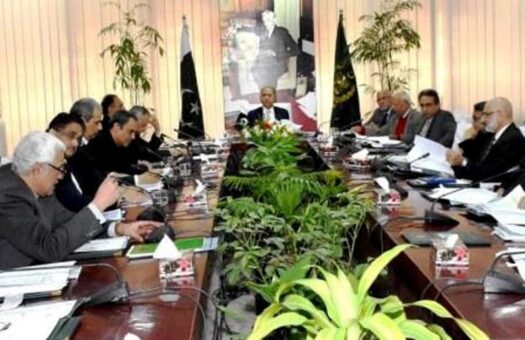
    ISLAMABAD: The Economic Coordination Committee (ECC) of the Cabinet on Monday banned the export of sugar to maintain the prices in domestic market.

    (more…)
  • PBS rules out fudging in inflation figures

    PBS rules out fudging in inflation figures

    ISLAMABAD – The Pakistan Bureau of Statistics (PBS) categorically rejected allegations of fudging in inflation figures, addressing concerns raised in some sections of the electronic and print media.

    (more…)