Category: Finance

Explore finance-related stories with Pakistan Revenue, your source for the latest updates on Pakistan’s economy, financial trends, and market insights. Stay informed with real-time economic developments.

  • Overseas Pakistanis send $11.4 billion during first half

    Overseas Pakistanis send $11.4 billion during first half

    KARACHI: Overseas Pakistanis have sent $11.4 billion during first half (July – December) 2019/2020, which is 3.31 percent higher than remittances received in the same period of the last fiscal year, State Bank of Pakistan (SBP) said on Saturday.

    The central bank said that overseas Pakistani workers remitted $11.4 billion in the first half (July to December) of FY20, showing a growth of 3.31 percent compared with $11.03 billion received during the same period in the preceding year.

    During December 2019, the inflow of workers’ remittances amounted to $ 2097.23 million, which is 15.25 percent higher than November 2019 and 20 percent higher than December 2018.

    The country wise details for the month of December 2019 show that inflows from Saudi Arabia, UAE, USA, UK, GCC countries (including Bahrain, Kuwait, Qatar and Oman) and EU countries amounted to $ 472.94 million, $ 427.56 million, $ 357.45 million, $ 324.57 million, $ 205.73 million and $ 56.42 million respectively compared with the inflow of $ 414.59 million, $ 351.19 million, $ 276.29 million, $ 267.79 million, $ 174.42 million and $ 47.48 million respectively in December 2018.

    Remittances received from Malaysia, Norway, Switzerland, Australia, Canada, Japan and other countries during December 2019 amounted to $ 252.56 million together as against $ 216.35 million received in December 2018.

  • Economy likely to grow better than World Bank forecast

    Economy likely to grow better than World Bank forecast

    ISLAMABAD: The finance ministry on Thursday said that the economy likely to grow better than forecast of World Bank.

    The ministry said that the government’s extensive measures have helped the economy move progressively along the adjustment path and stabilization process and economic recovery is expected towards the end of FY2020.

    “The government is focused on bringing improvement in the real sector growth through inclusive growth in agriculture, industrial and services sectors,” said a statement by the Finance Division in response to certain news reports carried in a section of the regarding downward revision of growth by the World Bank.

    The government is cognizant of challenges and stringently focused on resolving them particularly, reducing inflation, creating job opportunities and achieving high growth rate.

    “Keeping in view the positive developments on major economic indicators, we expect that the economy will likely to achieve better growth prospects as against the projections of the World Bank.”

    The World Bank in its report ‘2020 Global Economic Prospects’ had forecasted Pakistan`s current year growth rate at 2.4 percent before touching 3 percent next fiscal year and 3.9 percent in FY2022.

    The bank’s report had also mentioned that the growth had decelerated an estimated 3.3 percent in FY2018-19, reflecting a broad-based weakening in domestic demand.

    In addition, the report had described that significant depreciation of the Pakistani rupee resulted in inflationary pressures, monetary policy tightening restricted access to credit, curtailing public investment to deal with large twin deficits and budget deficit rose more sharply than expected.

    It may be pointed out that during FY2019, the slowdown in economy was largely attributed to various policy measures to manage the twin deficit crisis. Consequently, these measures helped to contain demand pressures and contributed to import compression.

    However, the outcomes of these measures were realized on the industrial sector.

    Particularly LSM sector witnessed a negative growth. At the same time, high input costs along with water shortages weakened agriculture sector’s output and hence, the drag in the commodity-producing segments spilled over to the services sector as well.

    Resultantly, the real GDP growth recorded at 3.3 percent. At the start of current fiscal year, with government’s extensive measures, Pakistan’s economy is now moving progressively along the adjustment path and stabilization process; however towards the end of FY2020, economic recovery is expected. In this regard, Government is focused on bringing improvement in the real sector growth through inclusive growth in agriculture, industrial and services sectors.

    For growth in agriculture sector, the target production of wheat is 27 million tons given by FCA in last meeting held in October. In addition to uplift agriculture sector “National Agriculture Emergency Programme” in coordination with all provinces has been introduced and approved 13 mega projects at the cost of Rs 287 billion.

    Agriculture credit disbursement target for CFY20 has been set at Rs.1,350 billion. Agriculture credit disbursement increased by 20 percent to Rs 482 billion during Jul-Nov, FY2020 against Rs.402 billion last year. To boost industrial sector, the government is providing a series of subsidies and incentives to industrial sector.

    These include subsidies to industry for electricity and gas, export development package and continue to provide Long-Term Trade Financing (LTFF) and Export-Refinancing Scheme (ERS) at subsidized rate. Similarly, PSDP release process is simplified and up to 3rd January, 2020 Rs.301.4 billion (Rs.225.4 billion) released to encourage construction related industries especially cement & steel.

    In addition, Cement dispatches growth of 6.55 percent (24.8 million) during July-Dec, FY2020 against 23.2 million in the last year. This development would likely stimulate the growth in LSM in coming months. On fiscal side, to control expenditures, government is following austerity measures with complete restriction on supplementary grants.

    For export promotion several initiatives have been announced such as support duty structure on raw materials and intermediate goods, improve mechanism for tax refunds, provide electricity and gas at competitive cost, and make Pakistan part of the global value chain.

    Government’s various measures to stabilize the economy has already started to reap benefits in the form of sustained adjustment in current account deficit (CAD) and continued fiscal prudence.

    A brief review indicates that CAD reduced by 72.9 percent during July-November FY2020, Fiscal deficit contained at 1.6 percent of GDP (Rs 686 billion) during Jul-Nov FY2020 ,Primary balance posted surplus of Rs 117 billion during Jul-Nov, FY2020 (0.3 percent of GDP), significant rise in FBR tax revenues to Rs.2085.2 billion (16.4 percent) during July-December, FY2020, improved ranking in ease of doing business, ranked among the world’s top 10 best business climate improver and ‘Stable’’ credit outlook to B3 from ‘Negative’ by Moody’s is an affirmation of Government’s success in stabilizing the economy and laying a foundation for robust growth.

  • Foreign exchange reserves flat at $18.084 billion

    Foreign exchange reserves flat at $18.084 billion

    KARACHI: The liquid foreign exchange reserves of the country was flat at $18.084 billion by week ended January 03, 2020 as compared with $18.081 billion a week ago, the State Bank of Pakistan (SBP) said on Thursday.

    The foreign exchange reserves held by the central bank increased by $14.3 million to $11.503 billion by week ended January 03, 2020 as compared with $11.489 billion by week ended December 27, 2019.

    The reserves held by commercial banks however declined by $10.9 million to$6.581 billion by week ended January 03, 2020 as compared with $6.592 billion a week ago.

  • ECC constitutes price negotiation committee for TAPI gas pipeline project

    ECC constitutes price negotiation committee for TAPI gas pipeline project

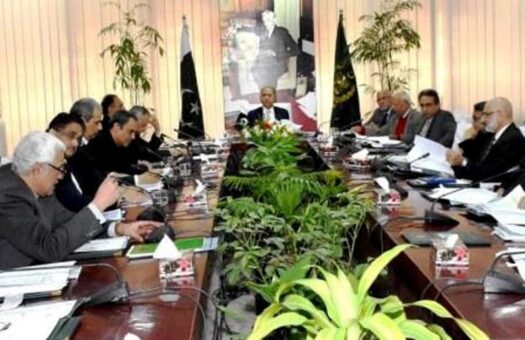
    ISLAMABAD: The Economic Coordination Committee (ECC) of the Cabinet on Wednesday approved the constitution of Price Negotiation Committee (PNC) for TAPI(Turkmenistan-Afghanistan-Pakistan-India) Gas pipeline project.

    Adviser to the Prime Minister on Finance, Dr. Abdul Hafeez Shaikh chaired the meeting of the Cabinet here at the Cabinet Division.

    The PNC shall negotiate the price with Turkmen gas. The Committee shall consist of the following members; Secretary, Ministry of Energy (Petroleum Division) as chairman. Secretary Finance or his nominee, Joint Secretary, Ministry of Energy (Power Division), Director General (Gas)/ Director (Gas) and Managing Director, SSGCL as members.

    The ECC approved the Technical Supplementary Grant of Rs 1.00 billion under demand No.04-Cabinet Division for establishment of Pakistan Tourism Development Endowment Fund under Public account.

    The Chair directed Pakistan Tourism Development Corporation to come up with their tourism development and soft image promotion plan in the next meeting.

    The ECC also granted approval of allocation of Gas from PGNiG’s RIZQ Gas Field to M/S SSGCL. It was briefed to the ECC that currently 2 wells namely Rizq-1 and Rizq -2 are producing 16 MMFCD gas from Rizq gas field, which are allocated to M/s SSGCL, whereas Rizq -3 which is under drilling, is expected to add another 9 to 10 MMCFD gas to the existing production. Upon completion of this well, the cumulative gas production from this gas field is expected to raise upto 25 MMCFD. The price of the gas shall be according to the applicable Petroleum Policy.

    On the Demand moved by the Ministry of Industries and Production for Rs 3.02 billion for the payment of outstanding dues of SSGC Private Limited by Pakistan Steel Mills on account of gas bills, the ECC directed to constitute a three-member Committee under the Chairmanship of Secretary Finance to find out a feasible solution for the issue so that the already allocated budget may not be exceeded and the liabilities of both SSGC and PSM are duly settled.

    ECC directed Ministry of Finance to explore the possibilities for improving the liquidity position of Pakistan State Oil as exchange losses of around Rs 28 billion have incurred on FE-25 loans by PSO.

    The loans were acquired under the instructions of Ministry of Finance for financing of import operations of PSO.

    Finance Ministry assured the ECC of utilization of possible all funding options in the ongoing financial year and any deficiency in the funds shall be entertained in the upcoming budget.

    ECC granted extension of Government of Pakistan guarantee against credit facility of National Bank of Pakistan amounting to Rs5 billion in favor of Utility Stores Corporation of Pakistan.

    On the request of the Ministry of Water Resources ECC granted approval to WAPDA to raise loan for the settlement of the Financial Facility amounting to Rs17.500 billion with one-year tenure and GoP guarantee.

    Clearance under Prudential Regulations R-4(clause 1a and 2) from the State Bank of Pakistan to disburse the facility initially against a letter of comfort was also granted.

  • SECP drafts framework to facilitate startups in Pakistan

    SECP drafts framework to facilitate startups in Pakistan

    ISLAMABAD: Securities and Exchange Company of Pakistan (SEC Pakistan) has issued draft regulatory framework to facilitate startups in the country.

    The SECP said that with the objective to promote growth in the startups sector of Pakistan, it is necessary to make relevant changes in Company Law to facilitate the incorporation process for the startups and provide a conducive regulatory environment.

    A) Proposed changes in the Parent legislation (Companies Act)

    i) Definition of Startups

    In the Third Schedule to the Companies Act, the following category is proposed to be added:

    An entity shall be considered as a Startup:

    a) Upto a period of 10 years from the date of incorporation/registration

    b) Turnover of the entity for any of the financial years since incorporation/registration is not greater than 100 Million Rupees

    c) Entity is working towards innovation, development or improvement of products or processes or services, or if it is a scalable business model with a high potential of employment generation or wealth creation.

    Provided further that an entity formed by splitting up or reconstruction of an existing entity or a separate company with similar objects and ownership shall not be considered a “Startup Company”

    i) Amendment in the Section “83 – Further issue of capital” to offer “Employee Stock Option Scheme (ESOS)” shall help address the employee retention and reward issues being faced by startups.

    The following new proviso is proposed to be added:

    “Provided that the directors of private limited company may allot the declined or unsubscribed shares to its employees under “Employees Stock Option Scheme”, on such conditions, as may be specified.”

    ii) Amendment in the clause “88 – Power of a company to purchase its own shares” shall facilitate ESOS option and shall facilitate buy back of shares by companies, since they do not have a secondary market. It would also facilitate startups in case, any founding member needs to exit from the company by allowing return of shares to a company.

    B) Changes required in Companies (Further Issue of Shares) Regulations, 2018

    i) Amendment in the clause “7. Application to the Commission for issue of shares other than right” is a consequential change whereby no application for approval shall be required to be made to the Commission under Section 83 of the Act, by a Private Company, and shall only be required to maintain and file the documents with the Commission not later than two months from the decision to issue such shares, as specified in sub-regulation (2) below.

    ii) Conditions for issuance of shares with differential rights

    The requirement for the company not to default in filing financial statements and annual returns for three financial years immediately is being changed to preceding the financial year in which it is decided to issue such shares.

    iii) Furthermore, for a private limited company, the valuation mechanism of non-cash consideration and further conditions, if any, will be amended in Companies (Further Issues of Shares) Regulations, 2018.

    Introduction of Regulatory Sandbox

    Regulatory Sandbox is a tailored regulatory environment for conducting limited scale, live tests of innovative products, services, processes, and/ or business models in a controlled environment for a limited period of time so as to assess their viability to be launched on full-scale, and to determine the compatible and enabling regulatory environment that will be conducive for the innovative solutions. The objective of these Guidelines is to purposefully meet the above.

    The Regulatory Sandbox is primarily applicable for new products, services or business models which have not been addressed under existing laws and regulations; or these new ideas bring an innovative approach to the market and there exists considerable uncertainty in terms of unexpected adverse outcomes or existing regulatory framework does not fully address the solutions proposed to be experimented through the regulatory sandbox.

  • Investigation launched against 88 housing schemes

    Investigation launched against 88 housing schemes

    ISLAMABAD: Competition Commission of Pakistan (CCP) has initiated investigation against around 88 housing schemes for deceptive marketing practices.

    In a statement on Monday, the CCP said that it had launched the enquiry while taking notice of the widespread concerns and complaints regarding the prima facie deceptive market practices by various housing schemes in Punjab.

    The CCP said that the Lahore Development Authority (LDA) informed through a letter that 88 housing schemes in Lahore and its adjacent district of Kasur, Sheikhupura and Nankana Sahib were luring investors and the general public through print and TV advertisements to invest in their schemes, without meeting the legal requirements and in violation of the pertinent laws.

    The LDA has sought a ban on the advertising campaign of these schemes to save the citizens from financial losses.

    The CCP took suo moto notices and authorized an enquiry team to thoroughly probe the housing schemes and submit the report to the Commission.

    As part of the investigation the team had visited 62 housing schemes to see the situation on ground and was scheduled to visit the remaining housing schemes.

    The team also met the Director General LDA and other concerned officials to enlighten itself about the pertinent issues and explore the ways to cooperate and coordinate in the areas of shared interests.

    The CCP said that Section 10 of the Competition Act prohibits businesses from indulging in deceptive market practices, which also include the distribution of false or misleading information lacking reasonable basis, deceiving the consumers, and harming the business interest of the other undertakings.

    If the violation of Section 10 is proved against the housing schemes, the CCP may issue show cause notices to them, according to the statement.

    The CCP is mandated under the Competition Act to ensure free competition in all spheres of commercial and economic activity, to enhance economic efficiency and to protect consumers from anti-competitive behavior including deceptive market practices.

  • Import bill plunges by 17.06% in first half

    Import bill plunges by 17.06% in first half

    KARACHI: Pakistan’s import bill fell by 17.06 percent during first six months (July – December) 2019/2010 owing to deceleration in international commodity prices and lower domestic demand.

    According to data released by the ministry of commerce, the import bill reduced to $23.18 billion during first half of current fiscal year as compared with $27.94 billion in the corresponding half of the last fiscal year.

    The exports exhibited 3.21 percent growth during the period under review owing to better earning of local manufacturers in the international markets.

    The total exports were at $11.54 billion during July – December 2019/2020 as compared with $11.18 billion in the corresponding period of the last fiscal year.

    The lower import bill brought down the trade deficit by 30.58 percent for the period under review.

    The trade deficit declined to $11.64 billion during July-December 2019/2020 as compared with the deficit of $16.77 billion in the corresponding period of the last fiscal year.

    According to trade data for the period July – December 2019/2020 revealed that the import of motor cars in completely build unit (CBU) fell by 80 percent to $31 million as compared with $156 million.

    While import of CKD (Completely Knocked Down) motor cars fell by 46 percent to $229 million in first six months of current fiscal year as compared with $426 million in the same period of the last fiscal year.

    The import of petroleum crude declined by 30 percent to $1.7 billion during first six months of current fiscal year as compared with $2.42 billion in the corresponding months of the last fiscal year.

    While import of petroleum products fell by 24 percent to $2.59 billion during July – December 2019/2020 when compared with $3.41 billion in the same period of the last fiscal year.

    According to top performing export items, basmati rice posted 56 percent increased to $380.2 million during first six months of current fiscal year when compared with $244 million in the corresponding period of the last fiscal year.

    Export of meat posted 52 percent growth to $155.9 million during July – December 2019/2020 when compared with $103 million in the corresponding period of the last fiscal year.

    The exports of readymade garments registered increase of 12 percent to $1.41 billion during first half of current fiscal year as compared with $1.26 billion in the same half of the last fiscal year.

  • Achieving 4% GDP growth target unlikely: SBP

    Achieving 4% GDP growth target unlikely: SBP

    The State Bank of Pakistan (SBP) issued a cautionary statement on Monday, stating that achieving the targeted 4 percent GDP growth for the current fiscal year is unlikely.

    (more…)
  • Pakistan’s foreign exchange reserves increase to $18.081 billion

    Pakistan’s foreign exchange reserves increase to $18.081 billion

    KARACHI: The liquid foreign exchange reserves of the country increased by $486 million to $18.081 by week ended December 27, 2019 as compared with $17.595 billion a week ago, State Bank of Pakistan (SBP) said on Thursday.

    The foreign exchange reserves held by the central bank increased by $582 million to $11.489 billion by week ended December 27, 2019 as compared with $10.907 billion a week ago.

    The SBP attributed the increase to bilateral and multilateral inflows including proceeds of US$ 452.4 million received from IMF under EFF program.

    The foreign exchange reserves held by commercial banks however declined by $95 million to $6.592 billion by week ended December 27, 2019 as compared with $6.687 billion a week ago.