Category: Finance

Explore finance-related stories with Pakistan Revenue, your source for the latest updates on Pakistan’s economy, financial trends, and market insights. Stay informed with real-time economic developments.

  • Pakistan to get Rs38bn from UK agency in Malik Riaz case

    Pakistan to get Rs38bn from UK agency in Malik Riaz case

    KARACHI: Pakistan will get around Rs38 billion (£190 million) after National Crime Agency (NCA) of the United Kingdom agreed settlement after frozen funds investigation into a case of Malik Riaz Hussain.

    According to a press release issued on Tuesday, the settlement includes a UK property valued at approximately £50 million.

    The National Crime Agency has agreed a settlement figure with a family that owns large property developments in Pakistan and elsewhere.

    The £190 million settlement is the result of an investigation by the NCA into Malik Riaz Hussain, a Pakistani national, whose business is one of the biggest private sector employers in Pakistan.

    In August 2019 eight account freezing orders were secured at Westminster Magistrates’ Court in connection with funds totalling around £120 million.

    These followed an earlier freezing order in December 2018 linked to the same investigation for £20 million. All of the account freezing orders relate to money held in UK bank accounts.

    The NCA has accepted a settlement offer in region of £190 million which includes a UK property, 1 Hyde Park Place, London, W2 2LH, valued at approximately £50 million and all of the funds in the frozen accounts.

    The assets will be returned to the State of Pakistan, the statement said.

  • SBP welcomes Moody’s stable outlook on Pakistan

    SBP welcomes Moody’s stable outlook on Pakistan

    KARACHI: State Bank of Pakistan (SBP) on Tuesday welcomed Moody’s change in outlook on Pakistan from negative to stable.

    (more…)
  • Moody’s changes Pakistan’s rating to stable from negative

    Moody’s changes Pakistan’s rating to stable from negative

    SINGAPORE: Moody’s Investors Service on Monday affirmed Pakistan’s outlook rating to stable from negative.

    In a statement the Moody’s said that the change in outlook to stable is driven by Moody’s expectations that the balance of payments dynamics will continue to improve, supported by policy adjustments and currency flexibility. Such developments reduce external vulnerability risks, although foreign exchange reserve buffers remain low and will take time to rebuild.

    Moreover, while fiscal strength has weakened with higher debt levels largely as a result of currency depreciation, ongoing fiscal reforms, including through the country’s International Monetary Fund (IMF) programme, will mitigate risks related to debt sustainability and government liquidity.

    The rating affirmation reflects Pakistan’s relatively large economy and robust long-term growth potential, coupled with ongoing institutional enhancements that raise policy credibility and effectiveness, albeit from a low starting point.

    These credit strengths are balanced against structural constraints to economic and export competitiveness, the government’s low revenue generation capacity that weakens debt affordability, fiscal strength that will remain weak over the foreseeable future, as well as political and still-material external vulnerability risks.

    Concurrently, Moody’s has affirmed the B3 foreign currency senior unsecured ratings for The Second Pakistan Int’l Sukuk Co. Ltd. and The Third Pakistan International Sukuk Co Ltd. The associated payment obligations are, in Moody’s view, direct obligations of the Government of Pakistan.

    Pakistan’s Ba3 local currency bond and deposit ceilings remain unchanged. The B2 foreign currency bond ceiling and the Caa1 foreign currency deposit ceiling are also unchanged. The short-term foreign currency bond and deposit ceilings remain unchanged at Not Prime.

    These ceilings act as a cap on the ratings that can be assigned to the obligations of other entities domiciled in the country.

    Narrowing current account deficits, in combination with enhancements to the policy framework including currency flexibility, lower external vulnerability risks in Pakistan. However, foreign exchange reserve adequacy will take time to rebuild.

    Moody’s expects Pakistan’s current account deficit to continue narrowing in the current and next fiscal year (ending June of each year), averaging around 2.2 percent of GDP, from more than 6 percent in fiscal 2018 (the year ending June 2018) and around 5 percent in fiscal 2019.

  • Pakistan’s trade deficit narrows by 34.42pc in July – November

    Pakistan’s trade deficit narrows by 34.42pc in July – November

    ISLAMABAD: Pakistan’s trade deficit has narrowed by 34.42 percent during first five months (July – November) of current fiscal year owing to improvement in exports, said Abdul Razak Dawood, Adviser to Prime Minister of Pakistan for Commerce, Textile, Industry & Production and Investment, on Sunday.

    In a tweet message, he said that as a result of the same policies of the government, the increasing EXPORTS are contributing to improvement in our Balance of Payments position and stabilization of the economy.

    The trade deficit reduced to $9.496 billion during July – November of current fiscal year as compared with the deficit of $14.479 billion in the corresponding period of the last fiscal year.

    The country’s exports registered five percent growth during the period under review. The exports grew to $9.55 billion during first five months of the current fiscal year as compared with $9.11 billion in the same period of the last fiscal year.

    However, the import bill of the country sharply fell by 19.27 percent during the period. The import bill declined to $19.04 billion during July – November of the current fiscal year as compared with $23.59 billion in the corresponding period of the last fiscal year.

  • ECC approves increase in wheat support price

    ECC approves increase in wheat support price

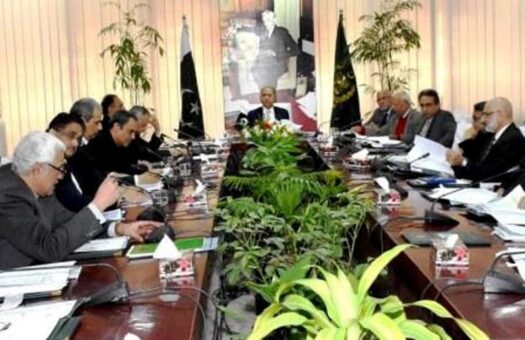
    ISLAMABAD: The Economic Coordination Committee (ECC) of the Cabinet has approved the minimum support price of wheat to Rs1365 per 40 kilograms from Rs1350.

    The ECC, which was chaired by Dr. Abdul Hafeez Shaikh, Adviser to Prime Minister on Finance and Revenue, on Thursday approved the minimum support price of wheat from the previously announced Rs 1350 per 40 kg to Rs 1365 per 40 kg in view of representations from various farmers and growers’ associations as well as the Federal Cabinet and the National Assembly Special Committee on Agricultural Products which had proposed a reconsideration of the minimum support price in order to compensate the farmers in areas where the cost of wheat production had increased to Rs 1349.57 per 40 kg.

    Earlier, the Ministry of National Food Security & Research briefed the ECC on the feedback received from various farmers’ associations as well as different government forums and requested for fixing the minimum support price of wheat at Rs 1400 per 40 kg.

    The ECC deliberated on the proposal at length and in view of the discussion and input regarding the impact of any further increase in wheat price on food inflation and financial impact on the commodity stock operations, decided to raise the minimum support price of wheat to Rs 1365 per 40 kg.

    The ECC also viewed a presentation from the Ministry of Finance on the government commodity operations which had over the years resulted in Rs 757 billion as total debt and liabilities and recommendations for reducing the debt.

    The ECC also considered a proposal from the Ministry of Energy regarding tariff rationalization for power sector in the first quarter of financial year 2019-20 and a approved proposal for notifying the NEPRA approved quarterly adjustment of 15 paisa per unit after incorporating a additional charge of 11 paisa per unit for maintaining uniform tariff on all categories of consumers except lifeline and domestic consumers.

    The increase coming into effect on December 01, 2019 for the next twelve-monthly billing cycle would not be applicable to nearly 20 million using up to 300 units per month, out of the total 30 million consumers while 600,000 of the remaining one million consumers would only pay 7 paisa per unit as a result of this increase.

    The ECC also constituted a committee headed by Adviser to Prime Minister on Finance and Revenue Dr Abdul Hafeez Shaikh and comprising Minister of National Food Security and Research Makhdoom Khusro Bakhtiar, Prime Minister’s Advisor on Commerce and Investment, Abdul Razak Dawood and Special Assistant to Prime Minister on Petroleum Nadeem Babar to examine the current framework of determining power tariff and make it more simple in line with the practice in mature markets.

    The ECC also considered a set of proposals from the Ministry of Energy (Power Division) for risk mitigation post privatisation of National Power Parks Management Company, especially the impact on fuel basket price due to non or reduced off take of 66 per cent generation under the PPA till year 2024 and cost of diversion of Regasified Liquefied Natural Gas (RLNG) to other sectors with workable options to mitigate the risk.

    The ECC discussed the proposals in details and approved them with a proviso that any other option that could be considered as part of the mitigation plan by the Power Division could also be taken into account and approved, if found suitable, by the ECC. To a proposal by the Ministry of Industries and Production, the ECC constituted an inter-ministerial committee under the chairmanship of Minister Planning, Development and Reforms and comprising Adviser to Prime Minister on Industries and Production, Special Assistant to Prime Minister on Petroleum, Secretary Finance, Secretary Industries and Production and Chairman FBR for preparation of a policy framework for promotion of steel and iron in the country through foreign direct investment.

    The ECC also considered a proposal by the Ministry of Communications that all cash development loans and foreign loans, whether direct or relent, including interest accumulated thereon, received up to June 30, 2019 by the National Highway Authority be converted into government grant or the Government of Pakistan may either “write-off” the said loans while for future, all PSDP allocations including relent/direct loans, both rupee and foreign exchange component i.e. for non-commercially viable projects and for strategic/defence roads to NHA may also be provided as government grant.

    The proposal also sought the CDL may be advanced only for commercially feasible projects on which Finance Division and NHA mutually agree regarding the terms and conditions of the loan and its repayment or these viable projects may be undertaken by NHA in PPP/BOT mode of financing.

    The ECC discussed the proposals and in view of input from the members constituted a committee comprising Minister for Planning, Development and Reforms, Secretary Finance, Secretary Communications, Secretary Economic Affairs Division and Deputy Chairman Planning Division to examine the proposals and submit their recommendations to the ECC.

    The ECC also took up a proposal from the Ministry of Industries and Production for a technical supplementary grant of Rs 6 billion to the Utility Stores Corporation (USC) for subsidy and procurement of essential commodities, including flour, ghee/oil, rice, sugar and pulses, to be sold at a fair price to the poor segment of the society.

    The ECC discussed the issue in detail and in view of input from the members, asked the Utility Stores Corporation to prepare within the next few days a practical and comprehensive mechanism involving use of information technology to ensure the disbursement of specific food items to the poorest of the poor.

    The ECC also constituted a committee comprising Adviser to Prime Minister on Industries and Production, Governor State Bank of Pakistan, Benazir Income Support Programme Chairperson and representatives from NADRA and PPRA to advise and assist the USC to firm up their proposals and present them to ECC.

  • Foreign exchange reserves increase by $115 million

    Foreign exchange reserves increase by $115 million

    KARACHI: The liquid foreign exchange of the country increased by $115 million by the week ended November 22, 2019, the State Bank of Pakistan (SBP) said on Thursday.

    The total foreign exchange reserves increased by $115 million to $15.577 billion by week ended November 22, 2019 as compared with $15.462 billion a week ago.

    The foreign exchange reserves held by the central bank increased by $240 million to $8.682 billion by week ended under review as compared with $8.442 billion a week ago.

    The foreign exchange reserves held by commercial banks fell by $125 million to $6.895 billion by week ended November 22, 2019 as compared with $7.020 billion a week ago.

  • International rating agencies visit Pakistan for annual exercise

    International rating agencies visit Pakistan for annual exercise

    ISLAMABAD: International rating agencies Moody’s and Fitch have visited Pakistan for annual credit rating exercise, said a statement issued by ministry of finance on Friday.

    Details of the visit and the last five-year rating assigned to Pakistan by these two rating agencies is contained in the write-up below:

    Recent interaction of the Ministry of Finance with International Credit Rating Agencies. As part of their animal credit rating exercise, Moody’s and Fitch recently visited Islamabad and held detailed discussions with the Ministry of Finance.

    The Government of Pakistan has been maintaining relations with Moody’s since 1994 and with Fitch since 2015 for sovereign as well as Eurobonds and international Sukuk specific rating advice.

    The sovereign credit rating assigned to Pakistan by these two rating agencies in the last five years is:

    Moody’s (Rating / Outlook) Fitch (Rating / Outlook) 2015-16 B3 / Stable B/Stable 2016-17 B3 / Stable B/Stable 2017-18 B3 / Negative B/Negative 2018-19 B3 / Negative B-/Stable 2019-2020 Rating exercise ongoing Rating exercise ongoing While conducting their rating reviews, these rating agencies conduct an indepth analysis of a country’s (i) macroeconomic situation and outlook (ii) competitiveness and reforms agenda (iii) fiscal and revenue developments (iv) debt sustainability (v) monetary regime and foreign exchange reserves positions, and vi) political climate and the law and order situation.

  • Foreign exchange reserves decline by $40 million

    Foreign exchange reserves decline by $40 million

    KARACHI: Pakistan’s liquid foreign exchange reserves have declined by $40 million to $15.462 billion by week ended November 15, 2019 as compared with $15.502 billion a week ago, State Bank of Pakistan (SBP) said on Thursday.

    The foreign exchange reserves held by SBP, however, increased by $45 million to $8.442 billion by week ended November 15, 2019 as compared with $8.397 billion a week ago.

    The reserves held by commercial banks fell by $85 million to $7.020 billion as compared with $7.105 billion a week ago.

  • Share of payment to Chinese imports increases 21.42pc

    Share of payment to Chinese imports increases 21.42pc

    KARACHI: The share of import payment to China has increased to 21.42 percent during first four months (July – October) 2019/2020 as compared with share of 18 percent in the corresponding period of the last fiscal year.

    The total payment for import from China was at $3.14 billion during first four months of current fiscal year out of Pakistan’s total import bill of $14.65 billion for the same period, according to statistics released by State Bank of Pakistan.

    The total payment for import from China was at $3.45 billion in first four months of fiscal year 2018/2019 when total import bill for the period was $19.02 billion.

    The payment for total import bill has registered 23 percent decline to $14.656 billion during first four months of current fiscal year as compared with $19.016 billion in the corresponding months of the last fiscal year.

    The payment for import from China, however, also declined but by 9.14 percent to $3.14 billion during first four months of current fiscal year as compared with $3.45 billion in the same period of the last fiscal year.

    China is remained the largest exporting country for Pakistani markets during the first four months of current fiscal year.

    The United Arab Emirates (UAE) is the second largest exporting country for Pakistani markets during the period under review.

    However, the import payment to UAE fell sharply by 30 percent and stood at $2.44 billion during first four months of current fiscal year as compared with $3.5 billion in the corresponding period of the last fiscal year.

    The share of import payment to UAE in total import payment of Pakistan also fell to 16.68 percent during July – October 2019/2020 as compared with share of 18.44 percent in total import bill in July – October 2018/2019.

    Pakistan has taken several measures during the past couple of years to discourage imports of luxury and non-essential items.

    The decline in import bill during the first four months can be attributed to those measures taken by the government.

  • Cabinet approves gradual reduction in regulatory duty

    Cabinet approves gradual reduction in regulatory duty

    ISLAMABAD: The Federal Cabinet has approved gradual reduction in regulatory duty and additional customs duty under first-ever National Tariff Policy (NTP).

    The federal cabinet, in its meeting chaired by the Prime Minister held on Tuesday November 19, 2019, approved the first-ever National Tariff Policy (NTP).

    The policy guidelines contained in the NTP, as approved by the Cabinet, provide that the tariff slabs will be simplified based on the principle of cascading; tariffs on raw materials, intermediate and capital goods will be gradually reduced; the additional customs duty and regulatory duties will be gradually reduced; the difference in the rates of tariff for the commercial importers and industrial users of raw materials, intermediate and capital goods will be eliminated to provide a level-playing field to the SMEs through competitive access to essential raw materials; the nascent industry will be provided time-bound protection, which will cover the payback period.

    The policy, developed by the commerce division after extensive consultations with the stakeholders, marks a milestone in the national economic policy paradigm by recognizing the importance of employing import tariffs for industrial development and export growth.

    The prime minister, in his remarks during the cabinet meeting, said that the import tariffs have been traditionally employed as a revenue generation tool, which has increased reliance on import tariffs for revenue collection. In accordance with the reform agenda of the government, the economic policy paradigm is now being realigned to leverage tariffs for industrial development.

    The National Tariff Policy aims at removing the anomalies in the tariff structure and making it a reflection of trade policy priorities and enhancement of competitiveness through duty-free access to imported raw materials and promotion of investment into efficient industries through a predictable tariff structure, decided through an institutional mechanism.

    The NTP is based on the principles of (i) employing tariffs as an instrument of trade policy rather than revenue generation, (ii) maintaining vertical consistency through cascading tariff structures (increasing tariff with stages of processing of a product), (iii) providing time-bound ‘strategic protection’ to the domestic industry during the infancy phase, and (iv) promoting competitive import substitution through time-bound protection, which will be phased out to make the industry eventually competitive for export-oriented production.

    The policy will be implemented through a Tariff Policy Board (TPB) chaired by the Commerce Minister/Advisor, with Minister for Industries & Production, Secretary Finance, Secretary Revenue, Chairman FBR, Secretary Commerce, Secretary Board of Investment, and Chairman NTC as its members.

    A Tariff Policy Centre shall be created in the Ministry of Commerce, which will serve as the Secretariat of the TPB.

    Abdul Razak Dawood, Commerce Advisor, stated that the NTP marks a watershed in the country’s economic policy making since it would energize export growth, lead to rapid industrialization, and import substitution through predictability in tariff framework.