Blog

  • Sales tax rates issued for retailers integrated with FBR

    Sales tax rates issued for retailers integrated with FBR

    ISLAMABAD: Federal Board of Revenue (FBR) has issued sales tax rate for different categories of retailers, who integrated their sales with online system of the FBR.

    The FBR said that the rate of sales tax for items sold by integrated retailers shall be the same as for all other suppliers as provided under the Sales Tax Act, 1990.

    Only exception is for locally manufactured textile and leather items, which if sold by integrated retailers are subject to concessionary rate of 14 percent, and if sold by any other supplier are subject to 17 percent standard sales tax.

    Category-wise rates for items sold by integrated retailers is as below:

    Items falling in Sixth Schedule to the Sales Tax Act, 1990, the sales tax shall be exempted on sale of milk, rice, wheat flour, pulses, fruits & vegetables (except canned and packaged), uncooked meat, poultry, eggs, stationary items, medicines, laptops and personal computers etc

    Items falling in Eighth Schedule to the Act, the reduced rate of sales tax rate shall be as provided in the Schedule. The sale of dairy items other than milk, fat-filled milk (tea-whitener), flours other than that of wheat, if sold in retail packing under a brand name, are subject to sales tax rate of 10 percent; and prepared products of meat or meat offal, if sold in retail packing under a brand name, are subject to sales tax rate of 8 percent;

    Precious jewellery at 1.5% of value of gold, plus 0.5% of value of diamond, used therein, plus 3% of making charges

    Finished fabric, and locally manufactured finished articles of textile and textile made-ups and leather and artificial leather (See S. No. 66 of Table 1 of Eighth Schedule) shall be subject to 14 percent of sales tax.
    This will include locally manufactured garments, shoes, bags, made-ups etc of textile, leather and artificial leather.

    Mobile phones and satellite phones: Under Ninth Schedule, sales tax is to be paid by the importer and manufacturers only. No sales tax to be charged on subsequent supplies. However, suppliers may pass on the burden of sales tax charged on their purchases in their selling price.

    Items not covered above shall be liable to standard sales tax rate at 17 percent on items in Third Schedule except fertilizers, imported textile and leather items, electronic items, watches, sugar, hardware, sanitary ware, kitchenware, toys, furniture, sports goods, surgical instruments, crockery, plastic products, imitation jewellery, etc.


  • SECP extends company registration facility to transgenders

    SECP extends company registration facility to transgenders

    ISLAMABAD: The Securities and Exchange Commission of Pakistan (SECP) has extended facility of company registration to transgenders community.

    The regulator introduced a separate category for members of transgenders community in its online portal for company registration and compliance i.e. eServices.

    This initiative is in line with the government efforts to grant fundamental rights to transgender community, under the “the Transgender Persons (Protection of Rights) Act, 2018”.

    This Act allows individuals to mention their identity on all official documents including IDs, passport, educational certificates and driving licenses.

    Now, in eServices, a person has an option to self-identify under three classifications i.e. male, female and other. With this initiative, the transgender community is able to register a company or become shareholder or director in a company with personal identity of their choice.

  • Banks asked to ensure compliance in collection of donations for Dam Fund

    Banks asked to ensure compliance in collection of donations for Dam Fund

    KARACHI: State Bank of Pakistan (SBP) on Monday said any laxity by banks in collection of donations for Dam Funds will tantamount to contempt of court.

    “The apex court of the country [Supreme Court of Pakistan] is monitoring progress in the matter of donations to the Fund. Any laxity by banks or their staff at branches will attract penal action and may also tantamount to contempt of court,” the SBP said.

    The banks are therefore, advised to ensure meticulous compliance of above instructions and extend full cooperation to donors in deposit of their donations/contributions, the SBP added.

    The central bank said that in a recent hearing of the subject case, the Honorable Supreme Court of Pakistan has observed that there are complaints that banks are not accepting donations from people contributing to the Dam Fund, and are also not actively facilitating donors in remittance of the funds stuck abroad.

    In order to address the issues being faced by donors, banks are advised to ensure that the arrangements made for collection of donations and contributions to the Dam Fund shall remain in place at every bank branch on an ongoing basis; requiring all concerned to provide necessary support and facilitation to donors.

    The banks are further directed to ask their overseas branches to facilitate the donors in depositing and remittance of donations to the Fund in accordance with the legal and regulatory framework of concerned jurisdiction.

    The banks shall display SBP’s helpline number and email address on their websites and branch notice boards for lodging of complaints by donors if they face any difficulty in depositing and contributing to the Fund.

  • Sales tax rate on services provided by fashion designers

    Sales tax rate on services provided by fashion designers

    KARACHI: Sindh Revenue Board (SRB) issued updated working tariff for tax year 2020 and notified sales tax rate on fashion designers.

    The services provided or rendered by fashion designers shall be 13 percent. The SRB does not provide any reduced rate for this service category.

    The FBR said the services provided by race club shall be subject to 13 percent sales tax. However, the services of entry/admission the sales tax shall be charged at Rs200 per entry ticker or entry pass of the person visiting the race event.

    The SRB said that services provided or rendered by program producers and production houses shall be 13 percent. However, reduced rate of eight percent with condition that the input tax adjustment shall not be admissible.

    Similarly, service provided or rendered by corporate law consultants the tax rate shall be 13 percent. However, the reduced tax rate of eight percent is available with condition that the input tax credit shall not be admissible.

    The tax rate is 13 percent for services provided or rendered by call centers.

    The reduced rate at 3 percent is available on:

    1. Services provided or rendered by a call center from a place of business in Sindh for which the registered person receives the value of the services from a place outside Pakistan in foreign exchange through banking channels in the business bank account of the registered person in the manner prescribed by the State Bank of Pakistan.

    2. Input tax credit shall not be admissible.

  • ECC allows import of 300,000 tons wheat

    ECC allows import of 300,000 tons wheat

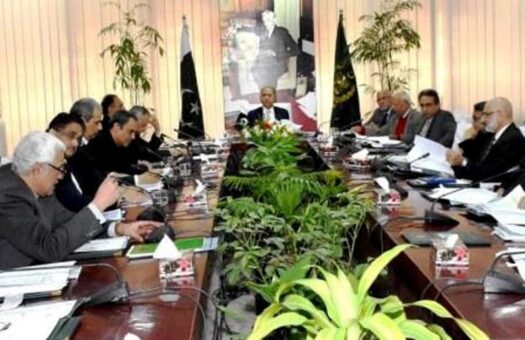
    ISLAMABAD: The Economic Coordination Committee (ECC) of the Cabinet on Monday allowed 300,000 tons of wheat to ensure sufficient supply of the commodity and reducing prices in the domestic market.

    A meeting of the Economic Coordination Committee of the Cabinet (ECC) chaired by Adviser to the Prime Minister on Finance and Revenue, Dr. Abdul Hafeez Shaikh on Monday allowed import of 0.3 million tons of wheat to decrease the local wheat price and meet the domestic requirement.

    Under the decision, the wheat would be imported by the private sector by withdrawing regulatory duty to the extent of the approved quantity.

    The ECC further decided that the wheat to be imported under the ECC decision would be allowed in the country until March 31, 2020 to ensure that the local wheat to be available from the start of April was picked up at the right price from the market.

    The ECC also issued instruction for the immediate release of stocks held by the PASSCO and the provincial departments.

    Besides the import of wheat, the ECC approved a proposal by the Ministry of Industries and Production to reduce the GIDC on gas consumed by the fertilizer manufacturers from Rs 405 to Rs 5 per bag so that this benefit could be passed on to the farmers.

    ECC also allowed the raising of Rs 200 billion on the request of Ministry of Energy (Power Division) from the Islamic Banks as fresh facility through Power Holding Limited by way of issuance of Pakistan Energy Sukuk-II against assets of the DISCOs/GENCOs as collateral through open competitive bidding to procure financing in a fair and transparent manner.

    The amount will be utilized for the purpose of the funding the repayment liabilities of the DISCOs.

    ECC approved the proposed mechanism by the Ministry of Finance for the grant of Sovereign guarantees. All requests for government guarantees are to be accompanied by request for guarantee by the governing body of PSE’s.

    Further

    • Every request must be reviewed and endorsed by the concerned Administrative Ministry/Department of the relevant entity.

    • Audited Financial statements of previous year prior to issuance of guarantee is mandatory for evaluation of guarantee request

    • Business plan including an explanation of the business model and financial projections for at least 5 years;

    • A note explaining the following;

    1. Whether its need for guarantee is short term or long term.

    2. Business model followed by the entity since inception or over the last 5 years, whichever is less

    3. Financial as well as non-financial performance of the entity since its inception or over the last five years, whichever is less

    4. Request, along with justification, for the type and amount of guarantee needed by the entity and the timelines over which it is required The Finance Division shall evaluate the request internally and finalize its recommendations with the approval of the Finance Secretary.

    ECC also approved the report on proposed exemption of 5% sales tax on cotton seed cake.

    It was briefed to the ECC that in case the exemption of sales tax on Cotton Seed Cake cannot be introduced during CFY 2019-2020, the same can be considered for inclusion in the Finance Bill of 2020-2021.

    The approval of Technical Supplementary Grant of Rs. 96.652 million of National Book Foundation in favor of Ministry of Federal Education and Professional Training was also granted by ECC.

    Technical Supplementary Grant amounting to Rs 15 million for centralized procurement of ICT infrastructure to ensure e-readiness of Federal Government for implementation of E-Governance program was also approved.

    ECC granted approval to the request of the Ministry of Interior for the Technical Supplementary Grant amounting to Rs458 million for payment of subsistence allowance to Personnel of Civil Armed Forces deployed in UN Peacekeeping Missions.

  • FBR clarifies delay in track, trace system implementation

    FBR clarifies delay in track, trace system implementation

    ISLAMABAD: Federal Board of Revenue (FBR) has said that implementation of track and trace system has been stayed by a court. As soon the stay is vacated by the court the process will be implemented, said a statement issued on Monday.

    The FBR issued the clarification in response to news reports published on January 20, 2020 about delay in the implementation of FBR’s Track & Trace System to control illicit tobacco trade.

    FBR has clarified that a license has been issued to M/s NRTC on October 14, 2019 through a transparent and fair process of bidding which is strictly in accordance with the PPRA Rules, 2004 and Licensing Rules, 2019.

    However, the award of license to lowest bidder i.e. M/s NRTC was challenged by some unsuccessful bidders i.e. M/s SICPA Ink in Sindh High Court and M/s Reliance IT Solutions (Pvt) Ltd and M/s NIFT Consortium in Islamabad High Court.

    Since, the Honorable Court has granted status quo and the matter is sub-judice before the aforesaid courts, therefore, there is no delay on the part of FBR.

    The process of implementation of Track and Trace System will be resumed as and when the stay order is vacated by the Honorable Court.

  • FPCCI fears no advantage for Pakistan under Phase-II FTA with China

    FPCCI fears no advantage for Pakistan under Phase-II FTA with China

    KARACHI: Federation of Pakistan Chambers of Commerce & Industry (FPCCI) feared that Pakistan would not be able to take advantage of opportunities under Phase II of China Pakistan Free Trade Agreement (CPFTA-II).

    Mian Anjum Nisar, President FPCCI and Sheikh Sultan Rehman, Vice President FPCCI said in a statement on Monday expressed fear that Pakistan may not be able to reap benefits under Phase II of China Pakistan Free Trade Agreement (CPFTA-II) despite elimination of duties on 313 tariff lines covering most of Pakistan’s exports.

    He pointed out that during Phase I of China Pakistan FTA, the balance of trade remained greatly in favor of China which managed to export 57 percent of its product lines while Pakistan could take advantage of only 5 percent of its product lines.

    Pakistan exported US $ 2.1 billion approx. while imports from China have reach more than US $ 17 billion approx. that created trade gap of US $ 15 billion approx. in favor of China.

    While products included in this volume of Pakistan’s exports to China are cotton (US $ 872.85 million), Cereals (US $ 161.3 million), Copper (US $150.26), Beverages, spirits and vinegar (US $133 million), Fish, crustaceans, molluscs, aquatics invertebrates (US $ 91.21 million), Ores slag and ash (US $ 66 million), Machinery, boilers (US $45.9 million), Salt, sulphur, earth, stone, plaster, lime and cement ( US $ 43.36 million), Raw hides and skins (other than furskins) and leather ( US $ 35 million, Articles of apparel, knit or crocheted (US 30 million).

    FPCCI Office Bearers expressed serious concern about Pakistan’s ability to benefit from Phase II, when Pakistan does not have surplus products to exportdue to a shrinking economy.

    He further highlighted the fact that industrial output is declining because of de-industrialization in the last few years. Serious issues like, high interest rates, frequent increases in power and gas tariff, unavailability of gas to industries, abrupt changes in government policies, rampant smuggling, refunds to exporters and an overall hostile environment are making it difficult for industries to sustain their existence.

    FPCCI Office Bearers urged Government of Pakistan to urgently develop a robust and holistic industrial policy that would lead to massive industrialization in the country, encourage R&D, innovation, diversification and development of new products, improve quality standards and enhance technical skills of labor.

    He also urged Chinese companies to enter into joint ventures with Pakistani manufacturers and relocate their industries to Special Economic Zones. These efforts will significantly raise industrial output enabling Pakistan to take advantage from Phase II of China Pakistan FTA.

    Otherwise, Pakistan will not be able to receive benefits from supposedly vast opportunities available to us and the fate of Second Phase of China Pakistan FTA will not be any different that the First Phase.

  • Stock market declines by 420 points on selling activities

    Stock market declines by 420 points on selling activities

    KARACHI: The stock market fell by 420 points on Monday owing to round the clock selling in the equity market.

    The benchmark KSE-100 index of Pakistan Stock Exchange (PSX) closed at 42,747 points as against 43,168 points showing a decline of 420 points.

    First day of the change in circuit breaker met with an overall negative performance on the bourse. After an initial surge of 135 points, market largely remained under selling pressure throughout the session and went down by 535 points during the session.

    MoC showed recovery of around 100 points from day’s low and closed the session at -420 points. Triggers causing investors to stay cautious included an early called FATF meeting, pending increase in gas prices by ECC and political uncertainty that marred the sentiment last week.

    Besides, the ECC also decided to reduce GIDC charge with the aim to reduce Urea price/bag. Resultantly, EFERT hit lower circuit breaker, whereas FFC and FFBL showed positive price performance.

    Banking sector topped the chart with 27.2 million shares, followed by Technology (25.6 million) and Fertilizer (25.3 million). Among scrips, EFERT ranked first with 15.3 million shares, followed by TRG (11.9 million) and BOP (11.7 million).

    Sectors contributing to the performance include Banks (-129 points), Fertilizer (-78 points), Cement (-51 points), INv Banks (-37 points) and O&GMCs (-25 points).

    Volumes declined further from 211.4 million shares to 173.9 million shares (-18 percent DoD). Average traded value, on the contrary, increased by 12 percent to reach US$ 45.6 million as against US$ 40.7 million.

    Stocks that contributed significantly to the volumes include EFERT, TRG, BOP, WTL and SMBL, which formed 33 percent of total volumes.

    Stocks that contributed positively include FFC (+56 points), MARI (+44 points), COLG (+11 points), BAFL (+8 points) and FFBL (+8 points). Stocks that contributed negatively include ENGRO (-85 points), EFERT (-55 points), UBL (-38 points), HBL (-37 points), and DAWH (-33 points).

  • Rupee ends down by three paisas on import demand

    Rupee ends down by three paisas on import demand

    KARACHI: The Pak Rupee ended down by three paisas against dollar on Monday due to increase in demand for the foreign currency by importers and corporate buyers.

    The rupee ended at Rs154.60 to the dollar from last Friday’s closing of Rs154.57 in interbank foreign exchange market.

    The currency dealers said that the demand for the foreign currency was higher as market resumed trading after two days weekly holidays.

    The foreign currency market was initiated in the range of Rs154.58 and Rs154.62. The market recorded day high of Rs154.66 and low of Rs154.54 and closed at Rs4154.60.

    The exchange rate in open market witnessed stable rupee value. The buying and selling of dollar was recorded at Rs154.50/Rs154.80, the same last Friday’s closing, in cash ready market.