Blog

  • Stock market makes 13-month high in intra-day trading

    Stock market makes 13-month high in intra-day trading

    KARACHI: The Stock market made a new 13-month high of 41,699 points on Monday with the index increased by 782 points during the session, analysts said.

    The benchmark KSE-100 index of Pakistan Stock Exchange (PSX) closed at 41,645 points as against 40,917 points showing an increase of +728 points.

    The analysts at Arif Habib Limited said that the index closed near day’s high at 41645 points.

    Oil & Gas chain remained in the limelight, particularly OGDC and PPL, which traded near and at upper circuits respectively.

    O&GMCs traded the most today with 86.7 million shares, mainly contributed by HASCOLR shares totaling 53.3 million. This was followed by Banks (44.2 million) and Cement (32.6 million). Among scrips, UNITY and SSGC followed HASCOLR with 31.4 million and 16.1 million shares respectively.

    Sectors contributing to the performance include E&P (+221 points), Banks (+162 points), Cement (+57 points), O&GMCs (+43 points) and Fertilizer (+39 points).

    Volumes increased significantly from 270.8 million shares to 357.8 million shares (+32 percent DoD). Average traded value also increased by 20 percent to reach US$ 90.3 million as against US$ 75.3 million.

    Stocks that contributed significantly to the volumes include HASCOLR1, UNITY, SSGC, FFL and PIBTL, which formed 37 percent of total volumes.

    Stocks that contributed positively include PPL (+97 points), HBL (+79 points), OGDC (+66 points), POL (+41 points) and UBL (+25 points). Stocks that contributed negatively include MCB (-12 points), BAFL (-5 points), EFERT (-5 points), NATF (-4 points), and INDU (-3 points).

  • Rupee ends down by five paisas on import payment demand

    Rupee ends down by five paisas on import payment demand

    KARACHI: The Pak Rupee ended down by five paisas against dollar on Monday owing to higher demand for import and corporate payments, dealers said.

    The rupee ended Rs155.01 to the dollar from last Friday’s close of Rs154.96 in interbank foreign exchange market.

    The currency dealers said that the rupee was under pressure due to higher demand for dollars. The higher demand was mainly attributed to two weekly holidays.

    The foreign currency market was opened in the range of Rs154.95 and Rs155.00. The market recorded day high of Rs155.01 and low of Rs154.98 and closed at Rs155.01.

    The exchange rate in open marked however was remained unchanged. The buying and selling of dollar was recorded at Rs154.40/Rs154.70, the same closing level on last Friday, in cash ready market.

  • SBP clarifies misconceptions on foreign investment in debt securities

    SBP clarifies misconceptions on foreign investment in debt securities

    KARACHI: State Bank of Pakistan (SBP) on Monday said that the risks posed by foreign investment in debt securities at current levels are limited due to various reasons.

    The SBP said that risks posed by such investments are limited at current levels on account of the following reasons.

    “First, the current level of such investments at $1.2 billion accounts for less than 2 percent of the total outstanding marketable government securities and less than 0.5 percent of GDP.

    “Second, this investment accounts for less than one-fifth of the increase in SBP’s net reserve buffers at current levels; the bulk of the increase in the net reserve buffers is accounted for by the continued current account improvement.

    “Third, the tenor of such investments has been increasing with more investments in longer dated instruments as investors’ confidence grows. Finally, the simplification of taxation for investment in government securities that was recently approved by the ECC, will promote greater interest in investments in longer dated maturities.”

    The SBP issued a statement pointing out several misconceptions about the implications of international investors’ investments in the debt markets of Pakistan.

    State Bank of Pakistan would like to clarify as under:

    International investors have been investing in Pakistan’s equity markets for a long time. Such investments are considered portfolio investments, just like investments in debt instruments, and use the same framework of Special Convertible Rupee Account (SCRA). Such investors have been able to move capital in and out of our financial markets without problems for the Pakistan economy.

    Recently, international investors have started investing in debt instruments issued by the government of Pakistan. This is largely a manifestation of their growing confidence in the positive outlook for the economy. As endorsed by international financial institutions, including the IMF, the ADB and the World Bank, and rating agencies, our reform program is beginning to show results.

    One key aspect of this reform program has been the shift to a market based exchange rate system since May 2019 which has addressed previous concerns regarding the sustainability of the exchange rate regime.

    Together with the continued improvement in our balance of payments and reserve buffers, this has raised the comfort level of international investors to invest in local currency denominated financial assets. It should be noted that interest rates have been higher in the past—for example interest rates were around 13.75 percent on average in FY11—but our debt markets did not attract interest from international investors.

    Investment in government securities by international investors provides several benefits to the economy. First, such investment helps to deepen capital markets by increasing the pool of funds available in the local market and diversifies the investor-base.

    Second, such investment helps to allow banks to deploy available funds for lending to the private sector since there is growing competition from international investors for placements in government securities.

    Third, such interest by international investors raises the demand for government securities and accordingly lowers yields and reduces the cost of borrowing for the government. Fourth, the growing role of international investors in the local debt market may serve as a positive feedback mechanism for further improving domestic practices, policies, systems and institutions in line with international best practices.

    There are several emerging market economies that have attracted investments from international investors in much greater amounts on a sustainable basis in their local currency debt markets and have used them as a major stimulus in their macroeconomic development. The SBP continues to monitor developments in the financial sector carefully and stands ready to take action against any risks.

  • Another date extension expected for filing returns tax year 2019

    Another date extension expected for filing returns tax year 2019

    ISLAMABAD: Tax managers and experts are expecting that the Federal Board of Revenue (FBR) likely to further extend the date for filing annual tax returns for tax year 2019.

    Today i.e. December 16, 2019 is the last date for filing returns other than companies for tax year 2019. The FBR on November 29, 2019 granted 16 days extension for filing income tax returns.

    The actual last day for filing income tax returns for tax year 2019 was September 30, 2019. On this date salaried persons, business individuals, Association Persons (AOPs) and corporate entities having special tax year are required to file income tax returns.

    However, due to small number of return filing and delayed issuance of return forms the FBR extended the date from September 30 to October 31. And then it was further extended to November 30, 2019. Now it is December 16, 2019.

    The received income tax returns are still below the expected numbers. As per Pakistan Tax Bar Association (PTBA) around 1.8 million tax returns were filed by December 13, 2019. The PTBA further pointed out that the number of return filers for tax year 2018 was increased to 2.71 million. Therefore, it was almost impossible for 0.9 million people to file their returns in remaining three days.

    The difference of 0.9 million has been calculated on the basis of returns filed last tax year and filed for tax year 2019.

    The actual number of persons required to file the income tax returns is very large. Under the Income Tax Ordinance, 2001, every person who obtains National Tax Number (NTN) is required to file annual return. According to estimates around 4.7 million NTN had been issued by the FBR.

    Further, every taxable income or persons own certain properties or assets defined under the Ordinance are required to file their annual returns.

    In order to facilitate the taxpayers in filing their returns the law accepts CNIC as NTN.

    The tax experts and tax consultants/experts believed that the FBR further extend the date to December 31, 2019. Interestingly, this is also the last date for filing returns by corporate entities whose financial year ends on June 30.

    The PTBA also urged the FBR to extend the last date up to December 31, 2019.

    Some officials in the FBR said that in case the board not extends the date beyond December 16, 2019 then the board will grant general extension any time after January 01, 2020 when small traders will be give time to file their returns.

  • Cash payment above Rs15,000 as salary not to be treated as income

    Cash payment above Rs15,000 as salary not to be treated as income

    KARACHI: An amount above Rs15,000 paid in cash as salary will not be treated as income and employers will not be allowed adjustment.

    The FBR officials said that any salary paid or payable exceeding Rs15,000 per month other than by a crossed cheque or direct transfer of funds to the employee’s bank account will not be allowed deduction as expenditure to an employer.

    The FBR said that Section 21 of Income Tax Ordinance, 2001 explained the deductions that are not allowed.

    Section 21: Deductions not allowed

    Except as otherwise provided in this Ordinance, no deduction shall be allowed in computing the income of a person under the head “Income from Business” for —

    (a) any cess, rate or tax paid or payable by the person in Pakistan or a foreign country that is levied on the profits or gains of the business or assessed as a percentage or otherwise on the basis of such profits or gains;

    (b) any amount of tax deducted under Division III of Part V of Chapter X from an amount derived by the person;

    (c) any expenditure from which the person is required to deduct or collect tax under Part V of Chapter X or Chapter XII, unless the person has paid or deducted and paid the tax as required by Division IV of Part V of Chapter X:

    Provided that disallowance in respect of purchases of raw materials and finished goods under this clause shall not exceed twenty per cent of purchases of raw materials and finished goods:

    Provided further that recovery of any amount of tax under sections 161 or 162 shall be considered as tax paid.”

    (ca) any amount of commission paid or payable in respect of supply of products listed in the Third Schedule of the Sales Tax Act, 1990, where the amount of commission paid or payable exceeds 0.2 percent of gross amount of supplies thereof unless the person to whom commission is paid or payable, as the case may be, is appearing in the active taxpayer list under this Ordinance;

    (d) any entertainment expenditure in excess of such limits 2[or in violation of such conditions] as may be prescribed;

    (e) any contribution made by the person to a fund that is not a recognized provident fund3[,]4[approved pension fund], approved superannuation fund or approved gratuity fund;

    (f) any contribution made by the person to any provident or other fund established for the benefit of employees of the person, unless the person has made effective arrangements to secure that tax is deducted under section 149 from any payments made by the fund in respect of which the recipient is chargeable to tax under the head “Salary”;

    (g) any fine or penalty paid or payable by the person for the violation of any law, rule or regulation;

    (h) any personal expenditures incurred by the person;

    (i) any amount carried to a reserve fund or capitalised in any way;

    (j) any profit on debt, brokerage, commission, salary or other remuneration paid by an association of persons to a member of the association;

    (l) any expenditure for a transaction, paid or payable under a single account head which, in aggregate, exceeds fifty thousand rupees, made other than by a crossed cheque drawn on a bank or by crossed bank draft or crossed pay order or any other crossed banking instrument showing transfer of amount from the business bank account of the taxpayer:

    Provided that online transfer of payment from the business account of the payer to the business account of payee as well as payments through credit card shall be treated as transactions through the banking channel, subject to the condition that such transactions are verifiable from the bank statements of the respective payer and the payee:

    Provided further that this clause shall not apply in the case of—

    (a) expenditures not exceeding ten thousand rupees;

    (b) expenditures on account of —

    (i) utility bills;

    (ii) freight charges;

    (iii) travel fare;

    (iv) postage; and

    (v) payment of taxes, duties, fee, fines or any other statutory obligation;]

    (m) any salary paid or payable exceeding 3[fifteen] thousand rupees per month other than by a crossed cheque or direct transfer of funds to the employee’s bank account;

    (n) except as provided in Division III of this Part, any expenditure paid or payable of a capital nature; and

    “(o) any expenditure in respect of sales promotion, advertisement and publicity in excess of ten percent of turnover incurred by pharmaceutical manufacturers.”

  • CDNS decides screening all customers of national saving schemes

    CDNS decides screening all customers of national saving schemes

    The Central Directorate of National Savings (CDNS) has decided to screen all customers of national savings schemes.

    (more…)
  • MCC Preventive Peshawar announces auction of used cars on Dec 16

    MCC Preventive Peshawar announces auction of used cars on Dec 16

    ISLAMABAD: Model Customs Collectorate (MCC) Preventive Peshawar announced public auction of used cars on December 16, 2019 at state warehouses of Peshawar, Frontier Corps, Nowshera, Mardan and Abbotabad.

    Following are the list of cars and location of auction:

    STATE WARE HOUSE, PESHAWAR

    01. Mercedes Benz (Bullet Proof) Model 1982, Chassis No. WDB-12603312037551

    02. Toyota Hilux Pick Up Model 2007, Chassis No. MROCS12G400043443

    03. Toyota Land Cruiser Model 2004, Chassis No. LTERB71J800020686

    04. Toyota Camry Car Model 2014 (as per Website), 6T1BF3FK-40X056581

    05. Toyota Land Cruiser, Model 1993, Chassis No. KZJ78-0007642

    STATE WARE HOUSE, MARDAN

    01. Daihatsu Mira Car (Avy), Model 2003, (as per website), Chassis No. L250S-1014196

    STATE WARE HOUSE, ABBOTTABAD

    01. Toyota Mark-X Car, Model 2006, Chassis No. GRX120-0009539

    STATE WARE HOUSE, FRONTIER CORPS

    01. Mark-1 Motor Car Model Nil, Chassis No. LA3VS-216474

    02. Motor Car, Model 1978, Chassis No. M-430-300918

    03. Toyota Corolla Car, Model 2003 (as per Website), Chassis No. NZE120-6005014

    04. Toyota Corolla Car Model 1992 (as per Website), Chassis No. CE100-3020027

    05. Toyota Mark-II Car Model 2001 (as per Website), Chassis No. JZX110-6022047

    06. Toyota Corolla Saloon Car Model 2004 (as per Website), Chassis No. ZZE121-9010983

    07. Toyota Corolla Car Model 2001 (as per Website), Chassis No. CE100-9020816

    08. Toyota Corolla Car Model 2000 (as per Website), Chassis No. CE100-9013329

    09. Toyota Corolla Car Model 1993 (as per Website), Chassis No. CE100-3029431

    10. Toyota Corolla Car Model 1991 (as per Website), Chassis No. EE90-5665542

  • K-Electric warns of crisis on non-payment of dues by Sindh departments

    K-Electric warns of crisis on non-payment of dues by Sindh departments

    KARACHI: K-Electric – the power generation and distribution company – has demanded the Sindh government to pay the dues on urgent basis as non-payment will result into potential crisis for Karachi city.

    In a letter to Sindh Chief Minister Syed Murad Ali Shah the power utility requested for support in expediting the release of outstanding dues of different department of the provincial government.

    The K-Electric said it was facing severe cashflow issues due to the non-payment of dues by the government of Sindh. The company is working tirelessly to manage its routine operations and maintainance along with the purchase of power for the smooth functioning of the operations and to supply safe and reliable power to Karachi and its adjoining area.

    “However, this has been communicated to your office time and again that with large amount pending in the form of receivable from the government departments, KE is facing severe constraints in running its day to day operations and ensuring seamless supply of power to the city.”

    The power utility said that its receivable from different departments of the Sindh government had increased to Rs19.2 billion, of which Rs4.5 billion had been reconciled.

    In addition, Rs33.09 billion is also receivable on account of KW&SB out of which Rs28.5 billion in dues have been fully reconciled.

    In its summary to the Supreme Court of Pakistan, the Sindh government agreed to devise a payment plan for the reconciled amount, which was also made part of the apex court’s order.

    However, there have been notable delays in the payment against the mentioned reconciled amount and a payment plan is still awaited.

    As a result, K-Electric’s borrowing has increased substantially, and the situation is not sustainable for the company. Moreover, the capacity of banks to finance KE has been exhausted, inadvertently effecting KE’s working capital and long-term expansion plan.

    The KE said that it was not a defaulter of current payments to any of its fuel suppliers since 2012, despite the cashflow situation. However, to be able to continue to make payments to the suppliers and ensure smooth operations, it is essential that the release of outstanding dues is expedited.

    “… the non-payment of these dues will result into potential crisis for the city and the sustainability of KE’s operations,” it said.

  • Gwadar Port starts exports operation: Razak Dawood

    Gwadar Port starts exports operation: Razak Dawood

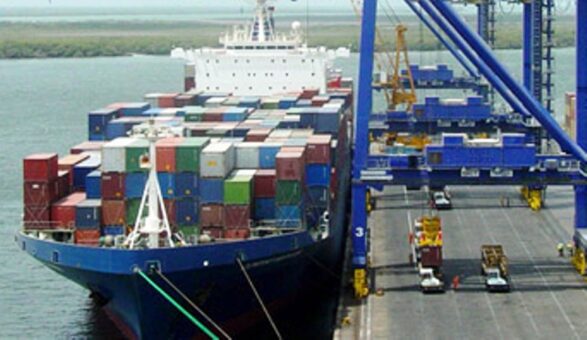
    KARACHI: Gwadar Port has become operational for exports as a vessel loaded with three containers of seafood left for Far Eastern ports, said adviser to prime minister.

    Abdul Razak Dawood, in his tweet on Saturday made this announcement about the exports through Gwadar Port.

    “Gawadar becomes operational for Exports! Seafood export, in reefer containers, using WeBOC system, started on 19 Nov 2019 through COSCO’s KGS service.”

    “The vessel loaded 3 containers of fish for Far Eastern ports.”

    The adviser said that average value of cargo was $50,000/container.

    This would reduce time taken for trading across borders and also reduce port congestion at Karachi.

    Gwadar is Pakistan’s largest infrastructural project since independence.

    After the completion of the first phase of Gwadar port, billions of dollars have been invested in Gwadar and in the next one or two years the investment can cross the figure of trillions.

    China is a major investor in Gwadar, and has spent $248 million in the first phase of Gwadar port, according to official website of Gwadar Port Authority.

  • Iranian delegation urges Pakistan for reducing customs duties for promoting formal trade

    Iranian delegation urges Pakistan for reducing customs duties for promoting formal trade

    KARACHI: Iranian trade delegation has urged Pakistani authorities to bring down customs duties in order to encourage formal trade between the two countries.

    Talking to the members of Karachi Chamber of Commerce and Industry (KCCI), Morad Nemati, leader of the Iranian delegation said that in order to improve the trade relations between Pakistan and Iran, it was really essential that steps have to be taken to deal with the barriers hindering smooth trade between the two brotherly countries while the high custom duties need to be brought down to encourage legal trade and discourage smuggling.

    Morad Nemati added that in addition to bringing down the high custom duties, formal banking channel between the two countries has to be activated which was widely being demanded by the business communities of the two countries since quite some time now.

    Commercial Attaché of the Iranian Consulate in Karachi Mahmoud Hajy Yousefi Pour, Vice President Shahid Ismail, Former Vice President Asif Sheikh Javaid, KCCI Managing Committee Members and members of the Iranian delegation from different sectors of the economy were also present on the occasion.

    While referring to China-Pakistan Economic Corridor (CPEC), Morad Nemati said that this essential project was going to open up huge opportunities not just for Pakistan but also for Iran and they (Iran) want to become part of this project which would surely ensure prosperity in the entire region.

    He also underscored that that the business communities of the two countries will have to meet more frequently and improve their contacts, besides holding Single Country Exhibitions which would certainly improve trade and investment in both the brotherly countries.

    Morad Nemati, who has also discharged his service as Commercial Attaché of the Iranian Consulate in Karachi, assured full support and cooperation to the business community so that trade could improve further and they collectively explore new avenues trade cooperation.

    Earlier, Vice President KCCI Shahid Ismail, while welcoming the Iranian delegation, stated that despite being brotherly countries, trade remains low hence, Pakistan and Iran must make collective efforts to explore new avenues. It has always been KCCI’s struggle to promote bilateral trade and the Chamber has a very positive approach towards improving trade ties particularly with neighboring countries.

    He pointed out that the bilateral trade between Pakistan and Iran was much less than the potential as Pakistan exports stood at a mere $330.2 million while the imports were around $1.247 billion during 2018.

    Shahid Ismail noted that the negotiations on Free Trade Agreement (FTA) are underway as both the countries have shared their desire of upgrading Preferential Trade Agreement (PTA) into Free Trade Agreement (FTA) for which initial drafts have already been shared while the State Bank of Pakistan has also shared draft of Memorandum of Understanding (MoU) for signing its Banking Paying Arrangement (BPA) with Iran’s Iranian Bank Markazi Jomhouri. Both countries have already signed MoU through which channels would be opened in the central banks of both the countries for trade transactions that would reduce the usage of dollar account for Letter of Credit (LC) clearance.

    He hoped that the desperately needed proper banking channel between Pakistan and Iran becomes a reality soon which would surely boost the existing trade ties.

    Shahid Ismail underscored the need to sort out infrastructural constraints to enhance bilateral trade via Quetta-Taftan land route whereas regular operation of ECO container train will lend impetus to cargo and transit facilities between the two countries. While underscoring the need for a realistic approach, Vice President KCCI said that KCCI was keen to strengthen trade ties with their counterparts in Iran.