Blog

  • Weekly Review: Stabilizing macro-economic continue to fuel bullish trend

    Weekly Review: Stabilizing macro-economic continue to fuel bullish trend

    KARACHI: The upswing in the market may be met with some profit-taking next week. The continuation of the sit-in in the federal capital may create some apprehensions which we expect to create some short-lived jitters in the market, analysts said.

    “We expect the stabilizing macro-economy to continue fueling the bullish trend over the medium to long term,” analysts at Arif Habib Limited said.

    The benchmark KSE-100 index of Pakistan Stock Exchange (PSX) is currently trading at a PER of 6.2x (2020) compared to Asia Pac regional average of 13.6x and while offering DY of ~8.8 percent versus ~2.5 percent offered by the region.

    The jubilance in the KSE-100 index continued from last week and provided an 11-week high return of 4.7 percent WoW. Expectation of a rate cut in the near future on the back of continuous decline in government securities’ yields was further cemented with the government slashing National Savings Scheme profit rates by 170-228bps across the different schemes.

    However, inflation reading for October 2019 settled at 11.04 percent YoY which was higher than expectations, but failed to deter the positive momentum. Moreover, SBP reserves increased to USD 8.4 billion which is the highest level since April.

    Furthermore, external account position continued to improve with the trade deficit declining 34 percent YoY during 4MFY20. The index closed at 35,978 points – a 6 month high (124 trading sessions), and up by 1601 points WoW.

    Foreign buying was witnessed this week clocking-in at USD 4.5 million compared to a net sell of USD 3.1 million last week. Buying was witnessed in Fertilizer (USD 6.7 million) and OGMCs (USD 3.2 million).

    On the domestic front, major selling was reported by Banks / DFIs (USD 6.0 million) and Insurance Companies (USD 4.6 million). Average Volumes settled at 258 million shares (up by 55 percent WoW) while average value traded clocked-in at USD 54 million (up by 52 percent WoW).

  • Jewelers, real estate agents to maintain register, report suspicious transactions: draft rules issued

    Jewelers, real estate agents to maintain register, report suspicious transactions: draft rules issued

    ISLAMABAD: Federal Board of Revenue (FBR) has proposed to make mandatory for jewelers and real estate agents to report suspicious transactions. In this regard the FBR issued draft rules through SRO 1320(I)/2019 to make amendments in Income Tax Rules, 2002.

    As per the draft rules, the designated persons as jewelers and real estate agents should maintain documents and records, where the value of transaction exceeds Rs2 million in case of immovable properties and Rs one million in other cases.

    The FBR said that the designated persons would require to obtain and maintain the following relating to its buyers and sellers, namely:

    In case of an individual any of the following documents should be obtained by jewelers and real estate agents:

    i. copy of computerized National Identity Card (CNIC) issued by National Database and Registration Authority (NADRA).

    ii. copy of National Identity Card for Overseas Pakistanis (NICOP) issued by NADRA.

    iii. copy of Pakistan Origin Card (POC) issued by NADRA.

    iv. copy of Alien Registration Card (ARC) issued by NADRA, and

    v. copy of passport, having valid visa on it or any other proof of legal stay along with the passport (foreign nationals only).

    The jewelers and real estate agents also required to keep a list of all such customers where the business transaction was refused or needed to be closed either on account of failure of the customer to provide the relevant documents or the original documents for viewing as required.

    Regarding furnishing of information, according to the draft rules, the sale and purchase register for the immediately preceding calendar month shall be uploaded by the designated persons on the IRIS online system within 15 days of the end of the preceding calendar month for transactions.

    The draft rules said that the designated persons would mark a transaction as suspicious in the IRIS online system if the person has reason to believe that the transaction or a pattern of transactions of which the transaction is a part:

    (a) involves funds derived otherwise than from the business activity or assets declared to the income tax authorities;

    (b) is designed to evade any requirement of the Income Tax Ordinance, 2001 or to conceal the beneficial owner or his activity.

    (c) has no apparent economic or lawful purpose after examining the available facts, including the background and possible purpose of the transaction; or

    (d) involves financing of terrorism, including fund collected, provided, used or meant for, or otherwise linked or related to, terrorism, terrorist acts or organization and individual concerned with terrorism.

    According to the draft rules, the designated persons have also been asked to mark as suspicious transaction if the buyer or seller –

    (a) frequently changes bank accounts;

    (b) uses a bank account other than an account maintained in the name of beneficial owner;

    (c) makes or receives payment in cash or primarily in cash; or

    (d) maintains a creditor or debtor account with the designated person and instructs the designated person to adjust the balance of his account against a creditor debtor account of another buyer or seller.

  • Stock market gains 220 points amid mixed impact of MSCI review

    Stock market gains 220 points amid mixed impact of MSCI review

    KARACHI: The stock market gained 220 points on Friday after mixed trading activities to respond MSCI review.

    The benchmark KSE-100 index of Pakistan Stock Exchange (PSX) closed at 35,978 points as against 35,759 points showing an increase of +220 points.

    Analysts at Arif Habib Limited said that the market on a positive note today with +20 points. The Index went uni-directional and gained 230 points by the end of first session, while reaching a high of +290 points, and finally closed the day with +220 points.

    Following past couple of sessions, Cement and Steel continued trading in red and kept the index under pressure. MSCI review, announced last evening, proved to be a sigh of relief for institutional funds which were expecting an exclusion from the Index and resultant deluge of selling activity in outgoing stocks.

    On the contrary, MSCI review proved largely to be a non-event, which gave confidence to investors in large cap Banks and E&P companies, particularly MCB, HBL, OGDC and PPL. Major activity (volume wise) was observed in PIAA, WTL, KEL and HUMNL.

    Sector wise, most volumes were registered in Technology (43.5 million), followed by Cement (25.6 million) and Inv Banks (18.3 million).

    Sectors contributing to the performance include Banks (+93 points), E&P (+64 points), Fertilizer (+47 points), Inv Banks (+31 points), O&GMCs (+13 points).

    Volumes continued declining trend and went down from 265.9 million shares to 209.4 million shares (+21 percent DoD). Average traded value also declined by 19 percent to reach US$ 41.9 million as against US$ 51.6 million.

    Stocks that contributed significantly to the volumes include WTL, HUMNL, KEL, PIAA and BOP, which formed 29 percent of total volumes.

    Stocks that contributed positively include MCB (+33 points), UBL (+30 points), DAWH (+30 points), OGDC (+27 points) and ENGRO (+27 points). Stocks that contributed negatively include HUBC (-27 points), COLG (-13 points), DGKC (-10 points), PMPK (-8 points), and FCCL (-7 points).

  • PM directs eradication of corruption in Utility Stores, ensure availability of essential items at lower prices

    PM directs eradication of corruption in Utility Stores, ensure availability of essential items at lower prices

    ISLAMABAD: Prime Minister Imran Khan has directed administration of Utility Stores Corporation (USC) to ensure eradication of corruption in the organization and ensure availability of essential foods items at subsidized rates following release of Rs6 billion.

    Prime Minister Imran Khan on Friday chaired a meeting to reduce prices of essential commodities which will provide immediate relief to the people.

    The Prime Minister directed that the supply of essential items should be ensured through use of Information technology and corruption must be eradicated at all Utility Store outlets.

    The meeting was attended by Minister for Planning Makhdoom Khusro Bakhtiar, Minister for Communications Murad Saeed, SAPM for Social Welfare Dr. Sania Nishtar, Secretaries and Additional Secretaries of Ministry of Finance, Planning Commission, Communication, National Food Security and Industry, Chairman and Managing Director Utility Stores Corporation, Chief Commissioner Islamabad and other senior officials.

    The prime minister said that provision of relief to the people is the top priority of the government.

    “We strive to provide special relief to low income groups and poverty-stricken families,” he said.

    The Prime Minister said that in view of the challenging economic situation, the government took difficult decisions.

    Due to these decisions, the economy is stabilizing today and economic indicators are showing improvement; the situation will improve further in the coming days.

    Despite the difficult conditions, every possible effort to provide relief to the people will be undertaken, added the prime minister.

    The meeting was briefed on the current situation of the prices of essential commodities (flour, wheat, sugar, ghee, rice and pulses) and measures to control them.

    Chairman and Managing Director Utility Stores Corporation apprised the meeting that immediate grant of Rs6 billion from the government will reduce the prices of basic essential food items.

    The prime minister was informed that the immediate supply of funds by the government would lead to price reduction of Rs-132 per kg in flour, Rs-09 per kg in sugar, Rs-30 per kg in ghee, Rs-20 per kg in rice and Rs-15 in pulses which would be made available for public consumption at Utility Stores.

    The prime minister was briefed on the steps taken to curb corruption and embezzlement in the Utility Stores, and to ensure the sufficient and steady supply of essential food items to the public.

    The prime minister was informed that it is being ensured that the purchased items at the Utility Stores are received at the Stores’ warehouses without pilferage for packaging and onward dispatch to the Utility Stores outlets.

    The measures are aimed at ensuring the quality of goods at Utility Stores in addition to eradicating corruption.

    Minister of Communications Murad Saeed said that in addition to a network of 4,000 utility stores, 800 post offices spread across the country can also be used to supply essential food items to the public.

    He further elaborated that home delivery service will soon be started by Pakistan Post Office to supply items at home to the poor and the needy.

  • FBR withdraws 3pc value addition tax on imported consumer items

    FBR withdraws 3pc value addition tax on imported consumer items

    ISLAMABAD: Federal Board of Revenue (FBR) has withdrawn three percent minimum value addition tax on import of consumer items on which sales tax is paid on retail basis.

    The FBR on Friday issued SRO 1321(I)/2019 and amended the Twelfth Schedule of Sales Tax Act, 1990 under which three percent minimum value addition sales tax has been imposed on all imported goods subject to exclusions.

    As per the amendment the FBR withdrew the imposition of minimum value addition tax on import of goods specified in the Third Schedule of the Sales Tax Act, 1990.

    Following is Third Schedule to Sales Tax in which consumer items are mentioned for collection of sales tax on the basis of printed retail price:

    • Fruit juices and vegetable juices.
    • Ice Cream.
    • Aerated waters or beverages.
    • Syrups and squashes.
    • Cigarettes.
    • Toilet soap
    • Detergents
    • Shampoo
    • Toothpaste
    • Shaving cream
    • Perfumery and cosmetics.
    • Tea
    • Powder drinks
    • Milky drinks
    • Toilet paper and tissue paper
    • Spices sold in retail packing bearing brand names and trade marks
    • Shoe polish and shoe cream
    • Fertilizers
    • Cement sold in retail packing
    • Mineral/bottled water
    • Household electrical goods, including air conditioners, refrigerators, deep freezers, televisions, recorders and players, electric bulbs, tube-lights, electric fans, electric irons, washing machines and telephone sets.
    • Household gas appliances, including cooking range, ovens, geysers and gas heaters.
    • Foam or spring mattresses and other foam products for household use.
    • Paints, distempers, enamels, pigments, colours, varnishes, gums, resins, dyes, glazes, thinners, blacks, cellulose lacquers and polishes sold in retail packing
    • Lubricating oils, brake fluids, transmission fluid, and other vehicular fluids sold in retail packing.
    • Storage batteries excluding those sold to
    • Automotive manufacturers or assemblers
    • Tyres and tubes excluding those sold to automotive manufacturers or assemblers
    • Motorcycles
    • Auto rickshaws
    • Biscuits in retail packing with brand name
    • Tiles
    • Auto-parts, in retail packing, excluding those sold to automotive manufacturers or assemblers.

    Procedure and conditions under the Twelfth Schedule has been defined as:

    (1) The sales tax on account of minimum value addition as payable under this Schedule (hereinafter referred to as value addition tax), shall be levied and collected at import stage from the importers on all taxable goods as are chargeable to tax under section 3 of the Act or any notification issued thereunder at the rate specified in the Table in addition to the tax chargeable under section 3 of the Act or a notification issued thereunder:

    Prior to the latest amendment the value addition tax under this Schedule shall not be charged on:

    (i) Raw materials and intermediary goods meant for use in an industrial process which are subject to customs duty at a rate less than 16% ad valorem under First Schedule to the Customs Act, 1969;

    (ii) The petroleum products falling in Chapter 27 of Pakistan Customs Tariff as imported by a licensed Oil Marketing Company for sale in the country;

    (iii) Registered service providers importing goods for their in-house business use for furtherance of their taxable activity and not intended for further supply;

    (iv) Cellular mobile phones or satellite phones;

    (v) LNG / RLNG;

    (vi) Second hand and worn clothing or footwear (PCT Heading 6309.000);

    (vii) Gold, in un-worked condition; and

    (viii) Silver, in un-worked condition.”

  • FBR officials display banners against proposed layoff plan

    FBR officials display banners against proposed layoff plan

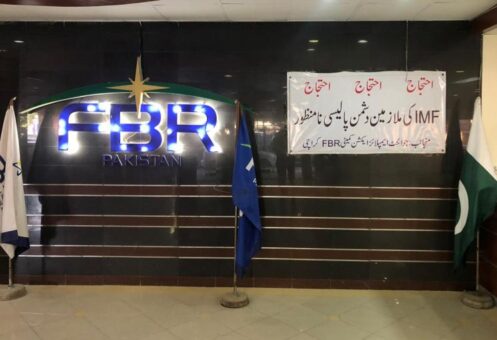
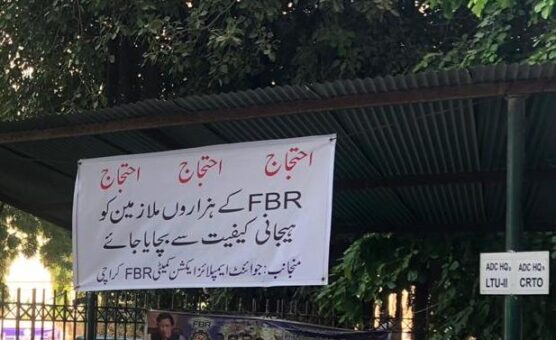
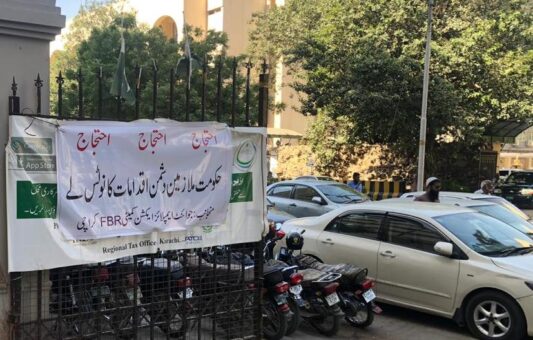
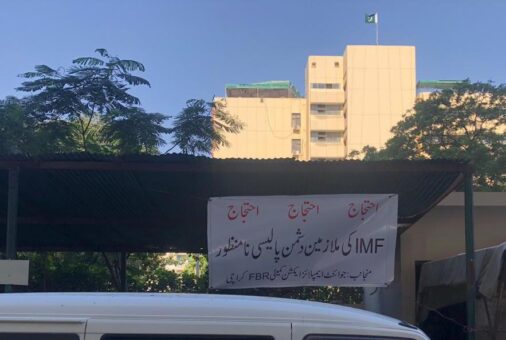
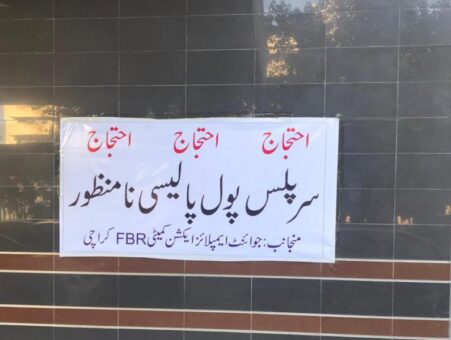
    KARACHI: The officials of Federal Board of Revenue (FBR) have protested against new reform program planned by the government, which may result in layoff in the revenue body.Surplus FBR 02Surplus FBR 02Surplus FBR 02Surplus FBR 04Surplus FBR 05

    The officials at the Income Tax Building Karachi on Friday displayed protest banners around the building to express their resentment against the reform plan, which can cause surpluses of staff.

    The officials through banners expressed their displeasure against IMF linked policy in Pakistan.

    The officials are protesting against news reports which said around 10,500 IRS officials would become surplus in the new system.

    The sources in the tax office said that for the past many years the government had banned new appointment in the FBR and the many of the existing staff were on verge of retirement.

  • Rupee gains eight paisas on increase in forex reserves

    Rupee gains eight paisas on increase in forex reserves

    KARACHI: The Pak Rupee gained another eight paisas against dollar on Friday owing to increase in foreign exchange reserves.

    The rupee ended at Rs155.47 to the dollar from previous day’s closing of Rs155.55 in interbank foreign exchange market.

    Currency experts said that increase in foreign exchange reserves had helped the rupee to appreciate.

    The liquid foreign exchange reserves of Pakistan have increased by $428 million to $15.518 billion by week ended November 01, 2019.

    The foreign exchange reserves were at $15.089 billion by week ended October 25, 2019.
    The reserves held by SBP increased by $443 million to $8.357 billion by week ended November 01, 2019 as compared with $7.914 billion in the preceding week.

    The reserves held by commercial banks decreased by $15 million to $7.16 billion by week ended November 01, 2019 as compared with $7.715 billion a week ago.

    The foreign currency market was initiated in the range of Rs155.53 and Rs155.56. The market recorded day high of Rs155.55 and low of Rs155.47 and ended at Rs155.47.

    The exchange rate in open market also witnessed appreciation in rupee value. The buying and selling of dollar was recorded at Rs155.20/Rs155.50 from previous day’s closing of Rs155.30 and Rs155.60 in cash ready market.

  • FBR proposed to collect sales tax on services

    FBR proposed to collect sales tax on services

    ISLAMABAD: The federal government is planning to takeover right to collect sales tax on services from the provinces as it was felt the true potential of collection was not realized.

    According to minutes of the meeting chaired by the prime minister to review proposed restructuring of Federal Board of Revenue (FBR) and domestic resource mobilization, held last month, it is discussed that revenue potential of General Sales Tax (Services) is not being fully realized owing to jurisdiction issues between FBR and provincial revenue authorities.

    It is also discussed that cross provincial jurisdictional and conflict of interest issues also stifles collection of GST on services.

    The sales tax on services needs to be collected centrally by FBR as per rates legislated by provincial governments.

    Tax proceeds of GST on services can be transferred directly to provinces as per delineated jurisdiction and share.

    In this regard it is decided that a joint committee comprising representatives of ministry of finance, FBR and provincial revenue authorities would be constituted to finalize proposal for central collection of GST on Services by the FBR.

    It is further decided mechanism of transfer of tax proceeds of GST on services be worked out by the ministry of finance.

    It is worth mentioning that prior the 18th Amendment to the Constitutions, the FBR was collecting sales tax on services. However, after the amendment the Sindh government was the first to establish a separate entity to collect sales tax on services arising within the jurisdiction of the province.

    The other provinces also followed the same and set up their revenue collecting agencies.

    Experts believed that the plan of the federal government would be reversal of such transfer of rights to the provinces.

  • Pakistan’s foreign exchange reserves increase to $15.518 billion

    Pakistan’s foreign exchange reserves increase to $15.518 billion

    KARACHI: The liquid foreign exchange reserves of Pakistan have increased by $428 million to $15.518 billion by week ended November 01, 2019, State Bank of Pakistan (SBP) said on Thursday.

    The foreign exchange reserves were at $15.089 billion by week ended October 25, 2019.

    The reserves held by SBP increased by $443 million to $8.357 billion by week ended November 01, 2019 as compared with $7.914 billion in the preceding week.

    The reserves held by commercial banks decreased by $15 million to $7.16 billion by week ended November 01, 2019 as compared with $7.715 billion a week ago.

  • IR officers oppose proposed setup of Pakistan Revenue Authority

    IR officers oppose proposed setup of Pakistan Revenue Authority

    KARACHI: Senior officers of Inland Revenue Service (IRS) has strongly opposed the formation of planned Pakistan Revenue Authority (PRA) and said it will have negative effect on revenue collection.

    The concerns were raised at a meeting of IRS Officers Association held on Thursday, which was attended by more than 120 IRS officers.

    It was unanimously agreed that the officers were in support of a meaningful and transparent reforms aimed at creating a viable automated and effective revenue organization.

    However, they showed their concerns over the discreetly and secretly approved haphazard reform plans which has apparently been prepared by non-service elements.

    It is neither any detailed plan nor it is legal in the strict sense of the constitutional and statutory impediments in the federal setup of the country, according to a statement.

    It said that the IRS is the largest service rank and is equipped with on-job training with necessary professional skills for effective tax collection given the country’s socio-economic ground realities.

    The reforms in revenue or in any state body, if experimented without involving the stakeholders as well as being oblivious of the ground realities, are bound to fail.

    In this backdrop, the concerns were raised that the under discussion reforms cannot be perceived to bring any betterment rather are to end up in creating confusion and uncertainty.

    It would frustrated the pace of tax collection which is much needed for defence and development of the country,” it said, adding that it would also frustrate the documentation and revenue drive in place by IRS against the Benami transactions/properties, to tax assets held abroad and weaken the case of Pakistan in the FATF proceedings.

    The meeting agreed that these reforms are aimed at creating a controversial authority wherein non-civil servants could be hired representing business communities and professional organization which might encourage tax avoidance and evasion instead of revenue collection.

    The reforms were perceived as a kind of coup against the willing, professional, sound and hands on experienced professionals of IRS who, despite business friendly tax policies, have raised tax revenues to five times in last ten years and that too with limited / meager resources, with no financial autonomy.

    They found that reforms under discussions conveyed the impression of some conspiracy hatched by non-professionals in a conniving and shabby manner which would lead to further deformation and deterioration of the service as well as the national economy.

    The participants showed unflinching support and solidarity with the chief commissioners for conveying the IRS community’s concerns to the Chairman FBR during the Chief Commissioners Conference held recently in Islamabad.

    Simultaneously, the house also expressed solidarity and support to the lower pay scale employees of IRS and assured them their concerns with regard to service conditions in the proposed reforms programme would be conveyed to the higher ups with the suggestion that representatives of these employees should also be made part of the consultative/inclusive process.

    The meeting ended with the resolution reiterating that the IRS officers and employees are not against reforms but the process should be inclusive giving due weightage to the concerns of all the stakeholders.