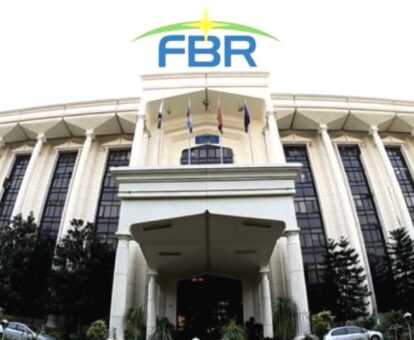
FBR, Pakistan’s national tax collecting agency, plays a crucial role in the country’s economy. Pakistan Revenue is committed to providing readers with the latest updates and developments regarding FBR activities.
116A. Foreign income and assets statement.– (1) Every resident taxpayer being an individual having foreign income of not less than ten thousand United States dollars or having foreign assets with a value of not less than one hundred thousand United States dollars shall furnish a statement, hereinafter referred to as the foreign income and assets statement, in the prescribed form and verified in the prescribed manner giving particulars of—
(a) the person’s total foreign assets and liabilities as on the last day of the tax year;
(b) any foreign assets transferred by the person to any other person during the tax year and the consideration for the said transfer; and
(c) complete particulars of foreign income, the expenditure derived during the tax year and the expenditure wholly and necessarily for the purposes of deriving the said income.
(2) The Commissioner may by a notice in writing require any person being an individual who, in the opinion of the Commissioner on the basis of reasons to be recorded in writing, was required to furnish a foreign income and assets statement under sub-section (1) but who has failed to do so to furnish the foreign income and assets statement on the date specified in the notice.
(Disclaimer: The text of above section is only for information. Team PkRevenue.com makes all efforts to provide the correct version of the text. However, the team PkRevenue.com is not responsible for any error or omission.)
The Federal Board of Revenue (FBR) has clarified the provisions of Section 115 of the Income Tax Ordinance, 2001, shedding light on specific categories of individuals who are exempted from the requirement of filing a return of income under the tax law.
The transfers have been made with immediate effect and until further orders.
01. Ms. Suraiya Ahmed Butt (Pakistan Customs Service/BS-21) has been transferred and posted as Director General, Directorate General of Training & Research (Customs), Karachi from the post of Chief Collector of Customs, Appraisement (South), Karachi.
02. Dr. Fareed Iqbal Qureshi (Pakistan Customs Service/BS-21) has been transferred and posted as Director General, Directorate General of Customs Valuation, Karachi. The officer in addition to his own duties shall hold additional charge of the post of Director General, Directorate General of Risk Management, Karachi. The officer has been transferred from the post of Director General, Directorate General of Training & Research (Customs), Karachi.
03. Ahmad Reza Khan (Pakistan Customs Service/BS-21) has been transferred and posted as Chief Collector of Customs Khyber Pakhtunkhwa, Peshawar from the post of Director General, Directorate General of Transit Trade, Karachi.
04. Wajid Ali (Pakistan Customs Service/BS-21) has been transferred and posted as Chief Collctor of Customs, Appraisement (South), Karachi. The officer in addition to his own duties shall hold additional charge of the post of Director General, Directorate General of Reforms and Automation (Customs), Islamabad (Stationed at Karachi). The officer has been transferred from the post of Director General, Directorate General of Reforms & Automation (Customs), Islamabad.
05. Ms. Shahnaz Maqbool (Pakistan Customs Service/BS-21) has been transferred and posted as Member, Federal Board of Revenue (Hq), Islamabad from the post of Director General, Directorate General of Customs Valuation, Karachi.
06. Imtiaz Ahmed Shaikh (Pakistan Customs Service/BS-20) has been transferred and posted as Director General, (OPS) Directorate General of Transit Trade, Karachi from the post of Member, (OPS) Federal Board of Revenue (Hq), Islamabad (Stationed at Karachi).
The FBR said that the officers who are drawing performance allowance prior to issuance of this notification shall continue to draw this allowance on the new place of posting.
Section 114A of Income Tax Ordinance, 2001 mandates the requirement that every taxpayer declare to the Commissioner the bank account used for business transactions.
“In order to win the trust of the taxpayers and spare the public resources for more productive use elsewhere, all departmental appeals filed on the strict sensu interpretation of the law, be withdrawn immediately, and no further appeals be filed if one all fours of this clarification,” according to the circular.
Further, all circulars and instructions issued on the matter previously issued stand rescinded, the FBR added.
The FBR said a controversy has loomed for a quite some time as innovations in banking, money transfer mechanism, and development of newer products for cross-border transactions have outflanked the letter of the law as now Money Services Bus (MSBs), Exchange Companies (ECs), and Money Transfer Operators (MTOs) perform almost identical to those of scheduled banks.
In some situations, IRS Field Formations have refused concessions vis-à-vis foreign remittances remitted via ECs, that is, Money Gram, Western Union and Ria France etc. relying on Appellate Tribunal Inland Revenue’s judgment reported as ITA.No.794/LB of 2021.
It has been held that four conditions are mandatory to claim the benefit of foreign remittances under Income Tax Ordinance, 2001. The exemption is available subject to fulfillment of the four conditions, namely: the remitted amount is in foreign exchange; the amount is remitted into Pakistan through normal banking channels; the amount is encashed by a scheduled bank; and a certificate of encashment is issued by the bank concerned.
However, the State Bank of Pakistan (SBP) while responding to Federal Tax Ombudsman (FTO)’s memorandum through letter No.EPD/8302/EPP16(37)-Misc-2019, dated April 08, 2019, has categorically taken the position that foreign exchange remitted into Pakistan etc. does constitute ‘foreign exchange remitted through normal banking channels’ for all legal purpose.
The FBR said that SBP’s stance legitimizing remittances via MSBs, ECs and MTOs, and equating them with scheduled bank as laid down in Section 111(4) of Income Tax Ordinance, 2001, was challenged through a precise reference bearing C.No.1(1)TP/2017(A), dated March 31, 2021, mainly on four grounds.
First, that all four conditions are to be concomitantly fulfilled and that, prima facie, “prefunded non-resident rupee account and the foreign current account of Overseas Money Service Bureau (MSB), Exchange Companies (ECs), Money Transfer Operators (MTOs) etc. locally maintained with the Pakistani banks, and the subsequent replenishment through SWIFT cannot substitute the strict conditions of Section 111(4) of the Income Tax Ordinance, 2001.
Second, as per Section 2(m) of the SBP Act, 1956, a scheduled bank means a bank for the time being included in the list of banks maintained under sub-section (1) of Section 37 of the SBP Act, 1956, and that MSBs, ECs and MTOs were not scheduled banks as per section 37(1) read with Section 111(4) of the Income Tax Ordinance, 2001.
Third, Honorable Supreme Court of Pakistan in case law titled as Army Welfare Sugar Mills Ltd. and other versus Federation of Pakistan reported and reported as 1992-SCMR-1652 has laid down a couple of fundamental principles of claiming exemption, namely that (a) the onus of proof is on the one who claims exemption, and (b) that “a provision relating to grant of tax exemption is to be construed strictly against the person asserting and in favor of the taxing officer.”
Fourth, it is for Supreme Court and High Courts to interpret law and not the regulators like SBP to do the same.
The FBR further stated that the SBP through Memorandum No. EPD-30-4-2021-97865, dated May 7, 2021, held their ground and have responded to FBR’s afore-cited observations by stating that “to claim exemption under aforementioned clause of Income Tax Ordinance, 2001, a taxpayer receiving home remittances” via MSB and ECs “strictly fulfills all the conditions set in Section 111(4)(a) of the Income Tax Ordinance, 2001.”
The SBP has also gone on to item-wise address the question of fulfillment or non-fulfillment of the four cardinal conditions laid down in the Income Tax Ordinance, 2001.
“The SBP having unequivocally responded to all four critical questions, that is, that foreign exchange ought to originate overseas, must reach and be surrendered to the SBP, and transaction should have a banking trail behind, have been answered affirmatively.”
Moreover, the SBP under the Foreign Exchange Regulations Act, 1947, is the institutions to attend to all matters pertaining to ‘dealings in foreign exchange and securities and the import and export of currency.”
Therefore, the SBP being the frontline regulator of all foreign exchange moving into or outside the country, is in best position to decide as to whether the necessary legal requirements have been met or not of a particular transaction to be able to avail the benefit cover under tax laws.
Foregoing in view, it is clarified, the FBR said, that all cases of claim of foreign remittances be disposed of by according lenient interpretation to the conditions stipulated in section 111(4) of the Income Tax Ordinance, 2001.
“Moreover, in order to win the trust of the taxpayers and spare the public resources for more productive use elsewhere all departmental appeals filed on the strict sensu interpretation of the law, be withdrawn immediately, and no further appeals be filed if on all fours of this clarification.”
ISLAMABAD: The Federal Board of Revenue (FBR) has offered assistance to the provinces in broadening the tax base in agriculture sector. Under the Constitution of Pakistan, the provinces have mandate to collect tax on agriculture income.
ISLAMABAD: Federal Board of Revenue (FBR) has invited applications for 912 vacancies in Inland Revenue Service (IRS) for BS-1 to BS-15.
The FBR said that applications are invited from eligible candidates against following vacant posts in field formations of Inland Revenue, FBRfrom Pakistani Nationals on local basis in case of vacancies of (BS 1 to 5) and from candidates domiciled of the province or region concerned in case of vacancies of (BS 6 to 15).
The eligible candidates are advised to submit their application on the prescribed form available on link i.e. https://fbr.gov.pk/jobs-vacancy-announcements/142246/131361upon FBR website www.fbr.gov.pkand field offices (duly filled in/complete in all respects) to the Admin officers of respective Tax Office.
Candidates applying for more than one post should submit separate application form in separate envelope, clearly marked against the post applied for and obtain separate receiving of the same.
The applications submitted and received in wrong office will be straight away rejected.
Vacancies for BS 01 to 05 shall be filled on local basis in terms of Rule, 16 whereas vacancies for BS 06 to 15 shall be filled by persons domiciled in the province or region concerned strictly under Rule 15 of the Civil Servants (Appointment, Promotion & Transfer) Rules, 1973 read with Establishment Division O.M No. 4/3/2019-R-II dated 21.08.2019.
Please attach attested copies of CNIC and all relevant documents with application form. Candidates will, however, be required to bring original documents Educational and Experience Certificate (if any) and one set of attested copies of document at the time of interview.
The contract employees (BS-01 to 05) who were appointed under the Prime Minister Assistance Package for the families of Government employees who died in service may also apply for the above posts (if they intend to apply). They will only be considered, if they will formally apply against the specific post.
All appointments shall be made on merit, however 10% quota for women, 5 per cent quota for minorities (non-Muslims) and 2% quota for disabled persons will be reserved for all above posts as per government instructions. Disabled persons are required to submit a certificate as proof of disability duly issued by recognized social welfare Board/ office or other authorized Government organization, otherwise they will not be considered against disabled quota.
The FBR reserve the right not to fill any vacancy or to increase/decrease/vary the number of vacancies if the circumstances so warrant.
The candidates working in public sector departments/ organizations should send their applications through proper channel and the same must be received in respective office before the date of interview. Nevertheless, advance copies can be submitted by the closing date of application.
Minimum and Maximum age shall be calculated on the closing date for receipt of applications.
The selected candidates for the post of Assistant (BS-15) shall have to undertake 6 weeks whereas UDCs and LDCs shall have to undertake 3 weeks basic IT training course (including MS Office) conducted by NITB within one year of their appointment, otherwise their service will be terminated in light of Establishment Division’s Office Memorandum No.1/13/96-R-6 dated 10-08-2016.
Information provided in the Application Forms will be verified. In case of any false or forged information, FBR reserves the right to cancel candidature of any person at any stage (even after employment, if so revealed later) and will initiate legal action against the applicant under the relevant law.
The eligible candidates will be called for test (where required) and only short listed candidates will be called for interview. All the candidates will be provisionally allowed to appear in the test/ interview subject to detail scrutiny/verification of their eligibility during the recruitment process.
No TA/ DA will be admissible for the Test/ Interview.
Last date for submission of application is 20.09.2021. Applications received after the closing date will not be entertained.