Tag: FBR

FBR, Pakistan’s national tax collecting agency, plays a crucial role in the country’s economy. Pakistan Revenue is committed to providing readers with the latest updates and developments regarding FBR activities.

  • Big retail units to be sealed till integration with FBR

    Big retail units to be sealed till integration with FBR

    ISLAMABAD: Big retail units shall be sealed till their integration with the online system of the Federal Board of Revenue (FBR) for sharing sales and purchases.

    Sources in the Federal Board of Revenue (FBR) said that the big retail units are required to integrate their outlets with the FBR under Sales Tax Act, 1990.

    However, those retailers who failed to integrate their outlets with the FBR would face punitive action as defined in the statute.

    The sources said that through Finance Act, 2020 amendment has been made related to penalty for non-compliance for linkage of sales and purchase data with the FBR.

    According to amendment made to Sales Tax Act, 1990, any person, who is required to integrate his business for monitoring, tracking, reporting or recording of sales, production and similar business transactions with the board or its computerized system, fails to get himself registered under the Act, and if registered, fails to integrate in the manner as required under law.

    “Such person shall be liable to pay a penalty up to one million rupees, and if continues to commit the same offence after a period of two months after imposition of penalty as aforesaid, his business premises shall be sealed till such time he integrates his business in the manner as stipulated under sub-section (9A) of Section 3 or Section 40C, as the case may be.”

    All tier-1 retailers are required to integrate all their POSs with FBR’s computerized system.

    Tier-1 retailer is defined in section 2(43A) of the Sales Tax Act, 1990, to be a person who falls in any of the following categories:

    (a) a retailer operating as a unit of a national or international chain of stores;

    (b) a retailer operating in an air-conditioned shopping mall, plaza or centre, excluding kiosks;

    (c) a retailer whose cumulative electricity bill during the immediately preceding twelve consecutive months exceeds Rupees twelve hundred thousand;

    (d) a wholesaler-cum-retailer, engaged in bulk import and supply of consumer goods on wholesale basis to the retailers as well as on retail basis to the general body of the consumers; and

    (e) a retailer, whose shop measures one thousand square feet in area or more.

    The FBR extended date for retailers to integrate their Point of Sale (POS) up to August 31, 2020.

    The last date for integrating the POS for Tier-1 retailers was previously June 30, 2020.

    The FBR said that only those retailers can integrate their POS by August 31 who submit their intention to RTOs/LTUs by August 20, 2020.

    FBR sources said that the decision had been taken due to lockdown in the many parts of the country in order to prevent spread of coronavirus the business activities had become stand still.

    The deadline was expired on December 15, 2019 which was given by the FBR to tier-1 retailers to integrate their POSs with the FBR online system. However, the date was extended in order to give opportunity to big retailers to make compliance.


  • Import of heavy electric vehicles allowed at 1 percent customs duty

    Import of heavy electric vehicles allowed at 1 percent customs duty

    ISLAMABAD: Federal Board of Revenue (FBR) has allowed import of heavy electric vehicles at one percent customs duty.

    Through Finance Act, 2020 the duty at one percent has been made part of Customs Act, 1969.

    According to the Finance Act, 2020 the imports of electric buses, electric trucks and electric prime movers have been allowed at one percent of customs duty and there is no condition attach to the imports.

    However, imports of other electric vehicles including auto rickshaw, 3-wheeler loader and motorcycle have been allowed reduced duty rate at 50 percent of the prevailing tariff rate of customs duty as specified in the First Schedule to the Customs Act, 1969.

    There are conditions attached to the imports of such motor vehicles. The FBR said that the concession shall be admissible for a period of five years with effect from July 01, 2020, on import of 10 electric vehicles (CBU – Completely Buildup Unit) of the same variant to the assembled / manufactured to the extent of maximum 200 units, to 2-3 wheeler segment, duly approved / certified by the Engineering Development Board (EDB).

    The EDB shall monitor compliance with the EV Policy 2020 and intimate FBR immediately in case of violation by any manufacturer to stop further clearance at the concessional rate.

  • FBR recommended imposing penalty for late return filing instead extending last date

    FBR recommended imposing penalty for late return filing instead extending last date

    ISLAMABAD: Federal Tax Ombudsman (FTO) has advised the Federal Board of Revenue (FBR) to impose penalty for late filing of income tax returns instead extending the last date.

    The FTO in its annual report recommended that the FBR that instead of extending the last date for filing of Returns, late filing be allowed with certain penalty per month or any part of it, as it would be a more revenue-pro measure.

    The FTO further recommended that in order to encourage increase in filing of Returns by employees of government and autonomous bodies, it was recommended that FBR to approach the concerned Authorities/Establishment Division to issue instructions to heads of government Departments, autonomous bodies and large scale public sector organizations for obtaining certificate of filing of Returns by their employees falling in the tax net, at the end of last date of filing of Returns, and link their promotions/increments to filing of Returns.

    It was also suggested to devise mechanism in consultation with Securities and Exchange Commission of Pakistan (SECP) to ensure that business entities registered with SECP, who were non-filers, must file Income Tax Returns regularly.

    It was also recommended that proper assistance to the Return filers be provided through establishment of facilitation centres at convenient places.

  • FBR notifies key transfers of senior IRS officers

    FBR notifies key transfers of senior IRS officers

    ISLAMABAD: Federal Board of Revenue (FBR) on Friday notified major transfers / postings of senior officers of Inland Revenue Service (IRS) with immediate effect.

    The FBR notified transfers and postings of following BS-19-22 officers of IRS:

    01. Hafiz Muhammad Ali Indhar (Inland Revenue Service/BS-22) has been transferred and posted as Member, (HRM) Federal Board of Revenue (Hq), Islamabad from the post of Member, (Strategic Planning Reforms & Statistics) Federal Board of Revenue (Hq), Islamabad.

    02. Dr. Faiz Illahi Memon (Inland Revenue Service/BS-21) has been transferred and posted as Director General, (Special Initiative) (stationed at Karachi) from the post of Member, (Admin) Federal Board of Revenue (Hq), Islamabad.

    03. Dr. Hamid Ateeq Sarwar (Inland Revenue Service/BS-21) has been transferred and posted as Member, (SPR&S) Federal Board of Revenue (Hq), Islamabad from the post of Member, (Inland Revenue Policy) Federal Board of Revenue (Hq), Islamabad.

    04. Ch. Muhammad Tarique (Inland Revenue Service/BS-21) has been transferred and posted as Member, (Inland Revenue Policy) Federal Board of Revenue (Hq), Islamabad from the post of Chief Commissioner-IR, Regional Tax Office, Sialkot.

    05. Dr.Lubna Ayub (Inland Revenue Service/BS-21) has been transferred and posted as Chief Commissioner Inland Revenue Regional Tax Office, Quetta from the post of Member, Federal Board of Revenue (Hq), Islamabad.

    06. Ms. Ambreen Iftikhar (Inland Revenue Service/BS-21) has been transferred and posted as Member, (Reforms & Modernization) Federal Board of Revenue (Hq), Islamabad from the post of Member, (HRM) Federal Board of Revenue (Hq), Islamabad.

    07. Bakhtiar Muhammad (Inland Revenue Service/BS-21) has been transferred and posted as Member, (Admin) Federal Board of Revenue (Hq), Islamabad from the post of Member, (FATE) Federal Board of Revenue (Hq), Islamabad.

    He is also assigned the additional charge of the post of Member (FATE), FBR till the posting of a regular incumbent.

    08. Sajidullah Siddiqui (Inland Revenue Service/BS-21) has been transferred and posted as Director General, (Retail) Federal Board of Revenue (Hq), Islamabad from the post of Chief Commissioner-IR, Corporate Regional Tax Office, Karachi.

    09. Dr. Aftab Imam (Inland Revenue Service/BS-21) has been transferred and posted as Chief Commissioner Inland Revenue Corporate Regional Tax Office, Karachi from the post of Chief Commissioner-IR, Regional Tax Office, Quetta.

    10. Tariq Mustafa Khan (Inland Revenue Service/BS-20) is presently working as Chief Commissioner-IR, (OPS) Regional Tax Office, Gujranwala. He is assigned the additional charge of the post of Chief Commissioner-IR, RTO, Sialkot till the posting of a regular incumbent.

    11. Malik Amjad Zubair Tiwana (Inland Revenue Service/BS-20) has been transferred and posted as Commissioner Inland Revenue (IP/TFD/HRM) Large Taxpayers Unit, Islamabad from the post of SA to Secretary Revenue Division / Chairman, Federal Board of Revenue (Hq), Islamabad.

    12. Naveed Khalid Khan (Inland Revenue Service/BS-19) has been transferred and posted as SA (OPS) to Secretary Revenue Division / Chairman, FBR from the post of Chief, (OPS) (Admin) Federal Board of Revenue (Hq), Islamabad

    The FBR said that the officers who are drawing performance allowance prior to issuance of this notification shall continue to draw this allowance on the new place of posting.

  • Advance tax on cable operators abolished

    Advance tax on cable operators abolished

    ISLAMABAD: The government has abolished advance tax on cable operators and other electronic media that was collected under Income Tax Ordinance, 2001.

    Through Finance Act, 2020 the Section 236F of the Income Tax Ordinance, 2001 has been deleted.

    The Section 236F was related to advance tax on cable operators and other electronic media, officials at Federal Board of Revenue (FBR) said on Thursday.

    After the deletion of the section the advance tax under this has no more required to be collected from July 01, 2020.

    The omitted section was as:

    236F. Advance tax on cable operators and other electronic media.— (1) Pakistan Electronic Media Regulatory Authority, at the time of issuance of licence for distribution services or renewal of the licence to a licencee, shall collect advance tax at the rates specified in Division XIII of Part IV of the First Schedule.

    (2) The tax collected under sub-section (1) shall be adjustable.

    (3) For the purpose of this section, “cable television operator” “DTH”, “Distribution Service”, “electronic media”, “IPTV”, “loop holder”, “MMDS”, “mobile TV”, shall have the same meanings as defined in Pakistan Electronic Media Regulatory Authority Ordinance, 2002 (XIII of 2002) and rules made thereunder.

    Division XIII of Part IV of the First Schedule

    1) The rate of tax to be collected under section 236F in the case of Cable Television Operator shall be as follows:—

    (License Category as provided in PEMRA RulesTax on License FeeTax on Renewal
    HRs. 7,500Rs. 10,000
    H-IRs. 10,000Rs. 15,000
    H-IIRs. 25,000Rs. 30,000
    RRs. 5,000Rs. 12,000
    BRs. 5,000Rs. 40,000
    B-1Rs. 30,000Rs. 35,000
    B-2Rs. 40,000Rs. 45,000
    B-3Rs. 50,000Rs. 75,000
    B-4Rs. 75,000Rs. 100,000
    B-5Rs. 87,500Rs. 150,000
    B-6Rs. 175,000Rs. 200,000
    B-7Rs. 262,500Rs. 300,000
    B-8Rs. 437,500Rs. 500,000
    B-9Rs. 700,000Rs. 800,000
    B-10Rs. 875,500Rs. 900,000

    (2) The rate of tax to be collected by Pakistan Electronic Media Regulatory Authority under section 236F in the case of IPTV, FM Radio, MMDS, Mobile TV, Mobile Audio, Satellite TV Channel and Landing Rights, shall be 20 per cent of the permission fee or renewal fee, as the case may be.]

    “(3) In addition to tax collected under paragraph (2) Pakistan Electronic Media Regulatory Authority shall collect tax at the rate of fifty per cent of the permission fee or renewal fee, as the case may be, from every TV Channel on which foreign TV drama serial or a play in any language, other than English, is screened or viewed.”

  • Hafeez Shaikh directs FBR to pay income tax refunds of up to Rs50 million

    Hafeez Shaikh directs FBR to pay income tax refunds of up to Rs50 million

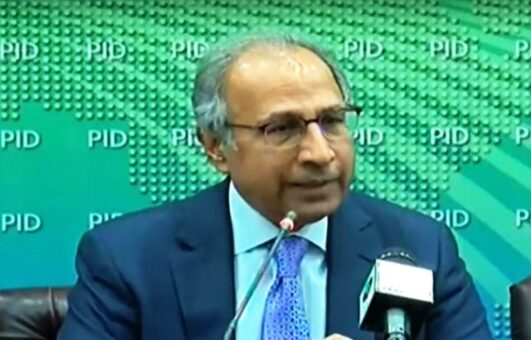
    KARACHI: Dr Abdul Hafeez Shaikh, Adviser to the Prime Minister on Finance and Revenue on Thursday directed Federal Board of Revenue (FBR) to make payment of all income tax refunds of up to Rs 50 million in the next couple of weeks.

    (more…)
  • FBR reorganizes DG transit trade; authorizes tracking of NATO, ISAF cargo

    FBR reorganizes DG transit trade; authorizes tracking of NATO, ISAF cargo

    ISLAMABAD: Directorate General of Transit Trade has been authorized to track cargo movement of Afghan transit, NATO/ISAF and transshipment in order to avoid incidence of en-route goods slippage.

    Federal Board of Revenue (FBR) on Wednesday issued SRO 609(I)/2020 for reorganization of the Directorate General of Transit Trade.

    The FBR said that the directorate shall be based at Custom House, Karachi, assisted by Director, Directorate of transit Trade (HQ), Karachi.

    The directorate general shall have its regional offices at Karachi, Gwadar, Quetta, Peshawar, Gilgit-Baltistan and Lahore. The director general shall report to the Member (Customs), FBR.

    The directorate general of transit trade shall be responsible for enforcement of all the international agreements, treaties, conventions, domestic laws, rules and procedures relating to transit trade with reference to cross border movement of bonded cargo and domestic laws, rules and procedures relating to transshipment with reference to inland movement of bonded cargo and shall also be responsible for enforcement of laws, rules and procedures relating to international transshipment, through the respective directorates and collectorates.

    The directorate general shall also supervise functioning of the directorates, furnish policy input to the FBR on matters relating to transit trade and transshipment and maintain liaison with all stakeholders.

    The Director, Directorate of Transit Trade (HQ) Karachi shall have jurisdiction over all customs matters relating to transit, transshipment and allied functions in respect of the national territory of whole of Pakistan covering the following functions and customs matters:

    (i) Project Director in terms of SRO 4139i0/2012 dated April 25, 2012.

    (ii) Supervision of tracking and monitoring across the national territory through the Central Control Room (CCR), established at Custom House, Karachi, in coordination with Regional Control Rooms (RCRs) established at respective directorates of transit trade of the following cargo:

    (a) Transit cargo;

    (b) POL products exported to Afghanistan;

    (c) US or NATO or ISAF cargo;

    (d) Transshipment cargo;

    (e) Safe transportation cargo;

    (f) EPZ/SEZ/Free Zones cargo;

    (g) Manufacturing bonds exports cargo;

    (h) Export oriented units exports cargo;

    (i) Transportation of imported liquid bulk cargo for exclusive use of ISAF/NATO forces in Afghanistan.

    (iii) Administration, budgeting and supervision of the Mobile Enforcement Units (MEUs) deployed at Transit Monitoring Response Centers (TMRCs) across the country;

    (iv) Sealing of cargo at Karachi sea ports and Port Qasim with respect to the following cargo:

    (a) Transit cargo;

    (b) POL products exported to Afghanistan;

    (c) US or NATO or ISAF cargo;

    (d) Transshipment cargo;

    (e) Safe transportation cargo;

    (f) EPZ/SEZ/Free Zones cargo

    (g) Manufacturing bonds exports cargo;

    (h) Export oriented units exports cargo;

    (i) Transportation of imported liquid bulk cargo for exclusive use of ISAF / NATO forces in Afghanistan.

    (v) Licensing of tracking companies in terms of SRO 413(I)/2012 dated April 25, 2012;

    (vi) Development, supervision and maintenance of transit trade facilitation portal including coordination with the relevant stakeholders.

    (vii) Development, supervision and updation of Risk Management System (RMS) through the local committee constituted for transit and transshipment RMS, including coordination with the relevant stakeholders;

    (viii) Association in development, updation and enhancement of MIS function;

    (ix) Personal management;

    (x) Coordination with all stakeholders for operational purposes;

    (xi) Business process re-engineering;

    (xii) Transit trade facilitation and redressal of complaints; and

    (xiii) Any other function assigned by the FBR from time to time.

  • Pakistan, Hungary sign treaty for exchange of information

    Pakistan, Hungary sign treaty for exchange of information

    ISLAMABAD: Pakistan and Hungary have signed a treaty for exchange of information under newer version of protocol of avoidance of double taxation and the prevention of fiscal evasion with respect to taxes on income, a statement issued by Federal Board of Revenue (FBR) said on Wednesday.

    Hungarian Ambassador to Pakistan Istvan Szabo signed the Protocol on behalf of Government of Hungary, while Dr. Muhammad Ashfaq Ahmed, Member (Inland Revenue Operations)/Additional Secretary inked it on behalf of Pakistan.

    The Article 27 of the Convention deals with Exchange of Information. Organization for Economic Cooperation and Development (OECD) approved changes in the Article on Exchange of Information in July 2012 to include provisions concerning cooperation between the tax administrations of the two Contracting States.

    The present article embodies the rules under which information may be exchanged to the widest possible extent to include taxes other than the income tax.

    Therefore, to incorporate the latest standard of administrative assistance in the extant Convention, Pakistan and Hungary decided to replace the Article on Exchange of Information with the new version through Protocol.

    The new Article on exchange of information provides that the competent authorities of the Contracting States shall exchange such information that will not be restricted by Article 1 & 2 of the Convention and no state shall decline to provide information merely for the reason that such information is of no interest to it, or because the information is held by a bank, other financial institution or nominee or a person acting in an agency or fiduciary capacity.

    According to the new version of the Article, the Contracting States shall exchange such information on request as is foreseeably relevant for carrying out of provisions of the convention or to the administration or enforcement of the domestic tax laws of the requesting state.

  • FBR to prescribe valuation method for used vehicles

    FBR to prescribe valuation method for used vehicles

    ISLAMABAD: Federal Board of Revenue (FBR) will prescribe method for valuation of used vehicles for the purpose of sales tax.

    FBR sources said that amendment has been made to Sales Tax Act, 1990 through Finance Act, 2020 related to value of supply of used vehicles.

    According to the amendment, in case of registered person who is engaged in purchasing used vehicles from general public on which sales tax had already been paid at the time of import or manufacturing, and which paid at the time of import or manufacturing, and which are, later on, sold in the open market after making certain value addition, value of supply will be difference between sale and purchase price of the said vehicles on the basis of the valuation method prescribed by the board [FBR].

  • Procedure for alternate dispute resolution

    Procedure for alternate dispute resolution

    ISLAMABAD: Federal Board of Revenue (FBR) has laid down procedure for alternate dispute resolution (ADR) in order to provide a platform to taxpayers for expeditious resolution of their cases.

    A new section 134A has been introduced to Income Tax Ordinance, 2001 through Finance Act 2020.

    Section 134A. Alternative dispute resolution.

    (1) Notwithstanding any other provision of this Ordinance, or the rules made thereunder, an aggrieved person in connection with any dispute pending before a court of law or an appellate authority pertaining to—

    (a) the liability of tax against the aggrieved person, or admissibility of refunds, as the case may be;

    (b) the extent of waiver of default surcharge and penalty; or

    (c) any other specific relief required to resolve the dispute, may apply to the Board for the appointment of a committee for the resolution of any hardship or dispute mentioned in detail in the application, which is under litigation in any court of law or an appellate authority, except where criminal proceedings have been initiated or where interpretation of question of law having effect on identical cases is involved having effect on other cases.

    (2) The Board may, after examination of the application of an aggrieved person, appoint a committee, within sixty days of receipt of such application in the Board, comprising,—

    (i) Chief Commissioner Inland Revenue having jurisdiction over the case;

    (ii) two persons from a panel notified by the Board comprising of chartered accountants, cost and management accountants, advocates, having minimum of ten years’ experience in the field of taxation and reputable businessmen.

    (3) The Board shall communicate the order of appointment of committee to the court of law or the appellate authority where the dispute is pending and the Commissioner.

    (4) The Committee appointed under sub-section (2) shall examine the issue and may, if it deemed necessary, conduct inquiry, seek expert opinion, direct any officer of the Inland Revenue or any other person to conduct an audit and shall decide the dispute through consensus, within one hundred and twenty days of its appointment.

    (5) The Committee may, in case of hardship, stay recovery of tax payable in respect of dispute pending before it for a period not exceeding one hundred and twenty days in aggregate or till the decision of the committee or its dissolution, whichever is earlier.

    (6) The decision of the committee under sub-section (4) shall be binding on the Commissioner when the aggrieved person, being satisfied with the decision, has withdrawn the appeal pending before the court of law or any appellate authority and has communicated the order of withdrawal to the Commissioner:

    Provided that if the order of withdrawal is not communicated to the Commissioner within sixty days of the service of decision of the committee upon the aggrieved person, the decision of the committee shall not be binding on the Commissioner.

    (7) If the Committee fails to decide within the period of one hundred and twenty days under sub-section (4), the Board shall dissolve the committee by an order in writing and the matter shall be decided by the court of law or the appellate authority where the dispute is pending.

    (8) The Board shall communicate the order of dissolution to the court of law or the appellate authority and the Commissioner.

    (9) The aggrieved person, on receipt of the order of dissolution, shall communicate it to the court of law or the appellate authority, where the dispute is pending.

    (10) The aggrieved person may make the payment of income tax and other taxes as decided by the committee under sub-section (4) and all decisions and orders made or passed shall stand modified to that extent.

    (11) The Board may prescribe the amount to be paid as remuneration for the services of the members of the committee, other than the member appointed under clause (i) of sub-section (2).

    (12) The Board may, by notification in the official Gazette, make rules for carrying out the purposes of this section.