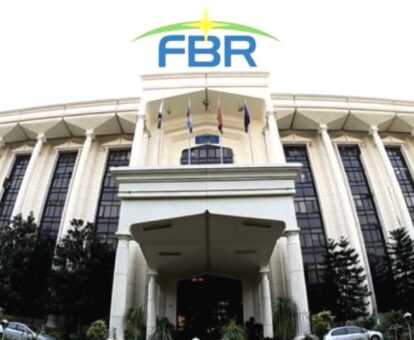
The Federal Board of Revenue is Pakistan’s apex tax agency, overseeing tax collection and policies. Pakistan Revenue is committed to providing timely updates on the Federal Board of Revenue to its readers.
Section 234 of Income Tax Ordinance, 2001 has defined the rate of advance income tax on motor vehicles to be collected by persons collecting motor vehicle tax.
234. Tax on motor vehicles.— (1) Any person at the time of collecting motor vehicle tax shall also collect advance tax at the rates specified in Division III of Part IV of the First Schedule.
(2) If the motor vehicle tax is collected in instalments or lump sum the advance tax may also be collected in instalments or lump sum in like manner.
(2A) In respect of motor cars used for more than ten years in Pakistan, no advance tax shall be collected after a period of ten years.
(3) In respect of a passenger transport vehicle with registered seating capacity of ten or more persons, advance tax shall not be collected after a period of ten years from the first day of July of the year of make of the vehicle.
(4) In respect of a goods transport vehicle with registered laden weight of less than 8120 kilograms, advance tax shall not be collected after a period of ten years from the date of first registration of vehicle in Pakistan.
(5) Advance tax collected under this section shall be adjustable.
“(6) For the purpose of sub-sections (1) and (2) “motor vehicle” shall include the vehicles specified in sub-section (7) of section 231B.”
(Disclaimer: The text of the above section is only for information. Team PkRevenue.com makes all efforts to provide the correct version of the text. However, the team PkRevenue.com is not responsible for any error or omission.)
233. Brokerage and commission. — (1) Where any payment on account of brokerage or commission is made by the Federal Government, a Provincial Government, a Local Government, a company or an association of person or
individual having turnover of hundred million rupees or more (hereinafter called the “principal”) to a person (hereinafter called the “agent”), the principal shall deduct advance tax at the rate specified in Division II of Part IV of the First Schedule from such payment.
(2) If the agent retains Commission or brokerage from any amount remitted by him to the principal, he shall be deemed to have been paid the commission or brokerage by the principal and the principal shall collect advance tax from the agent.
(2A) Notwithstanding the provisions of sub-section (1), where the principal is making payment on account of commission to an advertising agent, directly or through electronic or print media, the principal shall deduct tax (in addition to tax required to be deducted under clause (b) of sub-section (1) of section 153 on advertising services excluding commission), at the rate specified in Division II of Part IV of the First Schedule on the amount equal to-
A x 15/85
Where A = amount paid or to be paid to electronic or print media for advertising services (excluding commission) on which tax is deductible under clause (b) of sub-section (I) of section 153.
(2B) Tax deducted under sub-section (2A) shall be minimum tax on the income of the advertising agent.
(3) Where any tax is required to be collected from a person under sub-section (1), such tax shall be the minimum tax on the income of such persons.
(Disclaimer: The text of the above section is only for information. Team PkRevenue.com makes all efforts to provide the correct version of the text. However, the team PkRevenue.com is not responsible for any error or omission.)
For income tax rates on brokerage and commission please visit the following link:
The FBR through Circular No. 08 extended the last date for filing income tax return for tax year 2021 up to October 15, 2021 from September 30, 2021. The FBR extended the date after admitting serious technical problems on the IRIS – the online return filing portal.
The KTBA wrote a letter to FBR Chairman Dr. Muhammad Ashfaq Ahmed apprising him about computational errors and technical issues in filing of income tax return for the tax year 2021.
In his letter KTBA President Muhammad Zeeshan Merchant said that technical issues were not rectified yet and taxpayers were facing difficulties in filing their returns.
“The 90 days time prescribed under section 118 of the Income Tax Ordinance, 2001, will only begin once the due diligence prescribed in law and rules is following in pitch and substance and a complete and flawless return of income is notified in terms of Section 237 of the Income Tax Ordinance, 2001,” Merchant said.
The tax bar said the issues were previously highlighted related to erroneous tax computation on the IRIS portal with respect to income expressed as ‘minimum tax’, where owing to pre-fixed attributes/formulas taxpayer are forced to pay additional tax or file mix-up return.
This issue despite being pitted to judicial wrangling before the Lahore High Court in writ jurisdiction dated September 24, 2021, has not been resolved as yet, Merchant added
Furthermore, the return of income at the IRIS still suffers technical issues and anomalies that were already highlighted through the KTBA letter dated September 21, 2021. The issues are included: loss on disposal of securities; incorrect working of tax on foreign incomes; discrepancies in tax computation of commercial importers; tax on fee for technical services/royalty of a non-resident person etc.
The KTBA pointed out that simplified return of income for SMEs was unceremoniously uploaded on IRIS portal without prescribing a draft return.
231B. Advance tax on private motor vehicles.— (1) Every motor vehicle registering authority of Excise and Taxation Department shall collect advance tax at the time of registration of a motor vehicle, at the rates specified in Division VII of Part IV of the First Schedule:
“Provided that no collection of advance tax under this sub-section shall be made after five years from the date of first registration as specified in clauses (a), (b) and (c) of sub-section (6).”
(1A) Every leasing company or a scheduled bank or a non-banking financial institution or an investment bank or a modaraba or a development finance institution, whether shariah compliant or under conventional mode, at the time of leasing of a motor vehicle to a “person whose name is not appearing in the active taxpayers’ list”, either through ijara or otherwise, shall collect advance tax at the rate of four per cent of the value of the motor vehicle.
(2) Every motor vehicle registering authority of Excise and Taxation Department shall collect advance tax at the time of transfer of registration or ownership of a private motor vehicle, at the rates specified in Division VII of Part IV of the First Schedule:
Provided that no collection of advance tax under this sub-section shall be made on transfer of vehicle after five year from the date of first registration in Pakistan.
(2A) Every motor vehicle registration authority of Excise and Taxation Department shall, at the time of registration, collect tax at the rates specified in Division VII of Part IV of the First Schedule, if the locally manufactured motor vehicle has been sold prior to registration by the person who originally purchased it from the local manufacturer.
(3) Every manufacturer of a motor “vehicle”shall collect, at the time of sale of a motor car or jeep, advance tax at the rate specified in Division VII of Part IV of the First Schedule from the person to whom such sale is made.
(4) Sub-section (1) shall not apply if a person produces evidence that tax under sub-section (3) in case of a locally manufactured vehicle or tax under section 148 in the case of imported vehicle was collected from the same person in respect of the same vehicle.
(5) The advance tax collected under this section shall be adjustable:
Provided that the provisions of this section shall not be applicable in the case of –
(a) the Federal Government;
(b) a Provincial Government;
(c) a Local Government;
(d) a foreign diplomat; or
(e) a diplomatic mission in Pakistan.
(6) For the purposes of this section the expression “date of first registration” means—
(a) the date of issuance of broad arrow number in case a vehicle is acquired from the Armed Forces of Pakistan;
(b) the date of registration by the Ministry of Foreign Affairs in case the vehicle is acquired from a foreign diplomat or a diplomatic mission in Pakistan;
(c) the last day of the year of manufacture in case of acquisition of an unregistered vehicle from the Federal or a Provincial Government; and
(d) in all other cases the date of first registration by the Excise and Taxation Department.
(7) For the purpose of this section “motor vehicle” includes car, jeep, van, sports utility vehicle, pick-up trucks for private use, caravan automobile, limousine, wagon and any other automobile used for private purpose.”
Explanation.— For the removal of doubt, it is clarified that a motor vehicle does not include a rickshaw, motorcycle-rickshaw and any other motor vehicle having engine capacity upto 200cc.
(Disclaimer: The text of the above section is only for information. Team PkRevenue.com makes all efforts to provide the correct version of the text. However, the team PkRevenue.com is not responsible for any error or omission.)
The FBR said that through Finance Act, 2019 added a sub-section (6) to Section 8B of the Sales Tax Act, 1990 whereby a Tier-1 Retailer who did not integrate its retail outlet in the manner prescribed under sub-section (9A) of Section 3 of the Sales Tax Act, 1990 during a tax period, its adjustable tax for that period would be reduced by 15 per cent. The figure of 15 per cent has been raised to 60 per cent through Finance Act, 2021.
In order to operationalize the provision of law, a system-based approach has been adopted whereby all Tier-1 retailers who are liable to integrate but have not yet integrated, with effect from July 2021 (Sales Tax Returns filed in August 2021) are to be dealt with as per the procedure laid down in STGO No.01 of 2022 issued on August 03, 2021.
Through the latest STGO, a list of 1,136 identified Tier-1 Retailers has been placed on FBR’s portal allowing them to integrate with FBR’s system by October 10, 2021 and the procedure of exclusion from this list of 1,136 identified Tier-1 retailers shall apply as laid down in STGO 01 of 2022 dated August 03, 2021.
Upon filing of sales tax return for the month of September 2021 all notified Tier-1 retailers not having yet integrated, the input tax claim would be disallowed as above, without any further notice or proceedings, creating tax demand by the same amount.
Section 227A and Section 227B of Income Tax Ordinance, 2001 have laid down procedure for reward to officials of Federal Board of Revenue (FBR) and whistleblowers in recovery of tax evaded amount.
227A. Reward to officers and officials of Inland Revenue.— (1) In cases (i) involving concealment or evasion of income tax and other taxes, cash reward shall, only after realization of part or whole of the taxes involved in such cases, be sanctioned to the officers and officials of Inland Revenue for their meritorious conduct in such cases and (ii) for other meritorious services and to the informer providing credible information leading to such detection.
(2) The Board may, by notification in the official Gazette, prescribe the procedure in this behalf and also specify the apportionment of reward sanctioned under this section for individual performance or to collective welfare of the officers and officials of Inland Revenue.
227B. Reward to whistleblowers.—(1) The Board may sanction reward to whistleblowers in cases of concealment or evasion of income tax, fraud, corruption or misconduct providing credible information leading to such detection of tax.
(2) The Board may, by notification in the official Gazette, prescribe the procedure in this behalf and also specify the apportionment of reward sanctioned under this section for whistleblowers.
(3) The claim for reward by the whistleblower shall be rejected, if—
(a) the information provided is of no value;
(aa) the information is not supported by any evidence;
(b) the Board already had the information;
(c) the information was available in public records; or
(d) no collection of taxes is made from the information provided
from which the Board can pay the reward.
(4) For the purpose of this section, “whistleblower” means a person who reports concealment or evasion of income tax leading to detection or collection of taxes, fraud, corruption or misconduct, to the competent authority having power to take action against the person or an income tax authority committing fraud, corruption, misconduct, or involved in concealment or evasion of taxes.”
Following are the text of Section 227C, Section 227D and Section 227E:
227C. Restriction on purchase of certain assets. [this section has been deleted through Finance Act, 2019]
227D.- Automated impersonal tax regime.- (1) The Board may design an alternate impersonal taxation regime whereby personal interaction will be minimized.
(2) The Board may, by notification in the official Gazette, prescribe the procedure in this behalf.
(3) This section shall be applicable only for low risk and compliant taxpayers as may be prescribed.
227E. E-hearing.— (1) The Board may design and prescribe e-hearing module for the purpose of conducting hearings, granting opportunity of being heard and electronically receiving any information for the purpose of this Ordinance.
(2) The recording of e-hearing proceedings shall be admissible as evidence before any forum or court of law for the purpose of this Ordinance.
(3) The Board may make rules for the purpose of this section.
(Disclaimer: The text of the above section is only for information. Team PkRevenue.com makes all efforts to provide the correct version of the text. However, the team PkRevenue.com is not responsible for any error or omission.)
Section 227 of Income Tax Ordinance, 2001 has explained that no suit or other legal proceedings would be brought in any civil court against any order made under this ordinance.
227. Bar of suits in Civil Courts.— (1) No suit or other legal proceeding shall be brought in any Civil Court against any order made or any notice issued under this Ordinance, and no prosecution, suit or other proceedings shall be made against any person for anything which is in good faith done or intended to be done under this Ordinance or any rules or orders made or notices issued thereunder.
“Explanation.—For the removal of doubt, it is clarified that Civil Court includes any court exercising power of the civil court.”
(2) Notwithstanding anything contained in any other law for the time being in force, no investigation or inquiry shall be undertaken or initiated by any governmental agency against any officer or official for anything done in his official capacity under this Ordinance, rules, instructions or direction made or issued there-under without the prior approval of the Board.
(Disclaimer: The text of the above section is only for information. Team PkRevenue.com makes all efforts to provide the correct version of the text. However, the team PkRevenue.com is not responsible for any error or omission.)
226. Computation of limitation period.—In computing the period of limitation, there shall be excluded –
(a) in the case of an appeal or an application under this Ordinance, the day on which the order complained of was served and, if the taxpayer was not furnished with a copy of the order when the notice of the order was served on the taxpayer, the time requisite for obtaining a copy of such order; and
(b) in the case of an assessment or other proceeding under this Ordinance,—
(i) the period, if any, for which such proceedings were stayed by any Court, Appellate Tribunal or any other authority; or
(ii) the period, if any, for which any proceeding for the tax year remained pending before any Court, Appellate Tribunal or any other authority.
(Disclaimer: The text of the above section is only for information. Team PkRevenue.com makes all efforts to provide the correct version of the text. However, the team PkRevenue.com is not responsible for any error or omission.)
Section 225 of the Income Tax Ordinance, 2001 grants the Federal Board of Revenue (FBR) the authority to continue or initiate proceedings against companies undergoing liquidation without the need for leave from the Court.