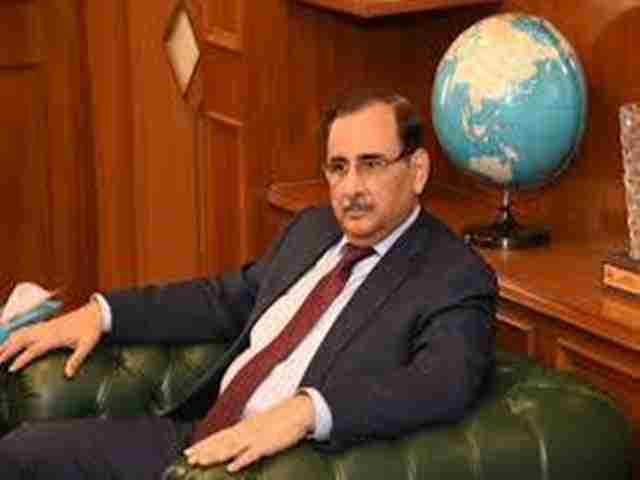
ISLAMABAD – The Pakistan Bureau of Statistics (PBS) categorically rejected allegations of fudging in inflation figures, addressing concerns raised in some sections of the electronic and print media.
(more…)Tag: inflation
-

Sensitive price inflation increases by 17.58pc
KARACHI: The prices of essential items have registered 17.58 percent increase by week ended February 06, 2020 when compared with corresponding week last year, according to data released by Pakistan Bureau of Statistics (PBS).
According to the data the combined Sensitive Price Indicator (SPI) increased by 17.58 percent by week ended February 06, 2020 as compared with the week ended February 07, 2019.
As per the data the highest inflation for the period under review was recorded at 19.99 percent for the expenditure group ranging between Rs22.889 and Rs29.517.
While the SPI was recorded at 16.18 percent for the period for expenditure group up to Rs17,732.
The PBS computes the weekly SPI with base 2015-16= 100 covering 17 urban centers and 51 essential items for all expenditure groups.
-

Finance ministry hopes ease in inflation in coming days
ISLAMABAD: Ministry of Finance has said that the outcome of stabilization policies, agriculture sector interventions, rigorous monitoring at federal/provincial levels, and favorable weather will bring better results in easing out inflation and sustaining the economy towards growth and productivity in the coming days.
Adverse effects of pre-monsoon rains on the wheat crop, disruption of the supply chain of essential items due to harsh winters and thick fog, delay in harvest and arrival of the crop in the market, and lower production of vegetables, including tomato in Sindh, led to higher food inflation but the change of weather and better supply of potatoes, tomatoes and onions should result in smooth supply and decrease price pressure, says the Finance Division in an official statement on Monday.
The Finance Division noted that another factor contributing to higher inflation was the global price impact due to international commodity prices like Palm oil increased by 43.9 percent, Soybean oil by 12.8 percent, Crude oil by 16.6 percent, etc December 2019 over December 2018 also pushed up the domestic prices. A downward trajectory in crude oil in the market will result in a downward pattern in domestic prices in the coming months.
While the factors above are likely to ease the inflation, the government has also taken several relief measures to protect the vulnerable from the price-hike. These measures include the provision of subsidy to Utility Stores Corporation on 05 essential items for which Rs. 7 billion has been transferred to Ministry of Industries and Production; Rs. 226.5 billion allocated in the budget, Rs. 141 billion already released so far, for low-end consumers using less than 300 units of electricity in a month; PM’s Ehsaas program with doubled social safety net allocation of Rs.190bn from 100bn; out of Rs. 24 billion allocated for a gas subsidy, Rs. 12 billion have so far been released; and Rs. 1000 per family given to 5.1 million families as a special transfer in August 2019.
Similarly, Rs. 5,000 quarterly tranche was paid to 4.3 million poor families in December 2019; Under Kifalat monthly stipends of Rs. 2,000 per month to 4.5 million families for consumption smoothing starting from 1st February 2020; 1 million new beneficiaries to be added to Kifalat in the next five months with a monthly transfer of Rs. 2,000; undergraduate scholarships to cover the cost of tuition fees and other expenses at the university for 50,000 needy students; Rs. 750 for boys and Rs. 1,000 for girls quarterly stipends to primary school-going children three million children covered; record allocation Rs.152 bn for merged FATA districts; and reduced GST on LPG to 10 percent from 17 percent.
The Ministry of Finance said the government had also devised a strategy to control and ease out the impact of inflation through a host of policy measures which included ECC permission for import of 0.3 million tons of wheat to decrease the local wheat price and meet the domestic requirement; Zero borrowing by Govt from SBP in Current FY.
Government retired Rs. 837.2 billion (1st July-17th January 2020) compared to the borrowing of Rs. 3770.5 billion same periods last year; Reduction in fiscal deficit, primary surplus H1FY 20; monetary tightening and demand compression by austerity; complete restriction on supplementary grants; prices monitoring Cell in Ministry of National Food Security & Research to check price hikes of essential food items; network of Sasta Bazaars and Utility Store outlets is being expanded for provision of essential items; cheaper Roti provided with a subsidy of Rs.1.5 bn for public tandoors; provincial governments monitoring the display of price list and quality of items in the open market and Sasta Bazaars; and 10) effective measures being taken by the CCP to control Cartelization and undue Profiteering
-

46 essential consumer items out of 51 register price hike in one year; prices go up to 116.82%
ISLAMABAD: About 46 essential consumer items out of 51 have registered increase in prices during past one year showing the inflationary pressure on the masses.
The inflation data based on Sensitive Price Indicator (SPI) released by Pakistan Bureau of Statistics (PBS) for the week ended January 01, 2020.
The PBS calculates the weekly SPI with base 2015-16=100 covering 17 urban centres and 51 essential items for all expenditure groups/quintiles and combined.
The following is the comparison of price increase for the period between January 23, 2020 and January 24, 2019:
01. Onions: 116.82 percent
02. Potatoes: 111.15 percent
03. Pulse Moong (Washed): 88.52 percent
04. Garlic (Lehsun) 1 Kg: 65.43 percent
05. Tomatoes: 56.91 percent
06. Pulse Mash (Washed): 50.9 percent
07. Gur (Average Quality): 43.26 percent
08. Chicken Farm Broiler (Live): 41.73 percent
09. Cigarettes Capstan 20’S Packet: 36.81 percent
10. Sugar Refined: 31.95 percent
11. Long Cloth 57″ Gul Ahmed/Al Karam: 31.3 percent
12. Pulse Gram: 30.2 percent
13. Lawn Printed Gul Ahmed/Al Karam: 28.52 percent
14. Petrol Super: 27.88 percent
15. Vegetable Ghee DALDA/HABIB or Other superior Quality 1 kg Pouch: 24.87 percent
16. Pulse Masoor (Washed): 22.92 percent
17. Wheat Flour Bag 20 Kg: 21.16 percent
18. Cooked Beef at Average Hotel: 20.26 percent
19. Hi-Speed Diesel: 19.18 percent
20. LPG 11.67 kg Cylinder: 18.87 percent
21. Cooking Oil DALDA or Other Similar Brand (SN), 5 Litre Tin: 17.98 percent
22. Vegetable Ghee DALDA/HABIB 2.5 kg Tin: 16.8 percent
23. Tea Prepared Ordinary: 16.6 percent
24. Shirting (Average Quality): 16.46 percent
25. Powdered Milk NIDO 390 gm Polybag: 16.29 percent
26. Cooked Daal at Average Hotel: 16.27 percent
27. Bananas (Kela) Local: 15.51 percent
28. Mustard Oil (Average Quality): 15.38 percent
29. Sufi Washing Soap: 14.61 percent
30. Bread plain (Small Size): 12.39 percent
31. Georgette (Average Quality): 11.85 percent
32. Rice IRRI-6/9 (Sindh/Punjab): 11.38 percent
33. Toilet Soap LIFEBUOY 115 gm: 11.14 percent
34. Eggs Hen (Farm): 10.4 percent
35. Mutton (Average Quality): 10.3 percent
36. Tea Lipton Yellow Label 190 gm Packet: 10.29 percent
37. Electricity Charges for Q1: 10.26 percent
38. Beef with Bone (Average Quality): 9.79 percent
39. Milk fresh (Un-boiled): 9.19 percent
40. Match Box: 8.47 percent
41. Energy Saver Philips 14 Watt: 8.37 percent
42. Firewood Whole 40 Kg: 7.08 percent
43. Rice Basmati Broken (Average Quality) 1 Kg: 6.6 percent
44. Curd (Dahi) Loose: 6.49 percent
45. Chilies Powder NATIONAL 200 gm Packet: 3.98 percent
46. Salt Powdered (NATIONAL/SHAN) 800 gm Packet: 0.91 percent
47. Gents Sandal Bata: 0 percent
48. Gents Sponge Chappal Bata: 0 percent
49. Ladies Sandal Bata: 0 percent
50. Gas Charges upto 3.3719 MMBTU: 0 percent
51. Telephone Call Charges: 0 percent
-

Policy rate likely unchanged on high inflation
KARACHI: The State Bank of Pakistan (SBP) is likely to keep the policy rate unchanged due to the recent surge in inflation, analysts said on Thursday.
Analysts at Arif Habib Limited expect inflation to remain elevated in upcoming months on account of regular adjustment in electricity price (fuel cost adjustment and base tariff hike), another round of gas price increase, increase in prices of petroleum products, and continuous surge in prices of perishable and non-perishable food items.
On the monetary policy front, they maintain a status quo stance on the upcoming Monetary Policy Statement (MPS) scheduled on 28th Jan’20, with no change expected in interest rate (policy rate to be maintained at 13.25%) as they believe the surge in inflation is due to supply disruptions of key commodities and this might settle down in coming months. We expect inflation to start declining from March 2020 to 11.5% due to the high base effect. After considering forecasted inflation, we expect rate cuts to begin from March 2020.
They expect January 2020 inflation to settle at 13.58% YoY compared to 5.6% in Jan’19 and 12.63% in December 19, respectively.
The YoY uptick in CPI is expected on the back of i) increase in prices of non-perishable products including Pulse Moong, Chicken, Pulse Gram, Eggs, Gur and Wheat Flour, ii) increase expected in quarterly house rent index by 1.5%, and iii) increase in prices of petroleum products.
Whereas a decline in prices of perishable items is expected to keep the inflation restrained. This will take the 7MFY20 average inflation to 11.46% compared to 5.9% in 7MFY19. On a yearly basis, an increase in inflation will likely be led by Food (+21% YoY), Transport (+15.4%YoY), Alcoholic Beverages & Tobacco (+14.6% YoY), and House Hold Equipment (+12.9%).
On a MoM basis, CPI reading is expected to increase by 1.20% attributable to surge in House Hold Equipment index (+2.4% MoM), Housing Index (+1.7% MoM), Food index (+1.4% MoM) and Transport Index (+1.4% MoM).
As per three weeks Sensitive Price Index (SPI) data published by the Pakistan Bureau of Statistics (PBS), average prices of Pulse Moong, Chicken, Pulse Gram, Eggs, Gur and Wheat Flour are expected to register a jump of 15%, 13%, 13%, 11%, 8% and 5% MoM, respectively.
On the other hand, meagre decline in prices of essential food items like Onions (-15% MoM), and Tomatoes (-5% MoM) are expected to keep the food index contained.
-

Headline inflation increases by 8.8 percent in April 2019
ISLAMABAD: The headline inflation has surged by 8.8 percent on year on year (YoY) in April 2019 as compared to an increase of 9.4 percent in previous month and 3.7 percent in April 2018, said Pakistan Bureau of Statistics (PBS) on Thursday.
The Consumer Price Index (CPI) based inflation on month-on-month basis, it increased by 1.3 percent in April 2019 as compared to an increase of 1.4 percent in the previous month and an increase of 1.8 percent in corresponding month i.e. April 2018.
Core inflation measured by non-food non-energy CPI (Core NFNE) increased by 7.0 percent on (YoY) basis in April 2019 as compared to an increase of 8.5 percent in the previous month and 7.0 percent in April 2018. On (MoM) basis, it increased by 1.0 percent in April 2019 as compared to an increase of 0.5 percent in previous month, and an increase of 2.5 percent in corresponding month of last year i.e. April 2018.
Core inflation, measured by 20 percent weighted trimmed mean CPI (Core Trimmed) increased by 7.2 percent on (YoY) basis in April 2019 as compared to 7.9 percent in the previous month and by 5.0 percent in April 2018. On (MoM) basis, it increased by 0.9 percent in April 2019 as compared to an increase of 0.4 percent in the previous month and an increase of 1.6 percent in corresponding month of last year i.e. April 2018.
The Sensitive Price Indicator (SPI) inflation on YoY basis increased by 9.3 percent in April 2019 as compared to an increase of 8.8 percent a month earlier and a decrease of 0.5 percent in April 2018.
On MoM basis, it increased by 0.9 percent as compared to an increase of 1.6 percent in the previous month and an increase of 0.4 percent in corresponding month of last year i.e. April 2018.
Wholesale Price Index (WPI) inflation on YoY basis increased by 13.8 percent in April 2019 as compared to an increase of 12.6 percent a month earlier and an increase of 4.0 percent in April 2018.
WPI inflation on MoM basis increased by 2.3 percent in April 2019 as compared to an increase of 1.7 percent a month earlier and an increase of 1.3 percent in corresponding month of last year i.e. April 2018.
-

Inflation increases by 17.15pc for higher income group
KARACHI: The prices of essential items has increased by 17.15 percent for higher income group above Rs35,000, according to weekly Sensitive Price Indicator (SPI) issued by Pakistan Bureau of Statistics (PBS).
The PBS said that the inflation of the income group above Rs35,000 was increased by 17.15 percent by week ended April 25, 2019 as compared with same week a year ago.
The PBS computes the weekly SPI with base 2007-08=100 covering 17 urban centres and 53 essential items for all income groups/quintiles and combined.
The PBS calculates SPI for income groups included Rs8,000; between Rs8,001 – Rs12,000; Rs12,001-Rs18,000; Rs18,001-Rs35,000; and above Rs35,000. The average inflation for all income group increased by 12.91 percent by week ended April 25, 2018 as compared with corresponding week last year. However, the average inflation increased by 0.37 percent over the previous week ended Aril 18, 2019.
During the week under review as compared with previous week, around 20 items registered increase in their prices. Some of these items are included: tomatoes, onions, potatoes, egg hen, bananas, pulse moong, sugar, pulse mash, garlic, pulse gram, tea prepared, mutton etc.
However, 10 items registered decline in their prices during the week, which included: chicken farm, LPG cylinder 11-kg, wheat, wheat flour, firewood, red chillie, cooking oil, vegetable ghee etc.
Average prices of 22 items remained unchanged during the week under review.
According to PBS the SPI was increasing for the last four consecutive weeks. The SPI is major component for headline inflation i.e. Consumer Price Index (CPI). The movement of SPI sets the monthly CPI.
-

Sensitive price inflation grows by 12.02 percent
KARACHI: The prices of essential items have registered 12.02 percent growth by week ended April 11, 2019 as compared with corresponding week last year, according to data released by Pakistan Bureau of Statistics (PBS) on Monday.
The Sensitive Price Indicator (SPI) based inflation has shown the increase with the average inflation for all income groups.
The weekly data revealed that the inflation grew by 16.31 percent for income group above Rs35,000. While the SPI based inflation grew by 12.89 percent for the income group range between Rs18,001 – Rs35,000.
Meanwhile, the inflation increased by 8.9 percent, 9.07 percent and 8.97 percent for income group up to Rs8,000, Rs8,001-Rs12.000 and Rs12,001 – Rs18,000, respectively.
The PBS calculates the weekly SPI with base 2007-08=100 covering 17 urban centres and 53 essential items for all income groups/quintiles and combined has been computed.
-

World Bank projects Pakistan’s growth to decelerate in FY19, FY20
KARACHI: World Bank has projected lower GDP growth for Pakistan during two fiscal years i.e. 2018/2019 and 2019/2020 to 3.4 percent and 2.7 percent, respectively.
The World Bank in a report released on Sunday, said that growth for Pakistan is projected to decelerate to 3.4 percent in FY19 and to 2.7 percent in FY20, as the government tightens fiscal and monetary policies.
“While domestic demand growth will slow down immediately, net ex¬ports will only increase gradually,” it added.
The World Bank said that as macroeconomic conditions improve, and a package of structural reforms in fiscal management and competitiveness is implemented, growth is expected to recover to 4.0 percent in 2020/2021.
“This baseline scenario assumes stable international oil prices and reduced political and security risks,” it added.
Inflation is expected to rise to 7.1 percent (average) in FY19 and projected to reach 13.5 percent in FY20 as a result of further exchange rate depreciation pass-through.
The trade deficit is projected to remain elevated during 2018/2019, but to narrow in 2019/2020 and 2020/2021 as the impacts of currency depreciation, domestic demand compression, and other regulatory measures to curb imports set in.
Remittances are projected to finance over 70 percent of the trade deficit.
FDI, multilateral and bilateral debt-creating flows as well as financing from international markets are expected to be the main financing sources of the current account in the near to medium term.
The fiscal deficit is projected to increase to 6.9 percent in 2018/2019 and to remain high during next two fiscal years, a result of large interest payments and a slow increase in domestic revenues.
Public debt to GDP is expected to cross 80 percent in 2018/2019 and to remain elevated in the next two years, increasing Pakistan’s exposure to debt-related shocks.
The pace of poverty reduction is expected to continue to slow-down in FY19 and FY20, following the projected growth deceleration and higher inflation rates.
Together with the macroeconomic adjustment expected over the next two years, there is an urgent need to implement structural reforms to support the growth rebound from FY21 onwards.
Economic uncertainty has increased due to protracted negotiations with the IMF.
In addition, recent regional tensions have had an impact on risk perceptions.
The low reserves position and high debt-ratios limit the buffers that Pakistan could use to absorb external shocks (such as an increase in US interest rates) and may negatively impact the government’s ability to access international markets.
Reforms to put the country on a stable growth path include increased exchange rate flexibility, improved competitiveness and lower cost of doing business.
On the revenue front, reforms to improve tax administration, widen the tax base and facilitate tax compliance are critical.
Higher inflation rates may jeopardize recent gains in poverty reduction, since poor households in urban areas are particularly affected by increases in prices, as shown by the most recent inflation hike during the 2007-08 food price crisis.
-

Headline inflation increases by 9.4pc in March
ISLAMABAD: The headline inflation based on Consumer Price Index (CPI) has increased by 9.4 percent on year-on-year basis in March, 2019 as compared to an increase of 8.2 percent in the previous month and 3.2 percent in March 2018.
The Pakistan Bureau of Statistics (PBS) on Monday said that on month-on-month basis, it increased by 1.4 percent in March 2019 as compared to an increase of 0.6 percent in the previous month and an increase of 0.3 percent in corresponding month i.e. March 2018.
Core inflation measured by non-food non-energy CPI (Core NFNE) increased by 8.5 percent on (YoY) basis in March 2019 as compared to an increase of 8.8 percent in the previous month and 5.8 percent in March 2018.
On (MoM) basis, it increased by 0.5 percent in March 2019 as compared to an increase of 0.2 percent in previous month, and an increase of 0.7 percent in corresponding month of last year i.e. March 2018.
Core inflation, measured by 20 percent weighted trimmed mean CPI (Core Trimmed) increased by 7.9 percent on (YoY) basis in March 2019 as compared to 7.7 percent in the previous month and by 4.1 percent in March 2018. On (MoM) basis, it increased by 0.4 percent in March 2019 as compared to an increase of 0.2 percent in the previous month and an increase of 0.2 percent in corresponding month of last year i.e. March 2018.
Sensitive Price Indicator (SPI) inflation on YoY basis increased by 8.8 percent in March 2019 as compared to an increase of 6.5 percent a month earlier and a decrease of 1.8 percent in March 2018.
On MoM basis, it increased by 1.6 percent as compared to an increase of 1.5 percent in the previous month and a decrease of 0.6 percent in corresponding month of last year i.e. March 2018.
Wholesale Price Index (WPI) inflation on YoY basis increased by 12.6 percent in March 2019 as compared to an increase of 11.0 percent a month earlier and an increase of 3.6 percent in March 2018.
WPI inflation on MoM basis increased by 1.7 percent in March 2019 as compared to an increase of 0.9 percent a month earlier and an increase of 0.2 percent in corresponding month of last year i.e. March 2018.