Islamabad, October 19, 2023 – The National Electric Power Regulatory Authority (NEPRA) has successfully concluded a public hearing on K-Electric’s (KE) Power Acquisition Programme (PAP) for the fiscal years 2024-2030.
(more…)Tag: NEPRA
-
NEPRA Approves Tariff Adjustments for Power Utilities
Islamabad, September 28, 2023 – The National Electric Power Regulatory Authority (NEPRA) has given the green light for an enhancement in tariff adjustments for power utilities.
(more…) -
K-Electric fails to improve power generation: NEPRA Chief
KARACHI: Touseef Hassan Farooqi, Chairman, National Electric Power Regulatory Authority (NEPRA) has said that K-Electric failed to improve power generation.
(more…) -
NEPRA acknowledges KE’s operational performance
KARACHI: A report published by National Electric Power Regulatory Authority (NEPRA) has acknowledged the improved operational performance of the KE, the utility company responsible for power generation and supply to Karachi.
The report, published annually by National Electric Power Regulatory Authority (NEPRA), also highlighted the longstanding issue of supply of low gas to K-Electric’s power plants at Korangi and SITE, which is affecting 200 MW of generation capacity for Karachi and leading to expensive power generation.
Through sustained investments, KE has been able to drive a significant reduction in Transmission and Distribution (T&D) losses, closing the financial year at 15.35%, lower than the regulator’s target of 15.95%. The utility has also been able to add over 250,000 new connections to its network bringing the total consumer base to over 3.4 million at the close of the fiscal year. Additionally, the number of units of energy served to these customers has also increased.
Commenting on the results, Director of Communications & Spokesperson KE, Imran Rana stated, “We continue to explore ways to improve our services for our growing customer base, and we are very pleased that KE’s operational improvement is being acknowledged in Power Sector’s credible annual performance report from the Regulatory Authority, NEPRA.
We look forward to carrying this momentum year on year, through increased digitization and automation of our processes and sustained investment across the value chain. We are also keeping our stakeholders – including the NEPRA Authority and the Ministry of Energy, Government of Pakistan among others – fully informed of the factors that continue to affect KE’s sustainability. Long delays in release of the Tariff Differential Subsidy (TDS) claims, and absence of supply of natural gas to KE are two important issues on top of the list that directly affects our ability to serve our customers.”
KE has also been actively developing a culture of regular bill payment and expanded its facilities to offer consumers convenient channels to clear their dues. Over the year, KE’s website has been integrated with NIFT ePay gateway offering real-time bill payment through interbank fund transfers.
Consumers can use the KE Live App to pay their bills from the convenience of their phones regardless of geographic location. Multiple banks and financial institutions have also been brought on board as partners offering cashback incentives and the option of converting utility bill payments on installments for certain credit cardholders.
Furthermore, KE is also engaging with area representatives at a community level for support in promoting a culture of bill payment and has also established multiple facilitation camps across the city to address and support billing queries. These efforts have resulted in improved recovery ratios which closed at 96.69%. During the same period, recovery ratios for DISCOs across the country dropped by 7 percentage points to 90.51%.
The company has also maintained a strong focus on safety, creating awareness on pertinent infrastructure issues including encroachment of constructed properties, the use of kundas, and unauthorized civil works carried across the city which create an unsafe environment for citizens. In addition to securing its infrastructure through earthing and grounding protocols, the utility continues to liaise with relevant civic agencies to ensure a safe and uninterrupted supply of electricity to the city. This has enabled KE to achieve a 28% reduction in safety related incidents within its territory. By comparison, safety incidents increased by 14% within state-owned DISCOs.
The report also commented on macroeconomic and other factors such as the devaluation of the Rupee against the US Dollar, delays in completion on power projects and outages of new power projects which exacerbated the cost of fuel procurement and raised the cost of electricity for the end-user. The report recommends a lot of measures for the improvement of power sector for Government to consider.
-
Techaccess Pakistan hosts session on in power sector cybersecurity
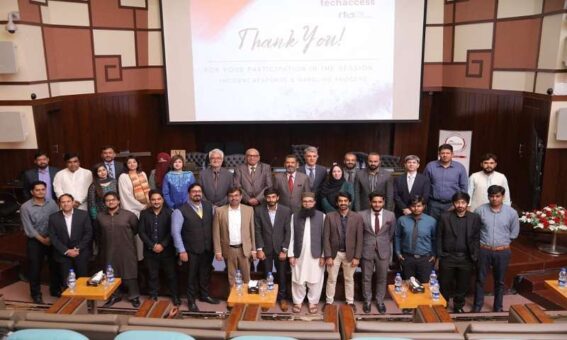
ISLAMABAD: Techaccess Pakistan has hosted a session on “Cybersecurity Challenge in Critical Infrastructure (Power Sector)” in Islamabad aim of soliciting awareness amongst national public and private sector’s energy power entities against the global risks of cyber-attacks.
The session was organized by Techaccess Pakistan and a large number of power sector’s professionals, trade and business representatives, NEPRA’s members of the authority and professionals attended the event.
Chairman NEPRA, Tauseef H. Farooqi in his welcoming address highlighted the importance of the session. He remarked that cyberspace is the new 21st century warzone.
Most of the cyber-attack in 2021 and 2022 were focused on energy sector. Cybersecurity is more challenging within power sector due to dispersed geo locations of generation plants and interdependence between OT and IT infrastructure.
Cybersecurity incidents are now “Eco-System” challenges because it is not just one electricity supply chain actor that is targeted but the weakest link in somewhere in country’s power system. We need comprehensive cybersecurity governance model to deal with this Ecosystem challenge and promote security and resilience-by design culture.
CTO Tariq Malik emphasized that the recent cyber-attacks by means of “viruses” or other known methods against primary energy operators and in general OT (SCADA) Systems, are once again reminding us that we are now facing a very expensive “digital pandemic” which has become an “endemic” in threat handling.
In fact, many events of cyber incidents are continuously emerging at global level on several OT Systems on different industrial technological plants with a fluctuation of increases and temporary apparent decreases in the number of cases identified (not always able to detect or report).
Unlikely, Industries have to learn to live with it, putting in place and continuously updating the necessary treatments to thwart and “mitigate their effects” according to “protocols” suggested by Cyber Security Authorities and Industrial entities, specialists in the Cyber Domain, daily involved to categories insurgences’ cyber incidents and their effects.
In the session the trainer also talked about the cyclical practice of identifying, classifying, prioritizing, remediating and mitigating software vulnerabilities that provides the idea of vulnerability management.
Among the indications that emerge from various parts as a common factor, it will undoubtedly be decisive that of investing with determination in the creation of a progressive national autonomy in the development of advanced products and technologies to be promptly integrated into the public cyber security ecosystem or private cyber security ecosystem.
Mehmood Jabbar CEO of Techaccess Pakistan jointly with its industrial partner RTA has exactly approached this mission to have a national under controlled cyber security solution which is able to manage in a secure way its H24 support national Corporates and Governmental Authorities by the adaptation of RTA and iSOC to the operational requirements and IT / OT infrastructures for its most sensitive Customers.
Saad Mudassir Chief Company Engineer from Associated Press of Pakistan said, “The event was so informative and well managed. The practical training is something above, considering generic workshops.”
-
KAPCO to contest NEPRA’s show cause notice
KARACHI: Kot Addu Power Company (KAPCO) on Tuesday announced to contest a show cause notice issued by a regulatory authority.
In a communication sent to Pakistan Stock Exchange (PSX), the company said it will contest the show cause notice as per law by, inter alia, submitting a detailed reply within the stipulated period and will vehemently present its case before NEPRA and all relevant forums that there is no breach by the Company of any rules and regulations under the NEPRA Act.
READ MORE: Pakistan approves LNG at $9 per MMBTU for export sector
The National Electric Power Regulatory Authority (NEPRA) has issued a show cause notice (received on July 25, 2022) to the Company under section 27B of Regulatory of Generation, Transmission and Distribution of Electric Power Act, 1997 (NEPRA Act) read with relevant rules and regulations alleging prima facie violation of Regulation 6 (2) of NEPRA Interim Power Procurement (Procedures and Standards) Regulations, 2005 in respect of the extension of the Company’s Power Purchase Agreement (PPA) for a period of 485 days pursuant to the terms agreed between the Company and the Power Purchaser for settlement of the liquidated damages dispute between the Company and the Power Purchaser by invoking the terms of the PPA under Other Force Majeure Events (OFME).
READ MORE: NEPRA to conduct public hearing on KE’s petition on July 28
Through the show cause notice, NEPRA has sought reply of the Company, to be submitted not later than fifteen days of receipt of the show cause notice, as to why appropriate legal action may not be taken against the Company under relevant rules and regulations of the NEPRA Act, inter alia, including imposition of fine as prescribed.
It is Company’s position that the extension of the PPA for 485 days is within the terms of the PPA and Company’s application for extension of generation license was filed with NEPRA within the period stipulated in the applicable regulations. Hence, there is no breach by the Company of any applicable regulations.
-
NEPRA to conduct public hearing on KE’s petition on July 28
KARACHI: National Electric Power Regulatory Authority (NEPRA) has announced to conduct a public hearing on July 28 over the petition submitted by K-Electric on Fuel Charges Adjustments (FCA) for June 2022.
The utility has sought an increase of Rs11.38/KWh in its FCA petition for June 2022. As per applicable tariff across the country, fuel adjustment is reviewed every month and is applicable on consumer bills for only one particular month.
READ MORE: Revised power tariff, taxes on electricity bills in Pakistan
The major impact on the monthly Fuel cost adjustment of June 2022 is due to an increase in the fuel price increase of Furnace Oil and power purchased from CPPA-G.
The price of RLNG in June 2022 has increased by 50 per cent from March 2022. The price of RLNG as at June 2022 is Rs4,627 / MMBTU as compared to the price of Rs3,083 / MMBTU in March 2022.
The price of electricity from CPPA-G in June 2022 has increased by 74 per cent from March 2022. The price of power purchased from CPPA-G as at June 2022 is Rs15.844/KWh as compared to the price of Rs9.098/ KWh in March 2022.
READ MORE: K-Electric, Siemens sign deal for KKI Grid construction
Fuel Charge Adjustment (FCA) is incurred by utilities due to global variation in fuel prices used to generate electricity and change in the generation mix. These costs are passed through to the consumers following NEPRA’s scrutiny and approval and are one-time charges. Consumers also receive a benefit when the cost of fuel decreases.
After the public hearing and scrutiny, the regulator will make a decision on the request and issue instructions on the period during which these costs can be applied to consumer bills.
READ MORE: Rupee devaluation severely affects KE’s profitability
K-Electric (KE) is a public listed company incorporated in Pakistan in 1913 as KESC. Privatized in 2005 KE is the only vertically integrated utility in Pakistan supplying electricity within a 6500 square Kilometre territory including Karachi and its adjoining areas.
The majority shares (66.4 per cent) of the company are listed in the PSX owned by KES Power, a consortium of investors including Aljomaih Power Limited of Saudi Arabia, National Industries Group (Holding), Kuwait, and the Infrastructure and Growth Capital Fund (IGCF). The Government of Pakistan is also a minority shareholder (24.36 per cent) in the company.
-
Excessive Billing: NEPRA asked to conduct detailed audit of K-Electric
KARACHI: Sindh Governor Imran Ismail on Tuesday asked National Electric Power Regulatory Authority (NEPRA) to conduct detailed audit of K-Electric as many complaints were received related to excessive billing.
In a letter to Tauseef H Farooqi, Chairman, NEPRA, the Sindh governor said that on a daily basis, a large section of society was complaining against K-Electric (KE) authorities for multiple issues, one out of them is excessive billing. Unfortunately, KE-being the sole electricity provider to Karachi City has an obvious monopolistic approach towards its consumers.
“It becomes a nightmare for a common person, when he receives an exaggerated bill from KE, as there is a general perception that such situation has no remedy,” according to the letter.
As a matter of fact, KE instead of giving people relief against their complaints, advise them to pay the billed amount first (to avoid disconnection of electricity) and then wait for what KE decides upon their complaints.
It is pertinent to add that these complaints are not limited with domestic consumers only, commercial and industrial consumers are also facing similar approach from KE, and voicing against excessive billing at different forum.
The Sindh governor proposed that the NEPRA to accord instructions for conducting a thorough audit of complaints lodged against KE for excessive billing.
“And those which are found valid, be refunded their excessive paid amount instantly,” according to the letter.
-
NEPRA examines power audit report to secure consumers interest
ISLAMABAD: National Electric Power Regulatory Authority (NEPRA) has decided to examine the power sector audit report and said that it will take every step to secure consumers’ interest.
In a statement issued on Saturday the regulator said that it is examining the recently released final Report by the Committee for power sector audit, circular debt resolution and future roadmap.
“The report has never been shared with the NEPRA Authority before despite a clear agreement on the onset with the Convener of the Committee,” it said.
NEPRA has constituted a team of experts to examine the report so as to prepare NEPRA’s detailed response and suggest suitable actions thereof. “NEPRA will take every action within its powers to ensure that consumer interest has not been compromised by carefully looking into any misrepresentation of facts and figures by any IPP as suggested in the report.”
NEPRA determines tariff as per the Council of Common Interest (CCI) approved Government policy and after carrying out quasi-judicial proceedings in an open and transparent manner.
Public hearings are held and participated by all the stakeholders including Government/ power sector representatives, industry experts, members of the civil society, media and legal experts.
Every single word during public hearing is recorded and verbatim transcript is maintained for any future reference.
NEPRA functions in the most professional manner, maintains the highest level of integrity and professional competence, duly acknowledged by local and international agencies.
“Earlier in Feb 2019, on reports of earning excessive profit by certain RFO based plants, NEPRA proceeded with the Suo Moto and issued notices against five RFO based plants namely (Nishat Power Limited, Nishat Chunian Power Limited, Atlas Power Limited, Attock Gen Limited, Liberty Power Tech Limited), according to the statement.
However, further proceedings were held up due to a restraining order issued by Honorable Islamabad High Court (IHC). Meanwhile, NEPRA is pursuing the case vigorously and it is likely to be decided shortly.
It is further emphasized that consumers’ interest is prime for NEPRA and we assure to do everything within our powers to safeguard it.
-
Law allows fuel adjustment charges only for two months
KARACHI: Industry has raised questions over decision by National Electric Power Regulatory Authority (NEPRA) to allow past four years fuel adjustment charges to K-Electric.
In a joint statement the leaders of North Karachi Association of Trade & Industry (NKATI) on Wednesday said that according to the law the distribution company not allowed to collect fuel adjustment charges for more than two months, but on the contrary, NEPRA has allowed to K-Electric for collecting four-year fuel adjustment charges which is a gross violation of the law.
They said that NEPRA’s move is a conspiracy against businesses as the products that was exported four years ago can how cover the cost of fuel adjustment now.
According to NEPRA’s notification, the amount will be charged from January 2020 to September 2020 in electricity bills.
Capt. A Moiz Khan, patron in chief, NKATI and Nasim Akhtar, president, has strongly opposed the NEPRA to receive 4-year fuel adjustment charges from industries and refused to accept this decision.
In an appeal to Arif Alvi, President of Pakistan, Imran Khan, Prime Minister, Power Minister and Chairman NEPRA, said that the permission to collect fuel adjustment charges to K Electric for the period from July 2016 to June 2019 should be canceled immediately or else industries will be destroyed.
Capt. Moiz Khan and Naseem Akhtar said that business community of Karachi are already badly affected due to high doing business cost, while electricity tariffs have also been raised, huge taxes and in the current economic situation it extremely difficult to run industries, as industrial wheel is almost jammed due to over-production costs, especially the SME sector will be ruined and even the remnants of exports will be completely closed.
They expressed concern that due to of such measures, industries will be defaulted and Government will be responsible.
Nkati’s leaders urged to President and Prime Minister to immediately cancel K Electric’s permission to collect 4-year fuel adjustment charges and measures should be taken to protect industries from destruction, otherwise the industries will be locked up, which will lead to unemployment and worsening financial crisis. It will also have a very negative impact on exports so such decisions should be avoided.