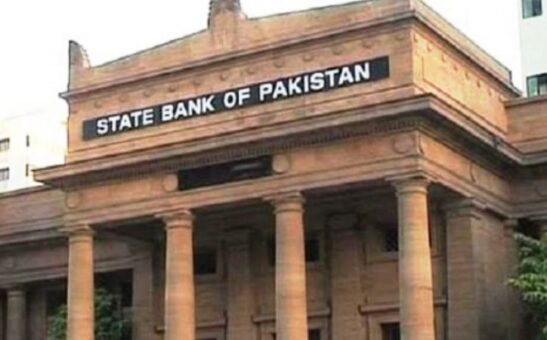
Tag: SBP

  • Mobile banking transactions registers massive growth of 192 percent

    Mobile banking transactions registers massive growth of 192 percent

    KARACHI: The value of mobile banking transactions have registered an unprecedented growth of 192 percent to Rs1.12 trillion during quarter October – December 2020, State Bank of Pakistan (SBP) said on Thursday.

    The volume of mobile banking transactions reached 44 million, (up 147 percent) valuing Rs.1.12 trillion (up 192 percent) compared to 17.8 million transactions valuing 382.5 billion in the same quarter, last year.

    The number of registered mobile phone banking users reached 9.4 million accounting an increase of 5 percent. Similarly, 22 million internet banking transactions valuing Rs1.3 trillion were recorded during this period compared to Rs. 1.1 trillion in the previous quarter.

    The SBP released its Quarterly Payment System Review (QPSR) for the second quarter, October – December 2020, of the fiscal year 2020-21, which shows strong growth in digital financial transactions in the country.

    During Q2FY21, 296.7 million e-Banking transactions valuing Rs21.4 trillion were carried out, registering a growth of 24 percent by volume and 22 percent by value, over the same quarter last year. Most of the uptake in e-banking transactions were seen in internet and mobile banking.

    In response to SBP’s measures to incentivize the installation of Point of Sale machines to facilitate digital payments through debit or credit cards, the number of POS machines have shown a notable growth of 18 percent during Q2FY21, reaching 62,480 installations throughout the country.

    On these POS machines, 23 million transactions amounting to Rs115 billion were processed during Q2FY21, which shows the positive impact of the market conducive policies adopted by SBP, particularly targeted towards increasing the payment acceptance infrastructure in Pakistan.

    Card based transactions on e-commerce portals also increased substantially, with e-commerce merchants processing 5.6 million transactions through payment cards amounting to Rs15 billion compared to 3.9 million valuing 11.9 billion in the first quarter of the current fiscal year, which marks a shift in the behavior of the Pakistani population and also complements Government of Pakistan’s efforts to develop a more market friendly landscape toward acceptance of payments by e-commerce merchants.

    Total number of payment cards issued in the country stood at 44 million out of which 27.6 million are debit cards and 1.7 million are credit cards. Further, 7.6 million social welfare cards have been issued by banks on behalf of BISP, EOBI and other government organizations.

    In the last few years, Digital payment transactions in Pakistan have shown significant growth, reflecting the favourable impact of the SBP’s policies in shifting customer preferences. Expansion in digital payment infrastructure as well as the emergence of new payment aggregators have played a role in this growth.

    In line with its declared objectives to digitize payment and financial services, SBP will continue promoting digitization in the country and expects the industry to support these efforts, which will increase convenience and financial inclusion for all Pakistanis.

  • Foreign direct investment falls by 30pc during July-Feb

    Foreign direct investment falls by 30pc during July-Feb

    KARACHI: The net inflow of foreign direct investment (FDI) has declined by 30 percent during first eight months (July – February) 2020/2021 owing to significant increase in outflow of the investment during the period under review.

    According to data released by State Bank of Pakistan (SBP) on Wednesday, the FDI fell to $1.3 billion during first eight months of the current fiscal year as compared with $1.85 billion in the corresponding months of the last fiscal year.

    The inflows under this head witnessed a decline of 16 percent to $1.98 billion during July – February 2020/2021 as compared with $2.36 billion in the corresponding period of the last fiscal year.

    However, outflow under this head increased by 35 percent to $683 million during the period under review as compared with $507 million in the corresponding period of the last fiscal year.

    The overall inflow of private foreign investment fell by 43 percent to $1.04 billion during the first eight months of the current fiscal year as compared with $1.83 billion in the corresponding period of the last fiscal year.

    The portfolio investment from the equity market witnessed massive outflows during the period. The portfolio investment saw an outflow of $256 million during the first eight months of the current fiscal year as compared with outflow of $26.3 million in the same period of the last fiscal year.

    The foreign public investment recorded outflow of $132 million during first eight months of the current fiscal year as compared with inflows of $2.16 billion in the corresponding period of the last fiscal year.

  • Bank holiday announced

    Bank holiday announced

    KARACHI: The banks will remained closed on March 23, 2021 on the occasion of Pakistan Day, State Bank of Pakistan (SBP) said on Wednesday.

    In a circular, the SBP informed the presidents and chief executives of all banks, development finance institutions and microfinance banks that the central bank would remain closed on March 23, 2021 (Tuesday) being public holiday on the occasion of “Pakistan Day” as declared by the government.

  • Poll suggests no change in key policy rate

    Poll suggests no change in key policy rate

    KARACHI: The State Bank of Pakistan (SBP) on Tuesday said it will issue monetary policy statement on Friday March 19, 2021. A poll suggested that the central bank likely to keep policy rate unchanged at 7 percent.

    However, some participants polled the policy rate might be increased by 25 basis points to 50 basis points in the upcoming monetary policy meeting.

    The Topline Securities conducted the poll of key financial market participants over their views on the upcoming Monetary Policy Statement (MPS) of Mar 19, 2021.

    A total of 118 participants took part in the latest poll, compared to 94 in Jan-2021 poll which was conducted for Jan-2021 MPS.

    Of the 118 participants, 82 percent expect no change in the Policy Rate in the Mar 19, 2021 MPS. In previous poll, 75 percent of the participants were expecting no change.

    In total, 18 percent of the participants are expecting increase in Policy Rate. Around 11 percent are expecting increase of 25 basis points and 4 percent are expecting hike of 50 basis points.

    In last the poll, 19 percent of the participants were expecting an increase in Policy Rate.

    Regarding cumulative hike in 2021, 65 percent respondents have voted for rate hike between 25-100 basis points. Similarly, 24 percent people expect rate hike in range of 125-200 basis points.

    Surprisingly, 8.5 percent of the participants yet expect no change in policy rate during 2021.

    We are also expecting no change in the Policy Rate in the March 2021 MPS, while we expect increase in Policy Rate by 100 basis points in 2021.

    On inflation front, 70 percent participants believe that during 2021 inflation will average between 8-10 percent, while 16 percent believe inflation will average lower than 8 percent. Rest of the participants believe, inflation will clock in above 10 percent during 2021.

    We believe change in views towards increase in Policy Rate going forward is owing to (1) likely restoration of IMF program over next couple of weeks wherein energy tariffs are likely to be adjusted upwards and (2) rising international oil and commodity prices (sugar, scrap, palm oil etc.)

  • Banks directed to discontinue paper-based submission of foreign exchange cases

    Banks directed to discontinue paper-based submission of foreign exchange cases

    KARACHI: State Bank of Pakistan (SBP) on Tuesday directed banks to discontinue paper-based submission of foreign exchange related cases to them by their clients latest by June 30, 2021.

    The SBP said it had initiated efforts to facilitate business community and promotes ease of doing business through end-to-end digitalization of approval of foreign exchange related cases in the banking system

    In order to further facilitate the business community in Pakistan, promote ease of doing business, enhance operational efficiency and make processing of Foreign Exchange (FX) related cases cost effective and environment friendly, State Bank has advised all banks to implement digital portals for end-to-end digitalization of case submission and processing.

    In the first leg of its end-to-end digitalization drive, SBP launched an online platform – Regulatory Approval System (RAS) to facilitate banks in online submission of foreign exchange related cases to the Exchange Policy Department (EPD) of SBP and the Foreign Exchange Operations Department (FEOD) of the SBP Banking Service Corporation (SBP BSC). The SBP-RAS has been operational since March 24, 2020 whereby banks are submitting their cases online to FEOD and manual case submission has been discontinued. Later on, paper based case submission to EPD by banks was also discontinued with effect from August 28, 2020.

    In the next leg of its digitalization drive, SBP instructed banks to develop portals to facilitate their customers for online submission of cases to banks and abolish paper based case submission. In this background, twenty-one (21) banks have already developed their portals and started onboarding their customers besides receiving cases digitally, while the rest of the banks are in the development phase and customers’ onboarding is underway.

    In view of SBP’s priority for end-to-end digitalization of foreign exchange related case submission, banks have been advised to complete development of portals, onboarding and educating their customers for the same and discontinue paper-based submission of foreign exchange related cases to them by their clients latest by June 30, 2021. It has further been advised that banks must make comprehensive arrangements for any contingency and ensure business continuity in case of disruption in their portals.

  • SBP imposes Rs93.23 million penalty on Meezan Bank

    SBP imposes Rs93.23 million penalty on Meezan Bank

    KARACHI: State Bank of Pakistan (SBP) has imposed an amount of Rs93.23 million as penalty on Meezan Bank Limited during the year 2020, according to annual financial results of the bank.

    The bank in its annual financial results for period ended December 31, 2020 said that it had paid Rs93.23 million to the SBP for violation of various regulatory provisions.

    The total monetary penalty on the bank imposed by the SBP reached to Rs175.5 million in past two financial years.

    The central bank imposed Rs82.27 million as penalty on the bank during the year 2019.

  • Foreign exchange reserves inch up to $20.158 billion

    Foreign exchange reserves inch up to $20.158 billion

    KARACHI: The liquid foreign exchange reserves of the country inched by $25 million to $20.158 billion by week ended March 05, 2021, the State Bank of Pakistan (SBP) said on Thursday.

    The foreign exchange reserves of the country were at $20.133 billion a week ago.

    The official foreign exchange reserves of the SBP increased by $38 million to $13.016 billion by week ended March 05, 2021 as compared with $12.978 billion a week ago.

    The foreign exchange held by commercial bank, however, fell by $13 million to $7.142 billion by week ended March 05, 2021 as compared with $7.155 billion a week ago.

  • Remittances surge by 24 percent in eight months

    Remittances surge by 24 percent in eight months

    KARACHI: The inflow of workers’ remittances has increased by 24 percent to $18.74 billion during first eight months (July – February) 2020/2021, according to data released by State Bank of Pakistan (SBP) on Thursday.

    The SBP received $15.104 billion as workers’ remittances during the same months of the last fiscal year.

    The inflows during the month of February 2021 also posted 24 percent increase to $2.26 billion when compared with $1.82 billion in the same month of the last year.

    The inflows recorded robust growth of 46.7 percent, 56.8 percent and 19.5 percent from USA, UK and Saudi Arabia, respectively, during first eight months of the current fiscal year.

  • SBP waives 100pc cash margin requirement on import of various goods

    SBP waives 100pc cash margin requirement on import of various goods

    KARACHI: State Bank of Pakistan (SBP) on Thursday waived requirement of 100 percent cash margin on import of various goods.

    The SBP said that based on the representations of industries and other relevant stakeholders, it has been decided to waive the condition of 100 percent cash margin requirement on imports made under following HS Codes:

    S. No.HS CodesDescription as given in BPRD CircularsDescription as per FBR’s PCT Codes
    148191000CARTONS, BOXES & CASESCARTONS, BOXES AND CASES, OF CORRUGATED PAPER OR PAPERBOARD
    284159030COVER FOR INNER BODY OF AIR CONDITIONERCOVERS FOR INNER BODY
    384149090OTHER PARTS AIR/VACUUM PUMPSOTHER
    484159099OTHER – AIR CONDITIONING MACHINESOTHER
    584189910EVAPORATORSEVAPORATORS (ROLL BOND / FIN / TUBE ON PLATE TYPES)
    684189920CONDENSORSWIRE CONDENSERS
    784509000PARTS FOR WASHING MACHINEPARTS
    885366990OTHER ELECTRIC SWITCH, RELAYS, FUSESOTHER
    984186990OTHERSOTHER
    1084193900OTHER DRYEROTHER
    1140141000SHEATH CONTRACEPTIVESSHEATH CONTRACEPTIVES

    The SBP directed the banks that cash margin requirement will not be applicable on the imports made under HS Code 87021090 (Others) by Category-A and Category-B investors as defined in the Automotive Development Policy, 2016-2021.

  • Banks barred from self issuing cheque books

    Banks barred from self issuing cheque books

    KARACHI: The State Bank of Pakistan (SBP) has barred financial institutions from issuing cheque book by default, according to a statement issued on Wednesday.

    The decision has been taken to promote digitalization in the banking sector. “Cheque-books that are currently being issued by default shall only be issued upon customer’s request,” the SBP said.

    In light of SBP’s vision to promote digitization in the banking sector and encourage use of digital channels, the following decisions have been taken for banks and microfinance banks.

    The financial institutions currently offering or planning to offer digital financial services shall create a role of Chief Digital Officer (CDO) or a similar role with a different designation.

    The CDO should preferably be a Key Executive responsible for steering the digitization efforts of the organization. The role would be in addition to existing Key Executives as required by relevant regulations.

    The financial institutions may consider recommended Terms of Reference (ToRs) for the above position. In addition, accelerated digitization should also be part of every CEO’s Key Performance Indicators (KPIs) and the board of the financial institutions should monitor the achievements at least on half-yearly basis.

    The SBP issued instructions Regarding Internet Banking (IB)/Mobile Banking (MB):

    All FIs providing IB/MB services shall:

    — Offer the minimum set of services as identified in Annexure-B through their IB/MB channels.

    — Provide their interface in English, Urdu and where possible, regional languages.

    — Rationalize the use of One Time Password (OTP) on their platforms to improve user experience. However, they are also encouraged to use other convenient and secure authentication factors to satisfy the 2-Factor Authentication (2FA) requirements.

    — Ensure that there are no activation, subscription or annual charges for customers using IB/MB services.

    — Arrange to provide full-fledged digital portal for their corporate customers (corporate portal) and align controls, transaction limits etc. to cater for their online business needs.

    In order to move towards self-service banking channels and allow round the clock banking solutions to customers and businesses, banks are encouraged to consider the deployment of Cash Deposit Machines (CDMs) at selected locations especially at branches with large number of customers.

    Participants and member FIs of a PSO shall ensure that all other participants, member FIs and billers of that PSO are enabled on their IB/MB/ATM channels.

    Further, they shall also ensure that new participants/member FIs and billers are added on their respective channels within 30 days of the date of intimation from the PSO.

    To promote the use of payment cards, it has been decided that FIs shall ensure that all new-to-bank account holders and those customers who have not opted for a debit card previously, shall be issued a debit card. However, customers shall also be given the option to opt out of receiving any card.

    Further, photo account holders, visually impaired and illiterate persons shall be exempted from mandatory card issuance. In this regard, FIs shall ensure full compliance with PSD’s Circular No. 1 of 2020 dated January 31, 2020, in letter and spirit and shall not unnecessarily coerce and/or convince their customers to opt for cards that are not issued by SBP-approved domestic payment scheme.

    Detailed record of customer consent shall be maintained and made available for SBP’s inspection, as and when required.

    As per the existing practice, FIs have been using signatures and paper based instruments for authenticating customers in branches. To leverage on the existing EMV enabled card based infrastructure, FIs are now allowed to authenticate their customers at branch counters using chip-and-pin cards and 2FA prior to offering them banking services.

    However, this change should be implemented without causing inconvenience to the customers.