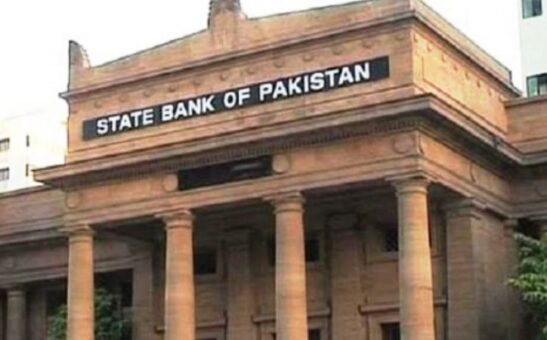
KARACHI: The State Bank of Pakistan (SBP) has extended the validity of measures up to June 30, 2021 to mitigate coronavirus pandemic related to Anti-Money Laundering (AML)/ Counter Financing of Terrorism (CFT), a statement said on Thursday.
The SBP invited the attention towards BPRD Circular Letters No. 32 & 33 of 2020 and AC&MFD Circular Letters No.3 & 6 of 2020 whereby measures like utilization of NADRA Verisys in place of Biometric Verification were prescribed to limit the spread of COVID-19 pandemic.
Keeping in view the intensity and ongoing impact of COVID-19 pandemic in the country, it has been decided to further extend the validity of measures stipulated in above referred Circular Letters from December 31, 2020 to June 30, 2021.
Additionally, Microfinance Banks (MFBs) shall resume biometric verification, prescribed vide AC&MFD Circular Letter No. 06 of 2020 with revised timelines of July 31, 2021 and September 30, 2021 for customers assigned medium and normal priorities, respectively.
Further, as mandated in BPRD Circular No. 06 of 2016, Authorized Financial Institutions may defer the requirement for visits of compliance officers to newly acquired agents within first quarter of their acquisition, till June 30, 2021. However, compliance officers shall visit all these newly acquired agents within the next quarter ending September 30, 2021.
KARACHI: The State Bank of Pakistan (SBP) on Wednesday declared bank holiday on January 01, 2021 on account of financial close of banking companies.
In a circular issued to presidents and chief executives of all banks, development financial institutions and microfinance banks, the SBP informed that the central bank will remain closed for public dealing on Wednesday, January 1, 2020, which will be observed as ‘Bank Holiday’.
All banks / DFIs / MFBs shall, therefore, remain closed for public dealing on the above date. However, all employees of banks / DFIs / MFBs will attend the office as usual, the SBP said.
KARACHI: A major step has been taken for the Government’s Naya Pakistan Housing Program and making affordable housing possible for all as Pakistan Mortgage Refinance Corporation (PMRC) signed a master guarantee agreements with six banks, State Bank of Pakistan (SBP) said on Monday.
A Credit Guarantee Trust, with Pakistan Mortgage Refinance Corporation (PMRC) as Trustee, has been set up by the Government of Pakistan with the support of State Bank of Pakistan (SBP) and funded by the World Bank.
In line with Government’s vision to promote affordable housing especially for the low- and informal-income segments, the Credit Guarantee Trust will provide risk coverage of up to 40% to primary mortgage financiers on first loss basis.
The guarantee will partially alleviate the credit risk of primary mortgage financiers and provide a conducive environment for banks to finance housing for the low-income. Keeping in view the dynamics of mortgage market and to facilitate market growth, the scheme has been designed for both conventional and Islamic banks.
PMRC as trustee today signed a Master Guarantee Agreement with six leading Islamic and conventional banks including Meezan Bank, Habib Bank, BankIslami, Faysal Bank, JS Bank and Soneri Bank. This is a major step for the Government’s Naya Pakistan Housing Program and making affordable housing possible for all.
Speaking at the occasion, Deputy Governor SBP Jameel Ahmed said that the risk coverage of mortgage portfolio under Government Markup Subsidy facility provides due comfort to banks in extending housing finance to the low income segment for buying or construction of new houses.
He urged the banking industry to benefit from this unprecedented facilitative environment and extend loans to their maximum potential. He also urged the PMRC to focus on developing secondary mortgage market through issuance of mortgage-backed securities in the capital market.
The Deputy Governor SBP emphasized that all stakeholders needed to make concerted efforts to achieve the goal of providing housing to the common people. He lauded the efforts by financial institutions over the last few months under the umbrella of Steering Committee on housing and construction finance established by State Bank of Pakistan.
Mudassir H. Khan, MD and CEO of PMRC, expressing his views said that this Credit Guarantee Scheme will pave the way for the banking industry to extend housing finance to the low income group, a market segment which has remained negligible for long.
He said that PMRC has a role of a catalyst in mortgage market development in the country and for growth of affordable housing in the country. He thanked the Deputy Governor SBP for his leadership and support for this sector, the Ministry of Finance, the World Bank and NAPHDA towards making the Government and PM’s vision of affordable housing a reality.
KARACHI: The State Bank of Pakistan (SBP) on Monday directed banks to open their branches for extended hours on December 31, 2020 in order to facilitate taxpayers in payment of duty and taxes.
In order to facilitate the collection of the government receipts/ duties/ taxes, it has been decided that the field offices of SBP Banking Services Corporation (SBP BSC) and authorized branches of National Bank of Pakistan (NBP) will observe extended banking hours till 9:00 P.M. on December 31, 2020 (Thursday), for which purpose a special clearing has been arranged at 6:00 P.M. on the same day by the NIFT, the SBP said.
The SBP directed that all banks keep their concerned branches open on December 31, 2020 (Thursday) till such time that is necessary to facilitate the special clearing for Government transactions by the NIFT.
KARACHI: State Bank of Pakistan (SBP) on Thursday launched a survey of Overseas Pakistanis to analyze recent trends in remittances and the future outlook.
The central bank launched the survey in collaboration with Ministry of Planning, Development and Special Initiatives (MPD&SI).
The survey will be available to all Overseas Pakistanis globally till January 9, 2021.
The survey attempts to assess underlying factors that may have affected recent remittances behavior, including switching from informal to formal channels, from brick and mortar outlets to digital platforms, future plans of moving back to Pakistan, as well as the amount of remittances they expect to send in the next six months.
With the support of the Ministry of Overseas Pakistanis and Human Resource Development (MOPHRD), Ministry of Commerce, Ministry of Foreign Affairs (MOFA) and Pakistan Remittance Initiative (PRI), this survey is being conducted simultaneously at Pakistani Consulates and Embassies, Overseas Bank Branches of Pakistani Banks as well as online.
SBP and MPD&SI encourage Overseas Pakistanis to actively participate in this short online survey. The survey is very easy to access through the following web link: https://surveyctosbp.surveycto.com/collect/survey_on_recent_remittance_behavior_of_overseas_pakistanis?caseid
KARACHI: The foreign exchange reserves of the country fell by $67 million to $20.313 billion by week ended December 18, 2020, State Bank of Pakistan (SBP) said on Thursday.
The foreign exchange reserves of the country were at $20.380 billion by week ended December 11, 2020.
The official reserves of the SBP fell by $83 million to $13.216 billion as compared with $13.299 billion a week ago.
The central attributed the decline in the official reserves to external debt repayment during the week.
The foreign exchange reserves held by commercial banks increased by $16 million to $7.097 billion by week ended December 18, 2020 when compared with $7.081 billion a week ago.
KARACHI: Depositors will require submitting a declaration to their financial service providers for taking responsibility for any security lapse and subsequent monetary losses related to their accounts.
New account holders will give this declaration to banks from April 01, 2021. Under this declaration customers will be responsible for sharing their personal information which resulted in fraudulent activity and monetary losses.
The State Bank of Pakistan (SBP) on December 14, 2020 issued regulations for further strengthening depositors’ protection. The regulations namely ‘Key Fact Statement for Deposit Products’ are aimed at increasing consumer comprehension about a banking product’s affordability and risks, leading to better decision-making.
However, the regulations provide a sigh of relief to banking institutions as an annexure related to this clearly explain: “Safe custody of access tools to your [prospective account holder] account like ATM cards, PINs, Cheques, e-banking usernames, passwords; other personal information, etc. is your responsibility. Bank cannot be held responsible in case of a security lapse at the customer’s end.”
At present a large number of people having bank accounts are receiving calls from fraudsters pretending themselves as bankers or officials from the SBP. Such fraudsters ask people to update their account details and demand secret information related to their accounts including identity, password, pin code etc. They further pressurize people that in case requirements are not provided then their bank account will be suspended. Having such serious calls many people compromise their information and lose a handsome amount within a short span of time.
The central bank and commercial banks for a long time are running an awareness campaign that financial institutions never ask account holders to share any information on phone calls.
“SBP never asks for any personal details regarding legal status, CNIC or any bank account details,” the central bank clearly mentioned on its website. Furthermore, banks have also displayed such messages on their official websites and aware people through the media.
Despite these clear instructions of the SBP and commercial banks, people are sharing their information to such fake calls and losing money on a regular basis. On the other hand, banks were held responsible for the losses when customers made appeals before Banking Mohtasib.
A customer declaration under ‘Key Fact Statement for Deposit Products’ will help banks to make strong defence in cases of security lapse and money losses.
KARACHI: The State Bank of Pakistan (SBP) on Tuesday announced that the central bank would remain closed on December 25, 2020 (Friday) due to Quaid-e-Azam Day and Christmas.
The SBP said that it will remain closed on December 25, 2020 (Friday) being a public holiday on the occasions of Quaid-e-Azam Day and Christmas, as declared by the Government of Pakistan.
The commercial banks shall also observe the public holiday.
KARACHI: State Bank of Pakistan (SBP) has issued updated list of panel of audit firms, which are allowed to conduct audit of banking companies.
The central bank updated the list up to December 21, 2020.
State Bank of Pakistan’s Panel of Auditors Maintained Under Section 35 (1) of Banking Companies Ordinance, 1962
Following is the list of chartered accountant firms with their categories to conduct audit:
Category Description Category ‘A’ Audit Firms in Category “A” are eligible to conduct audit of all Banks and DFIs Category ‘B’ Audit Firms in Category “B” are eligible to conduct audit of Banks and DFIs having assets up to Rupees 100 billion or branches up to 160. Category ‘C’ Audit Firms in Category “C” are eligible to conduct audit of banks and DFIs having assets up to Rupees 15 billion or branches up to 30.
Category ‘A’
A1. A.F. Ferguson & Co. State Life Building No. 1/C, I.I. Chundrigar Road, Karachi. Tel: +92 (021) 32426711-15 Fax: +92 (021) 32415007 Web: www.affco.com.pk
A13. Riaz Ahmad & Co. 10-B, Saint Mary Park, Main Boulevard, Gulberg III, Lahore. Tel: +92 (042) 35718137-39 Fax: +92 (042) 35718136 Email: [email protected] Web: www.racopk.com
KARACHI: The Balance of Payment (BOP) of the country has posted $1.64 billion as current account surplus during the first five months of the current fiscal year, according to data released by State Bank of Pakistan (SBP) on Tuesday.
The BOP of the country posted a current account deficit of $1.74 billion in the same months of the last fiscal year.
The surplus in current account is mainly attributed to strong growth in inflows of workers remittances and export receipts.
During the first five months of FY21, workers’ remittances have reached an unprecedented level of US$ 11.77 billion, 26.9 percent higher than the same period last year. On average, workers’ remittances have been about half a billion (US$ 499 million) higher in each month of FY21 as compared to the same period last year.
On the other hand the exports registered 2.21 percent growth to $9.74 billion during July – November of the current fiscal year as compared with $9.535 billion in the corresponding period of the last fiscal year.
The current account posted a surplus of $447 million in November 2020 as compared with a surplus of $415 million October 2020 and a deficit of $326 million in November 2019.