Tag: SBP

  • Foreign investment grows by 51pc during first quarter

    Foreign investment grows by 51pc during first quarter

    KARACHI: The total inflow of foreign private investment increased by 51 percent growth during first quarter (July-September) of 2019/2020, State Bank of Pakistan (SBP) said on Thursday.

    The total foreign private investment increased to $565 million during the first quarter of current fiscal year as compared with $374 million in the same period of the last fiscal year.

    The foreign direct investment (FDI) posted nominal decline of 3.1 percent to $542 million during the period under review as compared with $559 million in the same period of the last fiscal year.

    The inflows under FDI were $763 million during July – September 2019, which were 5.4 percent lower when compared with inflows of $806 million in the same period of the last year.

    The outflows under FDI were declined by 11 percent to $221 million as compared with $247 million.

    The foreign investment in capital market witnessed 112.2 percent increase during the first quarter of current fiscal year.

    The portfolio investment recorded $22.7 million inflows during July – September 2019 as against outflows of $185 million in the corresponding period of the last year.

  • SBP directs banks to verify trade price before approving import, export forms

    SBP directs banks to verify trade price before approving import, export forms

    KARACHI: State Bank of Pakistan (SBP) has directed banks, exchange companies to verify trade prices before approving import or exports forms.

    The central bank issued instructions to the authorized dealers in foreign exchange related to Framework for Managing Risks of Trade Based Money Laundering and Terrorist Financing.

    The SBP said that the Authorized Dealers (ADs) shall define clear policies and procedures for price verification, including defining the level of acceptable price variance, escalation procedures and suspicious transaction reporting mechanism when significant differences in prices are identified.

    ii. It shall be the exclusive responsibility of an AD to perform due diligence with respect to various risk factors in a trade transaction. In this regard, ADs shall be specifically required to verify the prices of underlying contracts as declared on EIF/MIF, EFE/MFE, Advance Payment Voucher from reliable sources i.e. chambers of commerce, local business circles, daily newspapers, Internet, historic appraisements, Customs valuation rulings, etc. where prices are available and shall satisfy themselves before approving EIF/MIF, EFE/MFE or disbursing the amount to the exporter as the case may be that the prices declared by their client represent the fair market value of goods.

    The ADs shall institute a mechanism, supported by technology-based solutions, to carry out assessment of prices of underlying contracts on post transaction basis that is after the approval of EIF/MIF, EFE/MFE or disbursing the amount to the exporter, where price checks are not performed at pre-transaction stage, and shall satisfy themselves that the prices declared by their client represent the fair market value of goods.

    This function may be performed by the department other than the front office/centralized trade-processing unit where transaction is taking place. To this end, ADs may assign this function either to their risk management department or compliance department.

    The department to which this function is assigned shall be under obligation to conclude the assessment with thirty days of approving EIF/MIF, EFE/MFE or disbursing the amount to the exporter as the case may be.

    The financial institutions shall require the exporter to submit a copy of underlying sale contract along with Advance Payment Voucher.

    The procedure of price verification/assessment shall be documented by ADs for later review /audit/inspection, the SBP said.

    The significant variance between the prices of goods declared on EIF/MIF, EFE/MFE, Advance Payment Voucher and their fair market value shall serve as one of the prime red flag indicators and all such transactions shall be escalated to the higher management, which shall review the same and consider the option of filing STR with FMU etc. This procedure shall be documented by ADs for later review /audit/inspection.

    The SBP further instructed that Authorized Dealers (ADs) shall ensure compliance of the following instructions while approving EIF/MIF, EFE/MFE:

    a) Full details/exact specification, quality/varieties/sub categories of goods being imported/exported are declared on EIF/MIF, EFE/MFE and declaring the description of goods that is general in nature or represents the generic name of goods should be avoided.

    b) Declaration of unit of measurement such as boxes, cases etc. on EIF/MIF, EFE/MFE, which obscures the actual quantity of goods being imported/exported, shall be avoided. In this respect, unit of measurement, if not required to be declared otherwise, shall be declared in line with relevant Custom Valuation Rulings (if available).

    c) In case, the brand/trade name/trademark of a product is to be declared on EIF/MIF, EFE/MFE, it shall be accompanied by the generic name of such product.

    d) H.S. Code of each product which forms the part of the underlying contract is declared on EIF/MIF, EFE/MFE. Where an H.S. Code includes multiple goods/products, ADs shall ensure that the particulars of each product are written against that H.S. Code.

    e) Guideline at (a)(c) & (d) above shall be followed while making declaration on Advance Payment Voucher. Moreover, it shall be ensured by ADs that in case of advance payment export, declaration made on EFE/MFE is strictly in accordance with the particulars declared on Advance Payment Voucher and name of consignee declared on EFE/MFE is of the same entity from which the advance payment is received.

    ii. The particulars of EIF/MIF, EFE/MFE shall be corroborated with that of Goods Declaration Form, where transaction does not involve a letter of credit, to check the cohesion and in case of significant variation(s), the matter shall be escalated to the higher management, which shall review the same and consider the option of filing STR with FMU etc.

  • Open account, advance payments considered as higher risk transactions for trade based money laundering

    Open account, advance payments considered as higher risk transactions for trade based money laundering

    KARACHI: State Bank of Pakistan (SBP) has advised financial institutions dealing foreign exchange to enhance due diligence on higher risk transactions to stop trade based money laundering.

    The SBP on Tuesday issued Framework for Managing Risks of Trade Based Money Laundering and Terrorist Financing and said that banks and financial institutions should ensure that high risk transactions in the area of trade business are subject to more extensive due diligence and are escalated, where required, to the higher management.

    ii. In this respect, following transactions may have higher Money Laundering/Terror Financing risks and may be considered for Enhanced Due Diligence (EDD):

    a) Open Account

    b) Advance Payments (Import & Export of Goods)

    c) Import/Export of Services

    d) Import/Export of Free of Cost Goods

    e) Trade transactions with related party

    f) Import of goods that are exempt from import related duties

    g) Import of goods that are subject to over 25% import duties

    h) Export of goods on which export related rebates are allowed by the Government of Pakistan

    i) Where an exporter allows trade discounts to the same importer consistently by the way of deduction of amount of discount from the proceeds of export bills.

    j) Trade transaction of sole proprietorship or partnership concern received by centralized trade processing unit from a different branch of an AD with whom their relationship is not generally associated or frequent switching of branch for trade transactions by such concerns.

    k) Trade transactions with high-risk jurisdictions or jurisdictions with lax AML/CFT regulations and implementations

    l) Outward remittance from personal FCY account of the importer

    m) Unusually relaxed terms for settlement of counter value both for exports as well as imports e.g. no specific timeline for shipment of goods against exports advance payment, extended credit period for payment against import of goods especially between unrelated parties.

    Due weightage shall be given by authorized dealers to the risk rating of the customer while allowing high-risk transactions.

    In this respect, a criteria shall be developed by the ADs whereby transactions falling in high-risk category specifically Advance Payments (Import & Export), where clients have outstanding overdues/poor performance history, shall be escalated to the higher management for taking appropriate decision about the fate of transactions.

    In case of recurrence of non-performance post allowing the transaction, the higher management of financial institutions may subject the customer to enhance/continuous monitoring.

    However, in case of persistent non-performance during the period in which the customer has been subjected to enhance/continuous monitoring, the AD may evaluate the transaction for filing an Suspicious Transaction Report (STR) with Financial Monitoring Unit (FMU) if they have sufficient grounds to form suspicion that the customer is using trade transaction to launder money, finance terrorism etc. ADs, in such circumstance, should also evaluate the risks of continuing relationship with the customer.

    Notwithstanding the above, even if the senior management of ADs on the matter escalated to it does not find sufficient grounds for filing of an STR, they may consider subjecting the customer to enhanced/continuous monitoring.

  • SBP issues framework for controlling trade based money laundering, terror financing

    SBP issues framework for controlling trade based money laundering, terror financing

    KARACHI: The State Bank of Pakistan (SBP) on Tuesday issued framework for controlling trade based money laundering and terror financing.

    In order to strengthen trade related Anti Money Laundering/Combating Financing of Terrorism (AML/CFT) regime and restrict possible misuse of banking channel, a comprehensive framework on the subject has been developed and attached herewith.

    Accordingly, Authorized Dealers (ADs) are advised to upgrade their systems and controls and bring policies and procedures in line with the requirements of the framework to ensure meticulous compliance with the provisions thereof with immediate effect except as otherwise provided in the framework

    The provisions of this framework are in addition to and not a replacement of already issued instructions on the subject of ML/FT risks. Therefore, the compliance of the same shall not absolve ADs from their legal and regulatory obligations under prevailing AML/CFT laws/rules and regulations or any other relevant law in force.

    ADs are also advised to educate their clients about their obligation of ensuring (a) correct declaration of particulars on the prescribed forms, (b) utilization of foreign exchange for the exact purpose for which it is acquired by them and (c) repatriation of foreign exchange that represents the full export value of goods.

    In the event, it is found that material information required to be submitted on the prescribed forms has been omitted or suppressed, foreign exchange is misutilized by a client of an AD or export proceeds repatriated by a client does not represent the full export value of goods, SBP shall initiate penal action against such delinquent parties under relevant provisions of the Foreign Exchange Regulation Act, 1947 (FERA).

    Further, the matter shall also be reported to relevant stakeholders for necessary action under the laws being administered by them.

    Failure to comply with the instructions on the subject and the regulatory obligations of AML/CFT may attract action against ADs under the FERA and other relevant laws.

  • Pakistan’s foreign exchange reserves at $14.993 billion

    Pakistan’s foreign exchange reserves at $14.993 billion

    KARACHI: The total liquid foreign exchange reserves of Pakistan declined nominally by $11 million to $14.993 billion by week ended October 04, 2019 as compared with $15.003 billion a week ago, State Bank of Pakistan (SBP) said on Thursday.

    The reserves held by SBP increased by $16 million to $7.757 billion by week ended October 04, 2019 as compared with $7.771 billion a week ago.

    The foreign exchange reserves held by commercial banks declined by 27 million to $7.235 billion as compared with $7.262 billion a week ago.

  • Overseas Pakistanis remit $5.478 billion in July – September

    Overseas Pakistanis remit $5.478 billion in July – September

    KARACHI: The overseas workers have sent $5.478 billion during first quarter (July – September) of current fiscal year, which is 1.43 percent down when compared with $5.557 billion in the corresponding period of the last fiscal year, according to data released by State Bank of Pakistan (SBP) on Thursday.

    However, inflows of workers’ remittances witnessed 17.59 percent growth to $1.747 billion in the month of September 2019 when compared with $1.486 billion in the same month of the last year.

    Saudi Arab was the major destination from where Pakistanis sent remittances to homeland. The inflows of remittances from Saudi Arabia were $1.269 billion during first quarter of current fiscal year as compared with $1.263 billion in the same quarter of the last fiscal year, showing growth of 0.49 percent.

    The country received $911 million as workers’ remittances from the US during first quarter of the current fiscal year as compared with $862.76 million in the corresponding quarter of the last fiscal year, showing 5.67 percent growth.

    The third major destination for workers’ remittances was the UK from where the country received $814.37 million during July –September 2019 as compared with $810 million in the same period of the last fiscal year.

    The combined inflows from United Arab Emirates (UAE) were $1.139 billion during first quarter of current fiscal year as compared with $1.227 billion in the same quarter of the last fiscal year, registering 7.19 percent decline.

    The inflows from other GCC countries were at $519.43 million during July – September 2019 as compared with $526.96 million in the same period of the last fiscal year, showing 1.43 percent decline.

  • Reforms showing improvement in economy: SBP governor

    Reforms showing improvement in economy: SBP governor

    KARACHI: The reforms to address the macroeconomic challenges faced by the economy are now beginning to bear fruit and improvement in the external sector has become visible, said Dr. Reza Baqir, Governor, State Bank of Pakistan (SBP).

    “Restoring stability will promote investment in the country and thus economic growth,” the SBP governor said during an interactive session with leading foreign investors at the Overseas Investors Chamber of Commerce and Industry (OICCI). Governor was accompanied by the senior leadership of the SBP.

    The SBP governor noted that the bold measures taken in recent past were painful but necessary.

    He elaborated that the average monthly current account deficit, which has been a prime concern for the economy, has halved, export volumes have been growing, non-borrowed foreign exchange reserves have stopped falling and in fact begun to grow, and pressures on inflation are expected to recede from the second half of the current fiscal year.

    President OICCI, Shazia Syed, Vice President OICCI, Shazad G. Dada and Secretary General OICCI, M. Abdul Aleem, highlighted the significant economic contribution of foreign investors at OICCI, who are among the largest economic stakeholders and have invested over $13 billion in the past seven years and continue to have a positive view of the opportunities for investment despite the ongoing challenging economic environment in the country.

    OICCI shared with Dr. Reza Baqir the key highlights of its annual survey on remittances and complimented the Governor that despite extreme pressure on the FX reserves in the past twelve months, the SBP did not delay the remittance of profit, which was appreciated by the foreign investors.

    However, concerns on some other areas were raised and OICCI sought Governor’s support in facilitating different matters in the light of its policies towards improving ease of doing business in Pakistan.

    OICCI members presented a comprehensive list of recommendations to facilitate doing business in Pakistan including proposal for doing away with additional approvals for remittance which are as per registered contract, and proposed that an online portal be established allowing banks to upload the request and supporting documents.

    Dr. Reza Baqir appreciated the contribution of OICCI members to the national exchequer and announced various measures to further streamline the processes for improving ease of doing business.

    “SBP is moving towards digitalization and proactive engagement that will address the major issues systematically,” informed the Governor.

    He promised to consider various OICCI recommendations and agreed on the need for continuous dialogue with the OICCI members inviting the Managing Committee to meet the SBP’s leadership at regular intervals for timely resolution of the issues.

  • Investment in premium Rs40,000 prize bonds surges by 156 percent

    Investment in premium Rs40,000 prize bonds surges by 156 percent

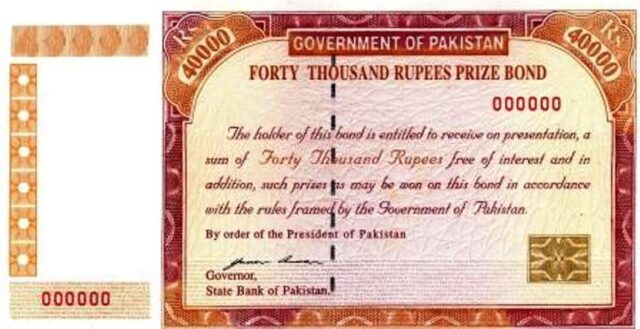
    KARACHI: The investment in premium prize bonds of Rs40,000 denomination has sharply increased by 156 percent to Rs14.84 billion by August 2019 as compared with Rs5.78 billion in the same month of the last year.

    The significant increase in registered prize bonds of Rs40,000 denomination has been attributed to the announcement of the government to seize the issuance of unregistered instrument to stop expansion of black economy.

    In February this year the central bank stopped the issuance of Rs40,000 denomination prize bonds from its offices. The SBP also advised the Central Directorate of National Savings (CDNS) to stop printing the unregistered Rs40,000 prize bonds.

    A member of Tax Reform Committee (TRC), which was constituted by the former government in 2014 said that it was recommendation of the TRC to stop the circulation of high denomination prize bonds.

    The member said that the committee had presented its report in May 2015 and advised the then finance minister the high denomination prize bonds were major source for expansion of black economy.

    The TRC had recommended to document high denomination prize bonds of Rs25,000 and Rs40,000 and should be issued against CNICs of individuals.

    The government on June 24, 2019 announced to discontinue the circulation of Rs40,000 denomination bearer prize bonds.

    In compliance to the government announcement the SBP also issued instructions to banks. The central bank issued procedure for the banks to facilitate general public in exchanging the unregistered prize bonds with three different modes.

    The SBP said that the bearer prize bonds of Rs40,000 cannot be exchanged against cash. However, it can be redeemed against registered prize bonds or can be converted into national saving schemes or face value (direct transfer to the bank account of bond bolder).

    The SBP informed the banks that such prize bonds would not be sold after June 24, 2019 and will not be encashed/redeemed after March 31, 2020. No further draws of Rs40,000 denomination national prize bonds shall be held.

    The government is intending to expand the documented prize bonds in other denomination as well on the recommendations of the TRC, the member said.

    The TRC in its report pointed out: “Issuance of prize bond of Rs 25,000 or Rs 40,000 should be discontinued as these high denomination bearer instruments fuel corruption and tax evasion.”

  • Unregistered prize bonds worth Rs206 billion surrendered on discontinuation announcement

    Unregistered prize bonds worth Rs206 billion surrendered on discontinuation announcement

    KARACHI: An amount of around Rs206 billion has been surrendered following the government announcement of discontinuation the circulation of unregistered prize bonds of Rs40,000 denomination.

    According to information received to PkRevenue.com, the total investment in unregistered Rs40,000 denomination prize bonds fell to Rs52.46 billion by August-end 2019 as compared with Rs258 billion in May 2019.

    The government on June 24, 2019 announced to discontinue the circulation of Rs40,000 denomination bearer prize bonds.

    In compliance to the government announcement the State Bank of Pakistan (SBP) also issued instructions to banks. The central bank issued procedure for the banks to facilitate general public in exchanging the unregistered prize bonds with three different modes.

    The SBP said that the bearer prize bonds of Rs40,000 cannot be exchanged against cash. However, it can be redeemed against registered prize bonds or can be converted into national saving schemes or face value (direct transfer to the bank account of bond bolder).

    The SBP asked the banks that such prize bonds would not be sold after June 24, 2019 and will not be encashed/redeemed after March 31, 2020. No further draws of Rs40,000 denomination national prize bonds would be held.

    The SBP issued the following instructions regarding handling of Rs.40,000/- denomination National Prize Bonds are issued herewith for information, guidance and meticulous compliance:

    a) National Prize Bonds of Rs.40,000/- denomination shall not be sold after June 24, 2019 and will not be encashed/redeemed after March 31, 2020.

    b) No further draws of Rs.40,000/-denomination National Prize Bonds shall be held.

    c) Cash payment for encashments of bonds is not allowed. However, the bond holder (s) shall have the following options to replace / encash these bonds:

    1. Conversion of premium prize bonds (registered)

    2. Replacement with special saving certificate (SSC)/Defence Saving Certificate (DSC)

    3. Encashment at face value.

    d) Appended below is the SOP for processing requests under the aforementioned options for compliance by all banks:

    1. Conversion to Premium Prize Bonds (Registered)

    i. The bonds can be converted to premium prize bonds (registered) through the 16 field offices of SBP Banking Services Corporation, and authorized branches of six commercial banks i.e. National Bank of Pakistan (NBP), Habib Bank Limited (HBL), United Bank Limited (UBL), MCB Bank Limited (MCB), Allied Bank Limited (ABL) and Bank Alflah Limited (BAFL).

    ii. The bond holder shall be required to submit a written request for conversion of bearer bonds to premium prize bonds (registered) to be registered in his (her) name on the prescribed application.

    iii. The bond holder shall also be required to submit prescribed applications forms for registrations / purchase of premium prize bond as per the procedure in vogue.

    Replacement with the Special Saving Certificate (SSC)/Defence Saving Certificate (DSC)

    i. The bonds can be replaced with SSC / DSC through the 16 field offices of SBP Banking Services Corporation, authorized commercial banks and National Savings Centers.

    ii. All authorized commercial banks shall, therefore, accept requests for replacement of bearer bonds with SSC or DSC on the prescribed application form.

    iii. The bondholder shall also be required to submit application form for purchase of SSC/DSC (SC-1) as per the prescribed procedure.

    Encashment at Face Value:

    i. The bonds will only be encashed by transferring the proceeds to the bond holder’s bank account through the 16 field offices of SBP Banking Services Corporation as well as the authorized commercial bank branches.

    ii. All commercial banks shall receive requests for encashment of bearer bonds on the prescribed application form.

    A cop of the application form, duly signed and stamped, shall be provided to the bondholder as an acknowledgement receipt.

    The SBP said that it is needless to mention that the National Prize Bonds of Rs40,000 denomination tendered at the counters of banks shall be subject to through scrutiny to ascertain their genuineness. In this regard, details regarding the security features in Rs40,000 denomination National Prize Bonds are available online.

    Moreover, the prize bonds encashed / replaced by general public may be surrendered to concerned SBP BSC office through respective regional office of the commercial banks. For the purpose, the regional office may intimate the SBP BSC office three days in advance so that necessary arrangements for receipt of the bonds can be made.

    It is imperative to mention that a notice regarding the above / mentioned facilities must be displayed at prominent places within branch premises for awareness and information of general public.

  • SBP governor emphasizes on rapid digitization of payments; cash payments major hurdle in documentation of economy

    SBP governor emphasizes on rapid digitization of payments; cash payments major hurdle in documentation of economy

    KARACHI: Dr. Reza Baqir, Governor, State Bank of Pakistan (SBP) has said that cash payments are major hindrance in documentation of economy and stressed the need for rapid digitization of payment system.

    The SBP governor was addressing on Saturday at a workshop titled ‘Digital Payments Reforms’ organized by the central bank in collaboration with the World Bank at its headquarters in Karachi.

    Dr. Reza Baqir, highlighted the issues that have been longstanding and needed attention of all the stakeholders.

    The governor emphasized the need for rapid digitization of payments in order to realize the full benefits for the economy as cash is still the preferred mode of payments for our routine and day to day activities.

    He noted that the heavy reliance on cash and the limited use of digital channels reduces economic efficiency, hinders financial and economic development and impedes the goal of documenting the economy.

    To address these issues, he emphasized the importance of building a modern and robust payment system in the country that enables the provision of cost effective and easily available digital financial services to the general public. This, he stated is a key strategic objective of SBP.

    Governor Baqir shared SBP’s plans for leading an aggressive adoption and implementation of the National Payment Systems Strategy in the country.

    He emphasized that interoperability is key to achieving faster digitization goals. Governor also informed the participants that a new faster payment gateway will be launched next year to facilitate instant transfer of funds.

    He identified government payments and receipts and merchant payments to be the key elements in accelerating digitization of payments in the country.

    He also noted the need for reducing the high cost, especially the interchange fee in the payments industry and emphasized to all stakeholders to work collaboratively for increasing digital access points in the country.

    The objective of the workshop was to share the draft National Payment Systems Strategy and solicit the input of key stakeholders involved in its implementation.

    The workshop was attended by senior officials from PTA, NADRA, SECP, FBR, the PM office’s Strategic Reforms and Implementation Unit, Banks, Telcos, Electronic Money Institution (EMIs), PSO/PSPs and Fintechs.

    Governor SBP, Dr. Reza Baqir led the workshop, while Chairman PTA, Major General (Retired) Amir Azeem Bajwa, and Country Director World Bank, Illango Patchamuthu were also present at the occasion.

    Stakeholders who attended the meeting shared valuable suggestions for increasing the pace of digitization of payment system. The discussion led to the identification of a number of next steps for the group.

    At the conclusion of the meeting, Governor Baqir thanked the participants for their concrete and specific suggestions which would help improve the development and implementation of the National Payment Systems Strategy.