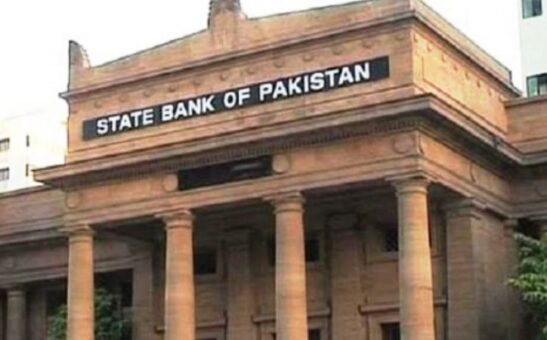
The State Bank of Pakistan (SBP) issued an important clarification on Monday regarding the restrictions on foreign currency accounts, emphasizing that these limitations do not apply to non-resident Pakistanis.
(more…)Tag: SBP
-

SBP to expedite payment license issuance to FinTech companies
KARACHI: State Bank of Pakistan (SBP) will expedite issuance of payment licenses to FinTech companies in order to accelerate financial inclusion program.
A report on “Roadmap for Stability and Growth” issued by Finance Ministry, regarding financial inclusion program, stated that SBP to expedite issuance of Payment licenses to Fintech companies with established customer base; development of Micro Payment Gateway (MPG) for retail payments; facilitate expansion of national merchant integration into mobile payments and commence operationalization of Asaan Mobile Account (AMA) Scheme.
It said that much remains to be done on financial inclusion. As of 2015, merely 16 percent of the adult population had a bank account, with account ownership for women standing at a dismal 11 percent, whereas a large segment of faith-sensitive population remained voluntarily excluded.
Financing to priority sectors such as agriculture and housing remained constrained, with SMEs claiming a minuscule share.
Moreover, regional disparities increased over time.
The National Financial Inclusion Strategy (NFIS), developed and adopted by the government in 2015, aimed at achieving inclusive economic growth through enhanced access to finance and deposit base, promotion of small and medium enterprises, easy and affordable access to finance to farmers, facilitation in low cost housing finance and provision of Shariah-compliant banking solutions.
Digitization of payments across the country borders is a priority of the Government and the following targets have been set for achievement by 2023:
Enhance usage of Digital Payments (65 million active digital transaction accounts, with gender segregation of 20 million accounts by Women).
By digitizing government payments and receipts, automation of CDNS branches, and digitization of services provided by Pakistan Post the Government san kick start digitization of payments.
Fiscal concessions may be offered on mobile phone duties (< Rs 8k), and sales tax for user charges for Data be refunded into subscriber account monthly by Telephone companies, against Government refunds, or suitable alternative method. To oversee progressive digitization of government payments and to coordinate regulatory enabling, the Government may consider institutionalizing centralized responsibility under a Chief Digital Officer at the Ministry of Finance. It would be necessary to hire a market professional for this function.
• Enhance Deposit Base (Deposit-to-GDP ratio to 55 percent)
• Promote SME Finance (Extend finance to 700,000 SMEs; 17 percent of the private sector credit)
• Increase Agricultural Finance (Serve 6 million farmers through digitalized solutions; enhance annual disbursement to Rs1.8 trillion)
• Enhance share of Islamic Banking (25 percent of the banking industry; increase branches of Islamic banks to 30 percent of the banking industry)
-

Instructions issued for moving public money to treasury single account
ISLAMABAD: The ministry of finance said that the State Bank of Pakistan (SBP) has been directed to design procedure for bringing back public money from commercial banks to Treasury Single Account (TSA).
‘A Roadmap for Stability and Growth’ issued by the ministry of finance this month, said that the central bank had been instructed to design administrative procedures, and an IT system, for rolling back public monies from commercial banks to TSA.
The ministry highlighted the weakness in fiscal management that many public sector agencies park unspent monies outside the TSA.
“By end 2018 there was an estimated Rs1.4 trillion in these accounts,” the ministry said.
This reflects a clear case of lack of oversight of public finances, it added.
These accounts of the public agencies are not linked to the Treasury Single Account (TSA) and while these amounts are reflected in SBP reports, they remain outside the fiscal reporting framework of the government.
Some of the monies are due to ‘leakages’ from the fiscal management system and are reported as expenditure in the past fiscal reports.
Thus, showing a larger than actual fiscal deficit.
Moreover, these accounts adversely impact government’s cash management and audits of public expenditure.
The government has introduced an enabling provision for Treasury Single Account (TSA) regime for Government’ cash management system has been incorporated in the draft Public Finance Management and Administration Bill.
This provision gives a rule-based regime of cash management through the TSA.
Simultaneously a policy for TSA is being drafted in consultation with stakeholders and expected to be ready soon for submission to the Federal Cabinet for approval.
-

Forex exchange reserves fall to $16.19 billion on sovereign bond repayment
KARACHI: The foreign exchange reserves of the country fell by $1.03 billion during a week owing to huge repayment made against Pakistan Sovereign Bond.
The total foreign exchange reserves of the country fell to $16.196 billon by week ended April 12, 2019 as against the reserves level of $17.228 billion a week ago, State Bank of Pakistan (SBP) said on Thursday.
The central bank said that during the week ending April 12, 2019, SBP’s reserves decreased by US$1,028 million to US$9,243.7 million.
The official reserves of the central bank were decreased due to payments on account of external debt servicing, including principal repayment of US$1,000 million against Pakistan Sovereign Bond.
The reserves held by commercial banks were flat at $6.952 billion from previous week’s level of $6.956 billion.
-

Pakistan current account deficit narrows by 29.44 percent in July – March
KARACHI: Pakistan’s current account deficit narrowed by 29.44 percent during first nine-months (July-March) of current fiscal year owing to falling imports and improved foreign remittances.
The current account deficit narrowed to $9.58 billion during first nine months of current fiscal year as compared with deficit of $13.589 billion in the corresponding period of the last fiscal year, according to Balance of Payment (BOP) details issued by State Bank of Pakistan (SBP) on Thursday
Pakistan’s trade deficit was contracted by 13.02 percent during first nine months (July – March) 2018/2019 due to significant decline in import bill in the same period.
The trade deficit shrank to $23.67 billion during first nine months of current fiscal year as compared with the deficit of $27.21 billion in the corresponding period of the last fiscal year.
The import bill during the first nine months was declined by 8 percent to $40.75 billion as compared with $44.28 billion in the same period of the last fiscal year.
However, growth in exports was remained flat. The exports were at $17.08 billion during the period under review as compared with $17.06 billion in the same period of the last fiscal year.
The import bill sharply declined by 21 percent in the month of March 2019 to $4.15 billion as compared with $5.25 billion in the same month of the last fiscal year.
On the other hand overseas Pakistani workers have remitted $16.1 billion during first nine months (July – March) 2018/2019 as compared with $14.8 billion in the same period of the last fiscal year, showing 8.74 percent growth.
During March 2019, the inflow of worker’s remittances amounted to US $1745.80 million, which is 10.73 percent higher than February 2019 and 3.20 percent lower than March 2018.
-

Foreign Direct Investment falls by 51.4 percent in nine months
KARACHI: The foreign direct investment (FDI) has declined by 51.4 percent to $1.27 billion during first nine months of current fiscal year as compared with $2.6 billion in the corresponding period of the last fiscal year, according to statistics issued by State Bank of Pakistan (SBP) on Thursday.
The inflows of FDI fell by 20.9 percent to $2.51 billion during the period under review as compared with of $3.18 billion in the same period of the last fiscal year. While the outflows sharply increased by 121.8 percent to $1.24 billion as compared with $560 million.
The portfolio investment in the stock market witnessed massive outflow during the first nine months of current fiscal year. The stock market witnessed outflow of $409 million during July – March 2018/2019 as compared with the outflow of $118.6 million in the corresponding period of the last fiscal year, showing sharp decline of 245 percent.
The foreign private investment with both the component of FED and portfolio investment declined by 65.5 percent to $864 million during first nine months of current fiscal year as compared with $2.5 billion in the same period of the last fiscal year.
The total foreign private investment after inclusion of foreign public investment witnessed decline of 82.4 percent to $873 million during July – March 2018/2019 as compared with $4.95 billion in the corresponding period of the last fiscal year.
-

Stakeholders to be taken onboard on TSA: SBP
KARACHI: State Bank of Pakistan (SBP) on Wednesday said that stakeholders would be taken onboard while taking decision on Treasury Single Account (TSA).
In a statement, the central bank said that some news are circulating on social media regarding government plans to introduce TSA.
While the proposal to introduce TSA is being examined by the government in consultation with the SBP as part of its agenda to reform public financial management, however, no decision has yet been made to implement the TSA, the central bank said.
“Any decision in this regard will be taken after due consultation with all the stakeholders and assessing its impact on the banking industry,” it added.
It will, therefore, be premature to form any opinion about the proposed policy decision and thus the market players should avoid engaging in any speculative activities based on this proposal which is still under examination.
-

Banking deposits reach all time high at Rs13.45 trillion
KARACHI: The banking deposits have reached to all time high at Rs13.45 trillion by end of March 2019 amid reports of government initiatives of Treasury Single Account (STA).
The deposits of the banking system increased to Rs13.456 trillion by March 2019 as compared with Rs12.57 trillion in the same month a year ago, showing growth of seven percent, according to statistics released by State Bank of Pakistan (SBP) on Wednesday.
Previously, the deposits hit record high at Rs13.35 trillion by the end of December 2018.
Analysts said that the initiatives of TSA would have negative repercussions on the banking deposits.
The has drafted a proposal to introduce TSA to transfer its deposits that are currently being maintained with commercial banks, to State Bank of Pakistan (SBP).
In this regard, SBP a day earlier held a meeting with bank representatives to brief them about the proposed mechanism of TSA.
The SBP has asked banks to provide feedback by the end of this month on the viability to consolidate government accounts into a single account as well as the readiness of their system to perform the implementation, as per channel checks.
Analysts at Topline Securities said that it would be a negative development for banks in terms of systematic risk as total government deposits with commercial banks are around Rs1.9 trillion or 13.7 percent of total deposits, around which, Rs0.9 trillion are of the federal government.
Bank of Khyber (BOP) has the highest government deposits (Federal & Provincial) of 63 percent of its total deposits, followed by Bank of Punjab (BOP) 56 percent, Askari Bank (AKBL) 33 percent and National Bank of Pakistan (NBP) 29 percent.
The analyst said that in the first phase, federal government deposits (around Rs0.9 trillion) will be transferred to SBP under single account, which may be followed by transfer of provincial deposits (around Rs1 trillion).
-

Senior citizens allowed investment in national savings on expired CNICs
KARACHI: The Central Directorate of National Savings (CDNS) has issued directives to its zonal offices, instructing them to follow the policy outlined by the central bank to facilitate older citizens aged 65 years and above in making investments using expired Computerized National Identity Cards (CNICs).
(more…) -

Non-acceptance of duty, taxes: SBP launches surprise inspection of bank branches
KARACHI: State Bank of Pakistan (SBP) has launched surprise inspection of bank branches across the country on complaints received from taxpayers that banks were not accepting duty, taxes through over the counter (OTC).
In a circular issued on Monday, the SBP said that banks are required to enable their OTC Channel for collection of taxes and duties and advise their branches to comply meticulously with the above instructions.
“However, despite above clear instructions, the complaints regarding non-acceptance of taxes particularly the mobile levy through banks’ OTC Channel are piling up unabatedly.”
Federal Board of Revenue (FBR), Pakistan Telecommunication Authority (PTA) and general public reported numerous instances whereby commercial banks are not accepting over the counter payments of Customs Duty and other taxes including mobile levy against PSIDs generated by the WeBoc system.
“The increasing large number of complaints shows that the branches are still not fully aware of the instructions to collect the taxes and duties through 1Link’s integrated/ enabled OTC facility.”
The central bank said that the matter was viewed seriously and therefore, it has been decided that SBP would conduct surprise inspection of bank branches across the country, to assess the level of dissemination of information, awareness at branches and compliance of instructions issued by SBP from time to time. “Any violation of above instructions by the branches if detected during surprise inspections i.e. the branches are found not accepting the taxes and duties from the clients approaching them with PSIDs for payment of the taxes and duties would attract strict punitive action including levy of monetary penalty,” the SBP said.
The SBP directed that keeping in view the above, the branches / Regional Offices must be advised again to ensure meticulous compliance of the instructions and facilitate the taxpayers in payment of taxes and duties.