KARACHI: The State Bank of Pakistan (SBP) on Saturday amended Prudential Regulations G-1 and sets maximum limits for payment to board members of banks and Development Financial Institutions (DFIs).
(more…)Tag: SBP
-

Foreign exchange reserves increase by $557 million to $15.577 billion
KARACHI: The foreign exchange reserves of the country have increased by $557 million to $15.577 billion by week ended August 09, 2019 as compared with $15.02 billion a week ago, State Bank of Pakistan (SBP) said on Saturday.
The foreign exchange reserves held by the central bank were increased by $535 million to $8.264 billion by August 09 as compared with $7.729 billion a week ago.
The increase in central bank’s reserves is mainly due to inflow of $500 million received from Asian Development Bank (ADB), the SBP said.
The reserves held by commercial banks also increased by $22 million to $7.313 billion as compared with $7.291 billion.
Related Posts
Foreign exchange reserves fall by $41 million to $15.02 billion
-
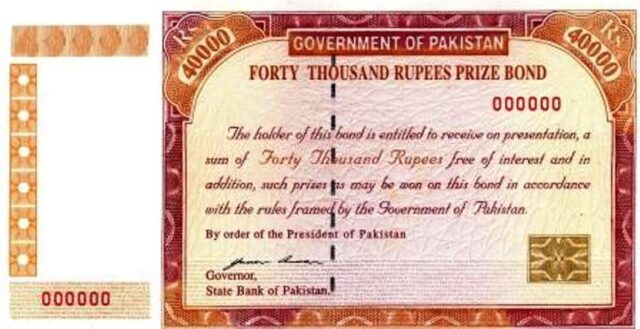
Investment into premium prize bonds post 46pc growth
KARACHI: The investment in premium prize bonds of Rs40,000 denomination has increased by over 46 percent as the government stopped the circulation of bearer bonds of same denomination and launched campaign to document the economy.
According to statistics released by State Bank of Pakistan (SBP) the total investment into premium prize bonds of Rs40,000 denomination increased to Rs7.665 billion by end of June 2019 as compared with Rs5.245 billion in same month of the last year.
The premium prize bonds were launched by the government in March 2019 with the aim to bring undocumented money into the mainstream economy.
According to salient features of the premium bonds issued by Central Directorate of National Savings (CDNS):
— The bond is available in Rs40,000 denomination
— Registered in the name of investor.
— Quarterly prize money draws as well as bi-annual profit payment.
— For individuals, public and private sector institutions except banks, insurance companies and mutual funds.
— Direct credit and prize money and profit in investors bank account.
— No Application Forms required for claiming prize money & profit.
— Unlimited Investment and Tenure.
— WHT applicable and Exempt from Zakat.
— Transferable and Pledge-able.
— Can be purchased through Cash, Cheque, Pay-Order and Bank Draft
— Can be purchased from offices of State Bank of Pakistan Banking Services Corporations.
The growth in premium prize bonds investment is much faster in the month of June 2019 as compared with the previous month due to the government announcement to stop the circulation of bearer bonds of Rs40,000 denomination.
The investment in Rs40,000 prize bonds denomination grew by 24 percent to Rs7.665 billion in June 2019 as compared with Rs6.17 billion in May 2019.
The government on June 24, 2019 notified withdrawal of Rs40,000 denomination national prize bonds from circulation.
On the same date the State Bank of Pakistan (SBP) issued instructions to chief executives and banks of all banks for compliance.
The SBP instructed:
(a) National Prize Bonds of Rs40,000 denomination shall not be sold after June 24, 2019 and will not be encashed/redeemed after March 31, 2020.
(b) No further draws of Rs40,000 denomination national prize bonds shall be held.
(c) Cash payment for encashment of bonds is ‘Not’ allowed. However, the bond holder(s) shall have the following options to replace/encash the bonds:
1. Conversion of Premium Prize Bonds (Registered)
2. Replacement with Special Saving Certificate (SSC)/Defence Savings Certificate (DSC)
3. Encashment at Face Value.
The SBP also issued Standard Operating Procedure (SOP) for conversion to premium prize bonds (registered).
i. The bonds can be converted to premium prize bonds (registered) through the 16 field offices of SBP Banking Services Corporation, and authorized branches of six commercial banks i.e. National Bank of Pakistan, Habib Bank Limited, United Bank Limited, MCB Bank Limited, Allied Bank Limited and Bank Alfalah Limited.
ii. The bond holder shall be required to submit a written request for conversion of bearer bonds to premium prize bonds (registered) to be registered in his/her name on the prescribed application form.
iii. The bond holder shall also be required to submit prescribed application form for registration/purchase of premium prize bonds as per the procedure in vogue.
The SBP also issued procedure for replacement with Special Saving Certificate (SSC)/Defence Savings Certificate (DSC).
i. The bonds can be replaced with SSC/DSC through the 16 field offices of SBP Banking Services Corporation, authorized commercial banks and National Saving Centers.
ii. All authorized commercial banks shall therefore, accept requests for replacement of bearer bonds with SSC or DSC on the prescribed application form.
iii. The bond holder shall also be required to submit application form for purchase of SSC/DSC as per the prescribed procedure.
The SBP issued procedure for encashment at face value and said that the bonds will only be encashed by transferring the proceeds to the bond holder’s bank account through the 16 field offices of SBP banking services corporation as well as the authorized commercial bank branches.
The SBP further said that all commercial banks shall receive request for encashment of bearer bonds on the prescribed application form.
The SBP said that the prize bonds encashed/replaced by general public may be surrendered to concerned SBP BSC office through respective regional office of the commercial bank. For the purpose, the regional office may intimate the SBP BSC office three days in advance so that necessary arrangements for receipt of the bonds can be made.
Related Posts
Investment in saving certificates rises by 19 percent to Rs2,217 billion
-

Investment in saving certificates rises by 19 percent to Rs2,217 billion
KARACHI: The investment in saving certificates has registered 19 percent growth to increase Rs2,217 billion in the last fiscal year owing to better rate of interest and safe investment avenue.
The data released by State Bank of Pakistan (SBP) revealed that the investment increased to Rs2,217 billion by June 2019 as compared with Rs1,865 billion by end of same month of 2018.
Experts said that the weak economic situation and continuous increase in interest rate by the central bank encourage investment in saving schemes.
According to the central bank data the investment in the certificates issued by National Saving Center (NSC) rose by 20 percent to Rs2,096 billion by June 2019 as compared with Rs1,749 billion in the same month a year ago.
The central bank had adopted monetary tightening stance since May 25, 2018 and pushed up interest rates to 13.25 percent from 6 percent during the past eight consecutive policy announcements.
The market sources further elaborated that the deterioration in stock market was also a major factor behind significant investment in the government securities.
As per the data the investment in the Defence Saving Certificates (DSC) increased to Rs393.58 billion by June 2019 as compared with Rs336.24 billion in the same month of last year.
Meanwhile, the investment in Special Saving Certificates (SSC) grew to Rs413.71 billion fro Rs381.87 billion in the period under review.
The data further showed that the investment in Regular Income Certificates posted sharp growth of 41 percent to Rs489.62 billion by June 30, 2019 as compared with Rs347.532 billion in the corresponding month of the last year.
Further the investment in Behbood Saving Certificates grew to Rs914.46 billion from Rs794 billion.
The market sources said that the government drive to document the economy and announcement to stop the circulation of Rs40,000 denomination prize bonds encouraged investors to divert the investments into saving schemes.
Related Posts
SBP stops banks selling Rs40,000 prize bonds, issues procedure for conversion into registered bonds
-
Overseas Pakistanis send $2.04 billion in July
KARACHI: Overseas Pakistani workers have remitted $2.04 billion in the first month of fiscal year 2019/2020 as compared with $1.98 billion in the same month of the last fiscal year, State Bank of Pakistan (SBP) said on Friday.
During July 2019, the inflow of worker’s remittances amounted to $2.04 billion, which is 23.91 percent more than June 2019 and 2.9 percent more than July 2018.
The country wise details for the month of July 2019 show that inflows from Saudi Arabia, UAE, USA, UK, GCC countries (including Bahrain, Kuwait, Qatar and Oman) and EU countries amounted to $470.95 million, $427.33 million, $332.37 million, $299.27 million, $198.06 million and $58.30 million respectively compared with the inflow of $437.48 million, $446.25 million, $291.87 million, $298.51 million, $199.30 million and $64.96 million respectively in July 2018.
Remittances received from Malaysia, Norway, Switzerland, Australia, Canada, Japan and other countries during July 2019 amounted to US $253.01 million together as against US $243.35 million received in July 2018.
Related Posts
-
SBP to monitor ATMs working during Eid holidays
KARACHI: State Bank of Pakistan (SBP) will monitor the working of Automated Teller Machines (ATMs) during Eid holidays to ensure uninterrupted availability of cash.
The central bank on Friday said that it had provided a sufficient quantity of fresh and good quality ATM notes of higher denominations to commercial banks for smooth ATM operations during the Eid Holidays.
“In this regard, special teams of SBP and SBP BSC officials shall inspect and monitor the working of ATMs across Pakistan to ensure uninterrupted availability of cash to the general public during the Eid holidays.”
The SBP, through 16 field offices of its subsidiary SBP Banking Services Corporation (SBP BSC), issued fresh banknotes of various denominations aggregating to Rs284 billion, including Rs.274 billion via commercial banks and Rs.10 billion via cash counters of SBP BSC , during days leading to Eid-ul-Azha.
Out of the total notes issued to commercial banks, Rs. 12 billion of lower denominations (upto Rs.100), fresh notes have been provided for onward distribution among general public and account holders, the SBP said.
Related Posts
-
SBP imposes penalty on four banks for violating AML/KYC
KARACHI: The State Bank of Pakistan (SBP) has imposed penalty of Rs184.64 million upon four commercial banks for violating laws related to Anti-Money Laundering (AML)/Know Your Customer (KYC).
The central bank on Thursday said that these penalty amount was imposed during the month of July 2019 against banks included: The Bank of Punjab; JS Bank Limited, Bank Al Habib Limited and Soneri Bank.
The SBP imposed penalty of Rs13.072 million against The Bank of Punjab on July 15, 2019 for violating in areas of foreign exchange operations.
In addition to penal action, the bank has been advised to improve its internal processes, the SBP said.
The Bank of Punjab was again penalized with Rs16.119 million on July 18, 2019 for violating in areas of AML/KYC, unclaimed deposits.
In addition to penal action, the bank has been advised for improvements in the areas of AML/KYC, the central bank added.
The SBP penalized JS Bank Limited with penalty amount of Rs48.211 million on July 23, 2019 for violating in areas of AML/KYC.
In addition to penal action, the bank has been advised to conduct a thorough review of relationship accounts, the SBP said.
The SBP imposed penalty of Rs51.75 million upon Bank Al Habib Limited on July 25, 2019 for violating in areas of AML/KYC, FX Operations.
In addition to penal action, the bank has been advised to update its systems and processes, and provide appropriate trainings to the concerned officials, the SBP said.
The SBP imposed penalty of Rs55.48 million upon Soneri Bank Limited on July 25, 2019 for violating in areas of AML/KYC, Asset Quality, FX Operations.
In addition to penal action, the SBP advised the bank to improve areas of AML/KYC and credit risk monitoring.
-
Foreign exchange reserves fall by $41 million to $15.02 billion
KARACHI: The liquid foreign exchange reserves of the country fell by $41 million to $15.02 billion by week ended August 02, 2019 as compared with $15.061 billion a week ago, State Bank of Pakistan (SBP) said on Thursday.
The foreign exchange reserves held by the SBP fell by $38 million to $7.729 billion by week ended under review as compared with $7.767 billion by week ended July 26, 2019.
The SBP said that its official reserves were declined due to external debt servicing and other official payments.
The foreign exchange reserves held by commercial banks were flat at $7.291 billion by week ended August 02, 2019 as compared with $7.294 billion a week ago.
Related Posts
-
SBP launches Islamic working capital financing for small, medium enterprises
KARACHI: State Bank of Pakistan (SBP) on Wednesday launched Islamic Working Capital Financing (IWCF) for small enterprises and low-end medium enterprises.
The central bank said that “Refinance Scheme for Working Capital financing of Small Enterprises and Low-End Medium Enterprises” was available through IH&SMEFD Circular No. 09 of 2017. However, Shariah compliant alternative of this scheme was not available.
Now, SBP is introducing a Mudarabah based “Islamic Refinance Scheme for Working Capital Financing of Small Enterprises and Low-End Medium Enterprises (IWCF)”.
SBP shall make Mudarabah investment in general pool of Participating Islamic Financial Institutions under the scheme.
Financing shall be initially available to meet the working capital requirements of SME sectors, included: Information Technology (IT); Gems and jewelry; Furniture; Leather industry; Surgical goods; Fruits, vegetables and food processing & packaging; Dates processing; Printing & packaging.
Small Enterprises (SEs) as defined in SBP’s Prudential Regulations (PRs) for SME financing are eligible under the scheme. Maximum financing limit for SEs is the same as defined in SBP’s relevant PRs.
Medium enterprises (MEs) with annual sales turnover of up to Rs 300 million are eligible under the scheme. Maximum financing limit for MEs is Rs 50 million. Maximum financing tenor under the scheme is one year.
The banks/development financial institutions (DFIs) may submit their requests for the status of Participating Islamic Financial Institution, the SBP said.
They may also apply for allocation/ assignment of limit under the scheme. These requests may be submitted within 30 days from the date of issuance of this circular, the SBP added.
-
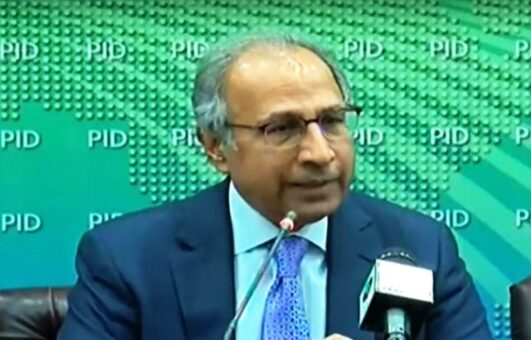
Hafeez Shaikh briefs US treasury officials on FATF action plan implementation
ISLAMABAD: A US delegation led by Ambassador Alice G. Wells, Acting Assistant Secretary of State for the Bureau of South and Central Asian Affairs, along with the US Treasury officials comprising Scott Rembrandt, Deputy Assistant Secretary, Grant Vickers, David Galbraith and others held a meeting with Abdul Hafeez Shaikh, Adviser to the Prime Minister on Finance & Revenue today at Finance Division, Islamabad.
A statement on Tuesday said that the adviser briefed the visiting delegation on measures pertaining to economic reforms being undertaken by the government of Pakistan to ensure economic discipline, efforts being made towards implementation of FATF Action Plan and the key challenges being faced.
He emphasized the importance of bilateral engagement with the US and the need to encourage entrepreneurs from private sector of both the countries which will lead to enhanced trade.
The Adviser informed that over the past three months, the Government has taken significant steps to bring financial discipline that include reduction in Current Account deficit, focus on increasing revenue generation, measures to reduce fiscal expenditures, reduce fiscal borrowings, efforts to enhance foreign exchange reserves through bilateral and multilateral support, arrangement of petroleum credit facility with KSA and IDB and IMF Program.
Further, as part of its institutional development initiative, SBP and FBR are being resourced and empowered. At the same time to support economic growth and facilitate the people below the poverty line, various Programs to support our export oriented industries and health insurance schemes have been introduced for the poor.
Regarding, implementation of FATF Action Plan, the Adviser briefed that the government is putting in all-out efforts to complete the Action Plan, involving all relevant authorities at the federal and provincial levels, supported by capacity building through international partners.
The Adviser expressed Government of Pakistan’s commitment to enhance the effectiveness of its AML/CFT Framework being undertaken by the government of Pakistan, with the objective to ensure that all the actions that are being taken to curb Terror Financing are irreversible and sustainable.
The Adviser urged for continued support of the international community for strengthening of the AML/CFT Framework over a longer period of time. Ms. Alice G. Wells appreciated the briefings and expressed that the US would continue to remain engaged with Pakistan in its economic reforms efforts and help build an environment that facilitates business development between the two countries.