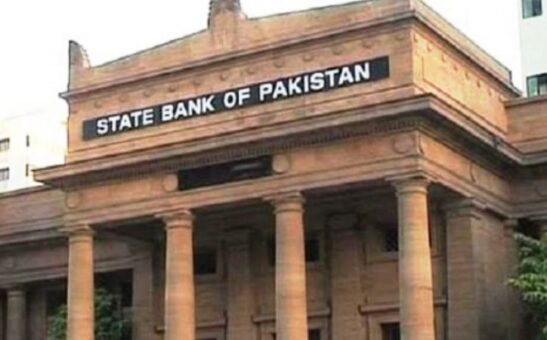
KARACHI: The State Bank of Pakistan (SBP) on Monday announced first increase in key policy rate by 25 basis points in past 25 months.
Previously, the SBP announced the increase in policy rate of 100 basis points to 13.25 per cent.
The SBP kept the policy rate unchanged at 13.25 per cent till March 17, 2020 when it decided to reduce the policy rate by 75 per cent to 12.50 per cent.
Due to coronavirus pandemic, the central bank brought down the policy rate to 7 per cent in short span of time and maintained at this level for the past many months. The SBP reduced the policy rate to 7 per cent in its announcement on June 25, 2020.
At its meeting on September 20, 2021, the Monetary Policy Committee (MPC) decided to raise the policy rate by 25 basis points to 7.25 percent.
Since its last meeting in July, the MPC noted that the pace of the economic recovery has exceeded expectations.
This robust recovery in domestic demand, coupled with higher international commodity prices, is leading to a strong pick-up in imports and a rise in the current account deficit.
While year-on-year inflation has declined since June, rising demand pressures together with higher imported inflation could begin to manifest in inflation readings later in the fiscal year.
With growing signs that the latest COVID wave in Pakistan remains contained, continued progress in vaccination, and overall deft management of the pandemic by the government, the economic recovery now appears less vulnerable to pandemic-related uncertainty.
As a result, at this more mature stage of the recovery, a greater emphasis is needed on ensuring the appropriate policy mix to protect the longevity of growth, keep inflation expectations anchored, and slow the growth in the current account deficit.
In line with this shift in the economic outlook, the MPC was of the view that the priority of monetary policy also needed to gradually pivot from catalyzing the recovery after the Covid shock toward sustaining it.
As foreshadowed in previous monetary policy statements, the MPC noted that this rebalancing would be best achieved by gradually tapering the significant monetary stimulus provided over the last 18 months.
The MPC noted that over the last few months the burden of adjusting to the rising current account deficit had fallen primarily on the exchange rate and it was appropriate for other adjustment tools, including interest rates, to also play their due role.
The MPC noted that the stance of monetary policy is still appropriately supportive of growth, with real interest rates remaining negative on a forward-looking basis. Looking ahead, in the absence of unforeseen circumstances, the MPC expects monetary policy to remain accommodative in the near term, with possible further gradual tapering of stimulus to achieve mildly positive real interest rates over time.
The pace of this possible further gradual tapering would be informed by updated information on the continued strength of demand growth and the stance of fiscal policy, amongst other factors.
In reaching its decision, the MPC considered key trends and prospects in the real, external and fiscal sectors, and the resulting outlook for monetary conditions and inflation.
With a supportiveFY22 budget and accommodative monetary policy, most high-frequency domestic demand indicators such as automobiles, POL (petroleum, oil and lubricants) sales, cement sales and electricity generation continue to depict robust growth. This growth is mirrored in the strength of imports and tax collections.
LSM registered strong growth in June (18.5 percent (y/y)) before moderating in August to 2.2 percent (y/y), in line with typical seasonal patterns. The services sector is also rebounding strongly; latest Google Community Mobility Reports show that activity across grocery stores, restaurants, and shopping centers during July and August rose above pre-Covid levels. In agriculture, the decline in the area under cultivation of cotton is expected to be compensated by an increase in area for rice, maize, and sugarcane. Based on these trends, growth in FY22 is now expected toward the upper end of the forecast range of 4-5 percent, notwithstanding some greater uncertainty with respect to spillovers from the evolving situation in Afghanistan.
The current account deficit rose to $0.8 billion in July and $1.5 billion in August, reflecting both vigorous domestic demand and high global commodity prices. While remittances remained strong, growing by 10.4 percent (y/y) during July-August and exports also performed reasonably well (averaging $2.3 billion per month), they were outstripped by imports. In response, the rupee depreciated by 4.1 percent since the last MPC meeting. The MPC noted that many other currencies have also depreciated recently as expectations of tapering by the Federal Reserve have been brought forward.
The MPC noted that the flexible market-based exchange rate regime has performed well since its introduction in June 2019, including through the Covid shock. It has overseen a healthy modulation of the current account and supported a critical build-up in the country’s gross and net FX reserves despite external pressures. Under this regime, the SBP does not suppress an underlying trend in the exchange rate and any interventions are limited to address disorderly market conditions. Since its floatation, the rupee has moved in an orderly manner in both directions and has depreciated by only 4.8 percent to date, much less than many other emerging market currencies over the same period. Since the rupee was floated, SBP’s gross foreign exchange reserves have nearly tripled to a record $20 billion, while net international reserves have risen by nearly $16 billion between end-June 2019 and end-August 2021.
The MPC observed that while the flexible exchange rate has appropriately played its role as a shock absorber, it is important that its role be complemented by strong exports, targeted measures to curb non-essential imports, and appropriate macroeconomic policy settings to contain import growth.
In FY21, prudent management of the public finances facilitated fiscal consolidation for the second year in a row despite Covid, with the primary deficit declining by around ½ percentage points to 1.4 percent of GDP. This improvement largely stemmed from strong growth in tax and petroleum development levy (PDL) revenues, together with significant deceleration in non-interest expenditures. Following the seasonal end-year release of expenditure allocations, the fiscal impulse was strongly expansionary in the final quarter of FY21. In the first two months of FY22, FBR revenue grew by over 40 percent (y/y)while Federal PSDP releases rose to an all-time high for this period, equivalent to nearly 44 percent of their budgeted amount for the full year. It will be important to support tax revenue growth and carefully monitor outturns through the year to ensure the budget remains on track. Any unforeseen slippages in the fiscal stance would further bolster domestic demand, imports and inflation.
The MPC noted that accommodative financial conditions have provided significant support to the growth recovery since the start of FY21. Following historic cuts in the policy rate and the introduction of SBP Covid-related support packages, private sector credit grew by more than 11 percent during FY21, on the back of consumer loans (mainly auto finance and personal loans) followed by a broad-based expansion in credit for fixed investment and finally working capital loans. The MPC felt that some macro prudential tightening of consumer finance may also be appropriate to moderate demand growth as part of the move toward gradually normalizing monetary conditions.
Inflation fell from 9.7 percent (y/y) in June to 8.4 percent in both July and August. In addition to favorable base effects, this decline reflects continued deceleration in administered prices of energy due to the reduction in PDL and sales tax on petroleum products. Core inflation also fell in both urban and rural areas in August. Nevertheless, the momentum of prices remains relatively elevated, with month-on-month increases of 1.3 percent in July and 0.6 percent in August. In addition, inflation expectations of both households and businesses have drifted up and wage growth has picked up as the recovery has strengthened.
Looking ahead, the inflation outlook largely depends on the path of domestic demand and administered prices, notably fuel and electricity, as well as global commodity prices. The MPC will continue to carefully monitor developments affecting medium-term prospects for inflation, financial stability and growth and stands ready to respond appropriately.
The central bank issued a circular to relax the conditions.
The SBP through Foreign Exchange Circular No. 07 dated August 05, 2021 in terms of which SBP notified revision of Chapter 14 of Foreign Exchange Manual.
“Based on representations received from various stakeholders and to facilitate Afghan Transit Trade in current circumstances, it has been decided to defer the following requirements until March 31, 2022:
“Submission of proceed realization certificate for freight and container detention charges in respect of consignment of Afghan Transit Trade as mentioned in Para 4((i(n)) & 4A((ii(g)), Chapter 14 of Foreign Exchange Manual.
“Maintaining separate PKR account by shipping companies/agents for accepting container detention charges as mentioned in Para 4A(i), Chapter 14 of Foreign Exchange Manual.”
The banks have been advised to bring the above developments to the notice of all their constituents for meticulous compliance.
The import bill increased by 74 per cent to $12.168 billion during first two months (July – August) of the current fiscal year as compared with $6.99 billion in the same period of the last fiscal year.
The exports of the country also grew by 28 per cent to $4.58 billion during first two months of the current fiscal year as compared with $3.58 billion in the corresponding months of the last fiscal year.
However, trade deficit ballooned by 122.58 per cent to $7.58 billion during first two months of the current fiscal year as compared with the deficit of $3.4 billion in the corresponding months of the last year.
Workers’ remittances increased to $5.36 billion during July – August of the current fiscal year as compared with $4.86 billion in the same period of the last year.
State Bank of Pakistan (SBP) on Friday launched “Banking on Equality Policy: Reducing the Gender Gap in Financial Inclusion (FI)” to enhance women’s financial inclusion.
Under the policy, it has been decided to introduce a gender lens within the financial sector through specific measures in key areas, to bring a shift towards women friendly business practices.
Framework of Measures under Banking on Equality Policy
These measures are targeted to improve institutional diversity, product diversification, customer acquisition & facilitation approaches and better gender-disaggregated data collection for improving women’s access to financial services.
The implementation of this policy will facilitate in reducing the gender gap in bank staff, as well as in improving the access and use of financial products & services by women. It will also be helpful in achieving National Financial Inclusion Strategy (NFIS) headline target of 20 million active women bank accounts by 2023.
1. Applicability/Scope
The ensuing instructions shall be applicable on Commercial Banks, Islamic Banks, Microfinance Banks (MFBs), Development Finance Institutions (DFIs) and those Electronic Money Institutions (EMIs) that have received commercial approval, hereinafter referred collectively as Financial Institutions (FIs).
2. Measures to Enhance Gender Diversity
Proportionate improvement in the ratio of women working in FIs is expected to aid the development of policies and practices for improving gender balance across the financial sector as well as developing women friendly products & services. Accordingly, FIs shall take the following measures:
2.1. Comprehensive Policy
All FIs shall develop a comprehensive gender mainstreaming policy to reduce the gender gap, duly approved by their Boards within six months of issuance of this circular. The policy must include:
2.1.1. Action plans along with timelines and responsibilities, to reach the goal of improving their institution’s overall gender diversity.
2.1.2. Proportionate strategies/ policies to encourage women’s employment rate. Towards this end, strategies/ policies shall encompass specific measures for hiring, retention, promotion, and mentoring gender diversity.
2.1.3. Strategies to improve representation of women in senior management, where merit-based criteria should be developed for women’s career growth path. The objective of the FIs’ policies should be to promote high potential women to senior management and improve the FIs’ outreach towards more women.
2.1.4. Set gender diversity action plans and targets in the Key Performance Indicators (KPIs) of their C-suite executives. The KPIs shall cascade to the regional and branch level staff to include a certain weightage of targets for accounts opened and financings for females.
2.1.5. Framework for protection against workplace harassment, harassment in customer interactions and improving overall work environment for women.
2.1.6. Strategies and measures to enhance women’s access and use of FIs’ products & services.
2.2. Governance In order to have institutional readiness for creating more focus on gender intentional approaches:
2.2.1. FIs must have at least one female independent director in their Board of Directors preferably within six months of the issuance of this circular, in-line with the SECP’s instructions under Section 154 of Companies Act, which states “Public interest companies shall be required to have female representation on their board”.
2.2.2. FIs shall create a dedicated Management Sub-Committee on Gender, or amend TORs of existing Management Committee within three months of the issuance of this circular, to create gender perspective in their institutions’ policies and practices. Moreover,
– FIs will appoint one to two focal person(s) on gender.
– The focal person(s) shall submit quarterly progress to SBP on FIs women’s financial inclusion measures in line with their gender mainstreaming policy.
2.2.3. FIs shall set up a specialized dedicated Women’s Financial Services Department within six months of the issuance of this circular.
2.3. Gender Diversity KPIs and Targets
The policy envisions that all FIs as a whole shall have 20% women in their workforce by 2024. However, keeping in consideration the FIs’ business models and women’s ratio in existing work force, SBP will assign separate institutional targets to Commercial Banks, MFBs, Islamic Banks, Specialized Banks and DFIs.
The following target grid for incremental percentage increase in women workforce will be observed by FIs from the baseline of women workforce as of December 2020:
3. Women Centric Products & Services and Outreach Targets
To shift from gender neutral to gender inclusive product design and marketing, it is imperative that all FIs have dedicated teams tasked to embed a gender lens in all product offerings and marketing strategies.
3.1. Women Centric Products & Services
Towards this end, the specialized Women Financial Services Department at FIs would:
3.1.1. Be responsible for reviewing and designing the FIs’ products, services and marketing strategies from a gender perspective, while keeping in view various use cases of women demographics of all ages and life cycle stages.
3.1.2. Develop new digital financial products for specific segments including startups with focus on women segments.
3.1.3. Ensure the achievement of assigned gender disaggregated outreach targets for women centric products & services, access & usage of accounts, and financing to women entrepreneurs under priority sectors like agri finance, housing finance, MSME finance, etc. Further, each FI will be assigned indicative gender disaggregated targets for active accounts separately.
3.2. Partnerships and Collaborations
The FIs shall:
3.2.1.Explore partnerships with statutory bodies such as NADRA to create opportunities for raising awareness and facilitating bank account opening of women when they are registering/updating ID cards, and/or voting etc.
3.2.2. Explore partnerships with Ehsaas program to facilitate their beneficiaries to graduate from simple cash transfers to use of other products & services such as savings and credit products, etc.
3.2.3. Develop linkages with universities/ academia, chambers of commerce and trade bodies to develop scholarship, career counselling and mentorship programs to attract more women in banking careers.
3.2.4. Team up with the Fintechs, Incubation Centers and Accelerators for developing & marketing digital financial products and services for women startups.
3.2.5. Partner with women associations/networks and civil society organizations to engage with women at the grassroots levels for provision of financial services.
3.3. Trainings and Capacity Building of FIs’ Staff
FIs shall ensure that all of their employees including those involved in mobilizing, onboarding and serving women customers, must go through gender sensitivity training. To ensure facilitation and availability of proper guidance for women customers, the training must include:
3.3.1. Appropriate contents to help employees to understand existing gender relations, eliminate implicit gender biases, improve the workplace environment and customer interactions, and factor in the needs and priorities of men & women to understand their expectations while planning, implementing and evaluating its activities.
3.3.2. Whistleblowing policy to disclose wrongdoings and instances of non-compliance.
3.3.3. Effective marketing approaches to offer informed and improved products, including better facilitation for women customers.
3.3.4. Key features and important information about FIs’ products & services including SBP and Government schemes.
3.4. Financial Literacy and Mass Awareness
To create awareness and impart financial literacy among women to access formal financial products & services to make well-informed financial decisions, FIs will:
3.4.1. Conduct women’s financial literacy and marketing campaigns, based on need assessment/ market analysis/ consumer surveys, to improve awareness of financial products and services for women.
3.4.2. Invest in digital initiatives that increase financial literacy and digital skills of women and girls across all levels of education and income.
3.4.3. Activate influencer women leaders at local level as brand ambassadors to reach out to more women customers.
3.4.4. Formulate a female marketing team, tasked to increase women financial literacy and enhance their inclusion in the formal financial system. They may also educate men to encourage and facilitate women to avail financial services.
3.4.5. Create tab/section of “Women Financial Services” on their websites and apps for their respective women centric products & services.
3.5. Simplification of Loan Processes & Documentation
To make the financing process easier for women, all FIs must:
3.5.1. Simplify the credit policies & processes for financing to women and provide non-financial advisory services especially to women SMEs to access formal financial services.
3.5.2. Provide digital access to SBP Refinance & Credit Guarantee Scheme for Women Entrepreneurs in due course of time.
4. Women’s Champions at all Customer Touch Points
Presence of women champions and specialized resources at all customer touch points, such as bank branches, branchless banking agents, call centers and alternate delivery channels is critical to aid women’s adoption of conventional and digital financial services.
4.1. In order to make women comfortable to approach FIs and access financial products & services suited to their needs, all FIs shall preferably place women champions at all customer touch points, such as branches, call centers and alternate delivery channels etc.
4.2. Women Champions Targets
4.2.1. FIs must ensure that at least 75% of touch points should have women champions within three years of the issuance of this circular, as per timelines stipulated below:
Timelines
Targeted Ratio of Touch Points with Women Champions
June 2022
15%
December 2022
30%
June 2023
45%
December 2023
60%
June 2024
75%
4.2.2. FIs may consider their existing male /female / transgender staff members for being assigned the role of Women’s Champion, provided that the resource has undergone gender sensitivity training, is well versed in the bank’s financial products for women, and can share details of current SBP/ Government schemes for women.
4.2.3. The women champions will serve as a central point of contact for women customers to provide information about FIs’ financial products & services, non-financial advisory services, complaint redressal facilitation and share the details of current SBP/ Government schemes for women.
5. Robust Collection of Gender-Disaggregated Data and its Reporting Framework
Absence of gender-disaggregated data can create a mismatch between perceived barriers to women’s financial inclusion and policy interventions to address these constraints. Therefore:
5.2.1. FIs shall immediately make necessary arrangements to collect reliable gender-disaggregated data, to accurately reflect the uptake and usage of products & services by men, women and transgender, at-least in terms of bank accounts, deposits, financing, payments, etc. as per Annexure II attached.
5.2.2. FIs will submit the gender-disaggregated data to SBP on periodic basis in the prescribed areas as per the attached Annexure II.
5.2.3. FIs will share regular progress with SBP against the headline targets and instructions/measures as laid down in this circular and Banking on Equality Policy.
All FIs are advised to meticulously comply with the above instructions in true letter & spirit and submit a comprehensive compliance/progress report to SBP on quarterly basis. Further, all FIs must make necessary arrangements, preparations, allowances in budgets and infrastructure, for implementation of Banking on Equality Policy within three months of issuance of this circular.
KARACHI: Pakistan’s liquid foreign exchange reserves have slightly down by $38 million to $27.065 billion by week ended September 10, 2021 as compared with $27.103 billion a week ago, State Bank of Pakistan (SBP) said on Thursday.
The foreign exchange reserves maintained by commercial banks fell by $38 million to $7.042 billion by week ended September 10, 2021 as compared with $7.08 billion by week ended September 03, 2021.
Banking on Equality policy is SBP’s flagship policy initiative for reducing the gender gap in financial inclusion. The policy with its tagline ‘Mali Shamooliat – Sinifi Imtiaz key Bagher’ aims to transform the banking sector in the adoption of women-friendly business policies and practices. The policy has an overarching theme of improving women’s access to financial services and specifies the following key pillars:
— Gender diversity in financial institutions and access points to encourage women towards formal financial services.
— Women-centric products that cater to women‘s financial needs specifically while increasing financial literacy and awareness about women-centric product offerings.
— Women’s champions and specialized resources at all customer touchpoints for a better customer experience.
— Robust collection of gender-disaggregated data and target setting for informed policy interventions and post-launch monitoring & evaluation.
— Policy forum on gender and finance to prioritize women’s financial inclusion, drive the agenda forward, and increase buy-in from multiple stakeholders for added momentum.
The Policy has been developed after having extensive consultation with relevant stakeholders including domestic as well as international institutions, thought leaders and gender experts.