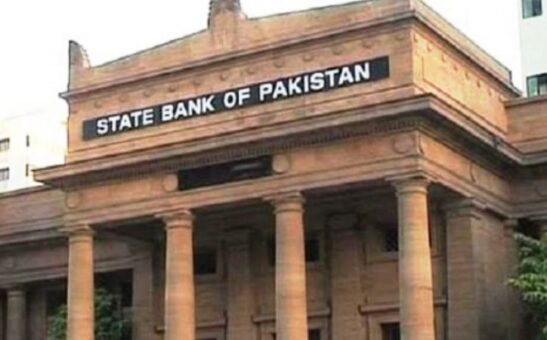
KARACHI: The State Bank of Pakistan (SBP) on Monday kept the policy rate unchanged at 13.25 percent for next two months considering the present discount rate to help in reducing inflation in next two years.
The Monetary Policy Committee (MPC) of the SBP on Monday decided to leave the policy rate unchanged at 13.25 percent.
“The decision reflected the MPC’s view that inflation outcomes have been largely as expected and inflation projections for FY20 have remained unchanged since the last MPC meeting on 16th July, 2019.
The MPC also viewed that, based on available information, the current stance of monetary policy was appropriate to bring inflation down to the target range of 5 – 7 percent over the next twenty-four months.”
In reaching this decision, the MPC considered key economic developments since the last MPC meeting, developments in the real, external and fiscal sectors, and the resulting outlook for monetary conditions and inflation.
The MPC noted two key developments since the last MPC meeting. First, the interbank foreign exchange market had adjusted relatively well to the introduction of the market-based exchange rate system.
The initial volatility and associated uncertainty in the exchange market had subsided. Reflecting these improved sentiments and continued adjustment in the current account, the rupee had strengthened modestly against the US dollar since the last MPC, unlike its previous trend.
Second, on the external front, the US Fed, as anticipated, reduced its policy rate by 25 basis points (bps), followed by policy rate cuts by other major central banks around the world.
This would help in lowering pressures on emerging markets’ currencies and potentially increase financial inflows.
Recent economic activity indicators show a gradual slowdown, in line with earlier expectations, and the MPC continued to expect average growth in FY20 of around 3.5 percent.
The slowdown is more pronounced in domestic oriented industries such as automobiles and steel. This trend is also reflected in the Large-scale Manufacturing (LSM) index which contracted by 3.6 percent in FY19, somewhat more than earlier expectations.
On the other hand, the MPC noted that the LSM index does not fully capture activity in some key industries such as high value-added textile products.
Export volumes have been growing briskly even though the growth in export dollar proceeds has been less pronounced due to declining international unit prices. The MPC also noted that the SBP-IBA Consumer and Business Confidence Surveys conducted during August-September 2019 show a modest improvement in the outlook for the economy.
The outlook for agriculture and the services sectors was largely unchanged from the time of the previous MPC meeting. The agriculture sector growth is expected to improve considerably in FY20 over the last fiscal year while growth in services is expected to moderate gradually. In sum, the MPC continued to expect that economic activity would gradually turn around as business sentiment improves.
The external sector continued to show significant improvement with a sizeable reduction of around 32 percent (or 1.5 percent of GDP) in the current account deficit during FY19. The trend continued in the first month of FY20 as well.
Specifically, driven by an encouraging 11 percent growth in exports and a contraction of 25.8 percent in imports, the current account deficit declined to US$ 579 million in July 2019 compared to US$ 2,130 million in the same period last year.
“This, together with the disbursement of program related inflows and activation of the Saudi oil facility, helped to build SBP’s foreign exchange reserves, which as of 6th September 2019, stood at US$ 8.46 billion. This is an increase of around US$ 1.18 billion from the end June FY19 level.”
The improvements in the balance-of-payments and market sentiment allowed SBP to reduce its forward short liability position and hence increase its net international reserves.
Recent developments in the fiscal sector had been mixed. On the one hand, revised figures showed that fiscal policy had been considerably more expansionary in FY19 than earlier expected with a primary deficit of 3.5 percent of GDP and an overall fiscal deficit of 8.9 percent of GDP.
On the other hand, tax revenues (net of refunds) had grown considerably in July and August of FY20 which suggested that the economic slowdown may not be as pronounced as may have been feared. The MPC noted that fiscal prudence and meeting the program targets is essential to sustaining the improvement in macroeconomic stability.
On a cumulative basis, private sector credit (PSC) contracted by 1.3 percent in Jul-Aug FY20 showing the results of previous monetary tightening.
The MPC noted that inflation developments were broadly similar between the new and the old base CPI: inflation had gradually risen over the previous months and remained high in both year-on-year and month-on-month terms. Core inflation had also risen in recent months.
These developments were in line with the SBP’s earlier projections and reflected the pass-through of earlier exchange rate depreciation, adjustment in utility prices, and an increase in food prices.
In sum, the MPC expected inflation to average 11 – 12 percent in FY20.
The MPC also considered risks to the inflation outlook. On the one hand, inflation could rise above the baseline projections in case of fiscal slippage or other adverse developments.
On the other hand, inflation could begin to fall earlier than expected if oil prices decline, aggregate demand slows faster than expected, or the exchange rate appreciates.
Related Stories
SBP increases key policy rate by 100bps to 13.25 percent