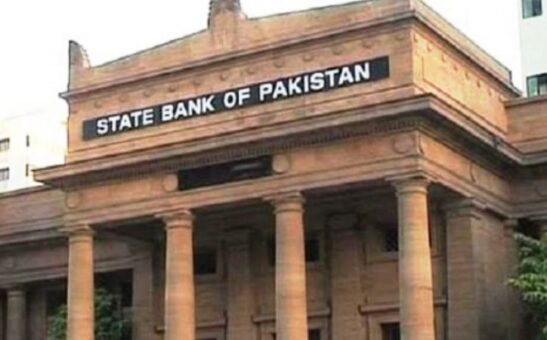
Tag: State Bank of Pakistan

  • Foreign Direct Investment falls by 51.4 percent in nine months

    Foreign Direct Investment falls by 51.4 percent in nine months

    KARACHI: The foreign direct investment (FDI) has declined by 51.4 percent to $1.27 billion during first nine months of current fiscal year as compared with $2.6 billion in the corresponding period of the last fiscal year, according to statistics issued by State Bank of Pakistan (SBP) on Thursday.

    The inflows of FDI fell by 20.9 percent to $2.51 billion during the period under review as compared with of $3.18 billion in the same period of the last fiscal year. While the outflows sharply increased by 121.8 percent to $1.24 billion as compared with $560 million.

    The portfolio investment in the stock market witnessed massive outflow during the first nine months of current fiscal year. The stock market witnessed outflow of $409 million during July – March 2018/2019 as compared with the outflow of $118.6 million in the corresponding period of the last fiscal year, showing sharp decline of 245 percent.

    The foreign private investment with both the component of FED and portfolio investment declined by 65.5 percent to $864 million during first nine months of current fiscal year as compared with $2.5 billion in the same period of the last fiscal year.

    The total foreign private investment after inclusion of foreign public investment witnessed decline of 82.4 percent to $873 million during July – March 2018/2019 as compared with $4.95 billion in the corresponding period of the last fiscal year.

  • Senior citizens allowed investment in national savings on expired CNICs

    Senior citizens allowed investment in national savings on expired CNICs

    KARACHI: The Central Directorate of National Savings (CDNS) has issued directives to its zonal offices, instructing them to follow the policy outlined by the central bank to facilitate older citizens aged 65 years and above in making investments using expired Computerized National Identity Cards (CNICs).

    (more…)
  • Non-acceptance of duty, taxes: SBP launches surprise inspection of bank branches

    Non-acceptance of duty, taxes: SBP launches surprise inspection of bank branches

    KARACHI: State Bank of Pakistan (SBP) has launched surprise inspection of bank branches across the country on complaints received from taxpayers that banks were not accepting duty, taxes through over the counter (OTC).

    In a circular issued on Monday, the SBP said that banks are required to enable their OTC Channel for collection of taxes and duties and advise their branches to comply meticulously with the above instructions.

    “However, despite above clear instructions, the complaints regarding non-acceptance of taxes particularly the mobile levy through banks’ OTC Channel are piling up unabatedly.”

    Federal Board of Revenue (FBR), Pakistan Telecommunication Authority (PTA) and general public reported numerous instances whereby commercial banks are not accepting over the counter payments of Customs Duty and other taxes including mobile levy against PSIDs generated by the WeBoc system.

    “The increasing large number of complaints shows that the branches are still not fully aware of the instructions to collect the taxes and duties through 1Link’s integrated/ enabled OTC facility.”

    The central bank said that the matter was viewed seriously and therefore, it has been decided that SBP would conduct surprise inspection of bank branches across the country, to assess the level of dissemination of information, awareness at branches and compliance of instructions issued by SBP from time to time. “Any violation of above instructions by the branches if detected during surprise inspections i.e. the branches are found not accepting the taxes and duties from the clients approaching them with PSIDs for payment of the taxes and duties would attract strict punitive action including levy of monetary penalty,” the SBP said.

    The SBP directed that keeping in view the above, the branches / Regional Offices must be advised again to ensure meticulous compliance of the instructions and facilitate the taxpayers in payment of taxes and duties.

  • forex reserves deplete by $169m to $17.228bn

    forex reserves deplete by $169m to $17.228bn

    Karachi – The foreign exchange reserves of Pakistan experienced a decline of $169 million, reaching $17.228 billion for the week ended April 5, 2019, according to the State Bank of Pakistan (SBP).

    (more…)
  • SBP sells treasury bills worth Rs415.72 billion at above 11pc cut-off yield

    SBP sells treasury bills worth Rs415.72 billion at above 11pc cut-off yield

    KARACHI: State Bank of Pakistan (SBP) raised an amount of Rs415.72 billion through sale of Market Treasury Bills (MTBs) at an auction held on Wednesday.

    The SBP received bids for three- and six months securities at realized value of Rs2,730 billion at face value of Rs2,799 billion. The central bank did not receive bids for 12-month maturities.

    The bids were mainly received in 3-moth MTBs at realized amount of Rs2,729 billion at face value of Rs2,798.74 billion. The central bank received bids for six-month treasury papers of Rs758 million at face value of Rs800 million.

    The SBP accepted 3-month maturities at realized value of Rs415.58 billion at face value of Rs426.103 billion. The cut-off yield was at 11 percent.

    The central bank accepted bids in six-month maturities of Rs142.14 million at face value of Rs150 million. The cut-off yield was at 11.0899 percent.

    The SBP raised the funds above the auction target of Rs350 billion.

    The cut-off yield is higher than the key policy rate of 10.75 percent.

    Experts said that the banks were anticipating further hike in interest rate in upcoming policy. The expectation of increase in interest rates showed the interest of banks in short-term maturities.

  • Remittances increase to $16.1 billion in July – March

    Remittances increase to $16.1 billion in July – March

    KARACHI: Overseas Pakistani workers have remitted $16.1 billion during first nine months (July – March) 2018/2019 as compared with $14.8 billion in the same period of the last fiscal year, showing 8.74 percent growth.

    State Bank of Pakistan (SBP) on Wednesday said that during March 2019, the inflow of worker’s remittances amounted to US $1745.80 million, which is 10.73 percent higher than February 2019 and 3.20 percent lower than March 2018.

    The country wise details for the month of March 2019 show that inflows from Saudi Arabia, UAE, USA, UK, GCC countries (including Bahrain, Kuwait, Qatar and Oman) and EU countries amounted to US $405.87 million, US $378.14 million, US $271.11 million, US $281.26 million, US $167.80 million and US $44.20 million respectively compared with the inflow of US $427.62 million, US $424.89 million, US $247.17 million, US $258.96 million, US $183.79 million and US $58.91 million respectively in March 2018.

    Remittances received from Malaysia, Norway, Switzerland, Australia, Canada, Japan and other countries during March 2019 amounted to US $197.41 million together as against US $202.26 million received in March 2018.

  • SBP to be given independence for money market discipline

    SBP to be given independence for money market discipline

    ISLAMABAD: The State Bank of Pakistan (SBP) to be given operation and institutional independence for bringing discipline in money market.

    According to ‘Medium-Term Economic Framework’ launched by Finance Minister Asad Umar on Monday, the government is considering giving the SBP greater operation and institutional independence to bring greater discipline in money market and exchange rate regimes.

    It said that the State Bank Act would be amended to further strengthen the autonomy of SBP and clarify its objectives and functions.

    “Specifically, the government, in consultation with SBP and other stakeholders, will finalize proposals to facilitate implementation of flexible inflation targeting as envisage in SBP Vision 2020,” it added.

    The existing exchange rate arrangements and possible limits of government borrowing from SBP will also be clarified in line with prioritizing price stability as an objective of monetary policy.

    The framework said that the exchange rate is one of the most important prices and is determined by underlying economic fundamentals.

    These fundamentals ensure that it would adjust to its equilibrium value over the long run.

    As mentioned earlier, Pakistan’s approach over the last two years to manage the exchange rate was structurally flawed, as it focused more on the overriding desire to avoid unnecessary volatility in the foreign exchange market and avoid fiscal cost of exchange rate adjustment, even when it was needed.

    “This led to persistent overvaluations of rupee contributing to a massive increase in trade and current account deficits; which was the central to the macroeconomic instability faced by the country today.”

    The recent pressures on external fronts are a manifestation of the misaligned exchange rate for the past two years.

    Against this background, the principal idea now is to enshrine an exchange rate policy which enhances competitive of Pakistani exports, by avoiding the persistent overvaluation of rupee.

    Accordingly, the Pakistani rupee has depreciated around 33.4 percent since November 2017. The depreciation has moved the exchange rate to a level, which is more reflective of economy’s medium-term needs and market conditions while at the same time minimizing disorderly fluctuations.

    The near-term goal of this policy is to move towards an exchange rate regime which SOEs not allow overvaluation of rupee on persistent basis.