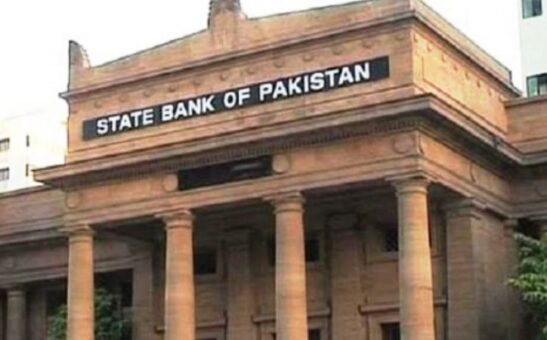
Tag: State Bank of Pakistan

  • SBP launches financing facilities for disable persons

    SBP launches financing facilities for disable persons

    KARACHI: State Bank of Pakistan (SBP) on Tuesday launches a concessionary Small Enterprise Financing and Credit Guarantee Facility for special persons.

    Tariq Bajwa, SBP, governor announced this special facility in the 7th meeting of the National Assembly Standing Committee on Finance, Revenue and Economic Affairs held at State Bank of Pakistan.

    Members of the Standing Committee and senior executives of State Bank of Pakistan were also present on the occasion.

    “Realizing the vulnerability of persons with disabilities in the country and cost associated with their exclusion for the economy, SBP in-line with its priority sector development has devised a scheme for special persons”, said Tariq Bajwa.

    This financing facility is expected to improve access to finance for special persons falling under Small Enterprise (SE) category at a concessional rate of 5 percent per annum.

    Under the scheme, banks and DFIs will provide financing facilities to special persons for establishing new business enterprises or for expansion of existing businesses.

    The SBP will provide refinance to banks/ DFIs up to 100 percent of finance extended by them.

    Special persons can avail financing up to Rs1.5 million for a maximum period of 5 years including grace period of 6 months.

    SBP will also provide risk coverage of 60 percent to banks/DFIs on their outstanding loans under the scheme. This financing facility has been issued with the main objective of improving the socio-economic life of special persons in Pakistan.

    Related Stories
    SBP launches three Sharia compliant refinancing schemes for SMEs

  • SCB Pakistan allowed Chinese Yuan clearing, settlement

    SCB Pakistan allowed Chinese Yuan clearing, settlement

    KARACHI: State Bank of Pakistan (SBP) has allowed Standard Chartered Bank, Pakistan to establish local Chinese Yuan Renminbi (CNY) clearing and settlement setup in the country.

    In a statement on Tuesday, the central banks said that Standard Chartered Bank (SCB) Pakistan can now open CNY accounts of the banks operating in Pakistan to facilitate settlement of CNY based transactions such as remittance to/from China.

    SCB can also provide CNY liquidity to the interbank market for the settlement of CNY based transactions.

    It may be mentioned here that over the years, the SBP has been at the forefront in providing a conducive policy and regulatory environment to encourage the use of local currencies in trade and financing transactions between China and Pakistan.

    Earlier, SBP had also permitted Industrial and Commercial Bank of China Limited (ICBC) Pakistan in 2015 and Bank of China Limited (BOC) Pakistan in 2018 to establish similar local CNY clearing and settlement mechanism in Pakistan.

    The expansion of local CNY clearing and settlement setup in Pakistan is expected to further improve efficiency of the local banking system in transacting in CNY, enhance market liquidity and facilitate rising trade and investment with China through fostering competition and increasing CNY resource avenues.


    Related Stories
    SBP directs banks to maintain depositor-wise database

  • SBP directs banks to maintain depositor-wise database

    SBP directs banks to maintain depositor-wise database

    KARACHI: State Bank of Pakistan (SBP) on Friday directed banks to maintain depositor-wise database in order to ensure reimbursement to genuine protected depositors.

    The SBP in a circular invited the attention of banks on Deposit Protection Corporation Act, 2016 (the Act) and DPC Circular No. 04 dated June 22, 2018 on Deposit Protection Mechanism for Banking Companies.

    The central bank said that Deposit Protection Corporation (DPC) shall pay the guarantee amount to the protected depositors of a member bank in accordance with stipulations under Section 21 of the Act, on a per-depositor per-bank basis.

    Therefore, in order to ensure that the payment of guarantee amount (reimbursement) to genuine protected depositors becomes a seamless process, the timely availability, integrity and reliability of depositors’ information maintained with banks is of utmost importance.

    In view of the above, all member banks are advised to appropriately install or update their systems including software(s)/ database(s) for maintaining a comprehensive depositor-wise database.

    Such database must have the ability to identify, on any given date, all the accounts of any single depositor and calculate the total liability of a bank towards that depositor (including any interest/ profit accrued on his/ her deposits).

    This Management Information System (MIS) will be used by DPC in the event of reimbursement at any given cut-off date.

    Single depositor view shall be achieved, preferably by using a Unique Identification Number that, in case of individuals’ accounts, should also be linked to their Computerized National Identity Cards (CNIC)/ Smart National Identity Cards (SNIC)/ National Identity Card for Oversees Pakistanis (NICOP).

    In addition to identifying all the protected deposit accounts on the required MIS, each member bank is expected to be able to provide information with at least following basic features:

    a) generate data of protected depositors after separately identifying all ‘Exceptions’ given in Section 8 of the Act read with DPC’s Circular Letter No. 01 of 2018;

    b) for foreign currency deposits, the outstanding liability(ies) of the member bank towards each protected depositor, should be convertible to local currency deposits on any given date by feeding a given currency conversion rate into the system;

    c) for a joint account, any outstanding amount should be split between the account holders according to the terms of account opening or equally (in absence of any such terms). In case the deposit is being maintained in favour of one or more third party(ies), the beneficiaries of such deposit shall be identifiable with share of each beneficiary;

    d) for such depositors having one or more accounts in both Conventional and Islamic Banking operations of any member bank, the MIS should be able to calculate;

    i. the total liability of the bank towards such depositor(s),

    ii. separate accumulated liabilities of Conventional and Islamic banking operations of the bank towards that depositor, and

    iii. In case of any combination of deposits as mentioned above, the system should proportionately distribute the guarantee amount so payable (based on the amount of total deposits in respective operations) between outstanding liabilities of Conventional and Islamic operations of the member bank.

    e) as stipulated under Section 20(4) of the Act, any depositor(s) that have their deposits placed under any encumbrance or as collateral should be separately identified along with such deposits/ accounts;

    f) any deposits that are marked as frozen, blocked or dormant or are under any sort of legal action by the order(s) of the court or are under investigation by any investigation agency through a formal communication to the bank shall also be separately identified and reported by the system.

    Based on any or all of the above factors, the system should identify the total payable amount on the basis of total liability towards each protected depositor by applying the formula of total liability of the bank towards each depositor and the guarantee amount (pronounced by the Corporation from time to time), whichever is less.

    The system should be able to generate a separate report assuming the adjustment of guarantee amount payable in the manner prescribed in ‘Para 6’ above and should adjust and settle one or more accounts of each protected depositor by making full settlement of the smallest deposit balance first and moving to the largest deposit(s) of the same depositor.

    Finally, the system should be able to update the information on daily basis and all changes and updates made in the depositors’ information shall be logged. The system’s readiness and efficacy should be tested at regular intervals by the relevant department(s) under the operational risk framework of each bank and also under Business Continuity Planning (BCP) exercise.

    The compliance of the above instructions should be scrutinized by the internal audit of banks. SBP inspection shall assess the system’s readiness and compliance of the overall deposit protection framework.

    Moreover, in case of any eventuality, the bank should be able to generate and provide the afore-mentioned information within a maximum time period of 48 hours of the issuance of notification under Section 21 of the Act.

    In light of the foregoing, all member banks are advised to update their systems accordingly, latest by June 30, 2019 and report the compliance to DPC. Further, all member banks are advised to provide a roadmap/ action plan indicating how they will progress towards above mentioned timeline; and such roadmap must be submitted to DPC latest by April 08, 2019.

    The banks are also required to report the position of depositors (on single depositor-wise basis) to DPC as per enclosed formats, as of June 30, 2019 by July 31, 2019; and onwards on quarterly basis within one month following each quarter-end.

  • Foreign investment declines by 72.5 pc during July – February

    Foreign investment declines by 72.5 pc during July – February

    The inflows of total foreign investment into Pakistan have witnessed a steep decline, plummeting by 72.5 percent to $1.21 billion during the first eight months of the current fiscal year (July – February), compared to $4.42 billion in the corresponding period of the previous fiscal year, according to data released by the State Bank of Pakistan (SBP) on Friday.

    (more…)
  • Banks may verifying goods for manual import payment

    Banks may verifying goods for manual import payment

    KARACHI: Banks shall be required to verify valuation of goods before approving electronic or manual import payment in order to prevent incidents of money laundering and terror financing.

    According to draft “Framework for Managing Risks of Trade Based Money Laundering, Terrorist Financing and Proliferation Financing” issued by State Bank of Pakistan (SBP) banks shall make a reasonable effort to verify the prices of underlying contracts as declared on EIF/MIF, EFE/MFE from reliable sources i.e. local business circles, daily newspaper, Internet, historic appraisements, Customs valuation rulings etc. and shall satisfy themselves that the prices declared by their client represent the fair market value of goods before approving an EIF/MIF, EFE/MFE.

    In the draft framework, the SBP said that transferring value through legitimate trade transactions has become increasingly attractive avenue for money launderers, terrorist financiers and proliferation financiers, as they are able to easily obscure their transactions in significant volumes of international trade and escape detection.

    “The main methods by which such people transfer value through legitimate trade transactions are under invoicing, over invoicing, short/over shipment, obfuscation of type of goods/services etc.” it said.

    As the international trade is becoming highly vulnerable to ML/TF/PF risks, effective regulatory framework is required to mitigate the misuse of trade transactions.

    The SBP said that the document contains instructions that shall help banks in effectively managing ML/TF/PF risks.

    However, it may not be construed as exhaustive list of measures for curbing TBML.

    Further, the compliance of the provisions of this framework does not absolve ADs from their legal and regulatory obligations under prevailing AML/CFT/CPF laws/rules and regulations or any other relevant law for the time being in force.

    The prime objective of this framework is to strengthen the trade related AML/CFT/CPF regime and conserve foreign exchange.

    This framework applies to all banks authorized by SBP to deal in foreign exchange.

    Bank’s AML/CFT/CPF Policies

    i. ADs shall emphasize on the overall trade related risks in their AML/CFT/CPF and relevant trade business guidelines, policies and procedures.

    Such policies and procedures should, inter alia, specify:

    a) Screening procedure of customers for trade transactions

    b) Procedure for identification and monitoring of trade transactions with related party.

    c) Procedure for complete risk profiling of customers involved in or intending to be involved in trade.

    d) Procedure for verification of prices of underlying contracts related to import/export of services.

    e) Procedure for handling descriptions, which are unclear, coded or worded in a language other than English.

    f) Screening procedure of goods being traded as per relevant Trade Policy

    g) Procedure for Identification of dual use of goods such as:

    Price related Due Diligence

    i. Banks shall define clear policies and procedures for price verification, including defining the level of acceptable price variance, escalation procedures and suspicious transaction reporting mechanism when significant differences in prices are identified.

    ii. Banks shall make a reasonable effort to verify the prices of underlying contracts as declared on EIF/MIF, EFE/MFE from reliable sources i.e. local business circles, daily newspaper, Internet, historic appraisements, Customs valuation rulings etc. and shall satisfy themselves that the prices declared by their client represent the fair market value of goods before approving an EIF/MIF, EFE/MFE.

    iii. In case of advance payment export, Banks shall satisfy themselves, before disbursing the amount to the exporter, that price declared on Advance Payment Voucher represents the fair market value of goods or services. In this respect, banks shall require the exporter to submit a copy of underlying sale contract alongwith revised Appendix V-14.

    iv. The procedure of price verification shall be documented by banks for later review /audit/inspection.

    v. In order to enhance the effectiveness, this function shall be performed by the department other than the front office/centralized trade-processing unit where transaction is taking place.

    vi. The significant variance between prices declared on EIF/MIF, EFE/MFE, Advance Payment Voucher and fair market value of goods declared therein shall serve as one of the prime red flag indicators and all such transactions shall be escalated to the higher management which shall review the same and consider the option of filing STR with FMU etc. This procedure shall be documented by banks for later review /audit/inspection.

    vii. Further, banks shall develop the detailed scenarios of other trade related red flag indicators. A non-exhaustive list of common red flag indicators is also provided for guidance.

  • Foreign exchange reserves flat at $14.966 billion

    Foreign exchange reserves flat at $14.966 billion

    KARACHI: The foreign exchange reserves were flat at $14.966 billion by week ended March 08, 2019, State Bank of Pakistan (SBP) said on Thursday.

    The foreign exchange reserves of the country increased by $10 million to $14.965 billion as compared with $14.956 billion a week ago.

    The reserves held by SBP also increased by $6 million to $8.122 billion by week under review from $8.116 billion a week ago.

    The reserves held by commercial banks posted $4 million increase to $6.843 billion from previous week’s level of $6.839 billion.

    Pakistan’s foreign exchange reserves increase by $140 million to $14.956 billion

  • SBP urges SMEs to avail refinance benefits

    SBP urges SMEs to avail refinance benefits

    KARACHI: State Bank of Pakistan (SBP) has urged Small and Medium Enterprises (SMEs) to avail refinance facilities as the central bank put in place number of refinance facilities both for purchase of plant & machinery for SMEs and working capital finance for special sectors.


    While speaking to SMEs, Syed Samar Hasnain, Executive Director, SBP at a meeting with manufacturers and exporters belonging to SME sectors and bankers based in Sialkot on Wednesday, he emphasized that banks have been instructed to inform SMEs about their facilities.

    At the same time, he also urged the SMEs to take a step ahead and approach nearby bank branches to know about SBP’s facilitates available for them.

    Hasnain stated: “In terms of numbers, most of the entities in your region are SMEs. If you want to graduate from indirect exporter to direct exporter, you can modernize and expand your plant and equipment by availing SBP’s refinance facilities for modernization.”

    He encouraged the SMEs to avail SBP’s refinance facility for renewable energy to overcome power problem. Adding further, he said that SMEs can also use SBP’s subsidized refinance facility for setting up silos, cold storage facility and warehouses. Mr. Hasnain assured the SMEs that SBPBSC- Sialkot office will be taking stock of the financing extended to SMEs and progress in this regard will also be monitored closely.

    In a presentation, salient features of SBP’s Policy for Promotion of SME Finance were explained. It highlighted the nine pillars of the policy, namely, i) Improving Regulatory Framework; ii) Upscaling through Microfinance Banks; iii) Risk Mitigation Strategy; iv) Simplified Procedure for SME Financing; v) Program Based Lending & Value Chain Financing; vi) Capacity Building & Awareness Creation; vii) Handholding of SMEs – Non Financial Advisory Service; viii) Leveraging Technology to promote SME Financing; and, ix) Simplifying Taxation Regime for SMEs.

    The meeting/awareness sessions were attended by representatives from associations including Pakistan Sports Goods Manufacturers & Exporters Association, Pakistan Gloves Manufacturers & Exporters Association, Leather Garments Manufacturers & Exporters Association, Pakistan Hosiery Manufacturers & Exporters Association and Pakistan Cutlery & Stainless Utensils Manufacturers and Exporters Association in Sialkot.

    Regional heads, SME heads and branch managers of all banks operating in the region also participated in these meetings. Chief Manger SBP Sialkot was also present on the occasion.

  • SBP allows exemptions, relaxations for housing finance

    SBP allows exemptions, relaxations for housing finance

    KARACHI: The State Bank of Pakistan (SBP) has allowed certain exemptions and relaxations in prudential regulations for promoting low cost housing finance.

    A circular issued a day earlier, the SBP said that in order to promote low cost housing finance in the country, it has been decided to define the low cost housing as part of SBP’s regulatory framework and allow certain regulatory relaxations for banks/DFIs.

    To qualify under low-cost housing finance, the borrower has to fulfill the following criteria:

    • Maximum value of the housing unit/apartment up to Rs3 million

    • Covered area of the housing unit / apartment up to 850 square feet in urban areas

    • Loan size up to Rs2.7 million

    To further encourage and facilitate the Banks/DFIs to pursue low-cost housing finance, regulatory exemptions/relaxations in the following Prudential Regulations (PRs) for housing finance are being advised:

    i. Regulation HF 4: Loan to Value Ratio (LTV): LTV ratio of upto 90:10 shall be maintained for low cost housing finance.

    ii. Regulation HF 5: Limit on Exposure against Real Estate Sector: Financing extended to low cost housing, shall be exempted from exposure limit of 10 percent on real estate sector.

    iii. Regulation HF-7: Property Assessment: For the purpose of financing low cost housing units, banks/DFIs are allowed to apply the valuation of single unit on all the units of the same society/colony instead of conducting separate valuation for each unit constructed on the same layout and size.

    iv. Regulation HF 9: General Reserve against Housing Finance: Banks/DFIs are exempted from general reserve requirement against the financing extended to low cost housing.

    Banks/DFIs have been directed to ensure circulation of these exemptions/relaxations in the regulations for housing finance among all their offices/branches for meticulous compliance in letter and spirit.

  • SBP launches Islamic loan facility for low cost housing

    SBP launches Islamic loan facility for low cost housing

    KARACHI: State Bank of Pakistan (SBP) on Monday launched Sharia compliant loans for low cost housing for special segments.

    In a circular issued by the central bank stated that in order to facilitate availability of long-term affordable funding to some of the selective low income segments, SBP had launched a “Financing Facility for Low Cost Housing for Special Segments” through IH&SMEFD Circular No. 05 of 2019.

    In this regard, SBP is also introducing a Mudarabah based “Islamic Financing Facility for Low Cost Housing for Special Segments” (The Facility) for Islamic Banking Institutions (IBIs) and Islamic DFIs; collectively referred as Participating Islamic Financial Institutions (PIFIs).

    Salient features of the financing facility are as under:

    Participants: All Banks/DFIs

    Loan Amount: Up to Rs. 2.7 million

    Refinance: Up to 100 percent by SBP

    Scope: Widows, Children of martyrs, Special persons, Transgender, and Persons in areas severely affected by terrorism.

    Eligibility of Borrower: First time home owner; Must not have availed housing finance previously; For construction of a new housing unit; Maximum value of the housing unit up to Rs. 3 million; The financing for plot to be purchased for constructing house shall be allowed upto Rs1 million only

    Loan Tenor: Up to 12½ years

    Under this facility, the central bank said that Mudarabah investment of SBP shall be available for up to 100 percent of the amount financed to eligible customers.

    SBP shall make Mudarabah investment in general pool of the PIFI.

    PIFIs may submit their requests for allocation / assignment of limits under this facility to be evaluated by SBP as per its internal criteria. Yearly limits shall be allocated to individual PIFI under the Scheme.

    Applications for sanction of limits for each fiscal year (July-June basis) shall be sent by the interested PIFIs to the Director, Infrastructure, Housing & SME Finance Department, latest by May 15 each year to facilitate sanction of annual limits at the earliest.

    For the current year, the request for sanction of limits may be submitted within 30 days from the date of issuance of this circular.