Karachi, September 20, 2019 – The Pakistani rupee appreciated by 16 paisas against the US dollar on Friday, buoyed by improved inflows of export proceeds and workers’ remittances, according to traders and market analysts.
(more…)Month: September 2019
-
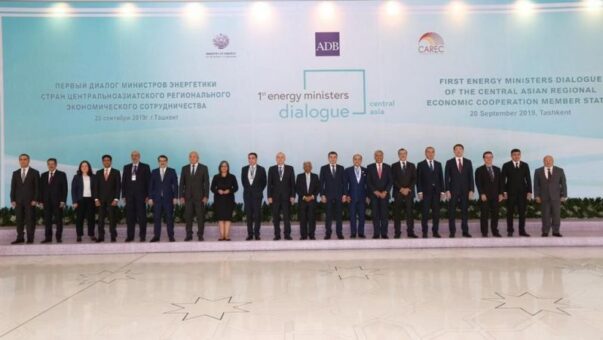
Nine countries sign declaration to enhance cross-border cooperation at CAREC Energy Ministers’ Dialogue
TASHKENT, UZBEKISTAN: Nine countries in Central and West Asia, including Pakistan, on Friday signed a historic declaration that will accelerate cross-border cooperation on energy issues and move the region a step closer to the creation of a regional energy market, said a statement issued by Asian Development Bank (ADB).
Energy ministers and leaders from Afghanistan, Azerbaijan, Georgia, Kazakhstan, the Kyrgyz Republic, Mongolia, Pakistan, Tajikistan, and Uzbekistan signed the 10-point declaration at the end of the Central Asia Regional Economic Cooperation (CAREC) Energy Ministers’ Dialogue held in Tashkent.
The meeting marks the first time energy ministers from Central and West Asia have come together to discuss common regional energy challenges. Uzbekistan’s Minister for Energy, Alisher Sultanov, opened the meeting on behalf of the Prime Minister of Uzbekistan Abdulla Aripov.
The opening address was delivered by Asian Development Bank (ADB) Vice-President for Private Sector Operations and Public–Private Partnerships Mr. Diwakar Gupta. The energy minister from Turkey, Fatih Dönmez, attended the meeting as an observer.
The declaration sets the region on a faster reform path toward more liberal energy markets with greater private sector participation and investment, increased power connections and exchanges between countries, and a strong commitment to tap renewable energy sources and clean technologies.
The group also endorsed a new CAREC Energy Strategy for the next 10 years that will provide the roadmap to reach the region’s goal of a secure energy future.
“This is a historic achievement and an important commitment,” said Gupta. “The energy sector drives economic growth in the region, so this unprecedented gathering of energy leaders is very important. Today, they have strengthened their commitment to work together to deliver an electricity supply for the region that is reliable and affordable, develop modern energy markets, and embrace clean energy as a more efficient, sustainable source of power.”
The meeting of ministers has come at a critical time for the region as its energy sector faces a number of challenges. CAREC countries are rich in natural resources, but uneven distribution of these resources—compounded by inadequate infrastructure and inefficient state-owned energy utilities—means some countries continue to face power shortages. To keep pace with the region’s economic growth and an increasing demand for power, the region will need to double its current power system capacity by 2030. The capacity expansion will require sizable investments, estimated to be about $400 billion in cumulative investments up to 2030.
Regional energy cooperation, modern energy markets, and a significant increase in private investment in the energy sector is an opportunity to overcome these challenges and to create a stable supply of power for domestic use and for export to attractive energy markets in the People’s Republic of China (PRC), Pakistan, and India, along with new strategic transit opportunities for oil and gas through Turkey and Georgia.
Unlocking private sector participation and investments is key to meeting the region’s significant energy infrastructure needs. The declaration committed the region to policy reforms in creating a more conducive business environment for attracting private investments across the region.
“The region cannot achieve the level of investment needed without large private investments,” said ADB Director General for Central and West Asia Werner Liepach. “Private investments demand predictive policies, stable regulations, transparency, and good governance. I am deeply impressed by the CAREC countries’ strong commitments to reforms, which is the only way towards a more reliable, affordable, modern, and sustainable energy future.”
Following the Ministerial Dialogue, officials attended the opening of the 4th CAREC Energy Investment Forum. The 2-day forum aims to unlock and guide private investment in the region’s energy sector and is attended by a mix of energy leaders, policy makers, project developers, technology providers, investors, international financial institutions, members of the diplomatic community, academia, and young entrepreneurs and students.
ADB is the secretariat of the CAREC Program. Since 2001, the CAREC Program has financed 196 regional projects worth $34.5 billion in the areas of transport, energy, and trade in its member countries. Over a third of this amount, or $12.8 billion, has been financed by ADB; $13.8 billion by other development partners such as the World Bank, the Islamic Development Bank, and the European Bank for Reconstruction and Development; and $7.9 billion from CAREC governments. The 11 members of CAREC are Afghanistan, Azerbaijan, the PRC, Georgia, Kazakhstan, the Kyrgyz Republic, Mongolia, Pakistan, Tajikistan, Turkmenistan, and Uzbekistan.
ADB is committed to achieving a prosperous, inclusive, resilient, and sustainable Asia and the Pacific, while sustaining its efforts to eradicate extreme poverty. In 2018, it made commitments of new loans and grants amounting to $21.6 billion. Established in 1966, it is owned by 68 members—49 from the region.
-

PIA’s empty flights cause Rs184 million losses
KARACHI: The Auditor General of Pakistan (AGP) has detected Rs184 million losses due mismanagement by Pakistan International Airlines (PIA) for carrying empty flights.
The AGP in its audit report for PIA Islamabad Office for the year 2016/2016, observed that 46 flights were operated without any passenger, resulting loss of Rs184 million. These flights are other than 36 flights for Hajj and Umrah.
The AGP said that General Manager, Network and Schedule Planning, PG-X(Reporting to Director Marketing) was responsible to supervise and monitor proper designing of long term and short term operating plans; and to focus on network management and evaluation of multiple scenario of schedule changes.
The audit of the view that operation of flight without passenger shows lack of proper planning and control on the part of the management.
“The matter was report to the management in October, 2018 but no reply was received. DAC meeting was not convened despite requests by the audit.”
The AGP recommended to investigate the matter with a view to fix responsibility on the persons at fault.
-
Sales tax registration made mandatory for buyers of ginned cotton
ISLAMABAD: Federal Board of Revenue (FBR) has made sales tax registration mandatory for persons buying ginned cotton.
The FBR issued SRO 1087(I)/2019 and said that the person receiving ginned cotton shall pay sales tax and shall discharged the liability in the following manner:
(a) the recipient of the supply of ginned cotton shall be duly registered under the Sales Tax Act, 1990, and the ginner shall not make any supply of ginned cotton to any person who is not so registered;
(b) the ginner shall issue a tax invoice on the supply of taxable goods under Section 23 of the Sales Tax Act, 1990 indicating the value of taxable supply and the amount of tax due on such supply, along with other particulars as prescribed therein. The ginner shall also file the monthly return in accordance with the rules prescribed under the Act;
(c) the tax invoice shall be issued of the date on which the ginned cotton was dispatched;
(d) the recipient of ginned cotton shall deposit the tax due thereon under a payment challan indicating the name and registration number of supplier, along with the return for tax period in which invoice is issued for the relevant supply;
(e) if the recipient fails to deposit sales tax payable on ginned cotton purchased by him by the due date for the relevant tax period, besides any other action which may be taken against him under the said Act, he shall not be entitled to claim adjustment or refund of input tax in respect of such purchase unless he pays the amount of additional tax or penalties chargeable on such late deposit under Section 33 and 34 of the said Act;
(f) in case the ginner fails to declare the supply of ginned cotton in his return and same is detected during the course of an audit or otherwise, the amount due on such supply shall be recoverable from the ginner in accordance with the provisions of the said Act and the rules made thereunder;
(g) the cases involving non-payment or short-payment of sales tax by a ginner or a recipient on supplies of ginned cotton made under the provisions of this notification shall be adjudicated by the officer having jurisdiction in the area where the contravention is made; and
(h) in case a ginner deposits the tax due on the supply of ginned cotton, the same shall absolve the recipient from liability to pay tax on such supply under this notification.
-
Current account deficit narrows by 54.66 percent in July – August
KARACHI: The current account deficit has sharply declined by 54.66 percent during first two months of current fiscal year owing to significant decline in import bill during the period under review.
According to Balance of Payment (BoP) details issued by the State Bank of Pakistan (SBP) on Thursday, the current account deficit narrowed to $1.292 billion during July – August 2019 as compared with deficit of $2.85 billion in the same period of the last fiscal year.
During the period under review the deficit in trade in goods and service shrank to $4.604 billion as compared with $6.782 billion in the comparative period of the last year.
The exports of goods were at $4.142 billion in July – August 2019/2020 as compared with $4.084 billion in the same period of the last year. On the other hand the import bill significantly declined to $7.704 billion as compared with $10.063 billion in the same period of the last year.
The inflows of workers’ remittances failed to impact balance of payment. The inflows of remittances declined to $3.73 billion in first two months of current fiscal year as compared with $4.071 billion in the same months of the last fiscal year.
Related Stories
Current account deficit narrows by 73 percent to $579 million in July
-
Reform program results encouraging, SBP tells IMF
KARACHI: The State Bank of Pakistan (SBP) has informed the International Monetary Fund (IMF) that initial results from the reform program are encouraging.
SBP Governor Dr. Reza Baqir told a delegation of IMF led by the Director Middle East and Central Asia Department, Jihad Azour on Thursday. He was accompanied by the IMF Mission Chief to Pakistan, Ernesto Ramirez Rigo; Resident Representative of IMF for Pakistan, Ms. Teresa Daban Sanchez; and Special Assistant to the Director of the IMF’s Communications Department, Olga Stankova. The delegation also met with senior management of the SBP.
The SBP governor said that the earlier volatility in the exchange market and associated uncertainty had subsided and confidence was slowly improving.
“Inflation had risen due to the economic imbalances accumulated from previous years but inflationary pressures were expected to recede in the second half of the current fiscal year.”
Nevertheless, the governor emphasized that these were the early stages of the reform process and it was essential to sustain the reform momentum and to keep policies focused on securing stability and promoting sustainable and shared growth.
He noted that Pakistan has embarked on its home-grown economic reform program and said that he looked forward to a continuing fruitful partnership with the IMF and other stakeholders in the international financial community to support this reform program.
He observed that the transition to a market-based exchange rate system, building foreign exchange reserves, and bringing down inflation were key elements of the SBP’s reform program to restore financial stability and lay the foundations for sustainable and shared growth.
In his discussions with the SBP, Azour shared his views on how central banks in the region were responding to the challenges being faced by them particularly with regard to capital flows, the role of technology, and the role of central banks in economic management, amongst other areas.
Azour looked forward to a continuing partnership with the State Bank.
-

Pakistan foreign exchange reserves increase by $148 million to $15.898 billion
KARACHI: The foreign exchange reserves of Pakistan has increased by $148 million to $15.898 billion by week ended September 13, 2019 as compared with $15.75 million a week ago, State Bank of Pakistan (SBP) said on Thursday.
The reserves held by the SBP increased by $138 million to $8.6 billion by week ended September 13, 2019 as compared with $8.462 billion a week ago.
The foreign exchange reserves held by commercial banks increased by $10 million to $7.297 billion by week ended under review as compared with $7.89 billion by week ended September 06, 2019.
Related Stories
Pakistan’s foreign exchange reserves increase by $132 million to $15.751 billion
-
Stock market gains 629 points on buying activity
KARACHI: The stock exchange gained 629 points on Thursday owing to buying activity observed across the board.
The benchmark KSE-100 index of Pakistan Stock Exchange (PSX) closed at 32,184 points as against 31,555 points showing an increase of 629 points.
Analysts at Arif Habib Limited said that the market increased significantly today after a bearish session yesterday.
All in all, the index surged by 680 points after an initial draw down of 80 points in the morning.
Buying activity was observed across the board, but mainly concentrated in Fertilizer, Banks and E&P Sectors.
International crude prices stayed above the levels seen yesterday, which attracted investors to invest in Oil & Gas sector scrips.
Besides, yesterday’s auction of PIBs helped investors take a view on interest rate, which yielded positively on stocks.
Chemical sector led the volumes table with 19.3 million shares, followed by Technology (16.2 million) and Cement (14.4 million). Among scrips, LOTCHEM garnered 15.5 million shares followed by PIBTL (8 million) and TRG (7.8 million).
Sectors contributing to the performance include Fertilizer (+129 points), Banks (+86 points), Power (+82 points), E&P (+74 points) and Cement (+53 points).
Volumes increased significantly from 99.4 million shares to 136.5 million shares (+37 percent DOD). Average traded value also increased by 48 percent to reach US$ 37.7 million as against US$ 25.4 million.
Stocks that contributed significantly to the volumes include LOTCHEM, PIBTL, TRG, MLCF and KEL, which formed 34 percent of total volumes.
Stocks that contributed positively include ENGRO (+81 points), HUBC (+70 points), LUCK (+36 points), PPL (+35 points) and HBL (+32 points). Stocks that contributed negatively include FABL (-3 points), AKBL (-1 points), ICI (-1 points), LOTCEHM (-1 points), and BWCL (-1 points).
Related Stories
Stock market ends down by 353 points on easing international oil prices
-
Rupee ends flat against dollar
KARACHI: The Pak Rupee ended flat against dollar on Thursday amid higher demand for import and corporate payments.
The rupee ended Rs156.25 to the dollar from previous day’s closing of Rs156.24 in interbank foreign exchange market.
Currency experts said that demand for dollar was higher earlier in the day but inflows kept the local currency stable.
The foreign currency market was opened in the range of Rs156.30-156.40. The market recorded day high of Rs156.35 and low of Rs156.20 and ended at Rs156.25.
The exchange rate in open market also witnessed stable value of the local currency. The buying and selling of dollar was recorded at Rs155.80/Rs156.30, the same previous day’s closing in cash ready market.
Related Stories
-

Any person can takeover imported goods by offering higher customs value
KARACHI: In order to prevent under-invoicing and mis-declaration the customs authorities have powers to accept offer from any person to allow clearance at higher value than the declared by an importer for the same consignment.
The Customs Act, 1969 has authorized the customs officials to allow such offer under Section 25C of the Act to takeover the imported goods.
Section 25: Power to takeover the imported goods
Sub-Section (1): If any person makes an offer in writing to buy the imported goods sought to be cleared at value declared by an importer in the goods declaration, and the Collector of Customs is satisfied that the declared value is not the actual transactional value, he may after approval of the Board order the following without prejudice to any other action against the importer or his authorized agent, namely:-
(i) entertain offer by any other person to buy these goods at substantially higher value than the declared customs value in the goods declaration and payment of customs duties and other leviable taxes thereon, provided such offer is accompanied by a pay order equal to twenty-five per cent of the amount of each such offer and duties and other taxes calculated in accordance with the offer;
(ii) give an option in writing to the importer of such goods for clearance of imported goods at the customs value equal to such highest offer for purchase of goods and payment of customs duties and other taxes chargeable thereon; and
(iii) in case the importer fails to clear the imported goods within seven days of the receipt of notice under clause (ii) above, the appropriate officer may takeover the goods on payment of customs value declared in the goods declaration and an amount equal to five per cent of such declared value;
Sub-Section (2): The imported goods taken over under sub-section (1) shall be delivered to the offerer on submission of two pay orders, one equal to the customs value declared in the goods declaration plus five per cent in the name of importer and the other pay order equal to the remaining amount of value of imported goods and the amount of customs duties and other taxes leviable on the imported goods in the name of Collector of Customs;
Sub-Section (3): In case the local buyer fails to take the delivery of the goods on payment of value and taxes as prescribed in sub-section (2) above, the pay order equal to twenty-five per cent of the amount shall be fore-feited in favour of the Federal Government and imported goods shall be released to the importer as per customs value determined under sections 25 or 25A as the case may be.