Month: January 2021

  • FBR launches mega crackdown against illegal petrol pumps

    FBR launches mega crackdown against illegal petrol pumps

    ISLAMABAD: Federal Board of Revenue (FBR) has launched massive crackdown against illegal petrol pumps from Monday (January 11, 2021) on the directives of Prime Minister Imran Khan.

    Prime Minister Imran Khan in a recent meeting directed the FBR and relevant authorities to initiate harsh action illegal petrol pumps selling smuggled petroleum products.

    The FBR in this regard wrote letters to Chief Secretaries of all the provinces, chairman Oil and Gas Regulatory Authority (OGRA), Inspector General of all the provinces and chief collectors of Pakistan Customs about initiating the crackdown from January 11, 2021.

    The FBR is going to launch action including on-ground checking and scrutiny of requisite documentary enforcement team during operation with the help of Pakistan Customs, District Administration, Police etc.

    A FBR notification said that during the course of operation the enforcement teams would enquire from the owner/manager of the retail outlet to present following documents:

    1. Oil Marketing Companies (OMC) authorization/dealership
    2. Form-K

    In case of non-production of requisite documents, following further steps shall be taken by the team:

    1. Failure to produce both these documents shall render the outlets ‘illegal and unauthorized’ and the POL products present there shall be deemed to have been smuggled or illegally acquired as per The Customs Act, 1969, The OGRA Ordinance, 2002 and Rules made thereunder.
    2. Inventorization of POL will be carried out as per details given in para 6.
    3. Customs officials shall serve the owner/manager of the POL outlet notices under Section 3(kk) and Section 26 of the Customs Act, 1969 to bring forth any legal document establishing the legality of the sale outlet within 7 days.
    4. In case, no one is available at the premises, the notices shall be posted on the doors/walls of the office/building.
    5. After service of notice under Section 2(kk), the POL products will be deemed ‘detained’ pending production of requisite documents by the owner, if any and its verification by customs.
    6. The illegal POL outlet will be sealed by District Administration as per para 5(c) and Police force shall be deployed immediately to safeguard the detained goods and premises till the finalization of the proceedings.

    In case, the process of documentary scrutiny or in the absence of any lawful document, confirms that the petrol pumps, outlet is illegal, the district administration shall seal the premises of the petrol pump under Section 43A of Pakistan Petroleum (Refining, Blending and Marketing) Rules, 1971 made by Minister of Petroleum.

    In case, if the premises of illegal outlet has been closed or found abandoned but it has been used previously as illegal petrol station, the same shall be sealed and the owner/manager shall be proceeded against by District Administration for violation of The Petroleum Act, 1934, the OGRA Ordinance, 2002 and Rules made thereunder.

  • PM reviews ongoing tax reforms

    PM reviews ongoing tax reforms

    ISLAMABAD: Prime Minister Imran Khan reviewed ongoing tax reforms program in the country which resulted in significant revenue collection during the first half of the current fiscal year, a statement said on Sunday.

    Prime Minister Imran Khan was told that tax receipts had surpassed Rs2,205 billion during first six months of current fiscal, manifesting the fruition of government’s taxation reforms.

    Chairing a meeting to review the tax reforms, the prime minister was briefed that owing to tax reforms, a growth in number of taxpayers had been witnessed.

    Federal Minister Abdul Hafeez Shaikh, Shibli Faraz and Hammad Azhar, Advisor to PM Dr. Ishrat Hussain, Special Assistant on Revenue Dr. Waqar Masood, Chairman of Federal Board of Revenue Javed Ghani and relevant senior officers attended the meeting.

    It was told that the tax collection was being automated and taxpayers were being given incentives.

    The automation of the taxation system would enhance transparency and reduce corruption and tax evasion.

    The meeting was told that tax form had been made far easier for the small and medium enterprises by reducing its pages from five to one and entries from 200 to just 24.

    The prime minister was told that owing to the introduction of direct link between FBR’s system and company through point of sale system, the receipt of sales tax had also increased.

    The prime minister appreciated the federal ministers, SAPM on revenue and FBR chairman for bringing about taxation reforms.

    He viewed that the taxpayers were in fact the benefactors for the country who deserved applause.

    Moreover, he also called for measures to introduce measures for encouragement of the taxpayers.

  • E-payment made mandatory for duty, taxes above Rs one million for customs clearance

    E-payment made mandatory for duty, taxes above Rs one million for customs clearance

    KARACHI: Pakistan Customs has announced that payment of duty and taxes above Rs one million will only be made electronically (Alternate Deliver Channels).

    According to an announcement on Saturday, consignments through WeBOC system will be cleared on e-payment of duty and taxes above Rs one million. The payment threshold shall apply from January 15, 2021.

    Pakistan Customs said that Payment System is a modern way of collecting tax payments through internet. Banks, Taxpayers, Withholding Agents and e-Intermediaries are beneficiaries of this system. Taxpayers can create their electronic payments from anywhere and can also schedule their payments to be credited to Government of Pakistan (GoP) accounts on any future dates.

    Payment System decreases the workload on Bank staff. Payments made through PAYSYS are instantly communicated to electronic systems of FBR and Banks. It’s very easy to use this system and generate various informative reports for daily branch level operations. Payment System provides you electronic payment documents in hard copy as well as electronic copy in PDF format for subsequent utilization.

    Following are the E-Payment System overview in general terms:

     Round-the-clock facility is being provided to importers / exporters to pay Customs Duties, taxes and other dues electronically from their bank accounts through internet banking and automated teller machines (ATM) for clearance of consignments through WeBOC system.

     Trader/Clearing Agent shall login to WeBOC system for filing of Goods Declaration in WeBOC.

     Trader/Clearing Agent will click on the “Submit” button of Goods Declaration. Upon click on the Submit button system will display the Goods Declaration Payment Information Screen to Trader/Clearing Agent.

     In the drop down menu for Payment Mode, the Trader/Clearing Agent shall select the Payment Mode of “E-Payment” and click on the “Submit” button. Upon click on the submit button, WeBOC system will submit the GD successfully and display the link “Pay duty and taxes via 1Link”.

     Trader/Clearing Agent will click on the above link and WeBOC system will generate a unique 20 digit Payment Slip ID (PSID). The system will display the duty and taxes breakup along with PSID.

     The trader shall login to the online banking system of his bank through computer or mobile phone or visit ATM facility. The bill payment screen of the bank shall reflect “FBR” as biller. The trader shall click the option “FBR”. The bank / ATM screen shall require the trader to enter PSID generated by WeBOC system.

     By entering PSID, the payment details shall be visible to the trader for approval of the payment of duty & taxes. Upon confirmation, the bank account of trader shall be debited and a message of successful transaction shall be visible on the screen.

     WeBOC system will accordingly process the Goods Declaration filed by the trader.

     For any subsequent payment of dues in relation to the processing of Goods Declaration as a result of any reassessment made by Customs, the trader shall click “Payment Management” from his WeBOC home screen and click the link “Pay duty and taxes via 1Link”. A sub menu “Payment against GD” shall be opened. Upon clicking the same, a new screen shall appear in which option will be available to search GD against which payment is require to be made. Upon clicking the specific GD, the system will provide “Generate PSID” option. Upon clicking the same, a new unique PSID shall be generated which can be utilized by the trader to pay duty / taxes in the same manner.

     On the basis of unique transaction ID issued by the SBP/BSC, WeBOC will issue e-CPR to importer / tax payer through WeBOC System.

  • Customs valuation issued for Afghan origin goods

    Customs valuation issued for Afghan origin goods

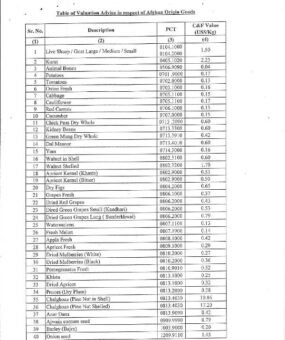
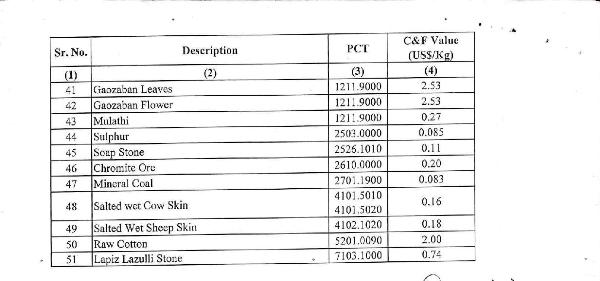
    KARACHI: The Directorate General of Customs Valuation has issued valuation advice for Afghan origin goods on recommendations received from Peshawar and Quetta collectorates.

    Previously a valuation advice was issued on December 12, 2020 in the light of values worked out and recommendations by MCC (Appraisement and Facilitation), Peshawar and Quetta, for Afghan origin goods imported via land route and cleared by said collectorates.

    “However, both the collectorates approached the directorate and proposed new values for certain items, agreed and worked out by them and requested for modification of valuation advice accordingly.”

    The directorate said that the new valuation advice has been issued on December 31, 2020 for a period of three months and the values are only for the purpose of assessment of duty and taxes for Afghan origin goods.

    Following is the valuation advice:

  • Federal Budget 2021/2022 to be announced during first week of June

    Federal Budget 2021/2022 to be announced during first week of June

    ISLAMABAD: The government on Saturday said it will present the federal budget 2021/2022 before the Parliament during the first week of June 2021.

    According to the budget call circular issued by the finance ministry, the presentation of budget to the cabinet and the parliament would be in the first week of June 2021.

    The finance division shall complete all budget documents, schedules and summaries for the cabinet by end of May 2021.

    The ministry issued timelines for budget preparation process under which by March 15, 2021 PAOs would provide revised estimates for current fiscal year and budget estimates for 2021/2022 for federal government receipts. On the same date PAOs will also be required to forward budget proposals relating to tax and non-tax revenues for inclusion in Finance Bill 2021/2022.

    The PAOs will also comply March 15, 2021 for submission of current and development expenditure budget estimates.

    The finance division shall finalize development of budget strategy paper by second week of March 2021. The budget strategy paper shall be submitted to the cabinet by first week of April 2021.

    APCC and NEC may hold meeting in April 2021.

    Submission of NO/NIS forms for current budget shall be by April 26 to May 14, 2021.

    Submission of BO/NIS Forms by ministries / divisions for development budget during May 10 –21, 2021.

  • Three years imprisonment for sales tax registration failure

    Three years imprisonment for sales tax registration failure

    ISLAMABAD: A person who makes taxable supplies but fails to get sales tax registration shall be liable to pay fine and penalties besides the person is also liable to imprisonment up to three years.

    Sources in the Federal Board of Revenue (FBR) said that the tax offices had launched operations to identify persons making taxable supplies but are not in the sales tax net.

    The sources said that under Sales Tax Act, 1990, any person who is required to apply for registration under the Act fails to make an application for registration before making taxable supplies:

    “Such person shall pay a penalty of Rs10,000 or five percent of the amount of tax involved, whichever is higher;

    “Provided that such person who is required to get himself registered under this Act, fails to get registered within sixty days of the commencement of taxable activity, he shall, further be liable, upon conviction by a Special Judge, to imprisonment for a term which may extend to three years, or with fine which may extend to an amount equal to amount of tax involved, or with both.”

    Section 14 of the Sales Tax Act, 1990 requires a person to get registration under this Act, who is making taxable services.

    Following is the tax of the Section 14:

    Section 14: Registration

    (1) Every person engaged in making taxable supplies in Pakistan, including zero-rated supplies, in the course or furtherance of any taxable activity carried on by him, falling in any of the following categories, if not already registered, is required to be registered under this Act, namely:-

    (a) a manufacturer who is not running a cottage industry;

    (b) a retailer who is liable to pay sales tax under the Act or rules made thereunder, excluding such retailer required to pay sales tax through his electricity bill under sub-section (9) of section 3;

    (c) an importer;

    (d) an exporter who intends to obtain sales tax refund against his zero-rated supplies;

    (e) a wholesaler, dealer or distributor; and

    (f) a person who is required, under any other Federal law or Provincial law, to be registered for the purpose of any duty or tax collected or paid as if it were a levy of sales tax to be collected under the Act.

    (2) Persons not engaged in making taxable supplies in Pakistan, if required to be registered for making imports or exports, or under any provisions of the Act, or any other Federal law, may apply for registration.

    (3) The registration under this Act shall be regulated in such manner as the Board may, by notification in the official Gazette, prescribe.

  • Weekly Review: Bull Run likely to continue

    Weekly Review: Bull Run likely to continue

    The Pakistan stock market is anticipated to continue its bullish trend in the upcoming week, spurred by promising advancements on the COVID-19 vaccine front and its gradual rollout globally, which are expected to maintain strong investor interest in equities.

    (more…)
  • Committee to review tax structure for stock market

    Committee to review tax structure for stock market

    ISLAMABAD: Federal Board of Revenue (FBR) on Friday set up a consultative committee to review tax structure for stock market.

    The FBR constituted the consultative committee on capital markets tax reforms, which comprising following members:

    Member Inland Revenue Policy, FBR as chairman

    Shauzab Ali, Commissioner Securities Market Division, SECP as Member

    Farrukh H. Khan, Chief Executive Officer, PSX as Member

    Ahmed Ali Mitha, Chief Financial Officer, PSX as Member

    Chief (Income Tax Policy), FBR as Secretary.

    According to the terms of reference for the committee, it shall act as a forum till budget making exercise for the year 2021/2022, to review tax policies and suggest specific short-term and medium to long term measures for the development of debt and equity market, commodity futures, mutual funds, REITs, corporate and insurance sector, amongst others.

    Broadly it will review and recommend all measures that impinge upon the capital markets and its stakeholders.

    The committee may invite proposals from relevant stakeholders, deliberate and finalize tax reforms in the aforementioned areas.

    The proposals shall be categorized into immediate, medium term and long-term reforms and shall accordingly be prioritized.

    First report of the committee shall be submitted to the FBR within 20 days of its constitution.

    The FBR said that necessary amendments to the tax laws shall be initiated in consultation with the committee for implementation of the agreed proposals.

  • FMU prepares red flags for real estate agents to report suspicious transactions

    FMU prepares red flags for real estate agents to report suspicious transactions

    KARACHI: Financial Monitoring Unit (FMU) has prepared red flags indicators for real estate agents to report suspicious transactions related sales and purchase of immovable properties for prevent money laundering and terror financing.

    According to the FMU, Under Section 7(1) of Anti-Money Laundering (AML) Act 2010 which states that reporting entities including Real Estate Agents, property dealers / brokers, housing authorities, and builders and developers are required to promptly report Suspicious Transaction Report (STR) for transaction conducted or attempted, at their counter or through such real estate agents/developers, if it knows, suspects or has reason to suspect that the transaction or a pattern of transactions of which the transaction:

    (a) involves funds derived from illegal activities or is intended or conducted in order to hide or disguise proceeds of crime.

    (b) is designed to evade any requirements of this section

    (c) has no apparent lawful purpose after examining the available facts, including the background and possible purpose of the transaction; or

    (d) involves financing of terrorism, including fund collected, provided, used or meant for, or otherwise linked or related to, terrorism, terrorist acts or organizations and individuals concerned with terrorism.

    In order to identify a suspicion that could be indicative of Money Laundering (ML) or Terrorism Financing (TF), FMU has prepared the red flags indicators that are specially intended as an aid for the real estate sector.

    These red flags may appear suspicious on their own; however, it may be considered that a single red flag would not be a clear indicator of potential ML / TF activity.

    However, a combination of these red flags, in addition to analysis of overall financial activity and client profile may indicate a potential ML / TF activity.

    Red Flags for Purchaser/Seller Behavior:

    —  Purchaser/Seller’s economic profile does not align with the cost of the property.

    —  Source of funds cannot be identified or is unclear.

    —  Client or transaction is from country or jurisdiction in relation to which the FATF has called for countermeasures or enhanced client due diligence measures or jurisdiction known to have inadequate measures to prevent money laundering and the financing of terrorism.

    —  The client or any of its associated person / entity found positive match while screening against UN Security Council Resolutions (UNSCRs).

    —  Purchaser / Seller is linked to negative news or named in a news report on a crime committed or under Law Enforcement investigation/inquiry).

    —  The use of intermediaries who are not subject to adequate AML/CFT laws and measures and who are not adequately supervised.

    —  Client insists on using an intermediary (either professional or informal) in all interactions during transactions without sufficient justification.

    —  Clients who appear to be acting on somebody else’s instructions without disclosing the identity of such person.

    —  Unexplained delegation of authority by the client by using powers of attorney.

    —  Purchaser/Seller appears to be acting as proxies for the purchase of the properties and makes attempts to conceal the identity of the beneficial owner.

    —  Purchaser buys property in the name of a nominee such as an associate or a relative (other than a spouse or child), or on behalf of minors or other persons who lack the economic capacity to carry out such purchases or on behalf of Politically exposed person (PEP).

    —  Political exposed client who is linked to negative news / crime or any client who is family member or close associate of such political exposed person.

    —  Purchaser/Seller provides an address that is unknown, believed to be false, or simply a correspondence address, e.g. a post office box number which might not provide details of the actual address.

    —  Purchaser/Seller is suspected to be using forged, fraudulent or false identity documents for due diligence and record keeping purposes.

    —  Significant and unexplained geographic distance between the agent and the purchaser/seller during the sale.

    —  Purchaser/ Seller appears unconcerned about the economic or investment value of the property he/she is purchasing /selling or associated commissions and fees.

    —  Purchaser buys property without making any attempt to inspect or review the brochure or marketing material of the property.

    —  Purchaser/seller respectively buys/sells multiple properties in a short time period and seems to have less concerns about the location and price of each property.

    —  Purchaser/seller seems very keen about AML/CFT reporting threshold requirements.

    —  Purchaser/seller is a shell company or trust and representatives of the company refuse to disclose the identity of the beneficial owners.

    —  Purchaser’s known business activity and purpose do not match the real estate transaction, e.g. purchaser is a non-profit organisation but the property is purchased for investment which requires a large loan.

    —  Purchaser/Seller appears hesitant or declines to put his name on any documents that would connect him with the property.

    —  Purchaser/Seller appears to be using business funds for personal use, or vice versa.

    —  Recording the sale of a vacant land and the sale of a newly completed in building in less time than construction would normally take.

    Red Flags for Transactional Patterns:

    —  Payments from purchaser are financed by an unusual source, e.g. from an offshore bank located in a jurisdiction identified as high-risk and non-cooperative by FATF.

    —  Transaction, whether property is sold directly by a developer or sold in a sub-sale by a purchaser, is entered into at a value significantly different (much higher or much lower) from the real or market value of the property.

    —  Purchaser pays the initial deposit with a cheque from a third party, other than a spouse or parent.

    —  Payment for purchase was done through multiple cash transactions and paid direct to the project account or Seller insisted to get the huge payments in cash only.

    —  Speed of the transaction (transactions that are unduly expedited without a reasonable explanation may be higher risk).

    —  Use of complex loans, or other obscure means of finance, versus loans from regulated financial institutions.


  • PM inaugurates special technology zone authority

    PM inaugurates special technology zone authority

    ISLAMABAD: Prime Minister Imran Khan on Friday said special technology zone authority will serve to create a space for foreign investors.

    At the launching ceremony of Special Technology Zone Authority (STZA), the prime minister said that the authority would serve to create a space for foreign investors, indigeneous companies and educational and training institutes to collaborate for Information Technology driven industrial revolution in Pakistan.

    Amer Ahmed Hashmi has been appointed the Chairman of the Authority who on the occasion lauded the Prime Minister for taking personal interest in prioritization of STZA’s establishment.

    The launch marks the beginning of an era of dedicated and integrated national knowledge-based ecosystem in Pakistan.

    The specific mandate of STZA is to lead the development of Special Technology Zones (STZs) in the country. The zones will help increase high-tech exports of Pakistan and facilitate technology transfer from major global Science and Technology hubs.

    Chairman STZA said that the zones will foster skills development, job creation, technology transfer and new economic value generation.

    Industrial clusters formation has not only led to rapid industrialization and social development of countries like China, Japan, and South Korea, but have become the global best practice for high-speed growth and development.

    The Prime Minister said that collaborative efforts and correct course of comprehensive national development through these STZs will lead to the utilization of the immense potential of the youth of Pakistan.