Author: Mrs. Anjum Shahnawaz

  • FBR issues procedure for sealing of transit cargo destined for India

    FBR issues procedure for sealing of transit cargo destined for India

    KARACHI: Federal Board of Revenue (FBR) has issued procedure for sealing of transit trade cargo containers at Torkham-Peshawar and Chaman-Quetta, destined for Wahga border station for India.

    Following procedure to be adopted under Customs General Order (CGO) No. 03 of 2020 under Pakistan Customs Container Security System (PCCSS) Procedure for sealing and desealing of transshipment, safe transportation, transit and export cargo.

    (a) NON-CONTAINERIZED CARGO:

    FIRST PORTION:

    (i) After the goods, loaded in high wall Transport Unit (1st Transport Unit) of Afghanistan been processed as per rules by Torkham/Chaman Customers, the Transport Unit will be secured and covered in proper tarpaulin. The PCCSS staff Focal point (Entry) will enter the required data and apply the wire punch plomb seal or a wire seal. The container will be allowed to proceed to Peshawar/Quetta Dry Port under escort. The escort officer of Customs will carry he convoy note to Peshawar/Quetta Dry Port.

    (ii) On arrival at Customs Dryport Quetta/Peshawar, the 1st Transport Unit will be moved to the Focal Point Exit. The escort officer of customs will hand over the convoy note to the PCCSS officer.

    (iii) The PCCSS will enter the exact time and date of the arrival. In case the Transport Unit reaches within time, the PCCSS officer will inspect the truck and security of tarpaulin ad the registration number of the 1st Transport Unit and check the PCCSS wire punch plomb seal.

    (iv) After satisfying himself that the seal and container are intact and not tampered, the PCCSS officer will generate discharge note which will be given to the Customs escort officer along with the convoy note.

    (v) If the seal or container etc. is not found intact or there are reasons to doubt the integrity of cargo or seal, a discrepancy report will be filled out on the computer. The concerned PCCSS focal point will also report the matter to the Directorate of Transit Trade having jurisdiction for initiating necessary action under the law.

    (vi) The Focal Point Exit Peshawar staff will cut and collect the used plomb seals and keep in a safe disposal box. The Incharge FP (Exit) will make arrangements for the proper disposal, recycling of the plomb seals.

    (vii) The escort will return the convoy note to the Customs at Border Crossing Point.

    SECOND PORTION:

    (i) The goods will be loaded on the Pakistani trucks, hereinafter called the Second Transport Unit and released in the same as done at Border Crossing Point, with wire punch plomb seal or new wire seal by the Focal Point Entry staff at Peshawar/Quetta.

    (ii) On arrival at Wahga border station, the Second Transport Unit will be moved to the Focal Point Exit and the escort officer of Customs will hand over the convoy note to the PCCSS officer.

    (iii) The PCCSS officer will enter the exact time and date of the arrival. In case the Transport Unit reaches within time, the PCCSS officer will inspect the truck and security of the tarpaulin cover, check the registration number of the Second Transport Unit and the PCCSS wire punch plomb seal.

    (iv) After satisfying himself that the seal and container are intact and not tampered, the PCCSS- officer will generate discharge note which will be given to the Customs escort officer alongwith the convoy note.

    (v) If the seal or container etc. is not found intact or there are reasons to doubt the integrity of cargo or seal, a discrepancy report will be filled out on the computer. The concerned PCCSS focal point will also report the matter to the Directorate of Transit Trade having jurisdiction of initiating necessary action under the law.

    (vi) The Focal Point Exit Wahga staff will cut and collect the used plomb seals and keep in a safe disposal box. The In charge FP (Exit) will make arrangements for the proper disposal, recycling of the plomb seals.


  • Sindh releases over Rs2 billion for coronavirus emergency funds

    Sindh releases over Rs2 billion for coronavirus emergency funds

    KARACHI: The Sindh government has released an amount of over Rs2 billion under coronavirus emergency fund, which included funds for filed isolation center and distribution of ration.

    According to details released by Sindh Finance Department regarding expenses issued date April 24, 2020 to dilute the economic impact of coronavirus and fight against the pandemic.

    The details showed that an amount of Rs1.08 billion has been spent as special grant for distribution of ration to poor. The provincial government has spent Rs580 million for disbursement to all Deputy Commissioners (DCs) for distribution of ration to daily wagers.

    Another amount of Rs500 million has been disbursed to all the DCs for distribution of ration to poor/ daily wages who are economically affected by spread of coronavirus.

    The provincial government released an amount of Rs300.79 million to Indus Hospital Karachi.  While another amount of Rs100 million has been released to director health services Hyderabad.

    The Sindh government released fund of Rs134 million for setting up field isolation centre at Expo Center Karachi.

    An amount of Rs30 million has been released for procurement of coronavirus rapid test kits. Further Rs50 million has been released for procurement of 2000 detection Kit CE-IVD marked Cat No. Z-Path. The provincial government also released an amount of Rs32.34 million for procurement of personal protection equipment (PPE).

    An amount of Rs50 million has been released to health department secretariat. The provincial government issued funds amounting Rs50 million to DC Malir Karachi, Rs60 to DC Sukkur and Rs5 million to DC Larkana.

  • NEPRA examines power audit report to secure consumers interest

    NEPRA examines power audit report to secure consumers interest

    ISLAMABAD:  National Electric Power Regulatory Authority (NEPRA) has decided to examine the power sector audit report and said that it will take every step to secure consumers’ interest.

    In a statement issued on Saturday the regulator said that it is examining the recently released final Report by the Committee for power sector audit, circular debt resolution and future roadmap.

    “The report has never been shared with the NEPRA Authority before despite a clear agreement on the onset with the Convener of the Committee,” it said.

    NEPRA has constituted a team of experts to examine the report so as to prepare NEPRA’s detailed response and suggest suitable actions thereof. “NEPRA will take every action within its powers to ensure that consumer interest has not been compromised by carefully looking into any misrepresentation of facts and figures by any IPP as suggested in the report.”

    NEPRA determines tariff as per the Council of Common Interest (CCI) approved Government policy and after carrying out quasi-judicial proceedings in an open and transparent manner.

    Public hearings are held and participated by all the stakeholders including Government/ power sector representatives, industry experts, members of the civil society, media and legal experts.

    Every single word during public hearing is recorded and verbatim transcript is maintained for any future reference.

    NEPRA functions in the most professional manner, maintains the highest level of integrity and professional competence, duly acknowledged by local and international agencies.

    “Earlier in Feb 2019, on reports of earning excessive profit by certain RFO based plants, NEPRA proceeded with the Suo Moto and issued notices against five RFO based plants namely (Nishat Power Limited, Nishat Chunian Power Limited, Atlas Power Limited, Attock Gen Limited, Liberty Power Tech Limited), according to the statement.

    However, further proceedings were held up due to a restraining order issued by Honorable Islamabad High Court (IHC). Meanwhile, NEPRA is pursuing the case vigorously and it is likely to be decided shortly.

    It is further emphasized that consumers’ interest is prime for NEPRA and we assure to do everything within our powers to safeguard it.

  • Think tank discusses viability of reducing GST to five percent

    Think tank discusses viability of reducing GST to five percent

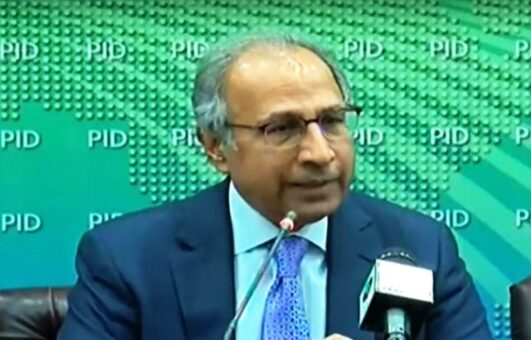
    ISLAMABAD: The second meeting of think tank on Saturday discussed the viability of reducing General Sales Tax (GST) from existing 17 percent to five percent on consumer goods to kick start consumer spending.

    Advisor to the Prime Minister on Finance and Revenue Dr. Abdul Hafeez Sheikh chaired the 2nd meeting of the Thinktank, recently constituted under the directions of Prime Minister, to deliberate on the Covid-19 related economic downturn and mitigation of ensuing risks.

    The forum discussed the need and scope for bailout package for large businesses and exporters apart from gauging the viability of reduction of GST on consumer goods, from 17 percent to 5 percent, to kick-start consumer spending for next two years.

    The constraints of FBR amid high revenue targets in a shrinking economy were highlighted by Finance Secretary. Decision in this regard would be made after detailed consultations.

    The forum has been mandated to provide platform for collective thinking on the emerging situation resulting from the Covid-19 related medical crisis and its spillover to economy.

    Its other members include Shaukat Tareen, Dr. Ishrat Husain, Dr. Ijaz Nabi, Sultan Ali Allana, Arif Habib, Dr. Waqar Masood. Advisor to PM on Commerce and Finance Secretary are also part of it.

    After extensive deliberations on emerging themes, the forum identified key areas for policy interventions, including monetary affairs and banking sector, fiscal matters and public finances, social safety nets, SMEs and large businesses, commodity prices, public health challenges and role of private sector and NGOs.

    Advisor to PM on Finance apprised the forum about developments at G-20 forum regarding debt relief package. There is potential for USD 1.8 billion debt deferment for one year under this, whereas proceeds worth USD 1.4 billion under IMF have already been received.

    Participants highlighted the need for further downward revision in policy rate coupled with passing on the benefits of slashed oil prices in global market to public. The focus of the deliberations remained on strengthening of aggregate demand and supply of the economy, with emphasis on lower income groups and small firms.

    Need for further liquidity for banks was discussed as strong and vibrant banking sector is essential to boost economy under such strong recessionary headwinds. Ways to further encourage remittances, agriculture financing and timely lifting of crops and vegetables from small farmers were analyzed.

    The progress of ongoing cash disbursements under Ehsas program were shared. The need for gathering reliable data on recently laid-off works and timely cash transfers to the most vulnerable were emphasized.

    Economists within the Think-tank stressed for the need of designing PSDP to facilitate labor intensive projects apart form crafting robust agriculture financing plans. The need for public private partnerships was elaborated to create fiscal space within public sector through these off-balance sheet financing arrangements which encourage private sector participation in public sector initiatives.

    Professionals within group stressed for the need of oil price hedging, power sector debt securitization and creation of fiscal space through rescheduling of foreign and domestic debts. The need for designing lending programs for housing sector participants came under consideration including facilitation of end-users. The massive scope for mortgage backed financing in Pakistan was also highlighted.

    Advisor to PM on Finance and Revenue took lead in picking most urgent themes for proper policy deliberations and decisions.

    He shared that Prime Minster of Pakistan may participate in the next session to give boost to the work of this Forum which has been constituted to provide intellectual and professional insights to the Ministry in designing and implementing incentives for economy in pragmatic fashion.

    Advisor decided that interventions with highest, medium and low impacts would be sorted out and aligned on the basis of short, medium and long term time horizons so that most essential tasks are pushed on priority basis, with proper funding and execution arrangements.

    It was also decided that international think-tanks will be engaged for cross-leaning for select policy making players in Pakistan so that robust interventions are designed to bring relief to economy and most deserving segments of public.

  • Tax liability for 2020 to be discharged with return for builders, developers

    Tax liability for 2020 to be discharged with return for builders, developers

    KARACHI: Builders and developers are required to discharge tax liability for tax year 2020 with the tax return. Commenting on Tax Laws (Amendment) Ordinance, 2020, tax experts at PwC A Ferguson said that the annual tax liability for a project is to be computed by dividing the total liability of the project under the regime by the estimated life of the project in years (which shall not exceed 2.5 years).

    (more…)
  • Weekly Review: market likely to stay range bound due to Ramazan

    Weekly Review: market likely to stay range bound due to Ramazan

    KARACHI: The trading activities in the stock market likely to stay range bound during next week due to commencement of the holy month of Ramazan.

    Analysts at Arif Habib Limited said that market to remain range bound in the upcoming week.

    With commencement of the month of Ramazan, volumes may dry down. While extension in lockdown by the Federal government to contain the spread of Corona may also build pressure on businesses and keep sentiment at the index lackluster.

    The benchmark KSE-100 index of Pakistan Stock Exchange (PSX) is currently trading at a PER of 6.9x (2020) compared to Asia Pac regional average of 10.2x and while offering DY of around 8.5 percent versus around 3.1 percent offered by the region.

    The market commenced on a positive note, continuing the unpreceded rally witnessed on last Friday over SBP’s surprise rate cut of 200bps.

    Albeit, the euphoria was short lived with investors parring earlier gains as banks felt the heat of compression in NIMs while oil scrips tanked with international oil prices.

    The local bourse displayed a mixed trend for the remainder of the week. Initially leveraged stocks gained traction (cements and steel; amid rate cut and news of potential price hikes) but market participants resorted to profit-taking by week-end as results disappointed.

    Whereas sentiment of the banking sector was eroded with the State Bank barring banks from declaring dividends in the March and June quarter of the ongoing year so as to conserve capital.

    Albeit, large banks posted gains the following day on clarity regarding disbursement provision in case of board approved dividends for the outgoing quarter. With that said, the KSE-100 closed at 32,806 points (down by 0.08 percent / 25 points WoW).

    Sector-wise negative contributions came from i) Oil & gas exploration companies (-48.6 points), ii) Power generation and distribution (-43.8 points), and iii) Commercial banks (-43.5 points).

    While positive contributions were led by i) Cement (128.2 points), ii) Fertilizer (63.9 points), and iii) Automobile assemblers (34.0 points).

    Foreign offloading during the week arrived at USD 2.5 million compared to a net sell of USD 14.2 million last week. Selling was witnessed in Fertilizer (USD 4.8 million) and Banks (USD 4.1 million).

    On the domestic front, major selling was reported by Individuals (USD 11.7 million) and Broker Proprietary (USD 4.7 million). Average Volumes settled at 261 million shares (up by 46.3 percent WoW) while average value traded clocked-in at USD 71 million (up by 88.5 percent WoW).

  • FBR issues procedure for safe transportation of ISAF cargo

    FBR issues procedure for safe transportation of ISAF cargo

    ISLAMABAD: Federal Board of Revenue (FBR) has issued procedure for movement of International Security Assistant Force (ISAF) cargo under Pakistan Customs Container Security System (PCCSS).

    The FBR through a notification dated April 17, 2020 said that the procedure as followed for the transshipment cargo shall be applicable for sealing and de-sealing of ISAF cargo with the following modification:

    (i) The containers will be sealed with customs machine readable seal at Karachi by PCCSS after representative of ISAF has inspected, verified and confirmed that the Bill of Lading (B/L) seal/ other seal are intact. Sealing will be done in presence of authorized agent.

    (ii) The routes shall be specified by the PCCSS, and any different route or time taken en route will be informed to incharge PCCSS by the ISAF representative.

    (iii) The private companies authorized by the FBR to carry ISAF cargo in addition to National Logistic Cell (NLC) will have their transport units registered with PCCSS and the Directorate of Transit Trade, Karachi, or as specifically allowed by Incharge PCCSS on, a case to case basis.

    (iv) The unloading from Pakistani Transport Unit and loading on Afghan Transport Unit/authorized units will be done at Peshawar/Quetta dry port. In case unloading is done at the respective terminals of the private carriers, the Incharge PCCSS FP Peshawar/Quetta will coordinate with the FP, carriers and ISAF officials and depute PCCSS staff of these terminals for checking of seals. Officials of ISAF/American Consulate will check their own seals and may affix another seal of their own for their checking at Beghrem Base.

    (v) The PCCSS FP Peshawar/Quetta will check the Customs seal as well as other seals and unless a discrepancy is noted, allow the change of transport after noting the number of Second Transport of the Form A. The staff on return to PCCSS Focal Point will enter the verification of the seal in the computer.

    (vi) The PCCSS seals will be removed at Focal Point Exit Torkham/Chaman, scanned by the bar code reader and stored in the disposal receptacle.

    (vii) Returning containers from Afghanistan will be sealed at Torkham/Chaman only if not empty, as per procedure adopted for ISAF at Karachi for container bound for Afghanistan. Empty containers will not be sealed.

    Goods not to be sealed: All containerized cargo which is transshipped, in transit or for export is to be sealed. However, in case of large machinery and awkward loads wherein the seals cannot be applied, the decision will be taken by Incharge Focal Point based on the level of risk in transshipment of such cargo. The Incharge Focal Points will also decided if photographs are to be taken and sent to Incharge PCCSS. In such case the Form A will not carry a seal number, but will mention reasons for not sealing the cargo and whether a photograph of the load/cargo has been sent by e-mail.

  • SBP advises banks to register security interest under STA

    SBP advises banks to register security interest under STA

    KARACHI: State Bank of Pakistan (SBP) on Friday advised banks, microfinance banks and development financial institutions (DFIs) to register their security interest under secured transaction laws.

    The SBP in a circular said that with a view to provide for registration of charge on security/collateral offered by un-incorporated entities including sole proprietorships and partnerships and thereby enhancing their access to finance, The Financial Institutions (Secured Transactions) Act, 2016 (STA) was promulgated on July 1, 2016.

    The government has authorized the Securities and Exchange Commission of Pakistan (SECP) to operate Secured Transactions Registry (STR) to record statements in relation to security interests created by entities under STA. SECP is going to launch the Secured Transactions Registry (STR) under the STA on April 27, 2020 for registration of security interests on movable assets of entities, other than companies.

    In view of the above, all the banks, microfinance banks and DFIs are advised to register their security interests against movable assets of entities for future as well as prior security interests (i.e. security interests created before the operationalization of the STR as provided under section 73 of the STA) in the STR.

    The security interest has been defined as: “a right, title, encumbrance or interest of any kind upon movable property created or provided for by a security agreement in relation to a transaction that in substance secures the payment or performance of a customer’s obligation under a finance without regard to the form of the transaction or the terminology used by the parties or the identity of the person who title to the movable property, and includes any charge, mortgage, hypothecation, fixed charge, floating charge, assignment, lien, pledge, assignment of receivable by way of security and transactions under which a secured creditor retains title such as a finance lease, hire purchase agreement, sale and lease back arrangement, conditional sale agreement and retention of title arrangement, having similar effect.”

  • IMF, WTO call for lifting restriction on medical supplies

    IMF, WTO call for lifting restriction on medical supplies

    KARACHI: Kristalina Georgieva, Manaing Director, International Monetary Fund (IMF) and Roberto Azevêdo, Director General, World Trade Organization on Friday jointly called for governments to refrain from imposing export and other trade restrictions on key medical supplies and food and to quickly lift those put in place since the start of the year.

    Statements issued by IMF and WTO and received here said that as our members grapple with their response to the global health and economic crisis, we call for more attention to the role of open trade policies in defeating the virus, restoring jobs, and reinvigorating economic growth.

    In particular, we are concerned by supply disruptions from the growing use of export restrictions and other actions that limit trade of key medical supplies and food.

    Trade has made cutting-edge medical products available throughout the world at competitive prices. Last year global imports of crucial goods needed in the fight against COVID-19, such as face masks and gloves, hand soap and sanitizer, protective gear, oxygen masks, ventilators, and pulse oximeters, totalled nearly $300 billion.

    Recognizing the importance of this trade, governments have taken dozens of measures to facilitate imports of COVID-related medical products—cutting import duties, curbing customs-clearance processes, and streamlining licensing and approval requirements.

    The world bodies said they welcomed these actions.

    Accelerating imports of critical medical supplies translates into saving lives and livelihoods. Similar attention should be paid to facilitating exports of key items like drugs, protective gear, and ventilators.

    Anticipating governments’ need to address domestic crises, WTO rules allow for temporary export restrictions “applied to prevent or relieve critical shortages” in the exporting country.

    We urge governments to exercise caution when implementing such measures in the present circumstances.

    Taken collectively, export restrictions can be dangerously counterproductive. What makes sense in an isolated emergency can be severely damaging in a global crisis. Such measures disrupt supply chains, depress production, and misdirect scarce, critical products and workers away from where they are most needed. Other governments counter with their own restrictions.

    The result is to prolong and exacerbate the health and economic crisis—with the most serious effects likely on the poorer and more vulnerable countries.

    To ramp up the production of medical supplies, it is essential to build on existing cross-border production and distribution networks.

    Both the bodies are concerned by the decline in the supply of trade finance. Adequate trade finance is important to ensure that imports of food and essential medical equipment reach the economies where they are most needed.

    Our institutions are tracking developments and engaging with key suppliers of trade finance.

    In addition to restrictions on medical goods, curbs on some food items are starting to appear, despite strong supply. The experience in the global financial crisis showed that food export restrictions multiply rapidly across countries and lead to ever greater uncertainties and price increases. We are also concerned that if critical agricultural workers are not able to move to where the harvest is, crops could rot in the fields. Where new cropping seasons are starting, planting could be hampered, lowering both domestic and international supplies and increasing food insecurity. We urge governments to address these challenges in a safe and proportionate manner.

    Amid the unfolding global financial crisis, global economic leaders in 2008 jointly committed to refrain for a year from new import, export, and investment restrictions.

    This pledge helped to avoid widespread trade restrictions that would have worsened the crisis and delayed recovery—just as trade restrictions deepened and prolonged the Great Depression of the 1930’s.

    A similarly bold step is needed today. We call on governments to refrain from imposing or intensifying export and other trade restrictions and to work to promptly remove those put in place since the start of the year. The WTO and the G20 offer two forums for global policy coordination on these important matters.

    History has taught us that keeping markets open helps everyone – especially the world’s poorest people. Let’s act on the lessons we have learned.

  • Engro signs pact with Bill & Melinda Gates Foundation to support poverty alleviation in Pakistan

    Engro signs pact with Bill & Melinda Gates Foundation to support poverty alleviation in Pakistan

    KARACHI: Engro Foundation has signed a three-year agreement with the Bill & Melinda Gates Foundation to promote the well-being of vulnerable and marginalized segments of the society in Pakistan.

    (more…)