Author: Faisal Shahnawaz

  • SBP launches Islamic loan facility for low cost housing

    SBP launches Islamic loan facility for low cost housing

    KARACHI: State Bank of Pakistan (SBP) on Monday launched Sharia compliant loans for low cost housing for special segments.

    In a circular issued by the central bank stated that in order to facilitate availability of long-term affordable funding to some of the selective low income segments, SBP had launched a “Financing Facility for Low Cost Housing for Special Segments” through IH&SMEFD Circular No. 05 of 2019.

    In this regard, SBP is also introducing a Mudarabah based “Islamic Financing Facility for Low Cost Housing for Special Segments” (The Facility) for Islamic Banking Institutions (IBIs) and Islamic DFIs; collectively referred as Participating Islamic Financial Institutions (PIFIs).

    Salient features of the financing facility are as under:

    Participants: All Banks/DFIs

    Loan Amount: Up to Rs. 2.7 million

    Refinance: Up to 100 percent by SBP

    Scope: Widows, Children of martyrs, Special persons, Transgender, and Persons in areas severely affected by terrorism.

    Eligibility of Borrower: First time home owner; Must not have availed housing finance previously; For construction of a new housing unit; Maximum value of the housing unit up to Rs. 3 million; The financing for plot to be purchased for constructing house shall be allowed upto Rs1 million only

    Loan Tenor: Up to 12½ years

    Under this facility, the central bank said that Mudarabah investment of SBP shall be available for up to 100 percent of the amount financed to eligible customers.

    SBP shall make Mudarabah investment in general pool of the PIFI.

    PIFIs may submit their requests for allocation / assignment of limits under this facility to be evaluated by SBP as per its internal criteria. Yearly limits shall be allocated to individual PIFI under the Scheme.

    Applications for sanction of limits for each fiscal year (July-June basis) shall be sent by the interested PIFIs to the Director, Infrastructure, Housing & SME Finance Department, latest by May 15 each year to facilitate sanction of annual limits at the earliest.

    For the current year, the request for sanction of limits may be submitted within 30 days from the date of issuance of this circular.

  • FBR imposes regulatory duty up to Rs18,500 per mobile phone

    FBR imposes regulatory duty up to Rs18,500 per mobile phone

    ISLAMABAD: The Federal Board of Revenue (FBR) has imposed regulatory duty up to Rs18,500 per set on import of mobile phones.

    The FBR issued SRO 327(I)/2019 on Monday to amend the SRO 1265(I)/2018 dated October 16, 2018, and imposed regulatory duty on six different categories of mobile phones imported under HS Code 8519.1219.

    The new rate of regulatory will be as follow:

    01. Mobile phones having Cost and Freight value up to $30 per set: Rs180 per set

    02. Mobile phones having Cost and Freight value above $30 per set but not exceeding $100 per set: Rs1,800 per set

    03. Mobile phones having Cost and Freight value above $100 per set but not exceeding $200 per set: Rs2,700 per set

    04. Mobile phones having Cost and Freight value above $200 per set but not exceeding $350 per set: Rs3,600 per set

    05. Mobile phones having Cost and Freight value above $350 per set but not exceeding $500 per set: Rs10,500 per set

    06. Mobile phones having Cost and Freight value above $500 per set: Rs18,500 per set

    Related Stories
    Finance Supplementary Bill: FBR issues salient features of customs duty regime

  • Car sales drop by 4.5 percent in eight months

    Car sales drop by 4.5 percent in eight months

    KARACHI: The sales of locally assembled cars have dropped by 4.5 percent to 162,692 units during July – January 2018/2019 as compared with 170,354 units in the same period of the last fiscal year.

    Analysts said that the decline car sales were due to jump in prices and restriction imposed on non-filers to register new cars.

    However, the government lifted this restriction through amendments made in Finance Supplementary (Second Amendment) Act, 2019.

    Analysts at Topline Research said Pakistan Auto sales are down by 13 percent YoY in February 2019, as against 4.5 percent YoY decrease in January 2019.

    Moreover, sales are down 13 percent MoM which can be attributed to lower number of working days in February compared to January.

    To note, measures in economic reforms package are expected to support declining volumes, however, volumes will still see a downward trend in months to come, in our view, due to slow down in economy as well as significant jump in prices in last 15 months.

    Total sales during 8MFY19 have come in at 163K units, down by 4.5 percent YoY.

    Indus Motors (INDU) reported YoY growth yet again (up 8 percent YoY in Feb 2019) as the strong (albeit thinning) order book continues to support sales. Fortuner sales rose 80 percent YoY, first YoY increase in 8 months, while Corolla continued its growth trend with sales up 23 percent YoY.

    On the other hand Hilux sales fell 72 percent YoY, highest YoY decline in 19 months.

    Pak Suzuki (PSMC) continued to report YoY decline in sales, down by 17 percent YoY in Feb 2019. Sales decline was led by Mehran, Bolan, Swift, Cultus and Ravi variants down by 33 percent YoY, 18 percent YoY, 28 percent YoY, 14 percent YoY and 14 percent YoY, respectively.

    Wagon-Rwas the only PSMC variant to record growth YoY (up 16 percent YoY).

    Honda cars (HCAR) sales fell 27 percent YoY, worst YoY decline since Apr 2012. This coincides with worst YoY decline in sales of city and civic variants, which fell by 24 percent YoY.

    In addition to the economic factors, decline in City and Civic variants can also be attributed to the expected launch of Civic 1.5 Turbo (substitute for Civic 1.8) in coming months.

    Simultaneously BR-V sales fell 45 percent YoY. To, note, BR-V sales have fallen YoY for the 10 consecutive month as the variant introduced in Apr 2017 loses its charm with the consumers.

    Related Stories
    Car sales decline 3.2 percent in July – January

  • FBR announces reward money for whistleblowers in benami properties

    FBR announces reward money for whistleblowers in benami properties

    ISLAMABAD: Federal Board of Revenue (FBR) on Monday announced reward for whistleblowers for helping tax authorities in detection and confiscation of benami properties.

    The FBR issued SRO 326(I)/2019 to notify rules calling Benami Transactions (Prohibition) Rules, 2019 in order to implement the benami law, which was passed in February 2017.

    The FBR said that for the purpose of reward, the provisions of the Inland Revenue Reward Rules, 2016 except as specified in these rules shall mutatis mutandis apply.

    Following are the rewards for the whistleblowers:

    01. Benami property value Rs2,000,000 or les. The amount of reward shall be five percent of the price of benami property.

    02. Benami property value more than Rs2,000,000 but not more than Rs5,000,000. The amount of reward shall be Rs100,000 plus four percent of the price of benami property in excess of Rs2,000,000.

    03. Benami property value over Rs5,000,000. The amount of award shall be Rs220,000 plus three percent of the price of benami property in excess of Rs5,000,000.

    Under the rules the FBR has been empowered to provisionally attach benami property or confiscate it.

    The benami law was passed by the national assembly two years back with aim to bring those persons into tax net, who had concealed their undisclosed assets in the name of others.

  • Remittances surge by 12pc to $14.35 billion in eight months

    Remittances surge by 12pc to $14.35 billion in eight months

    KARACHI: The inflows of home remittances surged by 12 percent to $14.35 billion during first eight months (July – February) of current fiscal year, State Bank of Pakistan (SBP) said on Monday.

    Overseas Pakistani workers remitted $14.35 billion in the first eight months (July to February) of FY19, showing a growth of 11.82 percent compared with $12.83 billion received during the same period in the preceding year.

    During February 2019, the inflow of worker’s remittances amounted to $1576.51 million, which is 9.56 percent lower than January 2019 and 8.71 percent higher than February 2018.

    The country wise details for the month of February 2019 show that inflows from Saudi Arabia, UAE, USA, UK, GCC countries (including Bahrain, Kuwait, Qatar and Oman) and EU countries amounted to $370.04 million, $335.66 million, $240.80 million, $251.99 million, $152.25 million and $37.71 million respectively compared with the inflow of $348.31 million, $332.18 million, $207.27 million, $201.01 million, $149.4 million and $48.65 million respectively in February 2018.

    Remittances received from Malaysia, Norway, Switzerland, Australia, Canada, Japan and other countries during February 2019 amounted to $188.06 million together as against $163.35 million received in February 2018.

  • Equity market sheds 26 points in range bound trading

    Equity market sheds 26 points in range bound trading

    KARACHI: The equity market has lost 26 points on Monday in a range bound trading activities.

    The benchmark KSE-100 index of Pakistan Stock Exchange (PSX) closed at 38,924 points as against 38,950 points showing a decline of 26 points.

    Analysts at Arif Habib Limited the market remained range bound throughout the day and oscillated between -74 points to +196 points.

    The index went up earlier during the day but selling pressure brought the index down.

    Majority of the volumes were observed in OGDC on the downside, both in regular market (2.6 million) and also on NDM (6.3 million).

    Other than OGDC, PPL and POL also saw activity on the downside.

    Banking sector topped the volumes chart, out of which BOP saw volume of 16 million.

    Volumes remained anaemic and investors generally remained cautious as the market is coming off slowly again after it dropped significantly last week due to tensions on the border.

    Sectors contributing to the performance include Banks (+46 points), Fertilizer (-21 points), E&P (-17 points), O&GMCs (-12 points), Insurance (-12 points), Autos (-7 points).

    Volumes declined again from 74 million shares to 68 million shares (-9 percent DoD).

    Average traded value also declined by 12 percent to reach US$ 23.8 million a as against US$ 27.1 million.

    Stocks that contributed significantly to the volumes include BOP, KEL, DCL, UNITY and OGDC, which formed 43 percent of total volumes.

    Stocks that contributed positively include MEBL (+21 points), UBL (+16 points), PMPK (+10 points), KTML (+9 points), and HCAR (+8 points). Stocks that contributed negatively include ENGRO (-15 points), OGDC (-12 points), PSMC (-8 points), JLICL (-7 points) and EFERT (-6 points).

  • Rupee falls by 26 paisas against dollar

    Rupee falls by 26 paisas against dollar

    The Pakistani Rupee experienced a depreciation of 26 paisas against the US Dollar, closing at Rs138.81 in the interbank foreign exchange market. This decline comes after last Friday’s closing of Rs138.55, reflecting heightened demand for dollars driven by import and corporate payment obligations.

    (more…)
  • FBR’s issues updated ATL, adds over 42,000 active taxpayers

    FBR’s issues updated ATL, adds over 42,000 active taxpayers

    ISLAMABAD: Federal Board of Revenue (FBR) updated Active Taxpayers List (ATL) on Monday and added around 42,000 taxpayers’ names since launch of new list.

    (more…)
  • Income Tax Ordinance 2001: advance tax on electricity consumption

    Income Tax Ordinance 2001: advance tax on electricity consumption

    KARACHI: Power supply companies are required to deduct and collect advance tax from industrial and commercial consumers at rates specified.

    According to updated Income Tax Ordinance, 2001 issued by Federal Board of Revenue (FBR), the Section 235 explained the rates of advance tax on consumption of electricity.

    Section 235: Electricity consumption

    Sub-Section (1): There shall be collected advance tax at the rates specified in Part-IV of the First Schedule on the amount of electricity bill of a commercial or industrial consumer.

    Rate of collection of tax under section 235 where the gross amount of electricity bill

    (a)does not exceed Rs. 400Rs. 0
    (b)exceeds Rs. 400 but does not exceed Rs. 600Rs. 80
    (c)exceeds Rs. 600 but does not exceed Rs. 800Rs. 100
    (d)exceeds Rs. 800 but does not exceed Rs. 1000Rs. 160
    (e)exceeds Rs. 1000 but does not exceed Rs. 1500Rs. 300
    (f)exceeds Rs. 1500 but does not exceed Rs. 3000Rs. 350
    (g)exceeds Rs. 3000 but does not exceed Rs. 4500Rs. 450
    (h)exceeds Rs. 4500 but does not exceed Rs. 6000Rs. 500
    (i)exceeds Rs. 6000 but does not exceed Rs. 10000Rs. 650
    (j)exceeds Rs. 10000 but does not exceed Rs. 15000Rs. 1000
    (k)exceeds Rs. 15000 but does not exceed Rs. 20000Rs. 1500
    (l)exceeds Rs. 20000.(i) at the rate of 12 per cent for commercial consumers;
    (ii) at the rate of 5 per cent for industrial consumers.

    Sub-Section (2): The person preparing electricity consumption bill shall charge advance tax under sub-section (1) in the manner electricity consumption charges are charged.

    Explanation.— For removal of doubt, it is clarified that for the purposes of this section electricity consumption bill referred to in sub-section (2) means electricity bill inclusive of sales tax and all incidental charges.

    Sub-Section (3): Advance tax under this section shall not be collected from a person who produces a certificate from the Commissioner that his income during tax year is exempt from tax.

    Sub-Section (4): Under this section, —

    (a) in the case of a taxpayer other than a company, tax collected up to bill amount of three hundred and sixty thousand Rupees per annum shall be treated as minimum tax on the income of such persons and no refund shall be allowed;

    (b) in the case of a taxpayer other than a company, tax collected on monthly bill over and above thirty thousand rupees per month shall be adjustable; and

    (c) in the case of a company, tax collected shall be adjustable against tax liability.

    Section 235A: Domestic electricity consumption

    Sub-Section (1) There shall be collected advance tax at the rates specified in Division XIX of Part IV of the First Schedule on the amount of electricity bill of a domestic consumer.

    The rate of tax to be collected under section 235A shall be-

    (i) 7.5% if the amount of monthly bill is Rs. 75,000 or more; and
    (ii) 0% the amount of monthly bill is less than Rs. 75,000.

    Explanation.— For removal of doubt, it is clarified that for the purposes of this section, electricity consumption bill referred to in sub-section (2) means electricity bill inclusive of sales tax and all incidental charges.

    Sub-Section (2): The person preparing electricity consumption bill shall charge advance tax under sub-section (1) in the manner electricity consumption charges are charged.

    Sub-Section (3): Tax collected under this section shall be adjustable against tax liability.

  • Pakistan emerges as ideal marked for investment

    Pakistan emerges as ideal marked for investment

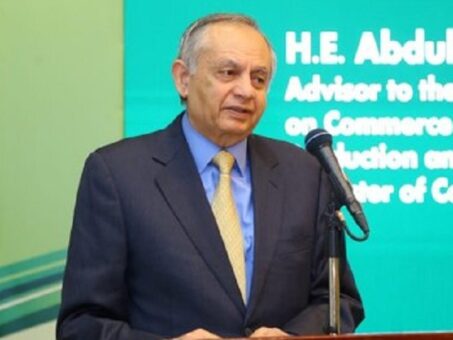
    ISLAMABAD: Abdul Razak Dawood, Advisor to the Prime Minister on Commerce, Textile, Industries & Production on Sunday said that Pakistan has become a sought after destination for investment due to Government of Pakistan’s recently carved out investor friendly policies.

    He was addressing at Pakistan – Qatar Trade and Investment Conference that was held in Qatar on March 10, 2019.

    He also elaborated these policies of the government and lucrative incentives being provided to the foreign investors.

    Highlighting the recent economic stability and progressive on-going economic activities in the wake of CPEC; he stated: “Pakistan has emerged as an ideal market for investment.”

    Furthermore, he was of the view that improved security situation has also motivated foreign investors for their safe investments in Pakistan.

    He stated that trade volume between Pakistan and Qatar can be enhanced through increased business engagements.

    He encouraged Qatari investors to invest in Pakistan mainly in the areas related with real estate, hospitality, petro-chemical, food & agriculture etc.

    Qatari Minister of Commerce and Industry Ali Bin Ahmed Al-Kuwari welcomed Pakistani delegates and told that there were approximately 1450 companies mutually owned by businessmen from both sides.

    He further added that Qatari side is ready to invest in Pakistan and is open to provide a platform to the Pakistani investors to use their market for business both inside and outside Qatar.

    He expressed his desire to further the relationship of both sides in trade and investment through regular business exchanges, trade expose and official engagements.

    Haroon Sharif, Chairman, Board of Investment made a brief presentation highlighting the potential areas of investment in Pakistan.

    He reiterated Prime Minister Imran Khan’s statement that it is the best time for investment in Pakistan and the opportunity shall not be missed.

    Yousef Al-Jaidah, Chief Executive Officer of Qatar Financial Center shed light on the new emerging belt initiative which includes countries like Turkey, Kuwait, Iraq, Qatar, Oman, Malaysia and Pakistan.

    He stated that this initiative will further enhance the trade and investment ties amongst these countries.

    Pakistan Ambassador to the State of Qatar Syed Ahsan Raza Shah was also present on the occasion.

    The conference was followed by business to business (B to B) meetings of the businessmen participating from both sides.