Explore finance-related stories with Pakistan Revenue, your source for the latest updates on Pakistan’s economy, financial trends, and market insights. Stay informed with real-time economic developments.
The total liquid exchange reserves of the county were $24.619 billion by the week ended August 20, 2021, the State Bank of Pakistan (SBP) said on Thursday.
The official reserves of the SBP also reached a historic high of $20.146 billion by the week ended August 27, 2021.
The SBP said that during the week ended Aug 27, 2021, the central bank received proceeds of IMF SDR allocation amounting to US$ 2.752 billion. After accounting for external debt payments, the reserves have increased by $ 2.567 billion to $20.146 billion.
The foreign exchange reserves held by commercial banks increased nominally to $7.082 billion by the week ended August 27, 2021 as against $7.040 billion a week ago.
ISLAMABAD: The ministry of finance on Thursday said that Pakistan’s debt-to-GDP ratio has increased by 1.7 per cent during the pandemic as against an increase in global average of 13 per cent.
Responding to some media reports regarding the increase in public debt during the last three years, the statement said that a better way to measure the level of debt was through the Debt-to-GDP ratio instead of looking at the absolute values of debt.
“Global Debt-to-GDP ratio increased by 13 percentage points, whereas, Pakistan’s Debt-to-GDP ratio witnessed a minimal increase of 1.7 percentage points in 2019-20,” it said adding that the country’s Debt-to-GDP ratio in fact reduced by 4 percentage points indicating lower debt burden at end June 2021 as compared with last fiscal year.
The ministry said that the increase in debt during the last three years occurred mainly during the Fiscal year 2018-19 due to implementing difficult and unavoidable policy choices.
Had the market-based exchange rate, a sustainable level of Current Account Deficit, adequate cash buffers and long-term domestic borrowing profile been maintained, the debt burden would have been reduced further on the back of fiscal consolidation efforts supported by aggressive control on expenses and growth in tax and non-tax revenues.
As most of the major adjustments to fiscal and monetary policies have been made, the debt burden is projected to decline firmly over the next few years.
The statement while referring to media reports said that these reports ignored the underlying reasons behind such increase adding that in order to fully understand the underlying economic realities, there was a need to analyze the sources of increase in total public debt during last three years. The underlining reasons are:
Interest Expenses: Preference towards short-term domestic borrowing in absence of adequate cash buffers resulted in short-term profile of domestic debt at the end of FY2018.
This short-term profile led to high-interest cost on debt as interest rates had to be increased significantly to curb rising inflationary pressures. The government paid Rs 7.5 trillion against interest servicing which explained 50 percent of the increase in total public debt.
Currency Devaluation Impact: The exchange value of the Rupee was maintained at an artificially high level in the past which triggered the balance of payment crisis.
Transition to a market-based exchange rate regime, being an unavoidable policy choice, resulted in sharp exchange rate depreciation leading to high inflation, high interest rates, slower GDP growth, and lower import-related tax revenues.
This exchange rate depreciation added around Rs 2.9 trillion (20 percent of the increase) in public debt. It is important to highlight here that this increase was not due to borrowing but due to the re-valuation of external debt in terms of rupees after currency devaluation.
Financing of Primary Deficit: The impact of economic slowdown due to the Covid-19 pandemic mainly resulted in higher than estimated primary deficits. Rs 3.5 trillion (23 percent of the increase) was borrowed for the financing of the primary deficit.
Cash Management & Others: Rs 1.0 trillion (7 percent of the increase) was on account of increased cash balances of the government to meet emergency requirements as well as due to difference between the face value (which is used for the recording of debt) and the realized value (which is recorded as a budgetary receipt) of government bonds issued during this period. The government took the revolutionary and economically sound step of not borrowing from the SBP and maintaining a cash buffer, which led to a one-off increase in debt. However, this increase in debt was offset by corresponding increase in the Government’s liquid cash balances.
ISLAMABAD: Federal Finance Minister Shaukat Tarin on Wednesday asked federal and provincial authorities to work together to resolve pending taxation matters for finalizing tax harmonization at the earliest.
The finance minister chaired the first meeting of the National Tax Council (NTC).
Finance Minister, Government of Punjab Makhdoom Hashim Jawan Bakht, Finance Minister, Government of Khyber Pakhtunkhwa Taimur Khan Jhagra, Finance Minister, Government of Baluchistan, Secretary Finance, Government of Sindh, Chairman, Sindh Board of Revenue, Secretary, Finance Division, Chairman FBR and other senior officers participated in the meeting.
Finance Minister welcomed the participants and stressed the need for greater cooperation between the Federal and Provincial Governments in matters relating to the harmonization of general sales tax (GST).
He expressed the hope that under the umbrella of the National Tax Council, both the Federal and Provincial Governments would move towards harmonizing Taxes across the multiple jurisdictions so as to facilitate the businesses and reduce the cost of doing business in Pakistan.
The Finance Secretary, Government of Pakistan highlighted the TORs of the National Tax Council and the progress achieved so far.
The Federal Board of Revenue and the respective Provincial Finance Departments gave a productive and positive input on various taxation issues which came under discussion.
The Provincial Finance Ministers welcomed the initiative of the Federal Government and assured to move ahead under the umbrella of NTC for the betterment of the country and to build a progressive economy.
Federal Minister for Finance & Revenue urged the participants to work together on the pending taxation matters so that an arrangement relating to harmonization of GST amongst Provinces and the Federal Government could be finalized at the earliest.
KARACHI: The Consumer Price Index (CPI) has increased by 8.4 per cent on year-on-year (YoY) basis in August 2021 as compared to an increase of 8.4 per cent in the previous month and 8.2 per cent in August 2020.
The Pakistan Bureau of Statistics (PBS) on Wednesday said that on month-on-month basis, it increased by 0.6 per cent in August 2021 as compared to increase of 1.3 per cent in the previous month and an increase of 0.6 per cent in August 2020.
CPI inflation Urban, increased by 8.3 per cent on year-on-year basis in August 2021 as compared to an increase of 8.7 per cent in the previous month and 7.1 per cent in August 2020. On month-on-month basis, it increased by 0.5 per cent in August 2021 as compared to increase of 1.29 per cent in the previous month and an increase of 0.8 per cent in August 2020.
CPI inflation Rural, increased by 8.4 per cent on year-on-year basis in August 2021 as compared to an increase of 8.0 per cent in the previous month and 9.9 per cent in August 2020. On month-on-month basis, it increased by 0.7 per cent in August 2021 as compared to increase of 1.4 per cent in the previous month and an increase of 0.4 per cent in August 2020.
Senstive Price Indicator (SPI) inflation on YoY increased by 15.9 per cent in August 2021 as compared to an increase of 16.2 per cent a month earlier and an increase of 11.7 per cent in August 2020.
On MoM basis, it increased by 0.7 per cent in August 2021 as compared to increase of 1.8 per cent a month earlier and an increase of 0.9 per cent in August 2020.
Wholesale Price Index (WPI) inflation on YoY basis increased by 17.1 per cent in August 2021 as compared to an increase of 17.3 per cent a month earlier and an increase of 3.3 per cent in August 2020. WPI inflation on MoM basis increased by 1.2 per cent in August 2021 as compared to an increase of 2.3 per cent a month earlier and an increase of 1.3 per cent in corresponding month i.e. August 2020.
ISLAMABAD: The finance ministry has estimated that the tax collection to reach Rs5.83 trillion during current fiscal year 2021/2022 (FY22).
In its monthly economic update – August 2021, the finance ministry said that in FY2021, tax revenue increased by 18.4 percent, whereas in July FY2022, tax collection climbed up by 42.5 percent, indicating a good start to the new fiscal year. For FY2022, the tax collection is expected to reach Rs. 5.83 trillion.
“To achieve the target, the government is pursuing a comprehensive tax policy that focuses on expanding the tax base by identifying new taxpayers, gradually eliminating exemptions and concessionary provisions, along with lowering tax rates.”
It said that during FY2021, the fiscal consolidation efforts remained on track. The successful consolidation achieved on the back of prudent expenditure management and revenue mobilization efforts.
For FY2022, the fiscal deficit is expected to reduce further.
These achievements in the fiscal sector are important, especially when Pakistan like the whole world is constantly battling the resurgence of COVID 19.
The persistence in consolidation efforts would pave the way to create fiscal space that would enable the government to withstand any untoward situation.
The Monthly Economic Indicator (MEI) is based on combining monthly data of indicators that are proven to be correlated with GDP at constant prices.
In July 2021, The MEI shows continued strong growth, mainly driven by several factors. First, an expected continued strong YoY growth of LSM in July. Furthermore, as observed in July continued cyclical uptrend in the main trading partners, continued strong growth in imports and deceleration of inflation.
According to Balance of Payments (BoP) data, imports of goods and services spiked in June 2021, but return to normal level in July 2021.
Usually, both June and July, but especially June, are characterized by positive seasonal effects. This positive seasonal impulse is expected to disappear in August.
On the other hand, other factors, such as the recent increases in international oil prices and the ongoing revival of economic growth, may stimulate imports. It is expected that imports of goods and services will settle at around $ 6 billion in August 2021.
Contrary to imports, exports of goods and services, according to BoP data, usually experience negative seasonality during June through September.
The moderation of this seasonal effect, together with the ongoing strong recovery in Pakistan’s main export markets, the momentum in domestic economic dynamism and specific Government policies to stimulate exports are expected to guide exports of goods and services towards the $ 3 billion in August and beyond in subsequent months.
It is expected that trade deficit in goods and services could stabilize to approximately $ 3 billion in August with expectations about remittances to be stabilized around $ 2.5 billion and taking into account the other secondary income and primary income flows, the current account would remain in deficit at moderate monthly levels of around $ 0.5 billion in the coming month.
These expectations depend on the absence of any unexpected negative shocks which may be generated by the potential slowdown of the economic revival abroad (due to loss of confidence, inflation fears, uncertainty for tapering of monetary accommodation and geopolitical risks, etc.). An international and domestic upsurge in COVID-19 infections remains an important risk factor.
The finance ministry said that recent developments in Pakistan’s macroeconomic indicators are positive.
In absence of any major unexpected negative shocks, the economy is moving on a balanced and sustainable growth path.
The challenge remains to elevate this sustainable growth path to a higher level. This requires extending Pakistan’s production capacity and ensuring that a sufficient proportion of this additional production is exported, besides satisfying the needs of domestic consumers.
Enhancing production capacity and increasing its efficiency is not possible without directing a larger proportion of the available and future income towards investments, instead of consumption.
KARACHI – Pakistan’s fiscal performance for the fiscal year 2020/2021 has shown encouraging signs as the budget deficit has reduced to 7.1 percent of the GDP compared to 8.1 percent in the preceding fiscal year.
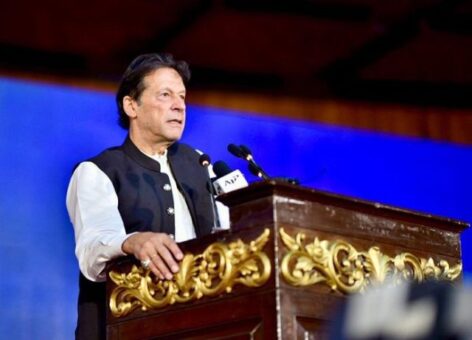
ISLAMABAD: Prime Minister Imran Khan on Thursday said that his government has put the economy on right track despite various challenges, including COVID-19.
Presenting three years performance of Pakistan Tehrik e Insaaf (PTI) government, the prime minister said during the last three years, the current account deficit has been significantly reduced from $20 billion in 2018 to $1.8 billion, foreign exchange reserves increased from $16.4 billion to $27 billion, revenue collection from Rs 3800 billion to Rs. 4700 billion, workers’ remittances from $19.9 billion to $ 29.4 billion.
Imran said that when the present government took reign of affairs in 2018, the country with the highest ever $20 billion of current account deficit was close to default and rupee was depreciating.
“If the friendly countries including Saudi Arabia, UAE and China did not help Pakistan, rupee in the country would have further depreciated,” he added.
The Prime Minister also mentioned 18 per cent growth in the Large Scale Manufacturing (LSM) sector as well as 42 per cent increase in cement sale during the previous fiscal and said it showed enhanced industrial activity.
He said that the receipt of an additional income of Rs 1100 billion by the farmers in agriculture sector and the historic sales of motorbikes, cars and tractors during the previous fiscal also depicted prosperity in rural areas.
The Prime Minister said that the government’s successful strategy to deal with the COVID-19 pandemic also led to saving the economy and poor masses, adding, the international institutions including the World Economic Forum and the World Health Organization appreciated Pakistan’s strategy on COVID-19.
He said that despite the criticism by opposition parties, the government did not go for complete lockdown of the economy, which, if opted, would have caused increase in poverty and hunger like in India.
The Prime Minister appreciated the National Command and Operations Center (NCOC) for its timely and effective decisions to tackle the COVID-19 pandemic.
The Prime Minister said his message to the youth was to follow the sublime path, set by Allah Almighty and Last Prophet Muhammad (PBUH). “We have to learn from the life and teachings of the Holy Prophet (PBUH).”
He said sports did inspire him to never give up and keep on striving and cited the example of Quaid-e-Azam who strove for a great cause and succeeded in creating Pakistan.
He said due to economic mismanagement of the past, the people had to endure price hike and inflation and the government had to take loans from International Monetary Fund (IMF) on stringent conditionalities.
He thanked Pakistan Army and Pakistan Air Force for countering aggression of India after the Pulwama incident and said there was no reason to have critical views about national institutions.
He said the PTI government was fully committed to its three guiding principles of humanity, rule of law and self-respect.
He said no country could progress if there was no of rule of law. He recalled that Asif Ali Zardari landed in jail because of his corrupt practices whenever the PPP government was ousted in the past.
He said the countries got weakened when the ministers indulged in corruption and cited the Holy Prophet’s system of justice of the Riyasat-e-Madinah.
He referred to a UN report which pointed out that $1000 billion was being transferred from developing countries to the developed ones every year which resulted in a widening gap between the rich and the poor.
According to another report, $10 billion was sent from Pakistan every year to bank accounts abroad to purchase properties there, he added.
He said the anti-corruption department of Punjab had recovered only Rs 2.5 billion during the regime of Pakistan Muslim League-Nawaz while in the tenure of present government, its recoveries stood at Rs 450 billion. Similarly, the recoveries of National Accountability Bureau (NAB) rose to Rs 519 billion in the last three years from Rs 290 billion in 18 years, he added.
Imran Khan said for the first time, the PTI government launched Ehsaas programme and enhanced the social sector allocation from Rs 110 billion to Rs 260 billion.
The World Bank declared Pakistan’s Ehsaas programme as the third best in the world, he said and added the programme played a vital role in taking care of the poor during the coronavirus pandemic.
Additional funds were allocated for scholarships of girls as compared to the funds for boys, the PM said and added the government empowered women with renewed focus on their education.
He said the government took steps to fully facilitate women in getting succession certificates and share of inheritance.
Under the Kamyab Naujwan Programme, he said, youth of four million poor families would be given interest-free loans, health insurance cards, and skills training.
Easy interest-free loans were given so that low income groups could build affordable houses, he said, adding 30 percent of the country’s population consisted of the youth.
Imran Khan said farmers would be given subsidy through Kisaan Card so that they could buy fertilizers, pesticides and other agriculture inputs.
Ten reservoirs including Mohmand and Dassu dams would be built to meet water requirements, he added.
He said uniform curriculum would be introduced and Seerat-e-Nabi courses would be taught in classes from eight to ten.
Expressing concern over the rising crimes against women and children, he underlined the need for character building of the youth with imbibing moral values.
He told the audience about Rs1300 billion special packages for merged tribal areas of Khyber Pakhtunkhwa, and districts of Balochistan, Sindh and Gilgit-Baltistan to eliminate backwardness and deprivation of local people.
The Prime Minister said the past leaderships did compromise dignity of the country by begging and getting loans from other states. Pakistan could make rapid progress by developing its agriculture, industry, mining, tourism and banking sectors, he opined.
He said today business confidence had markedly improved in the country while foreign remittances were on the rise.
He recalled Pakistan sided with the United States in the war on terror but latter carried out 480 drone attacks on its soil.
Over 70,000 Pakistanis lost their lives in the war fought on behalf of another country, he added.
The Prime Minister said the Afghan defence forces declined to fight for their corrupt leaders.
He called upon the world to support the Taliban as they wanted an inclusive government in Afghanistan, and declared general amnesty for all, besides assurance that no one would be allowed to carry out terrorist attacks from their soil against other countries.
He said the world community should help the Taliban to maintain peace in Afghanistan.
Imran Khan recalled that Sindh Governor Imran Ismail, folk singer Attaullah Khan Esakhailvi, Ibrarul Haq and many others played an important role in taking forward Pakistan Tehreek-i-Insaf (PTI).
He thanked the allies including Pakistan Muslim League (Quaid), Muttahida Qaumi Movement and Grand Democratic Alliance for extending support to the PTI government during the last three years.
ISLAMABAD: The Korean EXIM Bank will sign a new framework arrangement with Pakistan (2022-2026) for enhancing financing to $1 billion.
A high-level Korean Delegation, led by Chong Hwa Lee, Director General, Ministry of Economy & Finance, Republic of Korea called on the Minister for Economic Affairs Omar Ayub Khan in his office during their 2-days visit to Islamabad.
The Korean delegation informed that EXIM Bank would soon sign a new Framework Arrangement with Pakistan (2022-26) for enhancing existing level of financing from $ 500 million to $ 1 billion for implementing new projects in road sector, climate change, healthcare and IT Sector development.
H.E. Suh Sangpyo, Ambassador of the Republic of Korea in Islamabad and representatives of Korean EXIM Bank also participated in the meeting.
The Minister for Economic Affairs appreciated the role played by EXIM Bank for financing various development projects in Pakistan. The Minister expressed that Pakistan desired to implement more development projects in IT, social sector and infrastructure under Korean financing facilities.
“The mobilization of financial resources from the Exim Bank would contribute in social and economic development of Pakistan”, the minister added.
At present, five development projects i.e. Technology Park in Islamabad, Kalkatak-Chitral Road, Chakdara-Timergara Road, Malakand Tunnel and Children Hospital in Sukkar are under implementation with US$ 343 million financing by EDFC/EXIM Bank of Korea.
The Minister for Economic Affairs appreciated the Korean government for their enhanced support for various development projects and disaster management including combating COVID-19 pandemic and locust in Pakistan.
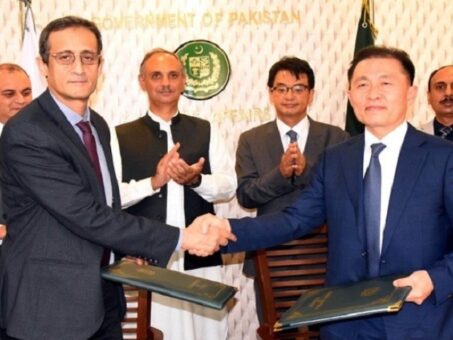
On the sidelines of meeting, a loan agreement for establishment of IT Park in Karachi was also signed.
The total cost of project is around US$199 million. Out of which, the EXIM Bank Korea will provide US$158 million.
This project is aimed at providing IT enabled high tech infrastructure wherein IT companies can work together by leveraging each other’s expertise, foster industry-academia cooperation and promote entrepreneurship in Pakistan.
The IT Park will provide state-of-the-art modern infrastructure to national and international IT firms for establishing their office in Karachi.
The financing agreement was signed by Zulfiqar Haider, Secretary, EAD and Chong Hwa Lee, Director General, Korea.
During this visit, both sides also held Policy Dialogue under EDCF Framework in Economic Affairs Division. Mr. Zulfiqar Haider, Secretary EAD welcomed the delegation and expressed that Government of Pakistan attached great importance for its relations with Republic of Korea and appreciated the efforts made by Korean Exim Bank for financing potential projects in healthcare, road infrastructure development, IT Sector and mitigating climate change.
Both side discussed future roadmap for mobilizing financing for potential projects and ways for expediting implementation of projects.
Chong Hwa Lee, Director General, Ministry of Economy & Finance of Korea thanked Pakistani-side for their hospitality and informed that Government of Republic of Korea would continue its endeavors for mobilizing financial & technical resources for development projects in Pakistan.
ISLAMABAD: The Economic Coordination Committee (ECC) of the Cabinet on Wednesday emphasized the importance of building strategic reserves of commodities in wake of evolving situation in Afghanistan.
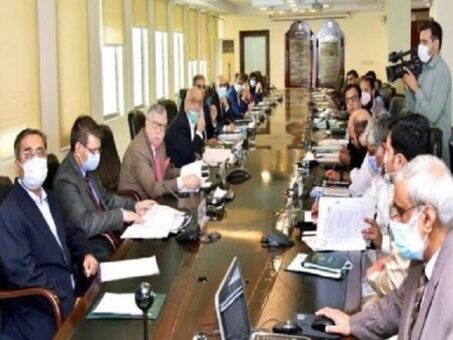
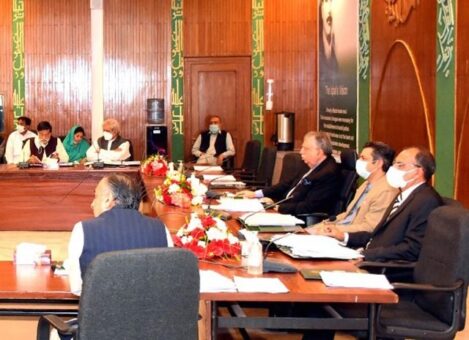
ISLAMABAD: Finance Minister Shaukat Tarin on Wednesday chaired a meeting of the Monetary and Fiscal Policies Co-ordination Board.
Other members of the Board present in the meeting were the Adviser to the Prime Minister on Commerce & Investment, Deputy Chairman Planning Commission, Governor SBP, Dr. Asad Zaman and senior officials of the Finance Division.
Finance Minister briefed the Members of the Board on the current economic situation of the country and highlighted the major incentives given in the budget due to which business confidence is improving and economy is moving on strong economic recovery path.
It was also informed that all key economic indicators relating to real sector of the economy, fiscal sector, monetary and external sectors are going well and government is proactively executing all policy measures to achieve the major socio-economic targets of the current fiscal year.
He also highlighted the possible risks to the economic activities and strategy to counter these risks which were appreciated by the members of the Board.
Secretary Finance briefed the Members of the Board on budgetary allocations for various activities and informed about the ways and means to maintain the fiscal discipline.
He also shared the strategy to contain the non-development expenditure with the focus to optimally utilize resources of the country and improve the service delivery at large for the common man.
Governor SBP informed the Board about Monetary Policy stance. He shared the analysis of the SBP on policy rate, credit availability, exchange rate movement and inflationary situation.
He also explained that policy mix is supporting the growth momentum and highlighted the increase in commodities prices in the global market which have implications for higher import bill and inflation.
It was also informed that it is encouraging signs that exports are picking up along with increase in import of machineries which will enhance productive capacity of the economy and create exportable surplus.
He also explained the policy measures which SBP is executing to encourage business activities in various sectors of the economy and highlighted that there are ample opportunities for investors/exporters and youth of the country to take benefits from SBP’s schemes to extend or initiate their business.
Deputy Chairman Planning Commission apprised the meeting about the execution of development activities.
He also highlighted the possible options for resource mobilization and to utilize them effectively for development of potential sectors of the economy.
The Adviser to the PM on Commerce and Investment briefed about the structure of trade of the country along with major destinations.
He also presented the various measures which are under execution to enhance exports in potential areas. He also mentioned the various categories of imports which can be rationalized by focusing on their substitutes.
A comprehensive road map was also discussed to minimize trade deficit of the country. It was also highlighted that fiscal and monetary facilitation will continue for potential sectors of the economy.
Dr. Asad Zaman appreciated the major fiscal and monetary measures of the government which are supporting the business activities. He also highlighted the potential areas where Pakistan has comparative advantages in export market and also identified some low hanging fruits for import substitution.
He emphasized that the goal of well-coordinated Monetary and Fiscal Policies is to achieve full employment.
Minister for Finance & Revenue emphasized the importance of Monetary and Fiscal Policies Co-ordination Board for designing and executing policies to achieve economic targets and overcome the possible risks.
He advised to make this forum more effective for maintaining better coordination of policies to achieve the planned macroeconomic goals.
The chair urged that the Board should be more proactive in reviewing the impact of Fiscal and Monetary Policies on economic growth, employment and external sector of the economy, he concluded.