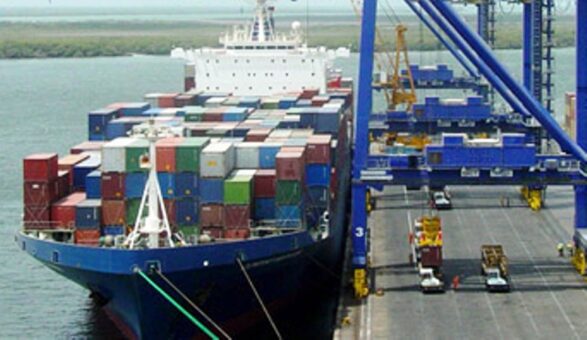
ISLAMABAD: The Economic Coordination Committee (ECC) of the Cabinet on Wednesday approved import of cotton through land route subject to fulfillment of codal formalities.
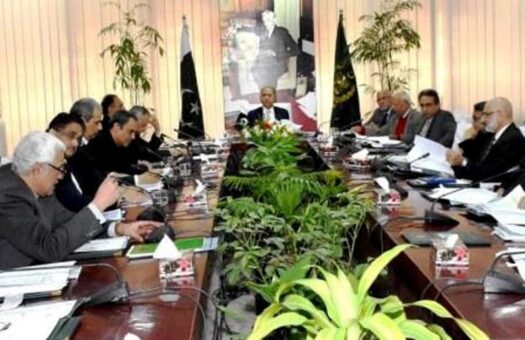
Federal minister for Finance and Revenue, Dr. Abdul Hafeez Shaikh, chaired the meeting of the ECC.
The ministry of commerce tabled a summary before the ECC seeking permission for import of cotton from Afghanistan and Central Asian States through land route via Torkham border to bridge the gap between supply and demand and to ensure sufficient availability of cotton for promoting textile exports.
The ECC had granted such permission earlier to workout necessary arrangements with reference to Plant Quarantine Rules to meet Sanitary and Phytosanitary (SPS) requirements for import of cotton via land routes.
The ministry of commerce requested to extend the above permission for import of cotton via land route during the current financial year. The ECC approved the said request subject to fulfillment of codal formalities.
Ministry of Industries and Production presented a ‘Ramadan Relief Package-2021’ in accordance with the directive of the Prime Minister to provide maximum relief to the marginalized segments of the society during the holy month of Ramadan.
The Utility Stores Corporation would subsidize 19 essential items under the proposed relief package entailing subsidy equivalent to approx. Rs. 7.8 billion including wheat flour, sugar and ghee which have significant differential vis-a-vis prevailing prices in the domestic markets.
The MD, USC briefed the forum that procurement would start from 01 April, 2021 to ensure availability of basic items at discounted prices across 4000 outlets of USCs throughout the country. The Committee directed MD USC to coordinate with Finance Division for timely release of funds to ensure well-timed procurement and other contingent arrangements.
The ministry of industries and production presented another summary seeking permission regarding operation of two plants namely Agritech and Fatima Fertilizer from March till November, 2021 to produce urea from SNGPL based plants.
The underlying rationale is to bridge the gap between estimated demand and actual domestic production of urea in the country.
The Committee approved operations of the above-mentioned plants with a direction that the Ministry may closely monitor the demand-supply situation and take decision to import urea, if needed, as per requirement during the current year.
Secretary, Ministry of National Health Services, Regulation and Coordination tabled a summary for exemption of taxes and duties on import of auto disable syringes and raw material needed for local manufacturing of auto disable syringes in the country.
The Secretary Health briefed the forum about efforts underway to switch from conventional syringes to auto disable syringes as reuse of conventional syringes leads to blood borne diseases in Pakistan such as hepatitis, HIV etc.
The ECC approved the summary, in principle, and directed the Ministry of Health to hold a follow-up meeting with the Law Division to fine tune details.
The ECC also considered a summary regarding exemption of Federal Excise Duty for 10 soft-skin vehicles imported by Food and Agriculture Organization (FAO) to be used by the Department of Plant Protection (DPP) for locust control operations. Ministry of NFS&R requested for a one-time exemption of Federal Excise Duty amounting to Rs.10.3 million for 10 vehicles.
After due deliberation, the ECC constituted a Committee with representatives from Law Division, FBR and Ministry of National Food Security and Research for further discussion and submission of updated proposal before the Committee.
Secretary, Ministry of the Information Technology and Telecommunication presented a summary before the Committee based on recommendations by a Cross-stakeholder Committee for addressing critical issues of Cellular Mobile Industry for digital enablement such as reduction in NADRA Biometric Verification Charges (BVC), License renewal under further Spectrum Price etc.
After detailed discussion, the ECC constituted a sub-committee under the Chairmanship of the Adviser to the Prime Minister on Institutional Reforms and Austerity Ishrat Hussain with Secretary IT, Secretary Finance and a representative from PTA as its members to deliberate further and present before the ECC accordingly.
Secretary, Ministry of Communications updated ECC on National Freight and Logistics Policy (NFLP) discussed in earlier meeting held on 20th January, 2021.
The Ministry of Communications has segregated the proposals into two broad categories in line with the earlier directive of the Committee.
The ECC directed to discuss the proposals involving multiple stakeholders as envisaged under the NFLP, through an Institutional framework, steered by the Deputy Chairman Planning for evolving consensus among all stakeholders including provincial representatives for a way forward.
Petroleum Division updated the ECC about the recommendations firmed up by a sub-committee established in line with the earlier decision of the ECC dated 28 Jan, 2021 regarding review of Oil Marketing Companies (OMCs) and Dealers Margins on Petroleum products.
After detailed discussion, the ECC approved to revise OMCs and Dealers Margins on the basis of 85% of the latest average core inflation with immediate effect, and directed to expedite a study by PIDE.
The Power Division submitted another summary about re-targeting of Power Sector subsidies (phase-I). The Committee considered and approved the proposals recommending that Power Division will complete the analysis based on the listed principles and submit specific recommendations on thresholds and rates for the consumers before the ECC by 31st March, 2021.
The following Technical Supplementary Grants were also approved by the ECC:
1. Rs. 1056 million for the Ministry of Federal Education and Professional Training for completion of Projects related to COVID-19.
2. Rs. 1.5 billion for the Ministry of Housing and Works for disbursement of interest free loans to the borrowers under Prime Minister’s Low-Cost Housing Scheme.
3. Rs.334.306 million for the Ministry of Interior for the payment of salaries / subsistence allowance to the Civil Armed Forces deployed in the Peacekeeping Missions.
4. Rs.31.50 million for meeting expenses of Federal Insurance Ombudsman Secretariat working under the Ministry of Law and Justice.
5. Rs. 9.685 million for Pakistan National Shipping Corporation, Karachi to clear the dues of M/s Coniston against PSM.
6. Rs.67.358 million for the Cabinet Division for meeting various expenses.
7. Rs. 419 million were approved to facilitate Pakistan Central Cotton Committee to carry out its research and development activities.
Federal Minister for National Food Security & Research Syed Fakhar Imam, Federal Minister for Energy Omar Ayub Khan, Federal Minister for Planning, Development and Special Initiatives Asad Umar, Federal Minister for Industries and Production Hammad Azhar, Federal Minister for Railways Azam Khan Swati, Federal Minister for Privatization Muhammad Mian Soomro, Adviser to PM on Commerce Abdul Razak Dawood, Governor State Bank of Pakistan Reza Baqir, SAPM on Revenue Dr. Waqar Masood, SAPM on Power Tabish Gauhar, Federal Secretaries from MNS&F, Ministry of Interior, Ministry of Maritime Affairs, National Health Services, Law and Justice Division, Ministry of Information Technology & Telecommunication, Chairman Board of Investment, Deputy Chairman Planning Commission, MD Utility Stores Corporation and other senior officials participated in the meeting.