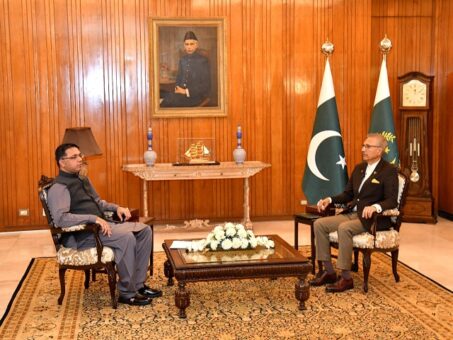
Pakistan’s political saga took a surprising turn over the weekend as Pakistan’s President approved the dissolution of the National Assembly on the Prime Minister’s advice, analysts at KASB Research said.
Imran Khan then announced early elections, likely within the next 3 to 6 months. Most notably, the Supreme Court of Pakistan (SCP) has scheduled a hearing on the Suo Moto notice taken by the CJP over the incident. Any parliamentary actions thereafter will be subject to the court’s orders.
The decision to dissolve the national assembly is likely a credit-negative event for the economy. Considerable risks to announced reforms have arisen, including fiscal reforms and planned revitalization of the energy sector. Moreover, concerns of delays in the upcoming federal budget will drive sentiments of further delays in the IMF tranche’s approval. With SBP’s reserves falling to a 15 months low level of 12.1 billion (import cover: nine weeks), risks to Pakistan’s credit outlook have greatly heightened.
The scenario is evidenced by the rising international bond yields of Pakistan securities, whose yields have surged past 16 per cent compared to 5 per cent a few months prior. Moreover, Pakistan’s CDS spreads have also crossed the 10 per cent mark, a rise of 6pps from a month prior. Month to date, foreign investors have offloaded USD 28 million worth of equities, and we expect potential outflows to gain pace in the coming weeks as the political situation unfolds.
Secondary market yields and currency likely to rise further:
We expect secondary market yields of domestic securities to face additional upside pressure as macroeconomic risks heighten. Yields were already on a sharp upwards trajectory following the rise in global commodity prices, rising risks to external accounts, and falling foreign currency reserves. Rising domestic yields will likely translate to increased lending rates. Moreover, external account imbalances amidst the commodity upcycle, coupled with expected delays in the IMF tranche, will likely keep the Pak Rupee under pressure.
Sectors dependent on policy reforms will likely underperform:
We highlight risks to sectors whose performance outlook hinged on the planned policy reforms. These risks are particularly weighted towards Pakistan’s energy sector, which is presently plagued with considerable inefficiencies. We had earlier highlighted our preference for the sector on account of the planned reforms to uplift the industry, including significant actions to curb the circular debt growth.
Key risks to the energy sector emerging:
1) Oil and Gas Exploration: The WACOG bill was introduced to alleviate the cash flow crunch of the sector originating from the sale of gas. With expected delays in the implementation of the WACOG bill, which has faced harsh criticism from the opposition, we expect the cash flow woes of the sector to continue for a sustained period.
2) Oil and Gas Marketing: The WACOG bill was also expected to alleviate the cash flow issues of the OMC sector, particularly PSO. Moreover, planned reforms to ease the circular debt, including a distribution network uplift, may also face delays, further exacerbating the industry’s cash flows.
3) Independent Power Producers: The IPPs were also expected to benefit from actions to curb the circular debt. Most notably, the sector’s collections have considerably worsened after the recent surge in global energy prices. While the government had plans to set up a Revolving Account of PKR 50bn to ensure timely clearance of overdue bills, any delays on this front will continue to keep the sector’s cash flows under pressure.
4) Refineries: The improving outlook on refineries was largely dependent on the approval of a long-term refinery policy, which was expected to attract investments of up to USD 10.0bn. We project significant delays in the policy’s approval and expect the sector to continue underperforming over the medium term.
Macroeconomic hedged sectors to fare better:
As highlighted in one of our previous reports (Pakistan Strategy – USD hedged stocks a shield against macroeconomic heads), we prefer industries capable of weathering the macroeconomic headwinds including Textiles and Technology. These industries have a relative shield against rising interest rates and currency weakness.
KARACHI: The holders of bearer prize bonds can exchange or convert the securities with documented ways by March 31, 2022.
Through a circular issued by the State Bank of Pakistan (SBP) on December 21, 2021 the date for exchanging the bearer prize bonds with denominations of Rs40,000, Rs25,000, Rs15,000 and Rs7,500 was extended up to March 31, 2022.
Earlier, the last date for exchanging the bearer prize bonds was December 31, 2021.
The SBP instructed the banks to accept requests for encashment / conversion / redemption of cited denominations from general public till March 31, 2022.
“Further, the banks shall submit branch / region wise consolidated data of cited denomination national prize bonds held by them on last date i.e. March 31, 2022 latest by April 1, 2022, as per the instructions stipulated in aforementioned CMD Circulars.
The finance ministry launched the withdrawal of the unregistered prize bonds in a phased manner. The federal government on June 24, 2019, announced to discontinue the circulation of Rs40,000 denomination national prize bonds. Similarly, on December 10, 2020, the government announced to discontinue the circulation of Rs25,000 denomination prize bonds. In April 2021, the finance ministry announced that national prize bonds of denominations Rs7,500 and Rs15,000 shall not be sold.
Since June 2019 the government repeatedly extended the date for exchanging the bearer bonds. Previously, the last date for exchanging the unregistered bonds was December 31, 2021.
The government is aiming to document the bearer bonds so the exchanging the unregistered bond with cash has been prohibited. The ministry of finance issued various procedure to convert the bond without exchanging with the cash.
The bonds can be converted to premium prize bonds (registered) of denomination of Rs25,000 and Rs40,000 (subject to the adjustment of differential amount) through 16 field offices of State Bank of Pakistan (SBP) Banking Services Corporation (BSC), and branches of six commercial banks i.e. National Bank of Pakistan, Habib Bank Limited, United Bank Limited, MCB Bank Limited, Allied Bank Limited, and Bank Alfalah Limited.
The bonds can be replaced with Special Saving Certificates/Defence Saving Certificates through the 16 field offices of SBP Banking Services Corporation, authorized commercial banks, and the National Savings Center.
The bonds will only be encashed by transferring the proceeds to the bonds holder’s bank account through the 16 field offices of SBP BSC as well as the authorized commercial bank branches and to the Saving Accounts at National Savings Centers.
KARACHI: The State Bank of Pakistan (SBP), in collaboration with banks, is organizing a two-day exhibition in Faisalabad on March 19, 2022 to provide information on house financing.
The State Bank of Pakistan is organizing a two-day Mera Pakistan Mera Ghar (MPMG) Mela at Circle Club Faisalabad on March 19 and 20, 2022, a statement said on Thursday.
In the Mela banks will provide information on the MPMG financing facility whereas builders, developers and real estate agents will showcase the various projects in which the people could purchase housing units or apartments using the financing facility.
The residents of Faisalabad who want to purchase/construct their own house will have an opportunity to obtain information about their eligibility for availing the subsidized housing finance, their monthly installments based on amount of financing and monthly income.
They will also be able to apply for financing from the banks, which may give an in-principal approval then and there provided the required information is provided to them.
The Mela offers free entry and parking for the families besides other attractions including opportunities to win valuable prizes through open draw, daily live music concert by renowned singers, food stalls, and an activity packed fun-area for kids and young ones.
LAHORE: Pakistan International Airlines (PIA) – the national flag carrier – has commenced its flight operations to Baku, Azerbaijan from the country’s two major cities i.e. Lahore and Karachi, according to a statement issued on Wednesday.
The airline management under the guidance and leadership of CEO PIA, Air Marshal Arshad Malik is fulfilling the vision of Prime Minister of Pakistan to foster and promote brotherly ties with Central Asian Countries and also keeping in view the demand of passengers, to increase revenue and to facilitate passengers, has initiated flights to Baku, one of the emerging tourists destinations that offer ease of Visa facility, having friendly and welcoming people with same religion and lots of historic sites to visit both in Pakistan and Azerbaijan.
The inaugural flights departed from the two cities on Wednesday morning. PIA will operate one flight per week from Lahore and Karachi to Baku. Simple Cake cutting ceremonies were held at Karachi and Lahore Airports. Both flights operated with full loads. CEO PIA also traveled on the first flight to Baku.
CEO PIA Air Marshal Arshad Malik welcomed the passengers of the first flight from Lahore. He met with the passengers and exchanged views with them. The passengers thanked CEO PIA Air Marshal Arshad Malik and the airline’s management for initiating direct non-stop flights to Baku.
Sharing his views on the occasion, he said that the flights to Baku will not only facilitate in trade between the two countries but also promote tourism and further build upon brotherly relations between Pakistan and Azerbaijan.
CEO PIA thanked the passengers for making PIA their preferred choice for travel. He said that the airline’s network expansion is under way more flights will be added to the airline’s network including non- stop flights to Australia.
Ambassador for Azerbaijan Khazar Farhdove also traveled on the inaugural flight from Lahore to Baku, while at Baku airport officials of Civil Aviation authority and senior Government officials welcomed the passengers.
The passengers of PIA’s flight to Baku from Karachi were welcomed and seen off by PIA senior officials.
KARACHI: The State Bank of Pakistan (SBP) has revised regulations related to housing loans and general loans mainly related to eligibility of borrowers.
The central bank on Wednesday issued a circular to revise Prudential Regulations for Microfinance Banks.
The SBP said that in order to align classification and provisioning requirements with enhanced loan sizes, it has been decided to revise Prudential Regulations R-5, R-8 and R-10 for MFBs as under;
Regulation R-5: Maximum Loan Size and Eligibility of Borrowers
Maximum loan sizes and borrowers’ income eligibility criteria shall be as under;
General Loans (Other than housing loans): The maximum size for general loans shall be up to Rs. 350,000/- to a poor person with annual income (net of business expenses) up to Rs. 1,200,000/-.
Housing Loans: The maximum size for housing loans shall be up to Rs. 3,000,000/- to a single borrower with annual income (net of business expenses) up to Rs. 1,500,000/-. Further, MFBs shall ensure to implement the following requirements:
(a) General Instructions
i) MFBs shall not allow housing finance purely for the purchase of land/plots; rather, such financing would be extended for the purchase of land/plot and construction on it.
ii) The sanctioned financing limit, assessed on the basis of repayment capacity of the borrower, value of land/plot and cost of construction on it etc. shall be disbursed in tranches.
iii) The amount disbursed for purchase of plot must not exceed the 90 per cent of the market value/cost of land/plot and 50 per cent of the financing limit. The remaining amount shall be disbursed for construction there-upon.
iv) MFBs will take a realistic construction schedule from the borrowers before allowing initial disbursement. For construction-only cases, the sanctioned financing shall also be released in tranches commensurate with the stage of construction.
v) In case of cost overrun, MFBs may entertain the customer for additional finance for completion of house, keeping in view the Debt Burden Ratio (DBR) and cushion in overall Loan-to-Value (LTV) ratio.
(b) Permission from Relevant Authorities
The MFBs shall not disburse housing finance unless ensured that prior permissions/clearances for construction/purchase of property from relevant authorities are available.
(c) Creation of Mortgage
The plot/house/flat financed by the MFBs shall be mortgaged in MFBs’ favour by way of equitable or registered mortgage.
(d) Loan to Value (LTV) Ratio
Loan to Value Ratio should not exceed 90 per cent.
(e) Risk Management and Internal Control Systems
Risk management framework, duly approved by the Board of Directors of MFBs, should appropriately cover housing finance. MFBs shall ensure strict compliance with their internal policies and procedures and those prescribed by SBP from time to time.
(f) Information Disclosure
MFBs shall clearly disclose all the important terms & conditions, fees, charges and penalties etc., which should, inter-alia, include annualized percentage rate, pre-payment penalties and the conditions under which they apply.
For the purpose of this regulation, Annualized Percentage Rate means as follows:
Mark-up for the period
X
365
x
100
Average outstanding principal amount during the period
No. of days
(g) Development of Financing Documentation
The MFBs shall prepare standardized set of financing and recourse documents, duly cleared by their legal counsels, comprising of financing agreement, application form and the other requisite supplementary documents.
(h) Title Documents
MFBs shall obtain all title and ownership related property documents from customers which should be clear and free from all encumbrances/legal charges and get these documents vetted by their legal department/advisor(s). MFBs shall provide a signed copy of the list of all title and property documents to the borrowers.
(i) Verification of Property-related Documents
MFBs shall verify necessary information provided in the application form. Accordingly, all title and other legal documents provided with application form shall be verified directly from the relevant issuing authorities. All the documents shall be kept in safe custody meeting all procedures/requirements.
(j) Property Assessment
MFBs shall ensure that a proper property valuation is done by their internal resources. However, properties valuing above Rs. 3.0 million shall be subject to assessment by valuator on approved panel of Pakistan Banks’ Association.
(k) Insurance/Takaful
MFBs may obtain insurance/takaful coverage of the housing unit financed through a reputable insurance/takaful company to sufficiently cover their risk.
(l) Monitoring of Market Conditions
The management of MFBs shall put in place a mechanism to monitor conditions in housing finance market at least on half-yearly basis to ensure that their policies are aligned with the current market conditions.
Microenterprise Loans:
The maximum size for microenterprise loans shall be up to Rs. 3,000,000/- to a single project or business. The MFBs shall extend the microenterprise loans only in the name of micro entrepreneurs to ensure traceability and reduce the incidence of multiple borrowing. However, the aggregate exposure against the microenterprise loans in excess of ceiling prescribed for general loans shall not exceed 40 per cent of the MFB’s gross loan portfolio.
Pre-requisites for Undertaking Microenterprise Lending:
Only those MFBs that are fully compliant with Minimum Capital Requirement (MCR) and Capital Adequacy Ratio (CAR) shall be eligible to undertake microenterprise lending.
i) MFBs interested to extend microenterprise loans exceeding ceiling prescribed for general loans shall develop related institutional capacity (products, credit risk management and monitoring system, trainings etc.) and submit detailed business plan of microenterprise lending to SBP for seeking necessary approval for pilot program. The SBP shall inter-alia evaluate the plan along with operational/financial performance, funding plan, supervisory assessment, and credit rating of the MFB, and accordingly grant permission for launching pilot program to the applicant MFB.
ii) During the pilot phase MFBs will have to ensure that their aggregate exposure against the microenterprise loans in excess of ceiling prescribed for general loans shall not exceed 20 per cent of the gross loan portfolio. The final approval for undertaking microenterprise lending on full/commercial scale shall be granted subject to satisfactory evaluation of pilot program.
iii) The enhanced loan size (up to Rs. 1,000,000/- and Rs. 3,000,000/- respectively) will be allowed to those MFBs which have graduated from pilot microenterprise lending programs (up to Rs. 500,000/- and Rs. 1,000,000/- respectively) to commercial scale. However, prior to extending microenterprise loans exceeding Rs. 500,000/- and Rs. 1,000,000/-, MFBs shall apply to Agricultural Credit & Microfinance Department, SBP for approval. SBP shall grant approval for pilot/commercial launch based on satisfactory assessment of the capital position and readiness level of the applicant MFB.
Miscellaneous
(a) Income Eligibility Assessment for General & Housing Loans:
While assessing income eligibility on individual borrowers (including salaried persons) for housing & general loans, MFBs shall ensure that the total installment of the financing facilities extended by the financial institutions is commensurate with monthly income and repayment capacity of the borrowers, such that total monthly amortization payments of financing facilities should not exceed 50 per cent of the net disposable income of the prospective borrowers. These measures would be in addition to MFBs’ usual evaluations of each proposal concerning credit worthiness of the borrowers, to ensure that their portfolio fulfills the prudential norms, instructions issued by the State Bank of Pakistan and does not impair the soundness and safety of the MFB itself.
(b) Consumption Financing against the Security of Gold:
In line with SBP’s instructions issued vide AC&MFD Circular No. 02 of 2015 (Annexure I, Para-2), MFBs may also extend loans against gold collateral for consumption purposes categorized as domestic needs/emergency loans. However, MFB’s aggregate loan exposure against the security of gold shall not exceed 35 per cent of its gross loan portfolio.
(c) Asset Liability Mismatches
MFBs shall prudently manage the maturity mismatches arising out of their housing and other long term financing portfolios by raising long-term funds for on-lending and vice versa.
Regulation R-8: Classification of Assets and Provisioning Requirements
A. Specific Provisioning:
The outstanding principal and mark-up of the loans and advances, payments against which are overdue, shall be classified as Non- Performing Loans (NPLs) as prescribed below:
Loan Categories
Time based Criteria for Classification of Assets and Provisioning Requirements
MFBs shall maintain a General Provision equivalent to 1.0 per cent of the net outstanding loans/advances. However, where the loans/advance have been secured against gold and/or other liquid assets, the general provisioning against outstanding amount net of such security shall be required.
C. General Instructions for Classification / Provisioning of all loan categories:
(a) Watch list
MFBs shall maintain a watch list of all overdue accounts before they are classified in terms of objective (time-based) criteria. However, such accounts may not be treated as NPLs for the purpose of classification / provisioning.
(b) Government Guaranteed Loans
Classified loans/ advances that have been guaranteed by the Government would not require provisioning to the extent of guaranteed portion. However, markup/ interest on such accounts would be taken to Memorandum Account instead of Income Account.
(c) Subjective Classification
i) In addition to the time-based criteria prescribed in this regulation, subjective evaluation of performing and non-performing credit portfolio may be made for risk assessment purposes and, where necessary, any account including the performing account can be classified. In this case, the category of classification determined on the basis of time based criteria can be further downgraded.
ii) Classification for program-based lending shall be based on objective (time-based) criteria only, though MFBs, at their own discretion, may also classify such portfolio on subjective basis.
iii) To strengthen subjective classification, MFBs may consider financial standing of guarantors.
(d) Reversal of Specific Provisions
In case of recovery against classified loan, other than rescheduling / restructuring under R-9 of PRs for MFBs, MFBs may reverse/adjust specific provision held against classified assets.
(e) Quarterly Review
MFBs shall review, at least on a quarterly basis, the collectability of their loans / advances portfolio and shall properly document the evaluations so made. Shortfall in provisioning, if any, shall be provided for immediately.
(f) Benefit of Forced Sale Value:
MFBs can avail the benefit of Forced Sale Value (FSV) of collateral held against loans / advances as under:
i) Profit arising from availing the benefit of FSV shall not be available for the payment of cash or stock dividend.
ii) The heads of Credit and Risk of respective MFBs shall ensure that FSV used for taking benefit of provisioning is determined accurately and is reflective of market conditions under forced sale situations.
iii) Borrower-wise details of such cases shall be maintained for verification by SBP. In case of misuse of this facility, SBP may also withdraw the benefit of FSV from the concerned MFB.
(g) Responsibility of the External Auditors
The external auditors shall, as part of their annual audits of MFBs, verify that all requirements, as stipulated in this regulation for classification and provisioning, have been complied with.
The intent of ‘charge-off’ is to clear the balance sheet of MFBs, and this shall in no way extinguish the MFBs’ right of recovery of such loans. NPLs shall be charged off as prescribed below:
Loan Categories
Criteria for Charging Off NPLs
General/Unsecured Loans
NPLs shall be charged off, one month after being classified as “Loss.”
Housing Loans
NPLs shall be charged off, one month after 05 years from the date of classification of financing.
Microenterprise Loans
NPLs secured against Mortgaged residential, commercial and industrial properties (Land & building only) shall be charged off, one month after 05 years from the date of classification. All other NPLs shall be charged off, one month after 03 years from the date of classification.
Note: Charge-off means reducing the value of the loans in ‘loss’ category to zero through offsetting the provisions, thus, removing such loans from the balance sheet.
4. Definitions. To add clarity, following terms have been defined:
(a) Housing Finance means financing provided to individuals for the construction, purchase of residential house/apartment and for purchase of plot and construction thereupon. Financing availed for the purpose of making improvements in house/apartment shall also fall under this category.
(b) Mortgage means transfer of an interest in specific immovable property for the purpose of securing the payment of money advanced or to be advanced by way of loan or finance.
(c) Liquid Assets means assets which are readily convertible into cash without recourse to a court of law and mean encashment/realizable value of government securities, bank deposits, gold ornaments, gold bullion, certificates of deposit, shares of listed companies which are actively traded on the stock exchange, NIT Units, certificates of mutual funds, certificates of investment (COIs) issued by DFIs/NBFCs rated at least ‘A’ by a credit rating agency on the approved panel of SBP, listed TFCs rated at least ‘A’ by a credit rating agency on the approved panel of SBP and certificates of asset management companies for which there is a book maker quoting daily offer and bid rates and there is active secondary market trading. These assets with appropriate margins should be in possession of the MFBs with perfected lien.
(d) Secured means exposure backed by liquid assets, pledged stock, mortgage of land, plant, building, machinery or any other fixed assets, hypothecation of stock (inventory), trust receipt, assignment of receivable, lease rentals, and contract receivables but does not include hypothecation of household goods.
The following entries in the valuation tables have been deleted for residential immovable properties:
62
DHA Phase 1
Any size
30,000
63
DHA Phase 2
Any size
35,000
64
DHA Phase 2 Extn
Any size
8,264
65
DHA Phase 3
Any size
16,529
66
DHA Phase 4
Any size
9,917
67
DHA Phase 5
Any size
19,835
68
DHA Valley
Any size
8,264
Similarly, following entries in the valuation tables have been deleted for commercial immovable properties:
171
DHA Phase 1
Commercial plot
23,900
172
DHA Phase 2
Commercial plot
22,200
173
DHA Phase 2 Extn
Commercial plot
9,183
174
DHA Phase 3
Commercial plot
9,183
175
DHA Phase 4
Commercial plot
9,183
176
DHA Phase 5
Commercial plot
18,365
177
DHA Valley
Commercial plot
2,755
The FBR on December 01, 2021 issued fresh and updated valuation tables for around 40 major cities of the country. However, the FBR deferred the implementation of the new valuations of immovable properties till January 15, 2022 and further deferred till January 31, 2022. The FBR once again deferred the implementation on the valuation table till February 28, 2022.
The revised tables of valuation of immovable properties have been issued and implemented on March 02, 2022.
ISLAMABAD: The Economic Coordination Committee (ECC) of the Cabinet approved Rs8.2 billion for Ramzan Relief Package for all Pakistanis.
Federal Minister for Finance and Revenue Shaukat Tarin presided over Economic Coordination Committee (ECC) of the Cabinet, on Tuesday.
Ministry of National Food Security & Research presented a summary for Ramzan Relief Package. The ECC approved in principle the Ramzan Relief Package -2022, involving subsidy of 8.2 billion for the whole population of the country rather than only 20 million households registered with Ehsaas Rashan Riyat Programme with directions to frame procedural mechanism for limiting the interventions by each family.
Ministry of National Food Security & Research submitted a summary regarding intervention price for Cotton 2022-23 Crop. In order to revive cotton production in the country, bring stability in domestic market and assure fair return to the farmers, the ECC allowed Rs. 5,700/40 kg threshold intervention price of seed-cotton. The ECC further allowed to initially procuring two million bales of cotton at intervention price with direction that quantity would be reviewed on monthly basis.
Federal Minister for National Food Security and Research Syed Fakhar Imam, Federal Minister for Planning, Development and Special Initiatives Asad Umar, Federal Minister for Economic Affairs Omar Ayub Khan, Federal Minister for Industries and Production Makhdoom Khusro Bakhtiar, Federal Minister for Energy Hammad Azhar, Adviser to the Prime Minister on Commerce & Investment Abdul Razak Dawood, Federal Secretaries and senior officials participated in the meeting.
Ministry of Economic Affairs submitted a summary on G-20 Debt Service Suspension Initiative (DSSI). The ECC allowed Ministry of Economic Affairs to sign 15 debt rescheduling agreements with various credit countries, finalized under Debt Service Suspension Initiative (DSSI).
ECC approved the proposal of Petroleum Division regarding issuance of sovereign guarantee amounting to Rs. 21,000 million in favour of M/s Faysal Bank Limited at considerably lower mark up rate for the remaining tenor of the loan i.e 4 and ½ years along with issuance of letter of comfort for new finance agreement w.r.t pipeline infrastructure development project LNG-II.
On a proposal of Petroleum Division for re-allocation of OGDCL’s Jhal Magsi gas to SSGCL, the ECC allowed reallocation of 15 MMCFD Jhal Magsi gas to SSGCL. SSGCL would carry out the project of gasification of Jhal Magsi town and would embark the required gas out of the proposed allocation. The injection of this gas will help mitigate SSGC’s gas demand-supply deficit.
On a proposal of Petroleum Division for allocation of gas from Mari (Deep) gas reservoir to M/s SNGPL, the ECC approved in principle upto 110 MMCFD gas from Mari deep (Goru-B) gas reservoir allocation to SNGPL till 30-06-2024 on firm basis with direction for the determination of price mechanism of gas.
To address PSO and other Oil Marketing Companies (OMCs) concerns over mechanism of payment of Price Differential Claims (PDC), Petroleum Division submitted a summary on revised mechanism with the change to the previously approved mechanism that the PDC will be applicable on sale of petroleum products rather than on procurement of products. The ECC approved the proposal with allocation of additional Rs. 11.73 billion as supplementary grant to meet the expenditure on payment of PDC up to 31st March 2022.
ECC also approved Technical Supplementary Grant amounting to Rs. 200 million to Pakistan Military Accounts Department (PMAD) for conversion of Pensioners to Direct Credit System.
ECC also approved Technical Supplementary Grant of Rs. 3500 Million in favour of Higher Education Commission for the Project titled “Pak University of Engineering and Emerging Technologies (PUEET).
ISLAMABAD: The President of Pakistan Dr. Arif Alvi has directed State Life Insurance Corporation of Pakistan (SLICP) to pay claim of Rs412,000 to a widow along with interest amount for unnecessary delay, statement said on Sunday.
Expressing displeasure over an unnecessary delay of seven years in the payment of life insurance claim to a widow, President Dr Arif Alvi directed the SLICP to pay the sum assured of Rs 412,000 as well as add inflation cost/interest to the accrued amount.
He further directed SLICP to apologize to the widow and change its financial system attitude and report compliance to Wafaqi Mohtasib within 30 days.
The President passed these orders while rejecting a representation of SLICP against a decision of the Wafaqi Mohtasib directing it to pay the claimants the assured amount without further delay.
As per the details, the deceased Mr Zahid Altaf Bhatti had obtained two life insurance policies from SLICP (the Agency) on 06.07.2007 and 25.06.2010 for the sum assured of Rs 212,000 and Rs 200,000 respectively. He died on 20.03.2015 and his wife, Mst Fouzia Zahid Bhatti (the complainant), approached the Agency to pay the insurance claim but the latter refused to pay the sum on the ground that the deceased had pre-insurance ailments and was a patient of liver disease/hepatitis C.
Feeling aggrieved, Mst Fouzia Zahid Bhatti filed a complaint with Wafaqi Mohtasib who directed SLICP to pay the amount and report compliance within 30 days.
Instead of implementing the orders of the Wafaqi Mohtasib, SLCIP filed a representation with the President against the decision of the Mohtasib. Rejecting the representation, President Dr Arif Alvi referred to section 80 of the Insurance Ordinance, 2000, which provides that an insurance policy cannot be called in question on the grounds of misrepresentation, false statement or suppression of material facts after two years from the date when the policy was originally effected.
In the present case, the policies were issued in 2007 and 2010, whereas the policyholder expired in 2015, thus, the policy could not be called into question. He further noted that the Agency had failed to substantiate its claim and no clinical investigation or diagnostic assessment had been produced to corroborate the existence of pre-insurance ailment.
The President further observed that the Confidential Report of the Field Officer had also declared the insured as healthy and categorically stated that he knew the deceased for the last 12 years.
The President underlined that ethical principles and compassion should not be ignored in the pursuit of making profits.
He stated that SLICP came out with frivolous excuses and delayed the payment in an unethical manner. The President advised the Agency to change its financial-system attitude and add inflation cost/interest to the accrued amount so that the beneficiary is not slighted because of pathetic delays.
ISLAMABAD: Pakistan’s Finance Minister Shaukat Tarin on Wednesday said International Monetary Fund (IMF) should not object to the relief package announced by the prime minister as the country is generating own resources for the package besides increasing the revenue.
The Finance Minister addressing a new conference here said negotiations have been held with the IMF over this relief package announced by the Prime Minister. He said the IMF should not have objections on the package as we are meeting it from our own resources including enhancement in tax revenues. He said this will not increase our fiscal deficit.
Finance Minister Shaukat Tarin said the government is providing a subsidy of one hundred and four billion rupees on petroleum products in order to provide relief to the people.
He said given soaring prices of petroleum products in the international market, we have reduced the petroleum levy and brought to zero the sales tax.
Tarin said that those using seven hundred units of electricity per month will be provided with subsidy of five rupees per unit for the next four months. For this, he said, we will have to give a subsidy of 136 billion rupees.
Shaukat Tarin said the government has also given industrial relief package to promote industries in the country. He said the package envisages tax holiday for overseas Pakistanis and incentives for the turnaround of sick industries.
The Finance Minister said tax exemptions have also been given to the IT sector in order to significantly bolster its exports. He pointed out that the IT sector grew by forty seven percent last year and currently growing by seventy percent. He said we target one hundred percent growth in this sector during the next year. Shaukat Tarin said our trade deficit has also come down.
Highlights of the press conference:
Petroleum relief: Prior to Prime Minister’s relief package, govt. was bearing Rs 39 billion fortnightly loss through budgeted PL and Sales tax. At that time, levy on petroleum was Rs17.92 per litre and on Diesel, it was Rs13.30 per litre. With the increase in international prices and Prime Minister’s relief Package, the government will further incur loss of Rs 13.9 billion and fortnightly loss will expand to Rs52 billion. Now petroleum levy and sales tax reduced to zero percent (except for petrol Rs1.8 per Litre)
The estimated budget loss in the next four months would be Rs250-300 billion just from petroleum relief with the assumption of $100/bbl weighted average international price.
Electricity relief: Prime Minister announced reduction of Rs. 5 per unit in base rate for four months consecutively. The package will be applicable to all commercial & domestic non-ToU ( non -Time of Use) consumers having monthly consumption up to 700 units, excluding lifeline consumers. Overall relief is estimated at Rs 136 billion.
1- Investment in new industrial units and expansion and modernization of existing units. 5 per cent across the board payment of tax for all amount invested Minimum investment threshold is Rs. 50 million.
Industrial unit to be set-up as a company Commercial production to begin by June 30, 2024. Previous beneficiaries of Amnesty Schemes of 2018 and 2019 will not eligible. Bank loan defaulters in last three years will not be eligible.
2- Incentive for Revival of Sick Units
Applicable only to companies. Industrial units facing accumulated losses in continuous 3 years to be treated as sick units.
Acquiring company allowed to adjust losses of the sick units against its income for consecutive three years.
Revival of the sick unit to be completed within three years of acquisition. Incentive for Foreign Investment in Industrial Sector.
3- Incentives for Overseas
Pakistan citizens who are non-resident for five years and resident Pakistani having declared foreign assets are eligible to invest.
One-time tax credit equal to 100 per cent of PKR equivalent of remittance to be availed in 5 years. Investment to be made in a new industrial unit. Commercial production to start by 30th June, 2024. New industrial unit to be a company
• Tax exemption for IT/TES (Information Technology Enabled Services) firms & free lancers for 5 years.
• Reduction in Capital Gain Tax on VC funding into Start ups to zero percent during 5 years.
• In a historic move, PM has directed to allow IT/ITeS(Information Technology Enabled Services) Companies and Freelancers to retain 100 per cent amount of remittances received through proper banking channels, in FCY Accounts, without any compulsion to convert them into PKR.
• Furthermore, there will be no restriction on outward remittances from FCY account for PSEB registered IT Companies and Freelancers.
• Prime Minister has also directed SBP to introduce Financing streams for IT/ITeS sector and Freelancers keeping in view operational architecture and industry needs for these sectors.
• Recommendations of Pakistan Technology Start-up Fund were also approved by the Prime Minister as part of this historic package for the creation of a Public Private Partnership (PPP) venture capital fund. Ignite National Technology Fund will create this Fund through PPP.
• Bringing internationally parked Foreign Currency to Pakistan.
• Encourage foreign companies to shift business to Pakistan.
• Employment creation and entrepreneurship promotion in the country.
Trade Deficit:
US $ mn November December January February Exports 2901 2765 2614 2808 Imports 7899 7666 6891 5903 Trade deficit 4998 4901 4277 3095
• Significant decline in trade deficit due to significant decline in imports in the month of January & February.
• Compared to 1HFY22, the current account deficit expected to decline in 2HGFY22. Already visible from trade deficit.
• The CAD reported by SBP is higher due to some imports not reflected at PBS data due to sensitive nature but recorded by EAD. Importantly, the import differential is funded.
• It is pertinent to note that trade deficit is lowest since June 2021. This will bring the deficit down significantly.
Inflation:
• February CPI is lower at 12.2 per cent as compared with 13 per cent in January.
• Adjusted with tomatoes prices the February inflation would have been 10.8 per cent YoY basis.
• Similarly, if we adjust the month on month tomatoes prices, the inflation would have been only 0.6 per cent, on month-on-month basis.
• It is pertinent to note that prices are flat since November 2021, month-on-month basis. Dec (-0.02 per cent), January (0.4 per cent) and February (0.6 per cent) adjusted with tomatoes prices.
• Lastly, Core inflation is witnessing a declining trend in February at 7.8 per cent as compared with 8.2 per cent in January.
• Going forward, it is expected that tomatoes prices will experience decline from mid March due to arrival of crop in Punjab. First week prices of Tomatoes have already declined by 27 per cent.
Key Takeaways of OICCI Press Conference:
• 207 Companies have invested $18.5 billion since 2012. They pay one 3rd of our taxes.
• They believe Pakistan is better than 6 out of 10 regional countries in 2021 verses 3 out of 10 in 2019.
• In 2021, 68 per cent expect accelerating growth in their businesses in the next 2-3 years vs only 27 per cent in 2019.
• They want long-term policies to be prepared by the government to help them invest in Pakistan. Moreover, they want further improvement in ease of doing business.
• Given, the significant improvement in business climate, they want to conduct international road shows to showcase the opportunities in Pakistan.
? Sehat Sahulat Program (Beneficiary Satisfaction Based on 3rd Party Feedback Survey)
Satisfaction rate ( per cent) Total Complaints Total Resolved Total Hospital Visits Total Families Enrolled 97 68,767 67,425 3,247,198 27,694,903
• 96 per cent beneficiaries are satisfied with the treatment provided by Sehat Sahulat program.
• 54 per cent beneficiaries are satisfied with the hospital services.
• 97 per cent beneficiaries are satisfied with the hospital staff behavior.
• 98 per cent beneficiaries are satisfied with Sehat Sahulat program staff behavior at hospital.
• 98 per cent beneficiaries were not asked to pay for services during treatment.
KARACHI: The no-confidence motions moved by opposition in the past have failed to remove sitting prime ministers, analysts at Arif Habib Limited said on Wednesday.
“No Prime Minister in the history of Pakistan has been removed via a no-confidence motion,” they said, adding these have been requisitioned twice before; the first time against Prime Minister Benazir Bhutto in 1989 and the second time against Prime Minister Shaukat Aziz in 2006, whereby both managed to overthrow the motion with more votes in favour of retaining the premiership.
As per Article 54 of the Constitution of Pakistan, the opposition has requisitioned the National Assembly for a no-confidence motion against the Prime Minister, dated March 8th, 2020. This was signed by one fourth of the members of the house, which gives the speaker a maximum of 14 days to summon a session.
Once the session is called and a no-confidence resolution is circulated, a motion will be moved the next day. Voting will then commence after the expiry of three days or before seven days, from the day the motion is moved. Therefore, a session has to be be called by March 22nd, 2022 whereas voting must take place between March 26th and March 30th, 2022.
Pertinently, voting against the Prime Minister is conducted via an open ballot. The motion is considered successful, that is no confidence of the house in the Prime Minister, if the voting tilts towards a simple majority i.e. 172 of the total 342 members vote in favour of removing the Premier.
Once the decision comes through and the result against the Prime Minister is submitted by the speaker to the President in writing, he shall cease to hold power, effective immediately, while the cabinet of the PM is also dissolved instantaneously. Moreover, the National Assembly is then required to immediately suggest and a vote upon a new PM.