Find top stories in this section. Pakistan Revenue brings you the latest and most important news from Pakistan and around the world, keeping you informed with key updates and insights.
KARACHI: The Pakistan Rupee (PKR) collapsed against dollar for sixth consecutive sessions on Monday and fell to new record low at Rs181.25 to the dollar.
The rupee lost 68 paisas against the dollar from last Friday’s closing of Rs180.57, which was the previous record low of the rupee against the dollar, in the interbank foreign exchange market.
The foreign exchange reserves of the country fell by $386 million to $22.283 billion by the week ended March 11, 2022 as against $22.669 billion a week ago. The official reserves of the State Bank fell by $381 million to $15.831 billion by the week ended March 11, 2022 as compared with $16.212 billion a week ago.
The oil prices in the international markets are highly volatile since the Russia-Ukraine war began on February 24, 2022. The benchmark Brent crude is currently trading at around $108 per barrel (March 18, 2022 at 4:30 PM PST), which fell below $100 per barrel a few days ago, after making $140 per barrel.
The country spent $11.69 billion for the import of petroleum products during the first seven months (July – February) 2021/2022 as compared with $5.64 billion in the corresponding period of the last fiscal year, showing an increase of 107 per cent.
Similarly, dollar demand will rise due to imports related to holy month of Ramzan. The country usually imports palm oil and soybean oil for domestic consumption. The edible oil has also witnessed a sharp increase in prices during past few months.
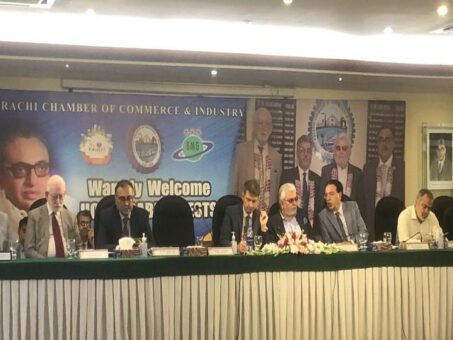
Karachi, March 14, 2022 – The Chairman of the Federal Board of Revenue (FBR), Dr. Muhammad Ashfaq Ahmed, emphasized the need for a shift in the approach to withholding tax (WHT), suggesting that it should be levied on income rather than transactions. He made these remarks during an address at the Karachi Chamber of Commerce and Industry (KCCI) on Monday.
ISLAMABAD: Pakistan on Sunday signed a new agreement on a framework to reconstitute the Reko Diq project and a pathway for Antofagasta to exit the project.
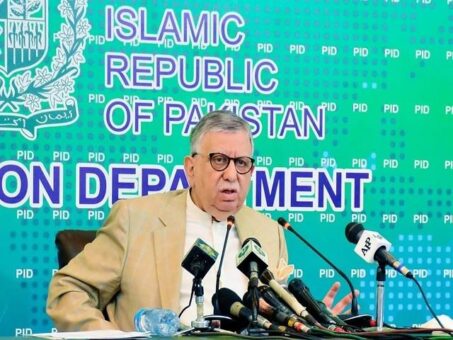
Finance Minister Shaukat Tarin said at a press conference. He said Governments of Pakistan and Balochistan, Antofagasta plc, and Barrick Gold Corporation have reached agreement in principle on a framework to reconstitute the Reko Diq project, and a pathway for Antofagasta to exit the project.
Addressing a hurriedly called press conference along with the Energy Minister Hammad Azhar and Chief Minister Balochistan Mir Abdul Quddus Bizenjo here, the minister said after the new development, Pakistan would not only avoid the $11 billion penalty but also get an opportunity of exploring the world’s largest gold and copper reserve.
He said some $10 billion would be invested under this project which would create 8000 new jobs for locals.
The minister said as per the new agreement, Barric Gold would retain 50 per cent share, while government of Balochistan would get 25 per cent share, and the rest 25 per cent share would be attributed to the State Owned Enterprises Oil and Gas Development Company (OGDCL), Pakistan Petroleum Limited (PPL), and Government Holdings Pakistan (GHPL).
Tarin said an agreement was signed in 2006 among a Canadian Company Barrick Gold, a Chilean company Antofagasta plc, and governments of Pakistan and Balochistan to extract gold and copper from the Reko Diq minses reserve.
As per the old agreement, 37.5 percent share each was given to the two foreign companies and 25 percent share was to given to Goverment of Blochistan.
The agreement was suspended in 2011 due to a dispute over the legality of its licensing process. As a result the International Court of Arbitration leveled $6.4 billion award on government of Pakistan while on the same time the London Court of Arbitration was also imposing another $4 billion fine on Pakistan.
He said soon after taking over the charge, Prime Minister Imran Khan aggressively pursued the case and directed to draw a suitable solution as early as possible.
As a result an agreement was settled today under which Antofagasta decided not to participate in the reconstituted project and withdrew from its claim of $3.9 billion in place of $900 million.
He informed that the $900 million would be paid by the three SOEs and in return they would get the 25 per cent share of the project.
Had the PM not taken his personal interest in the case, Pakistan would have to pay the huge amount of $11 billion as a penalty, he added.
Shaukat Tarin said Pakistan and Balochstan would be benefited for over 100 years from this project and the total worth is estimated to be over $100 billion.
Terming the new agreement as a land mark achievement for Pakistan, Hammad Azhar said it was a historic day as it had not only avoided $11 billion worth of penalty but also created a new opportunity for Pakistan.
He said this was not for first time the PTI government had achieved the landmark success, but it had also avoided the country from moving to FATF black list by implementing 32 out of 35 conditions. The government also saved billions of dollars by renegotiating the costly IPP agreements.
The minister informed that according to the Barrick Gold, Reko Diq was the only one part with such huge gold and copper reserves. There were also other reserves in the area.
So a lucrative mining cluster is going to be developed in Pakistan, he added.
Dr. Muhammad Ashfaq Ahmed, the Chairman of the Federal Board of Revenue (FBR), has drawn attention to the United Arab Emirates (UAE) as a preferred destination for parking offshore undisclosed funds by Pakistan nationals.
KARACHI: Pakistan’s Current Account Deficit (CAD) has widened to staggering above $12 billion during first eight months (July – February) 2021/2022, the State Bank of Pakistan (SBP) said on Saturday.
The current account was surplus by $994 million in the corresponding period of the last months, according to the balance of payment (BOP) issued by the SBP.
Primary reason behind bargaining current account deficit is extraordinary gap in national trade. The trade deficit widened by 82 per cent to $31.95 billion during the first eight months of the current fiscal year as compared with the deficit of $17.53 billion in the corresponding months of the last fiscal year.
Pakistan’s import bill registered an increase of 55 per cent to $52.5 billion during the period under review as compared with $33.86 billion in the same period of the last fiscal year. On the other hand, the exports also grew by 26 per cent to $20.56 billion in the first eight months of the current fiscal year as compared with $16.32 billion in the same period of the last fiscal year.
Meanwhile, workers’ remittances rose to $21 billion during July – February 2021/2022 as compared with $18.7 billion in the same period of the last fiscal year.
On the foreign investment front, the foreign direct investment (FDI) registered 6.1 per cent growth to $1.26 billion during first eight months of the current fiscal year as compared with $1.19 in the same period of the last fiscal year.
ISLAMABAD: The Federal Board of Revenue (FBR) has explained cash discount related to invoices issued through Point of Sale (POS) by Tier-1 retailers.
The FBR explained through an official note dated March 17, 2022 that cash discount has been allowed in the form of reduction of prices in seasonal sales / sales and the consideration in money is received after cash discount has been allowed.
It is clarified that the value of supply for sales tax purpose is the actual value received in monetary terms excluding the amount of sales tax and not the gross value. “Hence, the sales tax will be calculated and charged on the actual or discounted price accordingly,” the FBR added.
The revenue body said that representations from the taxpayers and bar councils were received seeking further clarification of the ‘trade discount’.
It said that value of supply as per section 2 (46) of the Sales Tax Act, 1990 in respect of taxable supply means the consideration in money which the supplier receives from the recipient for that supply but excluding the amount of tax.
In the previous explanation dated October 13, 2021, the FBR clarified that the discount if any to be given by a retailer has to be depicted on the invoice horizontally i.e. from left to right.
“The captions such as total, sales tax, discount allowed appearing at the bottom of the invoice are standalone notations and do not necessarily add or subtract one another.”
KARACHI: The total inflows of foreign investment into Pakistan has increased by 131 per cent to $1.85 billion during first eight months (July – February) 2021/2022, State Bank of Pakistan (SBP) said on Friday.
The net inflow of the foreign investment into Pakistan was $799 million in the same months of the last fiscal year.
The foreign public investment increased around eight times during the period under review due proceeds received under Sukuks. The inflows under debt securities jumped up to $905 million during July – February 2021/2022 as against outflow of $132 million in the same period of the last fiscal year.
Total foreign private investment is flat at 1.2 per cent to $943 million during first eight months of the current fiscal year as compared with $931 million in the corresponding months of the last fiscal year.
Total foreign direct investment (FDI) into Pakistan has posted an increase of 6.1 per cent to $1.26 billion during first eight months (July – February) 2021/2022. The flow of FDI was $1.19 billion in the corresponding period of the last fiscal year.
The portfolio investment recorded a 24 per cent increase in outflows to $315 million during first eight months of the current fiscal year as compared with the outflow of $254 million in the corresponding period of the last fiscal year.
KARACHI: Pakistan’s economy has maintained growth momentum in first quarter of fiscal year 2021/2022, which was begun during the preceding fiscal year, the State Bank of Pakistan (SBP) said in the first quarterly (July – September) 2021-2022 report on State of Pakistan Economy.
“Both the supply and demand sides contributed to this momentum. Broad-based expansion in large-scale manufacturing (LSM) and improved kharif crop outcomes reflected favorable supply-side dynamics; whereas strong sales of fast-moving consumer goods and cars, import volumes, energy consumption and consumer financing, indicated buoyancy on the demand side,” according to the report.
Higher economic activity contributed to improved tax revenues and a lower fiscal deficit. However, the substantial increase in global commodity prices contributed to in a build-up in inflationary pressures and a widening current account deficit, it added.
The SBP said the analysis and economic outlook of the report are based on data for the July-September 2021 period, and were finalized in November 2021, using data available as of then. As such, the report did not incorporate the rebasing of the large-scale manufacturing and GDP in January 2022.
The report notes that the continuation of the accommodative policy stance during the Jul-Sep 2021 period; SBP’s longstanding refinance schemes for exporting firms; and a growth-oriented Budget FY22 – contributed to LSM growth rising to 5.1 percent from 4.5 percent last year. Industries that benefited directly from the fiscal support – such as automobiles and construction-allied sectors – also posted higher growth. In agriculture, preliminary estimates for rice, sugarcane and cotton pointed to encouraging output levels.
On the monetary side, the availability of affordable credit played a major role in propping up industrial activity, especially in the wake of rising input costs. Commercial banks’ lending to private sector businesses rose by Rs.177.4 billion during Q1-FY22, compared to a net retirement of Rs.101.4 billion witnessed last year. Textiles, edible oil companies and oil refineries borrowed heavily for working capital, partly due to higher imported input costs.
For export-oriented industries like textiles, the Export Finance Scheme and the Long-Term Financing Facility, along with continued disbursements under the Temporary Economic Refinance Facility, allowed them to borrow at concessional rates for working capital and fixed investment purposes respectively.
The government and the SBP’s efforts to encourage housing finance – including via subsidized financing under the Mera Pakistan Mera Ghar (MPMG) scheme – began to yield desirable results as well. Banks approved Rs.72 billion in financing under MPMG by end-September 2021, out of which Rs.16.97 billion were disbursed. As a result, the outstanding stock of banks’ housing and construction finance had increased to Rs.305 billion by quarter-end, from Rs.166 billion a year earlier.
The report points out that this increased economic activity – coupled with rising imports, withdrawal of corporate income tax exemptions, increase in domestic prices, tax administration efforts and some budgetary measures – contributed to the sizable 38.3 percent growth in FBR taxes during Q1-FY22. The higher revenues allowed for a substantial rise in non-interest expenditures, stemming from an increase in development spending, purchase of Covid-19 vaccines, and power sector subsidies. As a result, the primary balance continued to remain in surplus. The fiscal position also materially benefited from the reduction in interest payments on both domestic and external debt. As a result, the fiscal deficit reduced to 0.8 percent of GDP from 1.0 percent last year.
At the same time, the report also notes that these macroeconomic gains were tested by the significant upswing in global commodity prices and shipping costs during the period. Despite some deceleration from last year, CPI inflation remained at an elevated level of 8.6 percent during Q1-FY22. The food group was the top contributor to headline inflation, amidst rising prices of edible oil, poultry, wheat and sugar. Meanwhile, the sharp rise in global oil prices contributed to higher energy inflation, despite the government’s decision to partially absorb the price hike by lowering taxes during Jul-Sep 2021.
The report points out that the surge in global commodity prices also played a dominant role in significantly pushing up import payments. The country’s import demand was also elevated amidst strong industrial activity, the need to import Covid-19 vaccines, and imports of capital equipment. The rise in export receipts and workers’ remittances, though quite encouraging, could not offset the increase in import payments. As a result, the current account deficit widened to US$ 3.5 billion in Q1-FY22, and these payment pressures led to the market-determined exchange rate depreciating by 7.7 percent against the US Dollar during the quarter.
In response to the pressures, the report notes that policymakers had to strike a careful balance. The primary concern was to avoid disrupting the ongoing economic momentum, especially given the heightened uncertainty created by the spread of the Delta variant-driven Covid-19 wave during the Jul-Sep 2021 period. These concerns had to be balanced against the external account pressures and expectations of higher inflation going forward. In response, the SBP’s Monetary Policy Committee modified its monetary policy stance by raising the policy rate by 25 basis points in its September 2021 meeting, after keeping rates unchanged during the July 2021 meeting. The SBP also undertook multiple regulatory measures to restrain import demand.
While the current account gap widened, the report highlights that the country’s external buffers remained intact, given the availability of higher external financing. The major financial flows came from the additional SDR allocation and tap issuance of Eurobonds. Furthermore, the Roshan Digital Accounts (RDAs) continued to attract interest from overseas Pakistanis, with inflows during Jul-Sep 2021 amounting to US$ 849 million, and cumulative inflows from inception reaching US$ 2.4 billion by end-September 2021. As a result, the SBP’s FX reserves increased by US$ 2.0 billion to US$ 19.3 billion by end-September 2021.
The report notes that the developments in the first quarter of FY22 highlight Pakistan’s susceptibility to global commodity price shocks, and the need for consistent policies at the sectoral level. Given the serious implications of the surging global palm and soybean oil prices on the external account and inflation, the Special Section in the report analyses the domestic oilseed sector in Pakistan. The section highlights that while reference to domestic oilseed development can be found as far back as in the country’s first Five-Year Plan (1955-60), the absence of a consistent policy and a dedicated and functional implementation agency over the years has steadily increased the country’s reliance on imports. The section concludes by providing policy recommendations to encourage domestic oilseed production.
The rupee was declining due political uncertainty and high commodity prices in the international markets.
Currency experts said that a no-confidence motion moved against the prime minister by the opposition parties had resulted in negative sentiments in the market.
They said that the dollar demand was also mounting due to import of commodities related to the holy month of Ramzan.
The import of petroleum products recorded over 100 per cent increase to $12.94 billion during the first eight months (July – February) 2021/2022 as compared with Rs6.44 billion in the corresponding months of the last fiscal year.
Furthermore, the fall in foreign exchange reserves also put pressure on the rupee value. The liquid foreign exchange reserves of the country slipped by $206 million to $22.669 billion by the week ended March 04, 2022 as against $22.875 billion a week ago.
KARACHI: The State Bank of Pakistan (SBP) has revised regulations related to housing loans and general loans mainly related to eligibility of borrowers.
The central bank on Wednesday issued a circular to revise Prudential Regulations for Microfinance Banks.
The SBP said that in order to align classification and provisioning requirements with enhanced loan sizes, it has been decided to revise Prudential Regulations R-5, R-8 and R-10 for MFBs as under;
Regulation R-5: Maximum Loan Size and Eligibility of Borrowers
Maximum loan sizes and borrowers’ income eligibility criteria shall be as under;
General Loans (Other than housing loans): The maximum size for general loans shall be up to Rs. 350,000/- to a poor person with annual income (net of business expenses) up to Rs. 1,200,000/-.
Housing Loans: The maximum size for housing loans shall be up to Rs. 3,000,000/- to a single borrower with annual income (net of business expenses) up to Rs. 1,500,000/-. Further, MFBs shall ensure to implement the following requirements:
(a) General Instructions
i) MFBs shall not allow housing finance purely for the purchase of land/plots; rather, such financing would be extended for the purchase of land/plot and construction on it.
ii) The sanctioned financing limit, assessed on the basis of repayment capacity of the borrower, value of land/plot and cost of construction on it etc. shall be disbursed in tranches.
iii) The amount disbursed for purchase of plot must not exceed the 90 per cent of the market value/cost of land/plot and 50 per cent of the financing limit. The remaining amount shall be disbursed for construction there-upon.
iv) MFBs will take a realistic construction schedule from the borrowers before allowing initial disbursement. For construction-only cases, the sanctioned financing shall also be released in tranches commensurate with the stage of construction.
v) In case of cost overrun, MFBs may entertain the customer for additional finance for completion of house, keeping in view the Debt Burden Ratio (DBR) and cushion in overall Loan-to-Value (LTV) ratio.
(b) Permission from Relevant Authorities
The MFBs shall not disburse housing finance unless ensured that prior permissions/clearances for construction/purchase of property from relevant authorities are available.
(c) Creation of Mortgage
The plot/house/flat financed by the MFBs shall be mortgaged in MFBs’ favour by way of equitable or registered mortgage.
(d) Loan to Value (LTV) Ratio
Loan to Value Ratio should not exceed 90 per cent.
(e) Risk Management and Internal Control Systems
Risk management framework, duly approved by the Board of Directors of MFBs, should appropriately cover housing finance. MFBs shall ensure strict compliance with their internal policies and procedures and those prescribed by SBP from time to time.
(f) Information Disclosure
MFBs shall clearly disclose all the important terms & conditions, fees, charges and penalties etc., which should, inter-alia, include annualized percentage rate, pre-payment penalties and the conditions under which they apply.
For the purpose of this regulation, Annualized Percentage Rate means as follows:
Mark-up for the period
X
365
x
100
Average outstanding principal amount during the period
No. of days
(g) Development of Financing Documentation
The MFBs shall prepare standardized set of financing and recourse documents, duly cleared by their legal counsels, comprising of financing agreement, application form and the other requisite supplementary documents.
(h) Title Documents
MFBs shall obtain all title and ownership related property documents from customers which should be clear and free from all encumbrances/legal charges and get these documents vetted by their legal department/advisor(s). MFBs shall provide a signed copy of the list of all title and property documents to the borrowers.
(i) Verification of Property-related Documents
MFBs shall verify necessary information provided in the application form. Accordingly, all title and other legal documents provided with application form shall be verified directly from the relevant issuing authorities. All the documents shall be kept in safe custody meeting all procedures/requirements.
(j) Property Assessment
MFBs shall ensure that a proper property valuation is done by their internal resources. However, properties valuing above Rs. 3.0 million shall be subject to assessment by valuator on approved panel of Pakistan Banks’ Association.
(k) Insurance/Takaful
MFBs may obtain insurance/takaful coverage of the housing unit financed through a reputable insurance/takaful company to sufficiently cover their risk.
(l) Monitoring of Market Conditions
The management of MFBs shall put in place a mechanism to monitor conditions in housing finance market at least on half-yearly basis to ensure that their policies are aligned with the current market conditions.
Microenterprise Loans:
The maximum size for microenterprise loans shall be up to Rs. 3,000,000/- to a single project or business. The MFBs shall extend the microenterprise loans only in the name of micro entrepreneurs to ensure traceability and reduce the incidence of multiple borrowing. However, the aggregate exposure against the microenterprise loans in excess of ceiling prescribed for general loans shall not exceed 40 per cent of the MFB’s gross loan portfolio.
Pre-requisites for Undertaking Microenterprise Lending:
Only those MFBs that are fully compliant with Minimum Capital Requirement (MCR) and Capital Adequacy Ratio (CAR) shall be eligible to undertake microenterprise lending.
i) MFBs interested to extend microenterprise loans exceeding ceiling prescribed for general loans shall develop related institutional capacity (products, credit risk management and monitoring system, trainings etc.) and submit detailed business plan of microenterprise lending to SBP for seeking necessary approval for pilot program. The SBP shall inter-alia evaluate the plan along with operational/financial performance, funding plan, supervisory assessment, and credit rating of the MFB, and accordingly grant permission for launching pilot program to the applicant MFB.
ii) During the pilot phase MFBs will have to ensure that their aggregate exposure against the microenterprise loans in excess of ceiling prescribed for general loans shall not exceed 20 per cent of the gross loan portfolio. The final approval for undertaking microenterprise lending on full/commercial scale shall be granted subject to satisfactory evaluation of pilot program.
iii) The enhanced loan size (up to Rs. 1,000,000/- and Rs. 3,000,000/- respectively) will be allowed to those MFBs which have graduated from pilot microenterprise lending programs (up to Rs. 500,000/- and Rs. 1,000,000/- respectively) to commercial scale. However, prior to extending microenterprise loans exceeding Rs. 500,000/- and Rs. 1,000,000/-, MFBs shall apply to Agricultural Credit & Microfinance Department, SBP for approval. SBP shall grant approval for pilot/commercial launch based on satisfactory assessment of the capital position and readiness level of the applicant MFB.
Miscellaneous
(a) Income Eligibility Assessment for General & Housing Loans:
While assessing income eligibility on individual borrowers (including salaried persons) for housing & general loans, MFBs shall ensure that the total installment of the financing facilities extended by the financial institutions is commensurate with monthly income and repayment capacity of the borrowers, such that total monthly amortization payments of financing facilities should not exceed 50 per cent of the net disposable income of the prospective borrowers. These measures would be in addition to MFBs’ usual evaluations of each proposal concerning credit worthiness of the borrowers, to ensure that their portfolio fulfills the prudential norms, instructions issued by the State Bank of Pakistan and does not impair the soundness and safety of the MFB itself.
(b) Consumption Financing against the Security of Gold:
In line with SBP’s instructions issued vide AC&MFD Circular No. 02 of 2015 (Annexure I, Para-2), MFBs may also extend loans against gold collateral for consumption purposes categorized as domestic needs/emergency loans. However, MFB’s aggregate loan exposure against the security of gold shall not exceed 35 per cent of its gross loan portfolio.
(c) Asset Liability Mismatches
MFBs shall prudently manage the maturity mismatches arising out of their housing and other long term financing portfolios by raising long-term funds for on-lending and vice versa.
Regulation R-8: Classification of Assets and Provisioning Requirements
A. Specific Provisioning:
The outstanding principal and mark-up of the loans and advances, payments against which are overdue, shall be classified as Non- Performing Loans (NPLs) as prescribed below:
Loan Categories
Time based Criteria for Classification of Assets and Provisioning Requirements
MFBs shall maintain a General Provision equivalent to 1.0 per cent of the net outstanding loans/advances. However, where the loans/advance have been secured against gold and/or other liquid assets, the general provisioning against outstanding amount net of such security shall be required.
C. General Instructions for Classification / Provisioning of all loan categories:
(a) Watch list
MFBs shall maintain a watch list of all overdue accounts before they are classified in terms of objective (time-based) criteria. However, such accounts may not be treated as NPLs for the purpose of classification / provisioning.
(b) Government Guaranteed Loans
Classified loans/ advances that have been guaranteed by the Government would not require provisioning to the extent of guaranteed portion. However, markup/ interest on such accounts would be taken to Memorandum Account instead of Income Account.
(c) Subjective Classification
i) In addition to the time-based criteria prescribed in this regulation, subjective evaluation of performing and non-performing credit portfolio may be made for risk assessment purposes and, where necessary, any account including the performing account can be classified. In this case, the category of classification determined on the basis of time based criteria can be further downgraded.
ii) Classification for program-based lending shall be based on objective (time-based) criteria only, though MFBs, at their own discretion, may also classify such portfolio on subjective basis.
iii) To strengthen subjective classification, MFBs may consider financial standing of guarantors.
(d) Reversal of Specific Provisions
In case of recovery against classified loan, other than rescheduling / restructuring under R-9 of PRs for MFBs, MFBs may reverse/adjust specific provision held against classified assets.
(e) Quarterly Review
MFBs shall review, at least on a quarterly basis, the collectability of their loans / advances portfolio and shall properly document the evaluations so made. Shortfall in provisioning, if any, shall be provided for immediately.
(f) Benefit of Forced Sale Value:
MFBs can avail the benefit of Forced Sale Value (FSV) of collateral held against loans / advances as under:
i) Profit arising from availing the benefit of FSV shall not be available for the payment of cash or stock dividend.
ii) The heads of Credit and Risk of respective MFBs shall ensure that FSV used for taking benefit of provisioning is determined accurately and is reflective of market conditions under forced sale situations.
iii) Borrower-wise details of such cases shall be maintained for verification by SBP. In case of misuse of this facility, SBP may also withdraw the benefit of FSV from the concerned MFB.
(g) Responsibility of the External Auditors
The external auditors shall, as part of their annual audits of MFBs, verify that all requirements, as stipulated in this regulation for classification and provisioning, have been complied with.
The intent of ‘charge-off’ is to clear the balance sheet of MFBs, and this shall in no way extinguish the MFBs’ right of recovery of such loans. NPLs shall be charged off as prescribed below:
Loan Categories
Criteria for Charging Off NPLs
General/Unsecured Loans
NPLs shall be charged off, one month after being classified as “Loss.”
Housing Loans
NPLs shall be charged off, one month after 05 years from the date of classification of financing.
Microenterprise Loans
NPLs secured against Mortgaged residential, commercial and industrial properties (Land & building only) shall be charged off, one month after 05 years from the date of classification. All other NPLs shall be charged off, one month after 03 years from the date of classification.
Note: Charge-off means reducing the value of the loans in ‘loss’ category to zero through offsetting the provisions, thus, removing such loans from the balance sheet.
4. Definitions. To add clarity, following terms have been defined:
(a) Housing Finance means financing provided to individuals for the construction, purchase of residential house/apartment and for purchase of plot and construction thereupon. Financing availed for the purpose of making improvements in house/apartment shall also fall under this category.
(b) Mortgage means transfer of an interest in specific immovable property for the purpose of securing the payment of money advanced or to be advanced by way of loan or finance.
(c) Liquid Assets means assets which are readily convertible into cash without recourse to a court of law and mean encashment/realizable value of government securities, bank deposits, gold ornaments, gold bullion, certificates of deposit, shares of listed companies which are actively traded on the stock exchange, NIT Units, certificates of mutual funds, certificates of investment (COIs) issued by DFIs/NBFCs rated at least ‘A’ by a credit rating agency on the approved panel of SBP, listed TFCs rated at least ‘A’ by a credit rating agency on the approved panel of SBP and certificates of asset management companies for which there is a book maker quoting daily offer and bid rates and there is active secondary market trading. These assets with appropriate margins should be in possession of the MFBs with perfected lien.
(d) Secured means exposure backed by liquid assets, pledged stock, mortgage of land, plant, building, machinery or any other fixed assets, hypothecation of stock (inventory), trust receipt, assignment of receivable, lease rentals, and contract receivables but does not include hypothecation of household goods.