Blog

  • Rate of capital gains tax on disposal of securities

    Rate of capital gains tax on disposal of securities

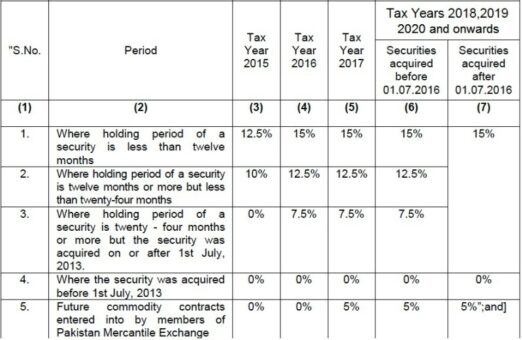
    KARACHI: Following is the rate of capital gains tax on disposal of securities after the amendment made through Finance Act, 2020.

    Officials at the Federal Board of Revenue (FBR) said that the rate of capital gains tax had been kept unchanged for tax year 2021 and subsequent years.

    cgt on disposal of securities.jpg

    Provided that the rate of tax on cash settled derivatives traded on the stock exchange shall be 5 percent for the tax years 2018 to 2020.

    Provided that the rate for companies shall be as specified in Division II of Part I of First Schedule, in respective of debt securities;

    Provided further that a mutual fund or a collective investment scheme or a REIT scheme shall deduct Capital Gains Tax at the rates as specified below, on redemption of securities as prescribed, namely:—

    CategoryRate
    Individual and association of persons10 percent for stock funds 10 percent for other funds
    Company10 percent for stock funds 25 percent for other funds

    Provided further that in case of a stock fund if dividend receipts of the fund are less than capital gains, the rate of tax deduction shall be 12.5 percent:

    Provided further that no capital gains tax shall be deducted, if the holding period of the security is more than four years.”

    Explanation.- For removal of doubt, it is clarified that, the provisions of this proviso shall be applicable only in case of a mutual fund or collective investment scheme or a REIT scheme.

  • KE starts updating information of industrial, commercial consumers for tax purpose

    KE starts updating information of industrial, commercial consumers for tax purpose

    KARACHI: K-Electric has launched updating details of industrial and commercial consumers, which is mandatory under income tax law.

    The company, which is providing electricity to 2.5 million consumers including residential, commercial, industrial and agriculture, has asked the consumers to update their details through an electronic form along with providing details of CNIC and NTN.

    The K-Electric said that pursuant to Section 181AA of Income Tax Ordinance, 2001 all entities with industrial and commercial electricity connections are required to maintain a National Tax Number (NTN) issued by the Federal Board of Revenue (FBR).

    In order to comply with the above-mentioned law, KE is updating its customer information database and in this regard we request you to share your NTN and CNIC numbers at earliest for our record.

    The power utility asked the consumers to provide details, included: name, CNIC, consumer number, mobile number, NTN, email address and occupancy.

  • Power generation eases by one percent in FY20

    Power generation eases by one percent in FY20

    KARACHI: Power generation in Pakistan declined by one percent YoY to 121,867 GWh (23,618 MW) during FY20 as compared to 122,708 GWh (23,781 MW) in FY19 due to overall slow economic activity during the year and the impact of COVID-19 related lockdowns and restrictions during Mar-May 2020, analysts said on Thursday.

    The analysts at Topline Securities said that power mix during FY20 moved in favor of Hydel (32 percent in FY20 against 26 percent in FY19) and Coal (21 percent in FY20 against 13 percent in FY19), replacing Gas (12 percent in FY20 against 18 percent in FY19) and Furnace Oil based generation (3 percent in FY20 against 7 percent in FY19).

    RLNG contributed 20 percent to the overall power mix, with Nuclear and Wind based generation clocking in at 8 percent and 2 percent, respectively during the year.

    Coal power generation has increased due to the commencement of China Hub Power Generation (1,220 MW) and Engro Powergen Thar (660 MW), while Hydel power generation increased due to improved availability of water amidst higher water availability during the year.

    The demand for Furnace Oil and Gas based power fell due to their higher cost of producing power, which resulted in their respective decline in merit order list.

    The installed Capacity in the country touched 34,157MW in Jun-2020 compared to 30,590 MWin Jun-2019.

    Power Generation started to decline in Mar-2020 (down by 9 percent YoY to 6,911 GWh from 7,621 GWh in Mar-2019) largely due to COVID-19 related lockdowns and restrictions.

    A similar trend was also witnessed in Apr-2020 and May-2020 as Power Generation declined by 14 percent YoY and 5 percent YoY, respectively.

    However, encouragingly Power Generation has picked up, though up 1 percent YoY, it is has almost double (+92 percent) from the low recorded in Mar-2020.

    With industries opening up post COVID-19 lockdown and subsequent pick up in economic activity, we expect demand for Power to increase from here forth.

    The average fuel cost was down by 3 percent YoY to Rs5.97/KWh in FY20 compared to Rs6.13/KWh in FY19.

    This is mainly due to increase in Hydel based generation by 20 percent YoY (no fuel cost) and increased in coal based power generation at a lower cost of Rs6.1/Kwh.

  • Foreign exchange reserves increase to $19.047 billion

    Foreign exchange reserves increase to $19.047 billion

    KARACHI: Pakistan’s liquid foreign exchange reserves have increased by $95 million to $19.047 billion by week ended July 17, 2020, State Bank of Pakistan (SBP) said on Thursday.

    The foreign exchange reserves of the country were at $18.952 billion by week ended July 10, 2020.

    The official reserves held by the central bank increased by $66 million to $12.121 billion by week ended July 17, 2020 as compared with $12.055 billion a week ago.

    Similarly, the foreign exchange reserves held by commercial banks improved by $29 million to $6.926 billion from $6.897 billion a week ago.

  • Stock market falls by 226 points on selling pressure

    Stock market falls by 226 points on selling pressure

    KARACHI: The stock market witnessed decline of 226 points on Thursday owing to selling pressure prevailed during the day.

    The benchmark KSE-100 index of Pakistan Stock Exchange (PSX) closed at 37,578 points as against 37,804 points showing a decline of 226 points.

    Analysts at Arif Habib Limited said that the market had an exciting session, which resulted in quite some fluctuation between positive and negative throughout the day and closed the session -226 points.

    Selling pressure was mainly observed in Cement, Steel, Pharma, OMCs etc. which caused the market to plunge.

    Banking sector stocks, MCB, HBL, UBL saw buying activity that helped Index balance a bit, however, selling pressure eroded the gains posted by Banking sector stocks.

    During the session, market went up by 302 points but lost these gains and declined by 264 points. Textile sector led the volumes with 41.4 million shares, followed by Vanaspati (38.1 million) and Technology (34.1 million).

    Among scrips, UNITY topped the volumes with 38.1 million shares, followed by ANL (31.2 million) and FFL (23.4 million).

    Sectors contributing to the performance include Banks (+21 points), Inv Banks (+12 points), Cement (-116 points), Power (-36 points), E&P (-30 points), O&GMCs (-24 points), Pharma (-22 points).

    Volumes declined from 405.5 million shares to 379.3 million shares (-6 percent DoD). Average traded value also declined by 21 percent to reach US$ 84.0 million as against US$ 106.2 million.

    Stocks that contributed significantly to the volumes include UNITY, ANL, FFL, KEL and HASCOL, which formed 35 percent of total volumes.

    Stocks that contributed positively to the index include MTL (+19 points), MCB (+18 points), DAWH (+14 points), INDU (+9 points) and UBL (+8 points). Stocks that contributed negatively include LUCK (-55 points), HUBC (-36 points), PPL (-25 points), ENGRO (-15 points), and DGKC (-14 points).

  • Complaints against banks double in four years: SBP

    Complaints against banks double in four years: SBP

    KARACHI: The State Bank of Pakistan (SBP) on Thursday said that complaints against banks have doubled in four years owing to effective dispute resolution and awareness of consumers.

    The SBP said that the complaints against banks during past four years have increased from 774,656 in 2016 to 1,549,837 in 2019.

    State Bank of Pakistan (SBP) has conducted a four year (2016-2019) review of complaints against Banks/MFBs/DFIs. The objective of the review was to gain insights on effectiveness of complaint management at banks.

    The salient features of the review are being published to emphasize SBP’s narrative that responsible complaint handling is the core element of Fair Treatment of Consumer (FTC).

    This review is conducted in addition to various regulatory measures to enhance consumer grievance handling in the industry including the issuance of detailed guidelines on complaint management at banks and self-assessment framework.

    It is pertinent to mention here that responsible banking conduct and FTC is one of the key regulatory agendas of the State Bank of Pakistan (SBP).

     SBP recognizes that effective and efficient consumer grievance handling mechanisms are crucial elements of FTC regime, therefore, it considers consumer complaints as an opportunity to improve banking services and increase customer satisfaction.

    This increase can be attributed to improved visibility and access of dispute resolution mechanism coupled with enhanced consumer awareness. Further, this is also due to the fact that number and value of banking transactions have increased substantially.

    For instance, the volume and value of ATM/debit card transactions have increased by 101 percent and 110 percent respectively over the reporting period.

    The number of deposit accounts per ATM and per branch shows increase of 62 percent and 81 percent respectively. Similarly, during 2016 to 2019, volume and value of E-banking transactions have substantially increased by 112 percent and 152 percent respectively on account of 71 percent increase in E-banking users.

    Moreover, credit card related transactions increased from 18 to 39 million showing an increase of 118 percent over a span of 4 years. Accordingly, the increase in complaints over the same period can be witnessed as concentrated in ATM/Debit Card, Account maintenance, E- Banking and Credit Cards.

    In terms of addressing the complaints, the resolution rate over the period 2016-2019 remained above 97 percent at each year’s end.

    The average time taken for resolution of complaints remained within regulatory turn around times. However, delays were observed in sending acknowledgments, interim and final responses.

    It may be mentioned here that banks being the first forum of redressal, have been handling 97 percent and above of the total complaints of the industry while less than 3 percent of complaints were escalated at higher levels including State Bank of Pakistan, Banking Mohtasib, and Pakistan Citizen Portal established by the Prime Minister Delivery Unit.

    In order to boost performance of complaint handling at banks and promote competition, SBP plans to further enhance the related disclosures which may include publishing of bank-wise complaint handling performance indicators in the near future by SBP.

    Currently, banks themselves are required to give disclosure about the complaint management in their annual audited account for public information.

  • Rupee ends firmer against dollar

    Rupee ends firmer against dollar

    KARACHI: The Pak Rupee ended firmer against dollar on Thursday as sufficient inflows of the foreign currency were available to meet import payment demand.

    The rupee ended Rs167.62 to the dollar from previous day’s closing f Rs167.63 in interbank foreign exchange market.

    Currency experts said that after ease in lockdown which resulted in improved economic activities the demand for foreign currency was increased especially for the import payment.

    They however said that the inflows in terms of remittances and export receipts helped the rupee to maintain levels.

    The workers’ remittances rose by a significant 50.7 percent during June 2020 to reach monthly record high $2.46 billion compared with $1.63 billion in June 2019.

    Similarly, on a cumulative basis, workers’ remittances increased to a historic high level of $23.12 billion during FY20, witnessing a growth of 6.4 percent over $21.74 billion during FY19.

    According to Pakistan Bureau of Statistics (PBS) the import bill of the country fell by 18.6 percent to $44.57 billion as compared with $54.76 billion in the preceding fiscal year.

    This helped the country to curtail the trade deficit for the year. The trade deficit of the country shrank by 27 percent to $23.18 billion during fiscal year 2019/2020 as compared with the deficit of $31.8 billion in the preceding fiscal year.

  • Persons not on ATL to pay advance tax on educational fee

    Persons not on ATL to pay advance tax on educational fee

    ISLAMABAD: Persons not appearing on Active Taxpayers List (ATL) are liable to pay advance income tax at the time of paying educational fee.

    Officials at Federal Board of Revenue (FBR) said that through Finance Act, 2020 the condition of paying advance tax under Section 236I of Income Tax Ordinance, 2001 on educational fee had been abolished for persons appearing on ATL.

    However, those persons not appearing on ATL shall remain required to pay advance income tax on payment of educational fee.

    Similarly, the educational institutions are required to provide details of those persons who are not ATL and making fee above Rs200,000 per annum.

    The rate of collection of tax under section 236I shall be 5 percent of the amount of fee for persons not appearing on ATL.

    The collection of advance income tax on payment of educational fee was introduced through Finance Act, 2013. The purpose of introducing the advance tax on such transaction was to bring those people into tax net who have taxable income but not paying their tax liability.

    The FBR officials said that after changes brought through Finance Act 2020, only those persons who are not on the ATL shall pay advance income tax.

    However, this tax shall be adjustable against income tax liability in case that person files his income tax return and ensure his name on the ATL.

  • LTU Karachi to hold e-Katcheri on July 24

    LTU Karachi to hold e-Katcheri on July 24

    KARACHI: Large Taxpayers Unit (LTU) Karachi will hold e-Katcheri on July 24, 2020 for efficient service delivery and ensure public trust.

    The program has been launched in compliance with the directive of the prime minister to conduct e-Khuli Katcheri to stay in contact with the public by all available means and provide them accessible platform to raise their issues for timely resolution.

    In this regard Badaruddin Ahmed Qureshi, Chief Commissioner Inland Revenue, LTUK Karachi will conduct e-Khuli Katcheri on Friday from 11:30 AM to 12:30 noon through Zoom video link.

    The taxpayers facilitation wing of the FBR recently circulated about the program directing that e-Katcheri would be conducted by every tier of FBR in the second week of every month on regular basis.

    The FBR directed all the tax offices to ensure that all proceedings of the e-Katcheri are property recorded and tasks should be assigned to concerned officers accordingly.

    The tax offices have also been directed to submit performance report on the outcome of the meeting with public.

    In the wake of COVID-19, the tax authorities shall conduct one e-Katcheri at all tiers of FBR in the second week of every month. In the backdrop of COVID-19, only e-Katcheris shall be conducted for the time being until normalcy of the situation.

  • SBP enhances financing limit to Rs2 billion for renewable energy schemes

    SBP enhances financing limit to Rs2 billion for renewable energy schemes

    KARACHI: The State Bank of Pakistan (SBP) has increased cumulative financing limit to Rs2 billion and also enhanced project size to 5MW.

    According to a statement issued on Wednesday, the central bank said it had enhanced the scope of its Refinance Scheme for Renewable Energy by allowing financing under category III of the scheme to solar and wind based energy sale companies.

    In light of the feedback received from stakeholders, the size of the project established by vendor/ supplier/ energy sale company has been enhanced from 1 MW to 5 MW. Accordingly, the cumulative financing limit has also been increased from Rs.1 billion to Rs.2 billion.

    SBP Financing Scheme for Renewable Energy was announced in June 2016with an aim to help addressing the challenges of energy shortages and climate change in the country.

    The scheme comprised of two categories: Category 1 allowed financing for setting up of renewable energy power projects with capacity ranging from 1 MW to 50 MW for own use or selling of electricity to the national grid or combination of both.

    Category II allowed financing to domestic, agriculture, commercial and industrial borrowers for installation of renewable energy based projects/ solutions of up-to 1 MW to generate electricity for own use or selling to the grid/distribution company under net metering.

    Later, in July 2019, SBP introduced a new Category III for facilitating financing to vendors/suppliers for installation of wind and solar systems/solutions of upto 1 MW. SBP also launched a Shariah complaint version of the scheme in August 2019.

    Since the introduction of the scheme, total outstanding financing under the Scheme has reached to Rs.15.6 billion for 217 projects having potential of adding 292 MW of energy supply.

    This revision in the scheme is expected to not only attract fresh local and foreign investment in the sector but also facilitate production of clean energy in the country, helping in managing climate change.