Blog

  • Reduction in rental income expense limit to encourage under-reporting

    Reduction in rental income expense limit to encourage under-reporting

    Presently, expenses incurred to the extent of 6 percent of rent chargeable wholly and exclusively for deriving rent are admissible as deduction against rental income.

    The Bill proposed to reduce the limit from 6 percent to 2 percent.

    The experts said that further reducing such limit would deprive a taxpayer for claiming a legitimate expense incurred solely for deriving taxable income and would ultimately lead to higher tax payable by the taxpayer. “It may encourage taxpayers to under-report their taxable income on the grounds that their legitimate expenses are disallowed,” experts at Deloitte Yousuf Adil Chartered Accountants said.

    Presently, income from property derived by an individual or an Association of Persons is subject to tax at the specified slab rates and treated as a separate block of income.

    However, individuals or AOPs whose income from property exceeds Rs 4 million per annum can opt to claim deductions under section 15A of the Ordinance and pay tax at normal rates specified in Division I of Part I of the First Schedule.

    The Bill proposed to abolish such limit of Rs. 4 million and therefore an individual or AOP can now opt for claiming tax deductions and pay tax at normal rates irrespective of amount of income derived from property.

  • PRA empowered to arrest tax defaulters, imprison for six months

    PRA empowered to arrest tax defaulters, imprison for six months

    LAHORE: Punjab Revenue Authority (PRA) has been empowered to arrest defaulters and imprison for six months for making recovery of outstanding tax.

    The Punjab Finance Bill, 2020 has proposed to empower PRA in certain provisions of Punjab Sales Tax Act, 2012 for making recovery of outstanding tax.

    According to interpretation of Punjab Finance Bill, 2020 by PwC A. F. Ferguson, the bill proposes to empower tax authorities whereby they may also require a financial institution or banking company to make payment of tax due from a registered person out of running and demand finance extended to the registered person.

    By way of insertion of clause (g) to section 70 of the Act, it also empowers the department to arrest a defaulter and imprison him for not more than six months where a tax demand has been upheld by the Appellate Tribunal.

    No action is presently taken where a person deposits at least 25 percent of the tax demand during pendency of an appeal. It is proposed to reduce this limit to 10 percent of the tax demand. This is a positive amendment.

    The amendments relating to administrative and procedural matters are summarized as under:

    — The power of the PRA to de-register a person is proposed to be devolved to the Commissioner.

    — The PRA is being authorized to specify format of invoices to be issued by a registered person or class of registered persons and to prescribe a procedure for authentication of such invoices.

    — The PRA or authorized officer may require any registered person or class of registered persons to issue invoices electronically and transmit such invoices to PRA in the prescribed manner.

    — To streamline audit proceedings, it is proposed to empower officers to conduct audit proceedings electronically through video links or any other facility as may be notified by PRA.

    — It is proposed to empower even officers, below the rank of an Assistant Commissioner, to call for information or documents regarding any enquiry or audit.

    Earlier, only an Assistant Commissioners or Officers with higher ranks may call for such information.

    — To facilitate taxpayers, it is proposed that appeal before the Commissioner (Appeals) may also be filed through electronically.

    — The period of filing an appeal before the appellate tribunal is proposed to enhance from 30 days to 60 days.

  • Punjab enlists records to be maintained by taxpayers

    Punjab enlists records to be maintained by taxpayers

    LAHORE: The service providers falling under the jurisdiction of Punjab Revenue Authority (PRA) are required to maintain records enlisted through provincial Finance Bill, 2020.

    (more…)
  • ECC extends SBP’s refinance scheme with additional benefits

    ECC extends SBP’s refinance scheme with additional benefits

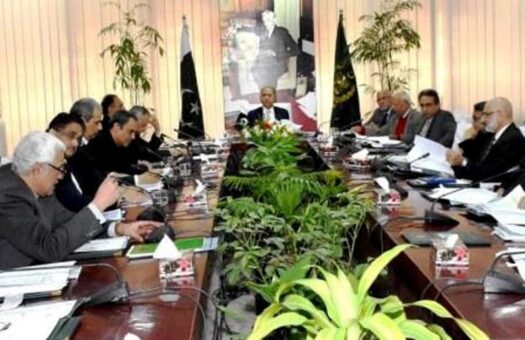
    ISLAMABAD: The Economic Coordination Committee (ECC) of the Cabinet on Wednesday approved extension to the refinancing scheme of the State Bank of Pakistan (SBP) up to September 30, 2020 from June 30, 2020.

    A statement said that the ECC approved the “Risk Sharing Facility for SBP Refinance Scheme to support employment and prevent layoff of workers.

    The scheme supports provision of credit at concessional rate to businesses that commit not to lay off workers till September 2020 (earlier the cutoff date was June 30, 2020), the loss coverage for SME sector has been increased to 60 percent from the existing 40 percent to promote greater take up at the smaller level of business.

    Under the new changes the borrowers having turnover up to Rs800 million can avail benefit of the scheme; earlier, for the eligibility of the scheme, the turnover limit was up to Rs 2 billion).

    Adviser to the Prime Minister on Finance and Revenue Dr. Abdul Hafeez Shaikh chaired the ECC meeting at the Cabinet Division.

    ECC approved the following technical supplementary grants:

    1) Rs.3.2 billion for PIACL (Pakistan International Airline corporation Limited) to discharge the obligations on account of markup against GoP guaranteed loans.

    2) Rs25,206,953 in favor of Pakistan Academy for Rural Development (PARD) Peshawar for the current financial year.

    3) Rs. 1300 million to Pakistan Atomic Energy Commission to discharge its various liabilities

    4) Rs 235 million to Deputy Commissioner Islamabad for making payment of internal security duty allowance to troops of Pakistan Rangers (Punjab) deployed in Islamabad

    5) Rs 500 million to the Ministry of Information and Broadcasting to meet the expenditure of media campaign on Covid-19

    6) Rs 100 million for National Disaster Management Authority (NDMF) for procuring equipment for locust control in Punjab

    7) Rs 7.947 billion to NDMA on account of procurement of emergency equipment through Pakistan Foreign Mission in China (Ex-post Facto approval on account of Pakistan National Emergency Preparedness and Response for Covid-19, procurement of equipment and transfer of funds)

    8) Rs.4.5 billion for the capacity building of Civil Armed forces as requested by the Ministry of Interior

    9) Rs.80 million for Competition Commission of Pakistan for different expenses

    10) Rs 100 million for the purchase of kerosene oil by Head Quarters Frontier Corps KP (North) to be used in different locations posts (8000 feet and above)

    11) Rs.8.093 million for the Privatization Division for employee related expenditure

    12) Two TSGs amounting to Rs 1192.325 million and Rs 358.506 million for Ministry of Federal Education and Professional Training for the Award of Scholarships to Afghan students ECC also granted approval for book value adjustment of overdue amount of loans amounting to Rs 30.807 billion to Earth Quake Reconstruction and Rehabilitation Authority over and above its allocated development and non-development budget.

    It also allowed, on the recommendation of the committee earlier constituted by ECC, to convert two relent Chinese loans in to Government loans keeping in view the subsuming of ERRA into NDMA and ERRA being non-profit/ non revenue generating entity. ECC also approved the “handing over of Pakistan Machine Tool Factory to Strategic Plans Division.

    For the purpose of operationalization of PMTF, Rs 500 million shall be provided to SPD as a loan.

    The Federal Government shall pay all the liabilities accrued till the transfer of management control of PMTF to SPD, after partial settlement of liabilities of Rs 1.78 billion.

  • SBP, banks discuss Naya Pakistan Housing Program

    SBP, banks discuss Naya Pakistan Housing Program

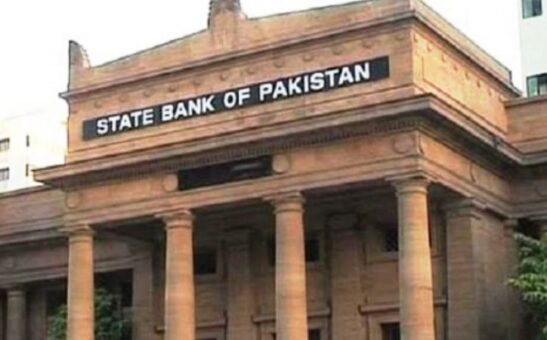
    KARACHI: Governor State Bank of Pakistan (SBP) Dr. Reza Baqir called a meeting of Banks on Wednesday for deliberations on the measures proposed by Naya Pakistan Housing and Development Authority (NAPHDA) and identify way forward to ensure sustainable market-led financing of housing projects and mortgages.

    The meeting was chaired by the SBP Governor Dr. Reza Baqir, and attended by Chairman NAPHDA, Lt. General Anwar Ali Haider, and members of the think tank formed by the government including Shaukat Tareen, Arif Habib and Aqeel Karim Dhedhi among others.

    Banks were represented by their respective presidents.

    The SBP governor at the outset praised the work of Lt. General Anwar Ali Haider and NAPHDA for its significant potential contribution in meeting the shortage of housing in the country and accelerating economic activity in the country.

    He said that housing finance has not only remained under-developed in Pakistan as compared with other emerging economies but seen little progress over time. In this regard, therefore, this initiative is of great national interest.

    He emphasized that the construction and housing sectors have strong linkages with the rest of the economic sectors and offer a commercially viable and long term business proposition for banks.

    He also stressed that supporting economic activity in these sectors would support economic growth and particularly employment in current times of economic stress.

    He encouraged banks to view housing and construction finance as an opportunity to broaden their balance sheet and cater to the huge financing needs of the sector.

    The SBP governor reiterated central bank’s commitment to play a facilitative and supportive role while also supporting a healthy credit culture in the country.

    Chairman NAPHDA made a presentation to the banks on the key features of Naya Pakistan Housing Program. He shared the details of the underlying development model for the successful implementation of the initiative.

    Complementing the presentation, Shaukat Tarin, member of the government’s think tank, presented a financial model and elaborated the incentives being offered by the government and emphasized that these will make the financing of developers and mortgages commercially attractive for banks.

    The presidents of banks in their deliberations appreciated the Naya Pakistan Housing Program and expressed their readiness for participating in this initiative of national importance.

    They also made queries and suggestions in this regard. It was decided that banks, NAPHDA, and SBP would work together to prepare an overall roadmap and execution plans with support from the relevant sub-committees of Pakistan Banks Association.

  • SBP suspends service charges to facilitate banks

    SBP suspends service charges to facilitate banks

    KARACHI: The State Bank of Pakistan (SBP) on Wednesday announced temporary suspension of 0.12 percent service charges levied on banks against deposit of re-issuable balance.

    Through FD Circular No. 03/2015, dated August 26, 2015, 0.12 percent service charges have been levied on the banks against deposit of re-issuable balances with SBP BSC offices or NBP chest branches.

    In order to facilitate the banks in managing the excess liquidity, consequent to large volumes of withdrawals on the eve of Eid and the COVID-19 pandemic, it has been decided to extend the temporary suspension of 0.12 percent service charges on deposit of re-issuable balances with SBP BSC offices or NBP chests branches.

    Accordingly, banks can deposit re-issuable balances with SBP BSC offices or NBP chests without levy of 0.12 percent service charges on deposit of re-issuable balances till June 30, 2021.

  • Equity market declines by 170 points on political uncertainty

    Equity market declines by 170 points on political uncertainty

    KARACHI: The equity market ended down by 170 points on Wednesday owing to uncertainty after a political party announced to leave government coalition.

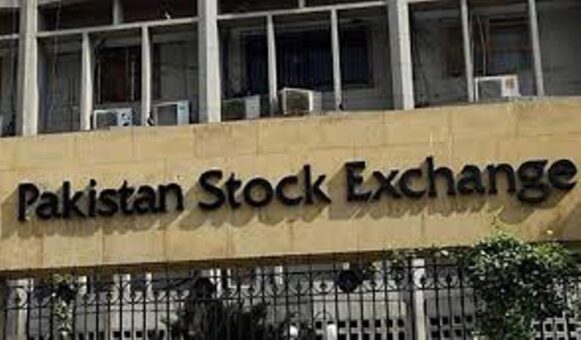
    The benchmark KSE-100 index of Pakistan Stock Exchange (PSX) closed at 33,849 points as against 34,019 points showing a decline of 170 points.

    Analysts at Arif Habib Limited said that the market made a strong come back today by registering an increase of 377 points, however, BNP Mengal’s decision to leave PTI Coalition government caused jitters in the market.

    The index lost all the gains made during the session and sustained a loss of -243 points, closing the session -170 points.

    Political uncertainty amid Corona crisis and border skirmishes between China and India have cumulatively dented the investor sentiment for the moment.

    Rupee parity also crossed 165 during the day, whereas international crude prices also picked pace, which in turn caused E&P stocks to post gains. Vanaspati sector topped the volumes with 43.9 million shares, followed by Inv Banks (35.5 million) and Chemical (34.8 million).

    Among scrips, UNITY led the volumes with 43.9 million shares, followed by JSCL (28.9 million) and PRL R1 (13.8 million).

    Sectors contributing to the performance include Banks (-77 points), Cement (-50 points), Fertilizer (-42 points), O&GMCs (-15 points) and Technology (-9 points).

    Volumes increased from 217.9 million shares to 340.8 million shares (+56 percent DoD). Average traded value also increased by 55 percent to reach US$ 61.0 million as against US$ 39.4 million.

    Stocks that contributed significantly to the volumes include UNITY, JSCL, PRLR1, AGL and NRSL, which formed 32 percent of total volumes.

    Stocks that contributed positively to the index include NESTLE (+10 points), HUBC (+10 points), OGDC (+10 points), SEARL (+9 points) and PMPK (+8 points). Stocks that contributed negatively include MCB (-42 points), ENGRO (-26 points), UBL (-25 points), FFC (-17 points), and HBL (-15 points).

  • Sindh Budget 2020-2021 at a glance

    Sindh Budget 2020-2021 at a glance

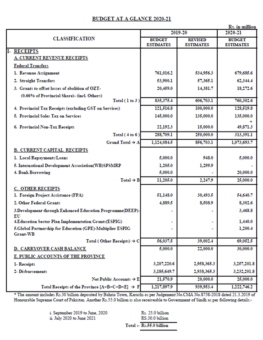
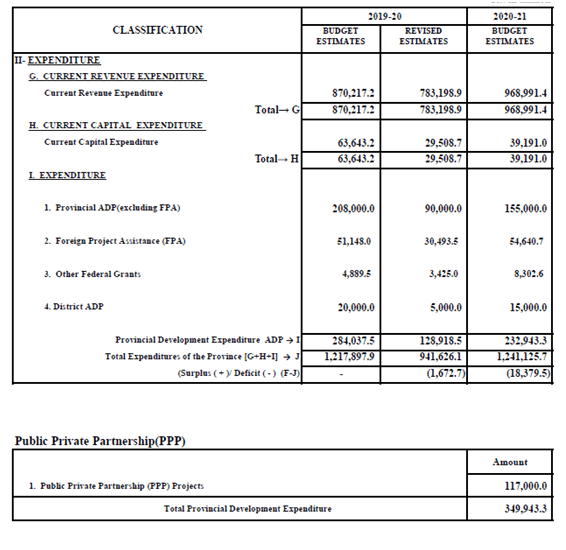
    KARACHI: The Sindh government on Wednesday presented budget for fiscal year 2020/2021. The following is budget at a glance:

  • Sindh unveils Rs1.2 trillion budget 2020/2021 with no new tax, 10 percent salary increase

    Sindh unveils Rs1.2 trillion budget 2020/2021 with no new tax, 10 percent salary increase

    KARACHI: Sindh Chief Minister Syed Murad Ali Shah on Wednesday presented Rs1.2 trillion provincial budget 2020/2021 with announcing no new tax and increase of 10 percent salary of the provincial government employees.

    On the floor of the house while delivering speech for budget 2020/2021, the chief minister said that the total outlay of budget for the next financial year 2020-2021 is Rs.1.2 trillion.

    The total size of current revenue expenditure is Rs.968.9 billion.

    “It is important to highlight here that for the next financial year, we have tried to align our Development as well as non-development expenditure priorities in line with the post COVID-19 situation,” the chief minister said.

    He said that during financial year 2019-20, the province faced financial constraints due to COVID-19 which significantly affected development progress in the entire country. Sindh was no exception.

    Government of Sindh budgeted Rs.284 billion as total development outlay in financial year 2019-2020, wherein Rs.208 billion were earmarked for Provincial ADP, Rs.20.0 billion for District ADP, Rs.51.0 billion in foreign projects assistance, and Rs.4.9 billion from Federal PSDP grant.

    Looking at the financial constraints, stakeholder departments are likely to complete 425 schemes during 2019-20, 33 schemes less as compared to 458 completed in 2018-19.

    “For the next financial year 2020-2021, the Administrative Departments in Sindh were earlier advised to prepare proposals for Provincial ADP 2020-21 at the size same as that of 2019-20 while allocating 85 percent for on-going schemes and 15 percent new schemes.

    “However, in a post Covid-19 scenario, with a reduction in federal transfers and funding for development, the total development outlay for Sindh for the next financial year 2020-2021 is proposed at Rs.232.9 billion, allocating Rs.155.0 billion to Provincial ADP and Rs.15.0 billion to District ADP schemes.”

    It would be pertinent to highlight that in this context Rs.54.6 billion are expected from Foreign Projects Assistance (FPA) and Rs.8.3 billion from Federal Government in Federal PSDP for 10 schemes under execution by Government of Sindh.

    The government had earlier decided to keep the size of development budget for the next financial year 2020-21 for important sectors such as Education, Health, Social Safety & Poverty Reduction and Water & Sanitation nearly same as that of 2019-20. In exceptional cases such as Health, allocation has been increased from Rs.13.50 billion to Rs.23.50 billion in order to meet the challenges of COVID-19 situation.

    The throw-forward amount in Provincial ADP 2020-2021 for 2209 schemes has reached at Rs.564.00 billion as compared to Rs.606.0 billion for 2705 schemes in 2019-2020.

    Keeping in view above non-development and development expenditure priorities, the major milestone of our objectives are:

    1. Exercise maximum austerity measures in our non-development expenditures.

    2. Provide maximum resources for Health sector.

    3. Enlarge substantially our social protection net through increased cash transfers to poverty inflicted people.

    4. Provide ways and means for employment generation as well sustaining economic activity for the poorest of the poor, in rural as well as urban areas.

    5. Continuing our focus on education, through increased allocations in financial year on development and non-development, despite huge resource constraints.

    6. Fashion our development spending in sync with the above mentioned post Covid preferences with increased focus on Public Private Partnership (PPP) projects.

    During his speech the chief minister said that the provincial government had decided not to introduce new tax in the budget 2020/2021.

    Further, in order to provide relief the salary of provincial government employees has been increased by 10 percent for grade 1-16 and five percent for grate 17 and above.


  • Rupee slides to Rs165.71 against dollar

    Rupee slides to Rs165.71 against dollar

    KARACHI: The Pak Rupee plummeted by 83 paisas Rs165.71 to the dollar on Wednesday owing to higher demand of the foreign currency for import and corporate payments.

    The rupee ended at Rs165.71 to the dollar against Rs164.88 in interbank foreign exchange market.

    Currency dealers said that the market witnessed demand for the foreign currency from importers and corporate buyers.

    They said that the market was also under pressure due to fall in foreign exchange reserves due repayment of external loans.

    Pakistan’s foreign exchange reserves have declined by $215 million to $16.705 billion by week ended June 05, 2020.

    The foreign exchange reserves of the country were at $16.92 billion by week ended May 29, 2020.

    The foreign exchange reserves held by the SBP fell by $266 million to $10.096 billion by week ended June 05, 2020 as compared with $10.362 billion a week ago.

    The central bank attributed the decline to the government external debt repayments of $301 million during the week.