Blog

  • Karachi Chamber demands lifting lockdown completely as corona cases rise above 40,000

    Karachi Chamber demands lifting lockdown completely as corona cases rise above 40,000

    KARACHI: Business community has demanded complete ease in lockdown on Sunday as cases of coronavirus have increased to over 40,000 in the country.

    The government has started easing lockdown since last Monday but the cases of coronavirus increase at faster pace. The corona cases have increased to 40,151 till May 17, 2020.

    Chairman Businessmen Group (BMG) & Former President Karachi Chamber of Commerce & Industry (KCCI) Siraj Kassam Teli in a statement urged the Sindh Government to completely do away with the ongoing lockdown at least during the last week of Ramadan ul Mubarak in which all the shops and shopping malls be permitted to operate 24-hours a day, which would not only help in dealing with the overcrowding issue at various commercial markets due to limited timings but would enable the small traders/ shopkeepers to recover some of the previous losses suffered by them because of the prolonged lockdown that began from March 23.

    Siraj Teli stressed that the lockdown has to be completely relaxed during the last six days from Monday to Saturday before Eid so that Karachiites could visit commercial markets without any hassle, haste or worries while the shopkeepers could also deal with their customers in an uncrowded atmosphere which was really needed to ensure social distancing, one of the key precautionary measure required to effectively contain further spread of coronavirus pandemic.

    “Subsequently, the lockdown can once again be fully re-imposed during Eid-ul-Fitr holidays and up to May 31 as announced by Sindh Government and from June 1, 2020 onwards, the Sindh government, after reviewing the overall situation, may follow the same formula in which small traders/ shopkeepers are allowed to operate for four days a week from Monday to Thursday and the lockdown remains active on Friday, Saturday and Sunday.

    While appreciating numerous steps taken by Sindh Government since the imposition of lockdown to prevent spread of coronavirus pandemic particularly the hard work by Chief Minister Syed Murad Ali Shah, Chairman BMG regretted that it was really unfortunate to see that during last week when the lockdown was eased, small traders and shopkeepers breached their commitments made to Sindh Government by grossly ignoring the mutually agreed Standard Operating Procedures (SOPs).

    “The Karachi Chamber, being the premier Chamber and actual representative of the entire business & Industrial community, is not only too concerned about the losses suffered by small traders, shopkeepers and the industrialists but also equally worried about the lives of the masses as we cannot afford to run our businesses at the cost of the lives of the innocent public, who could become victim of the life-threatening virus anytime, hence it is the moral and social responsibility of everyone to adopt the SOPs”, Siraj Teli said, while appealing the Small Traders and Shopkeepers from each and every commercial market across Karachi to strictly adhere to all the SOPs at any cost during the remaining days of the ongoing shopping season of Eid ul Fitr as any negligence towards these SOPs would create a disastrous situation, which was already too bad as the number of COVID-19 infected people continues to rise across the country.

    “Meanwhile, the citizens must also be very careful and take necessary precautionary measures so that we all could collectively battle against the life threatening coronavirus pandemic and save our beloved country from further disaster”, he added.

    Siraj Teli further commented, “Since day one, I have been reiterating that Coronavirus is not going to go anywhere and it is going to stay with us for the time being. It has become part of our lives and we will have to live with it. We cannot afford to keep the businesses closed forever so the government and the business community will have to jointly devise ways and means of how to safely get back to daily routine life in the presence of the virus.”

    He was of the opinion that all the SOPs were not just limited to the shopping season of Ramadan only but these must become part of our daily lives and routine business activities.

    He said, “The Sindh government has strived really hard during the last almost two months to contain the spread of coronavirus pandemic. We cannot put all these efforts at stake hence, the shopkeepers must strictly ensure social distancing and take precautionary measures within and outside their business premises which is not only in favor of their own lives and businesses but also in the larger interest of the country. Every single life is very important so we all have to maintain strict discipline and adopt the SOPs which would help us in continuing our businesses in the presence of the virus”.


  • Corporate, super tax rates should be aligned for banks

    Corporate, super tax rates should be aligned for banks

    KARACHI: Federal Board of Revenue (FBR) has been proposed to bring down the corporate tax rate for banks at par with other corporate sector and also treatment of super tax for banking companies aligned with other taxpayers.

    The banks are paying 35 percent income tax whereas the corporate tax rate for other sectors is 29 percent. Likewise, super tax at four percent is applicable on banks.

    Overseas Investors Chamber of Commerce and Industry (OICCI) in its budget proposals for 2020/2021 submitted to the FBR, highlighted that the banking sector tax rates are not aligned with the general corporate tax rates.

    Furthermore, through Finance Supplementary (Second Amendment) Bill 2019, Super Tax at 4 percent is made applicable on banks from tax year 2018 to tax year 2021.

    The OICCI recommended that corporate tax rates for the banking sector should be aligned with other sectors.

    Meanwhile, super tax relief, as granted to other industries, should be given to banking sector as well.

    The OICCI also highlighted tax deduction on profit on debt under section 151 of Income Tax Ordinance, 2001.

    Through Circular No.1/2-STB/2019 dated 26th July 2019, FBR has clarified that withholding tax under section 151 shall be deducted on the basis of cumulative profit paid in a tax year.

    The circular is in contradiction with the Act, which requires that withholding tax shall be deducted on payment basis.

    The circular should be withdrawn, to avoid litigation between banks and department.

    There should be a uniform withholding tax rate of 15 percent for all payments of profit on debt.

    The OICCI pointed out Section 165 and 165A of Income Tax Ordinance 2001related to submission of statements and information by the banks.

    The Clause (81A) of Part IV to the Second Schedule was inserted vide the Finance (Second Amendment) Act 2019 to exclude the reporting requirements under section 165 of Income Tax Ordinance, 2001 with respect to withholding tax under section 151 (Profit on Debt) and 231A (Cash Withdrawal) since both the withholding sections are required to be reported under section 165A.

    The clause was abolished vide Finance Act 2019, resulting in duplication of reporting i.e. withholding tax under section 151 and 231A has to be reported, with a threshold, under section 165A on monthly basis and again under section 165 on bi-annual basis, but without any threshold i.e., withholding tax of even Re 1 has to be reported under section 165A.

    Therefore, the OICCI recommended that Clause (81A) of Part IV to the Second Schedule should be restored to avoid duplication of reporting and handling of voluminous data for immaterial withholding tax transactions, which is not clear.

    Alternatively, reporting requirement of section 165A for both these sections (151 and 231A) should be deleted to avoid double reporting.

  • MCC Peshawar announces auction of vehicles, auto parts on May 19

    MCC Peshawar announces auction of vehicles, auto parts on May 19

    ISLAMABAD: Model Customs Collectorate (MCC) Appraisement and Facilitation, Peshawar has announced auction of vehicles and auto parts to be held on May 19, 2020 at State Warehouse (Custom Railway Dry port, Peshawar.

    Following vehicles will be presented for the auction:

    1. Mercedes Benz Car, Chassis No. WDB2110722B156275
    2. Suzuki Wagon R, Chassis No. MH345-745380, Model 2014
    3. Corona Premio Motor Car, Chassis No. NZT240-0001908
    4. Range Rover, Chassis No. SALGA2EE9EA162991, Model 2015
    5. Range Rover, Chassis No. SALGGA2EE6FA232125, Model 2015
    6. Toyota Land Cruiser Prado, Chassis No. GRJ151-0001019, Model 200
    7. Toyota Passo Car, Chassis No. KGC30-0031398, Model 2011
    8. Toyota Passo Car, Chassis No. KGC30-0033637, Model 2011
    9. Toyota Passo Car, Chassis No. KGC30-0094690, Model 2012
    10. Toyota Passo Car, Chassis No. KGC30-0090187, Model 2012
    11. Toyota Passo Car, Chassis No. KGC30-0089661, Model 2012
    12. Toyota Passo Car, Chassis No. KGC30-0095048, Model 2012

    The collectorate also announced the auction of old and used auto parts of five different lots.

  • Tax authorities consider reducing minimum tax rate: Zeeshan Merchant

    Tax authorities consider reducing minimum tax rate: Zeeshan Merchant

    KARACHI: Tax authorities have agreed to consider reducing minimum tax rate for corporate sector and individuals in the upcoming budget, especially in the wake of financial losses due to coronavirus pandemic, a senior tax consultant said.

    “In different meetings with Dr. Abdul Hafeez Shaikh, Finance Advisor to Prime Minister, Razak Dawood, Commerce Advisor to PM and senior officers of Federal Board of Revenue (FBR) have agreed to reduce minimum tax rate for providing relief to mitigate adverse impact of coronavirus,” Zeeshan Merchant, former vice president of Karachi Tax Bar Association (KTBA) said this while talking to PkRevenue.com.

    Merchant, who is also honorary consultant to Federation of Pakistan Chambers of Commerce and Industry (FPCCI), said that the actual proposal for the budget 2020/2021 is to reduce minimum tax rate for corporate sector to 0.5 percent and abolish this tax for two years in case of individuals and Association of Persons (AOPs).

    He said that in meetings Dr. Abdul Hafeez Shaikh and Abdul Razak Dawood appreciated the proposals and promised to consider in the budget for providing maximum relief to businesses.

    Merchant further said that the FBR chairperson also pledged to move this proposals after consideration for incorporation in the Finance Bill 2020.

    He said that due to coronavirus and subsequent lockdown many corporate entities would not able to post significant profits or declare substantial losses for the year.

    Merchant further said that the minimum tax applied on turnover when a taxpayer declare lower profit or declare gross losses to the year.

    The FPCCI in its proposals for fiscal year 2020/2021 said that the existing rate of 1.5 percent minimum tax is very high and results in financial hardships to the taxpayers.

    Due to the current economic conditions and its negative impact on productivity, the businesses are not operating at optimum level.

    According to changes vide Finance Act, 2016 threshold of turnover for individual and AOP for turnover tax at the rate of 1.25 percent decreased from Rs50 million to Rs10 million. This had adversely affected the true declaration of turnover and has created hardship for the taxpayers.

    After changes made in Section 113(1) of Income Tax Ordinance, 2001, now companies have to pay turnover tax even in case of gross loss before charging of depreciation. This has adversely affected the industry.

    Under section 113(2) (C) where Minimum Tax paid under sub section (1) exceeds the actual tax payable under Part I, Clause (1) of Division I, or Division II of the first Schedule, the excess amount is carried forward for adjustment against tax liability of the subsequent tax year(s).

    The FPCCI also proposed to reduce the minimum tax rate and enhance the limit of turnover to Rs50 million.

  • Time limit for customs valuation issuance should be fixed

    Time limit for customs valuation issuance should be fixed

    KARACHI: Federal Board of Revenue (FBR) has been recommended to fix time limit for issuance of customs valuation.

    Federation of Pakistan Chambers of Commerce and Industry (FPCCI) in its proposals for budget 2020/2021, said that the validity of Valuation Ruling under Section, 25-A of the Customs Act, 1969 is life time utill or unless revised or rescinded by the competent authority and Genuine Importer suffer as the Assessing Offices reject the transaction Values and Increase the Values of Assessments.

    Time limit may be fixed for issuance of Valuation Ruling under subsection 1 of section 25A of Custom Act, 1969, may not be more than 30 days and validity period under subsection 4 of section 25A of the Act should not be more than 90 or 120 days as we have fast internet system in the world over.

    (i) The following proviso may be inserted after subsection 1 of section 25A of the ACT,1969.

    “Provided that the time limit to notify the customs values under subsection 1 of section 25A should not me more than 30 days from date of first initiative of the subject exercise”.

    (ii) The words after the “applicable” in subsection 4 of section 25A should be substituted as; “till ninety days from the date of issuance of determined customs values.”

  • Weekly Review: market likely gain as lockdown eases

    Weekly Review: market likely gain as lockdown eases

    KARACHI: The share market to remain green due to easing of lockdown in the country which will revive economic activity.

    Analysts at Arif Habib Limited said that moreover, SBP announced 100 basis points reduction in policy rate to cushion economic fallout amid lower inflationary readings on account of slowdown in demand and decline in fuel prices which may fuel bullish sentiments.

    That said, rising cases of Coronavirus in Pakistan may again lead to a strict lockdown which would once again put pressure on the index.

    Investors may opt for profit taking in upcoming week before Eid Holidays.

    The benchmark KSE-100 of Pakistan Stock Exchange (PSX) is currently trading at a PER of 7.1x (2020) compared to Asia Pac regional average of 10.2x while offering a dividend yield of 8.2 percent versus 3.1 percent offered by the region.

    This past week, the benchmark equity bourse (KSE-100) sustained the 33,000 level and exhibited gains on 5 out of 5 trading sessions (this has happened after 26 weeks).

    Reasons for the positive sentiment include: i) Softening of lockdown announced by federal and provincial governments helped to increase domestic business activity including opening of industries, ii) Pakistan weight in MSCI EM index remained unchanged, iii) Government announced construction of Diamer-Bhasha Dam that will generate demand for Cement and Steel, and iv) Expectation of further rate cut improved activity in highly levered stocks.

    However, Commercial Banks felt the heat on account of expectation of further rate cut which may stress profitability of the banking sector.

    As a result, the KSE-100 index closed at 34,008 points, up by 741 points or 2.2 percent WoW.

    Contribution to the upside was led by i) Oil and Gas Exploration Companies (192 points), ii) Cements (177 points), iii) Fertilizer (148 points), iv) Food and Personal Care Products (61 points), and v) Technology and Communication (57 points). Scrip wise major gainers were FFC (74 points), MARI (73 points), LUCK (66 points), NESTLE (59 points), and OGDC (56 points). Whereas, scrip wise major losers were BAHL (40 points), SNGP (35 points) ABL (20 points), INDU (17 points) and PAKT (14 points).

    Foreigners offloaded stocks worth of USD 10.91 million compared to a net sell of USD 17.82 million last week.

    Major selling was witnessed in Commercial Banks (USD 2.89 million) and Power Generation and Distribution (USD 2.40 million).

    On the local front, buying was reported by Individuals (USD 5.56 million) followed by Mutual Funds (USD 4.97 million). That said, average daily volumes for the outgoing week were up by 15 percent to 219 million shares whereas value traded decreased by 13 percent to USD 40.3 million.

  • FBR advised to make annexure-J mandatory to prevent under reporting

    FBR advised to make annexure-J mandatory to prevent under reporting

    KARACHI: Federal Board of Revenue (FBR) has been advised to make it mandatory the filing annexure-J along with monthly sales tax returns in order to remove disparity between formal and informal sectors.

    Pakistan Business Council (PBC) in its proposals for budget 2020/2021 submitted to the FBR, said that currently only certain persons as defined under Rule 14 to Sales Tax Rules, 2002 are required to file annexure J.

    Annexure J requires taxpayers to file details of stock in hand in terms of value as well as quantity.

    Other taxpayers are encouraged to file the same but there is no mandatory requirement as per applicable laws to file the same.

    “It is feared that registered taxpayers are under reporting or suppressing their actual sales to escape the sales tax charge as currently there is no mechanism to report the details of stock (Raw material, WIP, and Finished Goods).

    The PBC proposed to make it mandatory for all the taxpayers to file Annexure J along with their monthly sales tax return in order to ensure that sales are not suppressed or made without charging proper sales tax.

    It said that the proposed mandatory requirement would help in removing disparity between formal and informal sectors.

  • FBR urged to clarify income tax relief to group companies

    FBR urged to clarify income tax relief to group companies

    KARACHI: Federal Board of Revenue (FBR) has been urged to clarify group relief under income tax laws regarding a holding company can purchase losses of its subsidiary.

    Pakistan Business Council (PBC) in its proposals for budget 2020/2021 submitted to the FBR, stated that as per Section 59B of the Income Tax Ordinance, 2001, a holding company can purchase the loss of its subsidiary provided there is continued ownership of five years as mentioned in sub-section 2 of Section 59B.

    The PBC said that this subsection 2 of Section 59B has already been misinterpreted by the tax department in various companies that purchase of loss by the holding company is allowed in the sixth year i.e. after the end of continued ownership of five years.

    “Practically speaking, subsidiary companies mostly incur losses in the initial years of establishment due to huge amount of depreciation / initial allowance on new setup (plant & machinery, etc.) and mostly no losses incurred after a period of 5 years (i.e. in the sixth year).”

    Taking the approach used by the tax authorities, practically speaking, none of the holding company would be able to claim losses of its subsidiary.

    Therefore, the PBC suggested following amendment to Income Tax Ordinance:

    At the end of sub-section 2 of Section 59B, an explanation be added as below:

    “Explanation: For the removal of doubt, it is clarified that the holding company can adjust the losses of its subsidiary during the aforesaid period of 5 years.”

    The PBC said that the propose amendment would promote consolidation of businesses.

  • FPCCI says lowering interest rate by one percent not to help economy

    FPCCI says lowering interest rate by one percent not to help economy

    KARACHI: Federation of Pakistan Chambers of Commerce and Industry (FPCCI) on Friday said that the decision to lower interest rate by one percent will not help the country to boost especially considering adverse impact of coronavirus.

    FPCCI president Mian Anjum Nisar while responding to rate cut by State Bank of Pakistan (SBP) and said that despite clear message by all segments of economy particularly trade and industry the SBP reduction of one percent policy rate is surprising and unfavorable to bleeding economy.

    He said that given the current deteriorating economic situation all the Central Banks are supporting by significant reduction in interest rate along with stimulus packages while current decision not based on forward-looking inflation.

    He further stated that the FPCCI deplores the regulator’s conservative stance where the speed and the magnitude of the response do not match the havoc caused by the virus.

    FPCCI completely agrees with the external account situation detailed in their monetary policy statement where current account deficit (CAD) will remain in control as was the case in April.

    He said that May and June imports will be even lower than 3 billion per month on account of fewer orders placed by importers due to depressed demand under lockdown.

    Nisar further said since the external situation is in manageable as per SBP, there is sufficient information available on the inflation front to forecast a much lower rate than 7-9 percent forecasted for next year by SBP.

    Importantly, SBP in their 17th March, 2020 MPC press release stated: “Average headline inflation is expected to remain within the SBP’s 11-12 percent forecast in FY20, before falling to the medium-term target range of 5-7 somewhat earlier than previously forecast.”

    FPCCI based on its own research tends to agree with SBP’s earlier assessment of 5 percent anticipated inflation. We would have understood a cautious approach if the situation was normal but in these unprecedented times, we urge the regulator to appreciate the gravity of the situation where most businesses are expected to accrue markup when their sales are ZERO.

    The need of the hour is to take a more aggressive approach to policy making where what can be done tomorrow should be done today.

    FPCCI acknowledges the regulator’s approach on refining their decisions and policies based on constructive feedback as has been demonstrated in multiple improved iteration of various refinance schemes. In the same spirit, we stand ready to work closely with the regulator in our quest to bring down the rate to 5% in the shortest possible time.

    Mian Anjum Nisar President FPCCI urged the SBP to shift its pre-COVID-19 mindset and adopt the policies according to the sentiment of the Prime Minister Imran Khan and Businesses community to bring out economy from crises.

  • Coronavirus may deeply distort economic fabric of Pakistan: Hafeez Shaikh

    Coronavirus may deeply distort economic fabric of Pakistan: Hafeez Shaikh

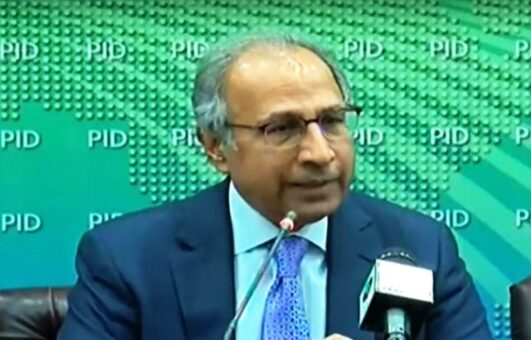
    ISLAMABAD: Coronavirus led impacts are expected to deeply distort economic fabric of Pakistan, said Dr. Abdul Hafeez Shaikh, Advisor to the Prime Minister on Finance and Revenue.

    (more…)